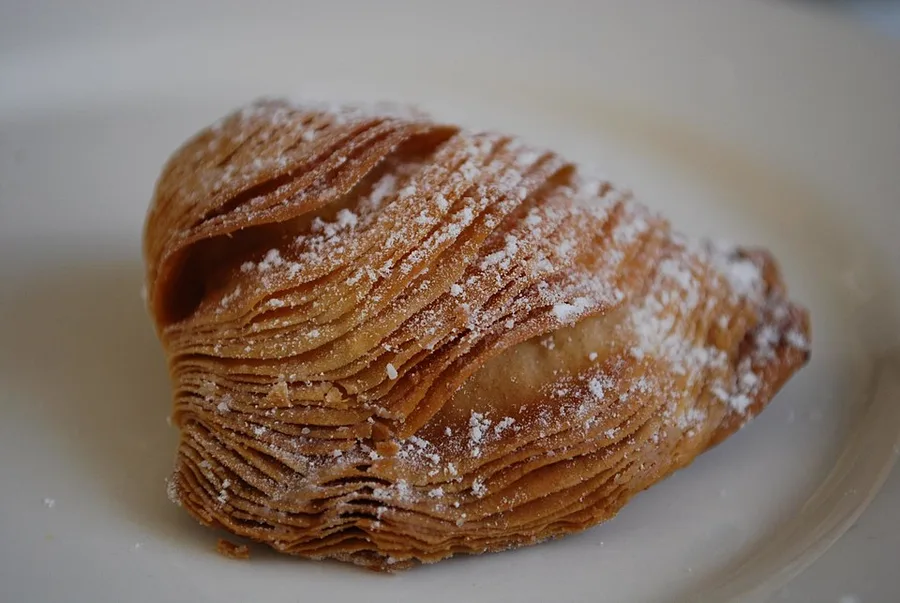
What is Sfogliatella?
The sfogliatella riccia is built from a single sheet of dough rolled out several metres long and as thin as paper, smeared with lard, wound into a tight cylinder, rested overnight, sliced into discs, and then pushed out by hand, thumbs turning, into a hollow cone. The fan of dozens of separate leaves you see when it comes out of the oven is not decoration; it is the mechanical consequence of that roll.
The sfogliatella frolla is a round, smooth shortcrust shell holding the identical filling. It is not the cheap version or a shortcut: it is a parallel pastry, soft where the other is crisp, and it has as many defenders in Naples as the riccia does.
The filling is the part nobody photographs and the part that decides everything: semolina cooked in milk until stiff, sieved sheep's ricotta, sugar, egg, small cubes of candied orange peel, cinnamon and vanilla.
What does it taste like?
The first sensation is noise. A fresh riccia shatters, sends flakes down your front, and gives way to a warm, dense, slightly grainy filling that tastes of orange peel, cinnamon and sheep's milk. It is sweet but not cloying: the ricotta keeps a savoury edge and the semolina gives it body rather than smoothness.
The layers themselves taste of lard, which sounds off-putting and is exactly right: it fries the leaves from the inside and gives a savoury depth that butter does not.
The frolla is a different experience: no crunch, a short buttery biscuit shell, and the filling more prominent because nothing is competing with it. People who find the riccia too aggressive often prefer it, and in Naples that is a legitimate position rather than a confession.
How to use it
Eat it warm, standing up, within minutes of buying it. That is not romanticism: heat keeps the layers separate and the filling loose, and within three hours a riccia has lost most of its crispness as moisture migrates from the filling into the pastry.
If you are reviving a bought one, five minutes in a 180C oven does more than any other treatment. Never microwave it, and never refrigerate it, because fridge humidity kills the layers in half an hour and the filling picks up smells.
Making the riccia at home is a serious undertaking: you need a pasta machine to roll a sheet several metres long and paper-thin, a twelve-hour rest for the rolled cylinder, and the hand skill to open each disc into a cone. The frolla is within reach of anyone who can make a tart.
The filling is worth making the day before either way. Boil 500ml milk with a pinch of salt, rain in 150g fine semolina while whisking, cook five minutes until it pulls away from the pan, cool, then beat in 250g drained sheep's ricotta, 150g sugar, one egg, 80g diced candied orange, cinnamon and vanilla.
How long it keeps
A riccia is at its peak for about an hour. By three hours the leaves have gone quiet, and by the next day the pastry is a different object: the filling is wet and the layers, which sat crisp because they were dry, have drawn moisture out of it from the inside. Keep it at room temperature in a rigid container left slightly open, and not in the refrigerator, where the damp air softens the leaves within half an hour and the ricotta takes on the smell of everything else on the shelf. Five minutes in a 180 degree oven drives the water back off and restores most of the crackle.
The frolla is far more forgiving, since a shortcrust shell has no layers to lose: two days in a closed box at room temperature and it gives up almost nothing. Freezing works, but only before baking. Shaped and raw, sfogliatelle hold two months in the freezer and go straight into a 200 degree oven for about thirty minutes without thawing; baked first and then frozen, the leaves come back limp. For anything boxed and dated, follow the bakery.
Spot the real thing
Two pastries share the name. The riccia is the fan of leaves; the frolla is the same filling inside a smooth shortcrust shell, and it is the one most bakeries abroad find easier to hold. On a riccia, count the leaves: they should be many, thin and clearly separate, not three or four thick bands, and the colour should run deep amber to almost scorched at the outer tips. Pale, evenly golden shells are underbaked and stay chewy in the middle. It should crackle when you bite and leave a shower of crumbs down your front.
The filling is the second check. Semolina gives it a faint grain rather than a smooth cream, real candied orange shows up as visible cubes instead of an even orange paste, and the cinnamon arrives late and quietly. Heat is the last signal and the best one: Neapolitan bakeries keep them in a warm case and hand them over warm. In American Italian bakeries the outsized lobster tail is a different pastry built on the same shell. Expect 4 to 7 dollars each.
How to pronounce Sfogliatella
sfoh-lyah-TEL-lah
Four syllables, stress on TEL. The hard part is 'gli', which is a single liquid sound made with the tongue flat against the palate, closest to the 'lli' in 'million', so 'lyah' rather than 'glee'. Never say 'sfog-lee-a-TELL-a' with a hard g. The plural is sfogliatelle, sfoh-lyah-TEL-leh, and it is what you order if you want more than one. In Italian-American bakeries you will hear the clipped Neapolitan 'sfogliatell'', roughly shfoo-ya-DELL, perfectly authentic in that context, confusing in Naples.
Sfogliatella compared
vsSfogliatella frolla
Same filling, opposite shell, equal standing. Riccia is laminated dough opened into a crisp shell-shaped fan; frolla is a round shortcrust case. One is a two-day project requiring a pasta machine; the other takes an afternoon. Neither is a copy of the other.
| This | Sfogliatella frolla | |
|---|---|---|
| Shell | Laminated sheet rolled and hand-opened | Shortcrust pastry, pressed into a mould |
| Shape | Ribbed shell or fan | Smooth round dome |
| Fat | Lard, spread between layers | Butter or lard, worked into the dough |
| Texture | Shatters, flakes everywhere | Short, tender, crumbly |
| Filling | Semolina, ricotta, candied orange | Identical |
| Keeps | About an hour at its best | Two days without much loss |
vsLobster tail (coda d'aragosta)
An Italian-American descendant, not an Italian pastry. It borrows the riccia shell, stretches it longer and taller, and fills it with pastry cream or whipped cream instead of the semolina-and-ricotta mixture. Bigger, sweeter, and missing the spice and the sheep's milk tang entirely.
| This | Lobster tail (coda d'aragosta) | |
|---|---|---|
| Shell | Riccia laminated dough | Riccia laminated dough, elongated |
| Filling | Semolina, sheep's ricotta, candied orange, cinnamon | Pastry cream, often lightened with whipped cream |
| Size | 80-110g | Frequently 200g or more |
| Sweetness | Moderate, with a savoury edge | Markedly sweeter |
| Where | Naples and Campania | New York, New Jersey, Philadelphia |
vsSantarosa
The ancestor, still made on the Amalfi Coast. Larger than a riccia, with a crest of pastry cream and a black cherry on top, and generally regarded as the form the pastry took in the convent before Naples stripped it back in the nineteenth century.
| This | Santarosa | |
|---|---|---|
| Origin | Naples, 19th century | Conca dei Marini convent, 17th century |
| Size | 80-110g | Roughly double |
| Top | Bare, dusted with icing sugar | Piped pastry cream and an amarena cherry |
| Filling | Semolina, ricotta, candied orange | The same, plus more cream |
| Where to find it | Every bar in Naples | Conca dei Marini and Amalfi, mainly |
Sfogliatella substitutes
- Sfogliatella frolla
The obvious answer if you want the flavour without the lamination. Make a standard shortcrust with 300g flour, 150g butter, 100g sugar and an egg, line small moulds, fill and bake at 180C for 30 minutes.
Same filling quantity as for riccia - Frozen raw sfogliatelle, baked at home
Genuinely the best option outside Naples. Italian frozen-food shops and some importers sell them shaped but unbaked; they go straight from the freezer into a 200C oven for 30 minutes and come out as good as anything you would buy on a Naples street.
1:1 by piece - Filo pastry cones
A cheat that captures the shatter if not the structure. Brush six sheets of filo with melted lard or butter, stack, roll into a log, chill, slice and shape. Lighter and more brittle than the real thing, and it will not hold its fan.
6 filo sheets make about 8 shells - Ricotta filling changes: cow's milk, drained overnight
Sheep's ricotta is what gives the filling its tang and body, but cow's milk ricotta works if you hang it in muslin overnight to lose the water. Add a squeeze of lemon juice to compensate for the missing sharpness.
1:1 by weight, drained, plus 1 tsp lemon juice per 250g - Candied orange substitutes
If you cannot find proper candied orange peel in cubes, use finely diced candied citron or the zest of one orange simmered for ten minutes in sugar syrup. Do not use marmalade, which makes the filling wet and one-dimensional.
80g per 250g ricotta - Lard-free version
Butter can replace lard in the lamination, but expect fewer separations and less savoury depth, because butter has water in it, which steams and merges the leaves. Clarified butter or ghee is a better compromise than plain butter.
1:1 by weight, using clarified butter
Where to buy it
In the US, Italian-American bakeries in New York, New Jersey, Philadelphia and Boston sell them daily at roughly 4 to 6 dollars each; many also sell the lobster tail, which is a different pastry despite the shared shell. Ask for them warmed if the counter has an oven: most will oblige, and it transforms the thing.
In the UK, Italian bakeries and delicatessens in London and a handful of other cities carry them at 3.50 to 5 pounds each, usually made in the morning. Frozen unbaked sfogliatelle from Italian importers are the most reliable option and often better than a shop-bought pastry that has sat for six hours.
Whatever you buy, look for many thin visible layers rather than three or four thick ones, deep amber colour with slightly scorched leaf tips, and a filling with a visible grain and identifiable cubes of orange peel. Pale, uniform pastry means underbaking; a smooth, very sweet, uniformly orange filling means a factory mix.
Where to eat it in Italy
Naples. Three historic addresses cover the ground without overlapping: the via Toledo shop associated with the Pintauro name, the pastry shop on piazza San Domenico Maggiore in the old centre, and the bakery behind the central station that runs its ovens all day and sells them hot. The last of these is the only place where you reliably meet a sfogliatella in its ideal state, minutes out of the oven.
The Galleria Umberto I and the bars along via Chiaia hold a high average standard with shorter queues.
For the Santarosa you have to go to the coast: Conca dei Marini, where it was born, and Amalfi, where a historic seafront pasticceria revived it. The festival at Conca dei Marini in early August is the moment to be there.
One practical tip that changes everything: ask whether they are hot. In Naples this is an ordinary question, not a demanding one.
Frequently asked questions
What is the difference between sfogliatella riccia and frolla?
The shell. Riccia is a paper-thin sheet greased with lard, rolled into a cylinder and hand-opened, which bakes into dozens of crisp separate layers. Frolla is a smooth round shortcrust case. The semolina, ricotta and candied orange filling is identical in both.
Why should sfogliatella be eaten warm?
Heat keeps the layers separate and the filling soft. As it cools, moisture moves from the filling into the pastry, and within about three hours a riccia has lost most of its crispness. Serious Neapolitan pastry shops keep them in a heated case for exactly this reason.
Is a lobster tail the same as a sfogliatella?
No. A lobster tail uses the riccia shell, stretched longer, but fills it with pastry cream or whipped cream instead of semolina and ricotta. It is an Italian-American creation: bigger, much sweeter and without the cinnamon and candied orange.
Can I make sfogliatella riccia at home?
You can, but it needs a pasta machine to roll a sheet several metres long and paper-thin, two days including two long rests, and practice at opening each disc by hand. For the same flavour in an afternoon, make the frolla version instead.
How do you pronounce sfogliatella?
sfoh-lyah-TEL-lah, with the stress on TEL. The 'gli' is a single liquid sound like the 'lli' in 'million', not a hard g. Plural: sfogliatelle, sfoh-lyah-TEL-leh.
Related foods
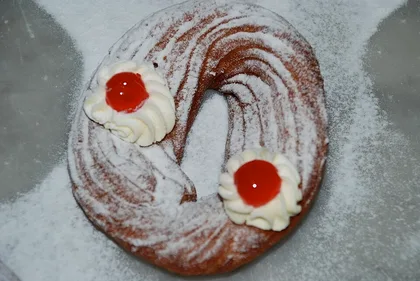 SweetsZeppoleZeppole are Naples' feast-day pastry for Saint Joseph on 19 March: a piped choux ring, fried or baked, filled…
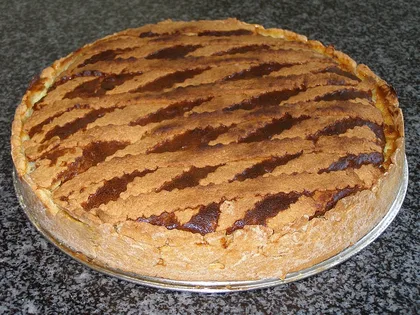 SweetsPastieraPastiera is the Easter tart of Naples: a shortcrust case filled with sheep's-milk ricotta, wheat berries…
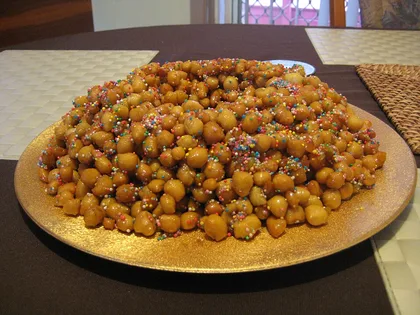 SweetsStruffoliStruffoli are tiny balls of fried dough tumbled in warm honey, heaped into a ring and scattered with candied…SweetsTorroneHoney and sugar go over a water bath and stay there for hours, sometimes twelve, while someone keeps stirring.
 SweetsBabàBabà is a yeasted, egg-and-butter-rich cake baked in a mushroom shape, dried out, then soaked in warm rum…SweetsMostaccioliDiamond-shaped spiced biscuits under a shell of dark chocolate, soft inside and heavy with cinnamon, cloves…
 Pasta and breadSpaghettiA solid round strand of durum semolina and water, 1.7 to 2.0mm across. It looks like the most neutral pasta…
 CheeseMozzarellaThe name is a verb before it is a cheese: mozzare means to lop off, which is what the cheesemaker does by…