What is Babà?
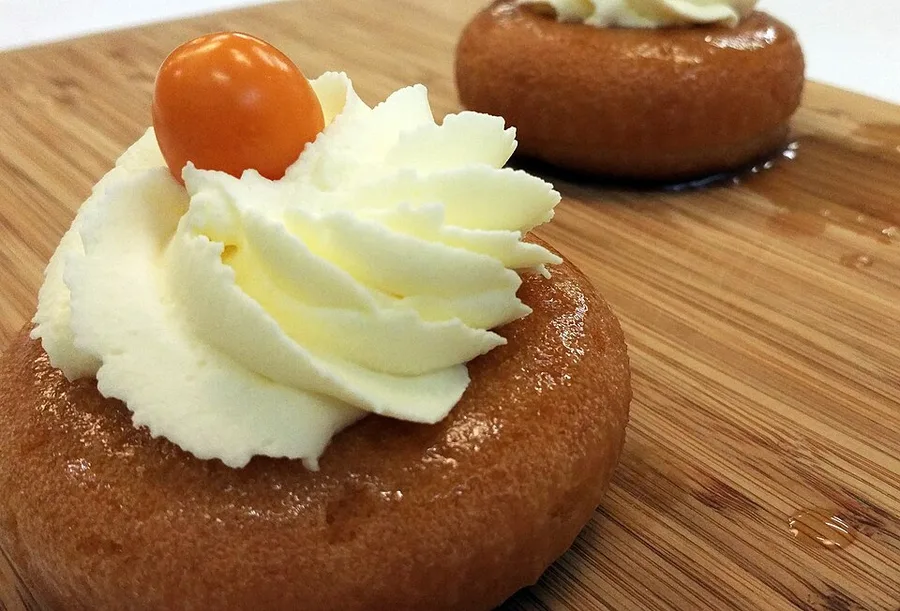
Babà is an enriched yeast dough, closer to brioche than to cake, with so much egg and butter that it is almost pourable before baking. It goes into flared moulds that give it the mushroom shape, or one large ring mould, and it is not finished when it comes out of the oven. It has to dry, sometimes for a full day, and only then is it dipped in hot syrup of water, sugar and dark rum.
The engineering matters. Long mixing builds a strong gluten network; proving fills that network with small, even cells; drying empties those cells of moisture; soaking refills them with syrup. A babà is not a wet cake, it is a sponge built on purpose, and its quality is measured by how much liquid it holds while still standing up.
The Neapolitan default is the single-portion mushroom, eight to ten centimetres tall, with a cap that overhangs. There is also a large ring version brought whole to the table and filled with cream, and the pastry-shop bestseller filled with crème pâtissière, whipped cream and a syrupy sour cherry.
One relative catches visitors off guard: the babà rustico, a savoury version with cured meats and cheese worked into the dough, no sugar and no syrup, eaten in Naples at Easter and at parties.
What does it taste like?
Rum, warm bread and butter, in that order. The first bite releases syrup, so the immediate impression is liquid and sweet, with the alcohol reading as caramel and vanilla rather than as spirit, because most of it has cooked off. Underneath is the flavour of a very rich brioche: egg yolk, butter, a trace of citrus zest from the syrup.
The texture is the point. A good babà collapses slightly when you press it and springs back, and every mouthful is wet without being soggy. The cap is a little firmer and slightly chewy where it caught colour in the oven; the base is the wettest part.
Sweetness is high but should stop short of cloying. When a babà tastes syrupy and one-note, the syrup was too heavy on sugar and too light on rum, or the pastry was soaked before it had dried properly: a wet crumb cannot take up flavour, only water.
How to use it
Serve at room temperature. A babà straight from the fridge is a waste of a babà: below about fifteen degrees the butter in the dough sets hard and the aromatics in the syrup stop volatilising. Take it out half an hour ahead.
If you are soaking your own, the temperature rule is counter-intuitive but reliable: cold cake, hot syrup. Bring the syrup to the boil with citrus zest, let it fall to around sixty degrees, add the rum off the heat so the alcohol survives, then submerge the dry babà for three to five minutes, pressing it gently under. Lift it out, let it drain, brush it with warmed apricot jam.
To fill, cut a slit in the cap and pipe in crème pâtissière lightened with whipped cream, then top with a syrupy amarena cherry. In summer Naples uses cream and strawberries instead.
The large ring version is a centrepiece: bring it out whole, fill the middle with cream and fruit, cut it into wedges at the table. And a broken babà is not a failure: crumble it into a glass with cream and fruit and you have an improvised trifle.
How long it keeps
The trade rule is to keep them dry rather than soaked. An unsoaked baked babà holds about a week in a tin at room temperature and three months in the freezer, and it takes five minutes in warm syrup when you want it, which is how pastry shops actually work. Once soaked, the clock is short. Two days under a dome at room temperature, three or four in the fridge if it is filled with cream, which then wants bringing back to room temperature before serving. Across those days the crumb keeps releasing syrup and slowly settles.
Sealed jars of babà in syrup sit in the cupboard to the date printed on the lid. Once opened they go in the fridge and are generally given a few days, with the cakes kept fully under the syrup, since anything standing above the line dries and darkens. Soaked babà can be frozen, but they come back changed: the syrup separates as it thaws and the cake sags. One that has dried out can be worked back: warm some syrup, dip it for two or three minutes, then let it rest half an hour.
Spot the real thing
Press the top with the back of a spoon. A babà should give, release a little syrup and come back up. If it stays flat it has drunk too much; if it does not give at all the centre is dry, the standard fault where a bakery is in a hurry. Cut one open: the crumb should be fine, close and regular, deep yellow from the eggs right through to the middle. Big irregular holes point to mishandled proving, and a paler, drier core means the syrup never reached it.
Smell it before you buy. Real rum reads as alcohol and cane sugar with vanilla and wood behind it, while synthetic flavouring is sharper and sweeter and stays in the mouth afterwards. The top should look glossy but feel dry to the fingertip: tacky usually means apricot glaze laid on thick over a crust that had dried. On shelves abroad the neighbours are French baba au rhum and the ring shaped savarin, both from the same dough, and Caribbean rum cake, a butter cake with rum poured over it. Jars of babà in syrup run about $10 to $18.
How to pronounce Babà
bah-BAH
Two syllables, stress firmly on the second, since the written accent on the final 'a' tells you so. Never BAH-bah, which is the Polish ancestor, and never 'baa-baa'. The plural in Italian is unchanged: un babà, due babà. In Neapolitan you will hear it doubled, bab-BAH, spelled babbà.
Babà compared
vsSavarin
Same dough, different presentation and different soak. The savarin was created in nineteenth-century Paris by the Julien brothers and named after the gastronome Brillat-Savarin: it is baked in a ring mould, soaked in a kirsch or maraschino syrup, and filled at the centre with crème Chantilly and fruit. The Neapolitan babà is a single-portion mushroom soaked in rum. If you are served a ring filled with cream and berries, you are eating a savarin, whatever the menu says.
| This | Savarin | |
|---|---|---|
| Shape | Mushroom, single portion | Ring (couronne) |
| Syrup | Dark rum | Kirsch or maraschino |
| Filling | Optional cream and cherry | Centre filled with Chantilly and fruit |
| Origin | Naples, 19th century | Paris, 1840s |
| Served | One each, room temperature | Sliced from a whole ring |
| Raisins | None | None (the earlier baba had them) |
vsFrench baba au rhum
The direct ancestor and still a Paris classic, sold at the shop Nicolas Stohrer opened in 1730 on rue Montorgueil. The French version is often larger, sometimes split and piped full of Chantilly, and traditionally contained raisins, which the Neapolitans dropped. The Naples babà is drier before soaking and therefore wetter after it, which is the whole difference in one sentence.
| This | French baba au rhum | |
|---|---|---|
| Raisins | Never | Traditional, now optional |
| Drying before soaking | Hours to a full day | Shorter |
| Saturation | Soaked to the core | Often moist rather than saturated |
| Finish | Apricot glaze | Frequently split and filled with Chantilly |
| Size | 80–120 g mushrooms | Larger, often shared |
vsJarred babà in syrup
The supermarket version, pasteurised in a jar and shelf-stable for months. To survive sterilisation the dough is made denser and less buttery, and the syrup almost always uses rum flavouring rather than distilled rum. It is a perfectly honest product and it is not the pastry: the light, saturated sponge of a Neapolitan pasticceria cannot be canned.
| This | Jarred babà in syrup | |
|---|---|---|
| Dough | High butter and egg, airy | Denser, less fat |
| Rum | Distilled, 10–20% of the syrup | Usually flavouring |
| Shelf life | Two days | Months, unopened |
| Texture | Springs back when pressed | Compact, slightly rubbery |
| Price | 20–30 €/kg | 10–16 €/kg |
Babà substitutes
- Savarin, unfilled
The nearest thing on a French bakery shelf. Soak it in rum syrup rather than kirsch and skip the cream filling, and you are within touching distance. Use a wider ring or slice it before soaking so the syrup reaches the middle.
1:1 by weight - Dry babà shells (babà secchi)
Sold unsoaked in Naples and by Italian importers, and this is what professionals buy. Make the syrup yourself, soak for three to five minutes, glaze with warmed apricot jam. Better than any pre-soaked product you can ship.
500 ml water : 250 g sugar : 100 ml dark rum soaks 8 shells - Stale brioche or panettone
A real compromise but a workable one for a dessert rather than the pastry itself. Cut thick rounds, dry them in a low oven for fifteen minutes, then soak them for half as long, because enriched bread crumb collapses faster than babà dough.
1:1 by weight, half the soaking time - Alcohol-free syrup
For children or anyone avoiding alcohol, replace the rum with the same volume of orange juice plus a vanilla pod and a strip of lemon zest. You lose the rum's depth, so reduce the sugar by a fifth or the result is flat and sweet.
100 ml orange juice for 100 ml rum, sugar reduced 20% - Rum choice
Dark aged Caribbean rum is the Neapolitan standard, and it is the flavour people recognise. Agricole rhum gives a grassier, sharper result; white rum gives almost nothing and needs a larger share of the syrup to register.
Dark rum 15% of syrup volume; white rum 25% for the same effect
Where to buy it
In Naples, from any serious pasticceria, and ask whether they will sell you babà secchi, the dry unsoaked shells, if you are travelling. They keep for a week in a tin and three months in the freezer, and you soak them at home in five minutes.
In the US and UK, Italian pastry shops in cities with a Neapolitan community are the only reliable source of the fresh article; elsewhere you are choosing between jarred babà from Italian importers and specialist online bakers who ship overnight. Expect roughly 12 to 22 dollars a pound in the US and 18 to 30 pounds a kilo in the UK.
What to check on jarred products: the ingredient list should say rum, not rum flavouring, and butter should appear before vegetable oil. Anything sold as 'rum baba' in a British supermarket is usually the French style, with a looser, wetter crumb.
Where to eat it in Italy
Naples, and it is worth making a short route of it. Gran Caffè Gambrinus on piazza Trieste e Trento is the historic stand-at-the-bar option, coffee and babà in four minutes. On Spaccanapoli, Scaturchio in piazza San Domenico Maggiore is one of the oldest pastry shops in the city.
The Rione Sanità is where Neapolitan pastry is most alive right now, and worth the walk regardless of what you order.
On the Amalfi Coast and in Sorrento you will find the limoncello version, syrup made with lemon liqueur instead of rum. It is recent and aimed at visitors, and it is genuinely good when the lemons are the local Sfusato.
And in Paris, the shop Nicolas Stohrer founded in 1730 on rue Montorgueil still sells the baba au rhum, the missing link between Lorraine and Naples, and the reason the Neapolitan version exists at all.
Frequently asked questions
Is babà French or Neapolitan?
Both, at different stages. It began as a Polish yeast cake, gained its syrup in Lorraine at the court of the deposed Polish king Stanisław Leszczyński, became baba au rhum in eighteenth-century Paris, and reached Naples with the monsù, the French-trained chefs of the Neapolitan aristocracy. Naples made it what it is now.
Why is the babà dried before soaking?
Because a moist crumb cannot absorb. Drying, which can take a full day, empties the cells of water so the syrup can fill them. Home recipes usually skip this step, which is exactly why home-made babà end up dry in the middle and wet on the outside.
How much alcohol is in a babà?
Rum makes up ten to twenty per cent of the syrup, but a good share evaporates in the hot syrup. A 100 g babà carries roughly the equivalent of a scant teaspoon of rum. Alcohol-free versions using citrus syrup are common in Naples for children.
What is the difference between a babà and a rum baba?
Very little in principle: rum baba is the English name for the same pastry. In practice the French and British version is often larger, sometimes contains raisins and is split and filled with Chantilly, while the Neapolitan babà is a single-portion mushroom dried hard and soaked all the way through.
How do you pronounce babà?
bah-BAH, with the stress on the second syllable: that is what the written accent means. Not BAH-bah, and the plural in Italian stays babà.
Related foods
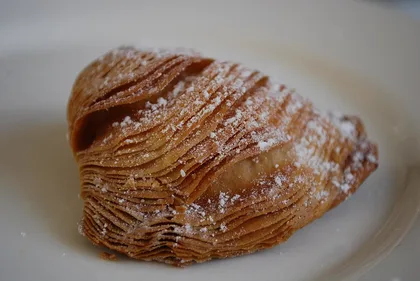 SweetsSfogliatellaThe sfogliatella is Naples' hardest pastry to make and its easiest to recognise: a shatteringly crisp fan of…
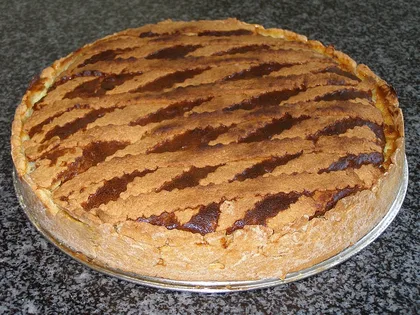 SweetsPastieraPastiera is the Easter tart of Naples: a shortcrust case filled with sheep's-milk ricotta, wheat berries…
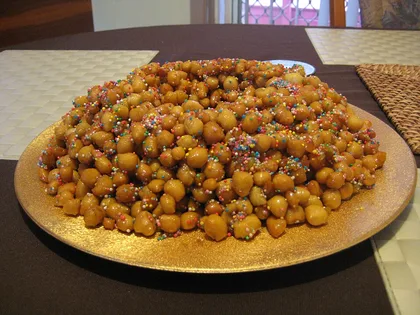 SweetsStruffoliStruffoli are tiny balls of fried dough tumbled in warm honey, heaped into a ring and scattered with candied…
 SweetsZeppoleZeppole are Naples' feast-day pastry for Saint Joseph on 19 March: a piped choux ring, fried or baked, filled…SweetsTorroneHoney and sugar go over a water bath and stay there for hours, sometimes twelve, while someone keeps stirring.SweetsMostaccioliDiamond-shaped spiced biscuits under a shell of dark chocolate, soft inside and heavy with cinnamon, cloves…
 Pasta and breadSpaghettiA solid round strand of durum semolina and water, 1.7 to 2.0mm across. It looks like the most neutral pasta…
 CheeseMozzarellaThe name is a verb before it is a cheese: mozzare means to lop off, which is what the cheesemaker does by…