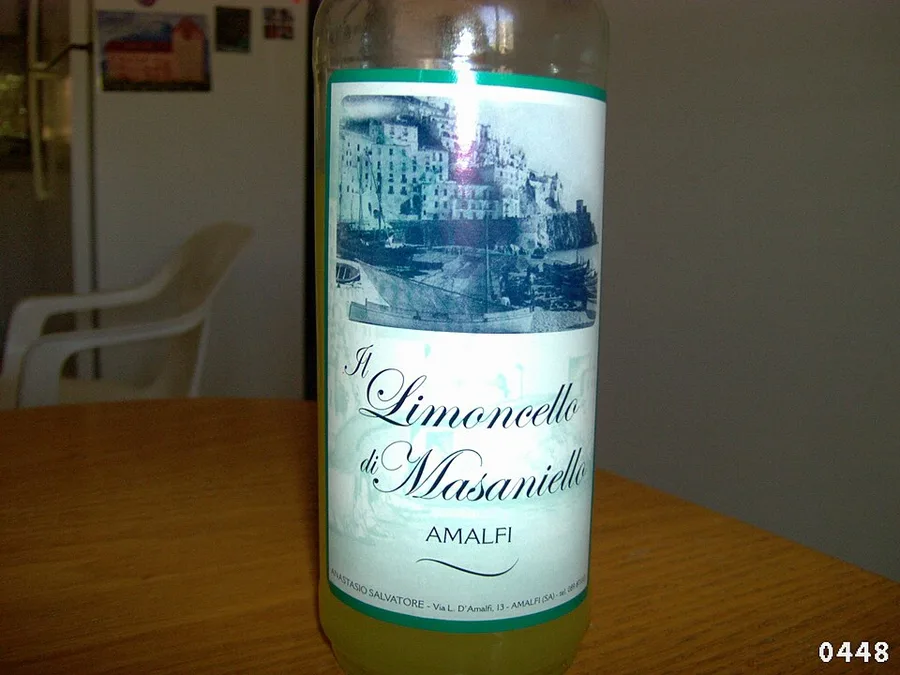
What is Limoncello?
Limoncello is an infusion of lemon zest in neutral alcohol, sweetened with sugar syrup. Four ingredients: lemons, alcohol, sugar, water. Everything else on a label is either a shortcut or a fault.
The rule no serious producer breaks is that the juice never goes in. Lemon aroma lives in the essential oils held in the flavedo, the thin yellow outer layer of the peel. Juice contributes only water and citric acid: it clouds the liqueur permanently, makes it unstable and turns it grey within weeks. A limoncello made with juice tastes sour rather than aromatic: that is the giveaway.
The second rule concerns the pith, the white albedo under the zest. It is bitter and must stay on the fruit. Peel with a thin-bladed vegetable peeler rather than a knife, and if white comes away with the yellow, the liqueur will turn bitter after a few months in the bottle.
Finished strength runs 25-32% ABV. The cloudiness that appears when it chills or when you add water is not a defect but proof that real essential oils are present: they are insoluble in water and drop out as microscopic droplets once the alcohol concentration falls. A limoncello that stays crystal clear at freezer temperature is almost always flavoured rather than infused.
What does it taste like?
Lemon oil rather than lemon juice, which sounds like a technicality until you taste it. The aroma is the smell of a lemon being zested, bright and slightly resinous, with no acidity behind it. The sweetness arrives second and the alcohol third, warming rather than burning if the liqueur has rested properly.
Served at freezer temperature it is thick, almost syrupy, and coats the glass. The cold suppresses the sugar, which is why the same liqueur tastes cloying at room temperature and clean at -18°C.
A good one finishes clean and slightly bitter in the way citrus peel is bitter. A lingering harsh bitterness means pith went in with the zest. A candied, sweet-shop character with no aroma behind it means flavouring rather than infusion.
How to use it
Keep the bottle in the freezer and the glasses with it. At 25-32% ABV it will not freeze; it turns thick and syrupy and pours slowly, which is exactly right. Thirty to forty millilitres is a serving. At room temperature the same liqueur reads as sugary and hot, so this is not a stylistic preference.
The moment is after the meal, after coffee, and the role is digestive rather than dessert.
In the kitchen it earns its place. It soaks the sponge in a delizia al limone, the domed lemon-cream cake of the Amalfi Coast; it replaces rum in the syrup for a babà; it goes over strawberries or peaches instead of sugar. A spoonful over fiordilatte gelato is the simplest good use of an open bottle.
For a cocktail, the sgroppino is the one that works: lemon sorbetto, prosecco and a measure of limoncello blended together and served immediately in a chilled glass.
Do not mix it with chocolate, and do not use it in tiramisù. Citrus oil and cocoa fight each other.
How long it keeps
Sealed and kept cold and dark, a bottle holds its aroma and colour for a year or two. The freezer is both the right storage place and the right serving temperature: at around 30 per cent alcohol it never sets solid, it just goes thick and syrupy. Light does more damage than heat. A clear bottle left on a shelf near a window drifts from pale yellow towards ochre within a few months and loses its top notes, so anything not in dark glass belongs in a cupboard.
Once opened, the change is one of aroma rather than anything else. The peel oils are volatile and the air space above the liquid grows every time you pour, so the citrus edge softens: the first six months are the best of it, and after a year the drink is rounder and quieter. Decanting into a smaller bottle slows that down. Crema di limoncello is a separate case, since it contains milk or cream: it lives in the refrigerator, carries a date of its own, and separates into layers that a shake puts back together. Follow its label and the producer.
Spot the real thing
Count the ingredients on the back label. Lemons, alcohol, sugar, water: four. Natural lemon flavouring in the list means part of the aroma did not come off a peel, and a colour listed as E102, E104, Yellow 5 or Yellow 10 means the shade was added. Real limoncello is a pale, soft, faintly cloudy yellow that shifts from batch to batch because the fruit does; an identical fluorescent yellow bottle after bottle is dye. Serious producers name the fruit, usually Limone di Sorrento IGP or Limone Costa d'Amalfi IGP, while a label that says only Italian lemons has said all it can.
Two checks settle it. Put the bottle in the freezer: essential oils come out of solution, so the liquid thickens and goes opaque. Add a splash of water to a glass and it turns milky. A limoncello that stays glassy and thin through both is carrying very little peel oil. Strength usually sits between 25 and 32 per cent. In the US and UK, bottles under about 15 dollars or 12 pounds are the flavouring route; the Sorrento and Amalfi bottlings run roughly twice that.
How to pronounce Limoncello
lee-mon-CHEL-loh
Four syllables, stress on the third. The 'c' before 'e' is soft, as in 'cello' the instrument, so 'lee-mon-CHEL-loh', never 'lee-mon-SELL-oh' and never with a hard 'k'. Hold the double 'l' very slightly. The final 'o' is short and clean.
Limoncello compared
vsLemon liqueurs made with juice
The single dividing line in the category. Limoncello is an infusion of peel: the yellow zest sits in neutral alcohol for one to two weeks, gives up its essential oils, and is then filtered out and thrown away. Most supermarket lemon liqueurs, and nearly all homemade versions that fail, use juice, which brings acidity and water but almost no aroma, clouds the liquid permanently and oxidises to a dull grey. If it tastes sour, it was made wrong.
| This | Lemon liqueurs made with juice | |
|---|---|---|
| Aromatic source | Essential oil in the yellow zest | Juice, plus added flavouring |
| Taste | Aromatic, barely acidic | Sour, thin |
| Appearance | Pale, clear at room temp, clouds when cold | Permanently murky |
| Stability | A year or two in the freezer | Greys within weeks |
| Infusion time | 7-15 days on the peel | None |
vsIndustrial limoncello
The word limoncello is not protected by any denomination, anywhere. Anyone in any country can make a lemon liqueur and put that name on it, which is why the label matters more here than with almost any other Italian product. What you are checking for is a four-ingredient list and a stated lemon origin. Natural lemon flavouring means part of the aroma did not come from peel; E102 or E104 means the yellow was painted on.
| This | Industrial limoncello | |
|---|---|---|
| Ingredients | Lemons, alcohol, sugar, water | Plus flavourings and colourings |
| Colour | Pale, varies by harvest | Fluorescent, identical every bottle |
| Freezer test | Thickens and goes opaque | Stays thin and clear |
| Lemon origin | Sorrento IGP or Amalfi IGP, declared | Unstated, or generic |
| Price (750 ml) | 22-38 dollars | Under 15 dollars |
vsSorrento IGP lemons vs Amalfi IGP lemons
The two protected lemons behind the real thing, and they are genuinely different fruit. The Limone di Sorrento is oval, thick-skinned and exceptionally rich in essential oil, grown on the peninsula under pagliarelle, straw mats on chestnut poles that shelter the groves and delay ripening. The Limone Costa d'Amalfi, the Sfusato, is tapered and paler, with a more delicate perfume, grown on hand-built dry-stone terraces that fall straight to the sea. Note that the IGP protects the lemons, not the liqueur.
| This | Sorrento IGP lemons vs Amalfi IGP lemons | |
|---|---|---|
| Shape | Oval, thick peel (Sorrento) | Tapered, thinner peel (Amalfi) |
| Essential oil | Very high | High, more delicate |
| Growing | Under straw pagliarelle | Cliff terraces, dry-stone walls |
| In the glass | Intense, resinous | Finer, more floral |
Limoncello substitutes
- Make it: the standard Campanian ratio
Easier than buying badly. One kilo of untreated lemons peeled to the yellow only, one litre of high-proof neutral spirit, 7-15 days in the dark, then syrup from 1.2-1.5 kg sugar in 1.5-2 litres of water, added cold. Rest a month before drinking.
1 kg lemons : 1 L 95% alcohol : 1.3 kg sugar : 1.7 L water - Everclear or high-proof vodka
Where 95% neutral alcohol is not sold, 151-proof grain spirit works with no adjustment. With 40% vodka the extraction is weaker and slower: infuse three to four weeks and cut the added water by roughly half, or the result will be watery.
Vodka version: 1 kg lemons : 1 L vodka : 800 g sugar : 0.8 L water - Meyer lemons
Widely available in the US and a fair stand-in, though botanically a lemon-mandarin cross. Sweeter, more floral and lower in essential oil, so use about 30% more peel and reduce the sugar to keep the balance.
1.3 kg Meyer lemons for every 1 kg of Sorrento lemons - Crema di limoncello
The same peel infusion with the syrup made from whole milk or cream instead of water. Sweeter, lower in alcohol, and a genuine Campanian variant rather than a compromise, but it must be refrigerated and drunk within two or three months.
Replace the water with an equal volume of whole milk - Non-alcoholic lemon peel syrup
Steep the zest in hot sugar syrup for 24 hours rather than in alcohol. It captures a good share of the aroma and works over fruit, gelato or soda water. It will not keep like limoncello, so refrigerate and use within two weeks.
Peel of 6 lemons : 500 g sugar : 500 ml water
Where to buy it
Look for two things on the label: a four-ingredient list, and a named lemon origin (Limone di Sorrento IGP or Limone Costa d'Amalfi IGP). Producers using protected lemons always say so, because it is the expensive part. A bottle that only says Italian lemons is telling you the most it can.
In the US, Italian importers and better liquor stores carry Campanian limoncello at 22 to 38 dollars for a 750 ml bottle; Eataly and specialist online sellers stock several producers. In the UK, expect 18 to 30 pounds a bottle from Italian delicatessens and the larger supermarkets' Italian ranges. Anything under 15 dollars or 15 pounds is generally a flavoured liqueur made outside Campania.
In Italy itself, 50 cl of artisan limoncello runs 12 to 20 euro and 70 cl runs 18 to 28. Industrial bottles sit at 7 to 12 euro a litre.
Ignore the painted ceramic bottles sold along the coast road. You are paying for the container.
Where to eat it in Italy
Start on the Sorrento peninsula (Sorrento itself, Massa Lubrense, Sant'Agata sui Due Golfi) where you can still see the groves under their pagliarelle, straw mats stretched over chestnut-pole frames. A number of farms open to visitors and walk you through the grove before the tasting.
On the Amalfi Coast the landscape turns vertical. The terraces above Amalfi, Minori, Maiori and Ravello are hand-built dry-stone walls on slopes no machine can work. The best way to see them is the Sentiero dei Limoni, the stepped path linking Maiori to Minori straight through the groves.
Capri, and Anacapri in particular, has a long tradition of family production and lemon gardens that are part of the island's landscape. Procida and Ischia make less-known versions, often more genuinely artisan than what is sold on the mainland tourist strip.
Go between February and May, when the harvest is at its height and the groves smell of blossom. August on that coast is about crowds, not lemons.
Frequently asked questions
Why is limoncello made with peel and not juice?
Because the aroma is in the essential oils of the yellow zest, not in the juice. Juice adds only water and citric acid, clouds the liqueur permanently and makes it oxidise to a dull grey within weeks. A juice-based version tastes sour rather than aromatic.
Why does limoncello go cloudy in the freezer?
Because lemon essential oils are insoluble in water. When the temperature drops or you add water, they come out of solution as microscopic droplets that scatter light. It is a sign of quality: a limoncello that stays perfectly clear when frozen contains little real oil.
Is limoncello a protected product?
The name is not. Anyone anywhere can make a lemon liqueur and call it limoncello. What is protected are the lemons: Limone di Sorrento IGP and Limone Costa d'Amalfi IGP. That is why a stated lemon origin on the label is the only real guarantee.
Should limoncello be kept in the freezer?
Yes. At 25-32% ABV it will not freeze, it thickens, and it is served at the right temperature. The freezer also protects colour and aroma, which fade within months in a clear bottle left in the light.
How do you pronounce limoncello?
lee-mon-CHEL-loh, with the stress on the third syllable and a soft 'c' as in the instrument cello. Not 'lee-mon-SELL-oh'.
Related foods
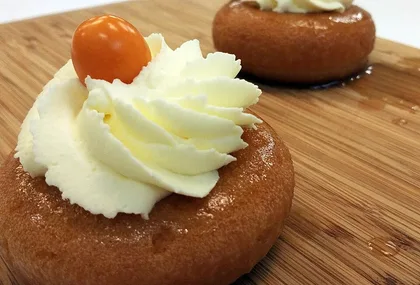 SweetsBabàBabà is a yeasted, egg-and-butter-rich cake baked in a mushroom shape, dried out, then soaked in warm rum…
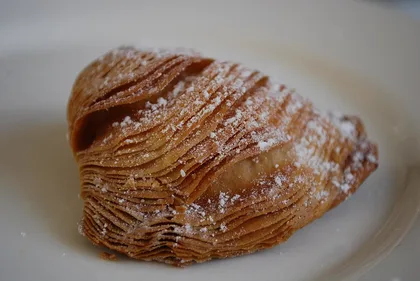 SweetsSfogliatellaThe sfogliatella is Naples' hardest pastry to make and its easiest to recognise: a shatteringly crisp fan of…
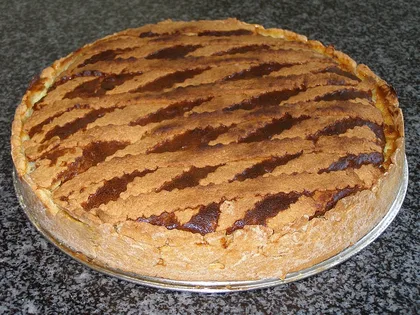 SweetsPastieraPastiera is the Easter tart of Naples: a shortcrust case filled with sheep's-milk ricotta, wheat berries…
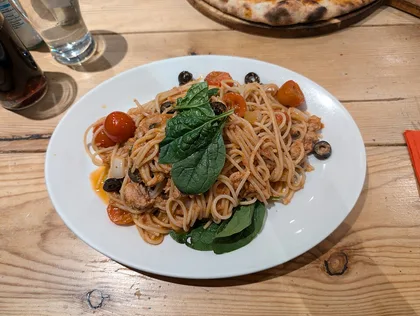 Pasta and breadSpaghettiA solid round strand of durum semolina and water, 1.7 to 2.0mm across. It looks like the most neutral pasta…
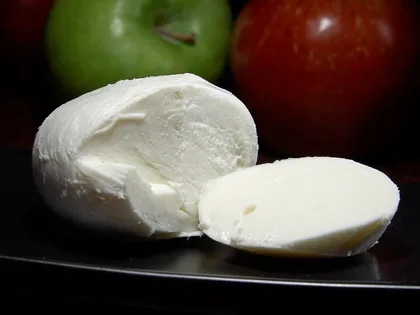 CheeseMozzarellaThe name is a verb before it is a cheese: mozzare means to lop off, which is what the cheesemaker does by…
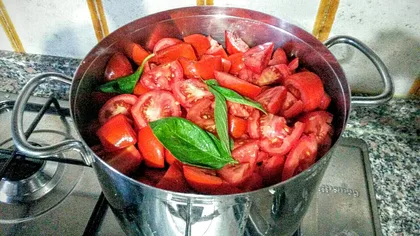 Vegetables and fruitSan Marzano TomatoesSan Marzano is a long, thin-skinned plum tomato grown in the volcanic plain between Naples and Salerno, and…
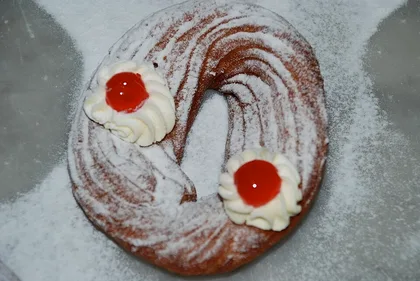 SweetsZeppoleZeppole are Naples' feast-day pastry for Saint Joseph on 19 March: a piped choux ring, fried or baked, filled…
 Pasta and breadFusilliTwo different pastas share this name. The industrial spiral is solid and holds sauce on its outside surface…