What is Sorrento Lemon?
The Limone di Sorrento is the fruit of a single cultivar, Femminello Ovale di Sorrento, protected as an IGP since 2000. Femminello is the growers' name for the group of ever-bearing lemons: trees that flower several times a year and carry blossom and fruit at the same moment.
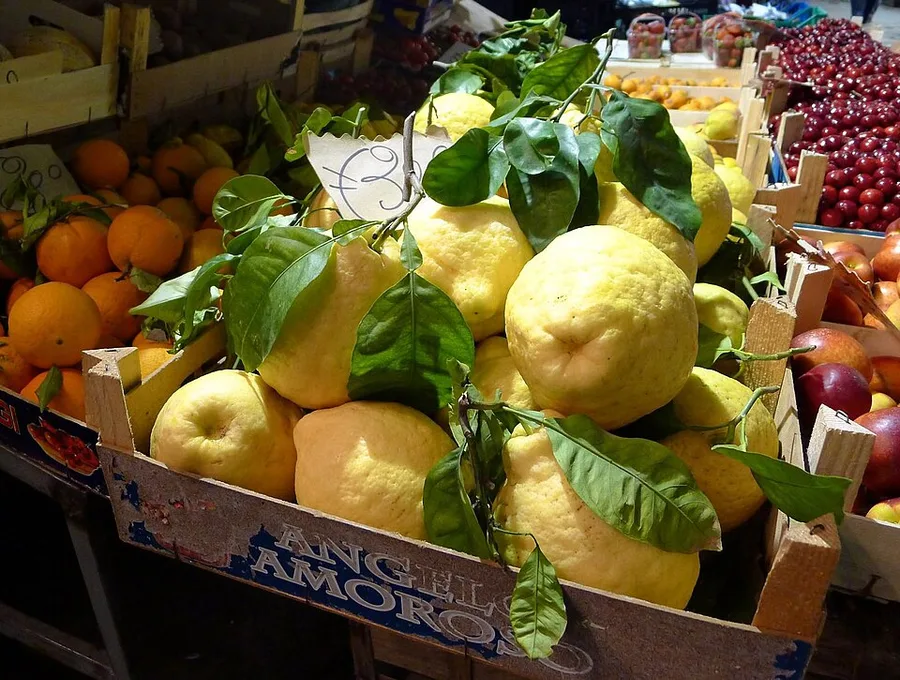
It is a medium-large, elliptical lemon that the rules require to weigh at least 85 grams, and it usually runs between 100 and 200. The skin is deep citrine yellow, thick, and visibly pitted with oil glands. Those glands are the whole point of the designation: what is protected here is essentially aroma density in the peel.
Under the yellow sits the albedo, the white spongy layer. In an ordinary lemon it is thin and bitter and gets thrown away. In a Sorrento lemon it is thick, soft, barely bitter and faintly sweet: edible, and eaten. That is the single most useful thing to know about it.
The flesh is pale straw yellow, in eight to ten segments, juicy and with few seeds. The rules set a minimum juice yield of 25 per cent and acidity above 3.5 grams per 100 millilitres. This is not a sweet lemon; it is a sharp one with an unusually generous rind. Older growers still call it massese, after Massa Lubrense, the town with the most lemon terraces on the peninsula.
What does it taste like?
The smell arrives before the taste. Scratch the skin and the oil sprays out: floral, resinous, closer to neroli and bergamot than to the flat citrus-cleaner note of a supermarket lemon, and it stays on your fingers for half an hour.
The juice is properly sour, with more body than a Eureka lemon and none of the sweetness of a Meyer. It is bright rather than harsh, and it carries a faintly bitter-almond finish.
The pith is the surprise. Bite a slice cut across the whole fruit and the white layer is cool, spongy and mildly sweet, closer to firm melon rind than to anything you associate with lemon peel.
How to use it
Start with the peel, because that is where the value is. Zest with a microplane, taking only the yellow, and add it off the heat: essential oils start disappearing with the steam above about 70°C, so zest stirred into a hot pan at the end delivers far more than zest cooked from the start.
Spaghetti al limone is the simplest demonstration: zest, good olive oil, black pepper, a ladle of pasta water and grated cheese, emulsified off the flame. No juice at all, or barely a spoonful.
For limoncello, peel the fruit with a vegetable peeler and leave the white behind, because pith in the alcohol makes the liqueur bitter. Steep the peels in high-proof neutral alcohol for seven to ten days, strain, then dilute with a cooled sugar syrup. A common home ratio is 1 kg of fresh peel to 1 litre of alcohol, extended with about 1.5 litres of syrup. Serve it at minus five, not at room temperature.
The lemon salad needs the real fruit: remove only the yellow skin, slice across at half a centimetre so each round is mostly white pith, dress with olive oil, salt, garlic, chilli and mint, and leave it half an hour.
And the obvious things, done properly: whole slices under and over a baked fish, candied peel, and granita of nothing but juice and sugar.
How long it keeps
At room temperature, in an open basket away from sunlight, they hold a good week, softening gradually as they lose water through the skin. In the fridge, in the vegetable drawer and not sealed inside a plastic bag, three weeks is straightforward. A closed bag traps condensation against the peel, and surface moulds appear faster there.
Do not wash them before storing, for the same reason. Over the weeks the skin dries and tightens and the fruit gives up less juice, while the peel keeps its oil, which is why older Sorrento lemons end up in limoncello rather than in a glass.
Zest freezes, and it is the best way to waste nothing: grated and spread flat in a container, or in whole strips in a bag, it holds around six months before the aroma thins. Juice freezes too, in ice cube trays, at roughly 15 millilitres a cube. One practical note: these are unwaxed fruit, so brown flecks and rough patches on the skin are simply what untreated citrus looks like.
Spot the real thing
Shape comes first: elliptical and elongated rather than round, with a barely marked tip. The skin is deep yellow and rough under the fingers, and the oil pores are visible without looking hard. Scratch the peel with a nail and the essential oil sprays out, and the scent stays on your fingers for half an hour.
Weight is the simplest test. A Limone di Sorrento IGP weighs at least 85 grams and usually between 100 and 200, noticeably heavier than a standard supermarket lemon. Cut across, the peel is several millimetres thick and the white pith under it is thick, firm and dry: taste a piece, and on the right fruit it reads faintly sweet rather than bitter. The pack, or the sticker on the individual fruit, should show the European IGP logo, the words Limone di Sorrento and the consortium.
The usual substitutions abroad are Siracusa IGP lemons, excellent but smaller and thin skinned; plain Italian lemons grown on flat land, similar in shape but low in oil; and Sfusato Amalfitano, a separate IGP, tapered with a pronounced point.
How to pronounce Sorrento Lemon
lee-MOH-neh dee sor-REN-toh
Six syllables, stress on the second in each word. Roll the double R in Sorrento or at least hold it: sor-REN-toh, not 'suh-REN-toe'. Limone ends in a pronounced 'eh', never 'lee-MOAN'. The related liqueur is lee-mon-CHEL-loh, with a soft 'ch' as in 'cello'.
Sorrento Lemon compared
vsSfusato Amalfitano (Limone Costa d'Amalfi IGP)
The other famous lemon of the same coastline, grown twenty kilometres away over the ridge, and a different cultivar with a different job. The Sfusato is long, tapered and pointed, with thinner skin, less acidity and an intensely perfumed rind; the Sorrento is squat, oval, thick-skinned and sharper. Both make limoncello and both are IGP, but the Amalfi one is more often eaten fresh in slices, the Sorrento one is the classic distillery and preserving fruit.
| This | Sfusato Amalfitano (Limone Costa d'Amalfi IGP) | |
|---|---|---|
| Designation | Limone di Sorrento IGP | Limone Costa d'Amalfi IGP |
| Cultivar | Femminello Ovale di Sorrento | Sfusato Amalfitano |
| Shape | Elliptical, blunt-ended | Elongated, tapered to a point |
| Skin | Thick, coarse, very oil-rich | Thinner, smoother, highly perfumed |
| Acidity | High, above 3.5 g/100 ml | Lower, rounder |
| Growing zone | Sorrento peninsula and Capri | Amalfi coast, Salerno side |
| Classic use | Limoncello, lemon salad, candied peel | Eaten fresh, desserts |
vsSupermarket lemons (Eureka, Lisbon, Verna, Primofiore)
The commodity lemons of Spain, Argentina, South Africa and California are bred for yield, shelf life and juice, and they are shipped waxed. They will do the acid job in a recipe. They will not do the aroma job, and they are the wrong starting point for anything that uses the peel.
| This | Supermarket lemons (Eureka, Lisbon, Verna, Primofiore) | |
|---|---|---|
| Skin | Thick, unwaxed, oil-dense | Thin to medium, usually waxed |
| Pith | Sweet and edible | Bitter, discarded |
| Aroma | Floral, resinous, persistent | Simple, sharp, short |
| Post-harvest | No wax, no fungicide | Wax and fungicide standard |
| Availability | February to October | Year-round |
| Price | EUR 2.50-10/kg | EUR 1.50-3/kg |
vsMeyer lemon
A lemon-mandarin hybrid, not a true lemon, and the fruit most American cooks reach for when a recipe sounds Italian. Sweeter, rounder and thin-skinned. Useful, but not a substitute where the rind is the ingredient.
| This | Meyer lemon | |
|---|---|---|
| Botany | True lemon, Citrus limon | Lemon x mandarin hybrid |
| Acidity | High | Noticeably low |
| Skin | Thick, oil-rich, pale yellow | Thin, smooth, orange-yellow |
| For limoncello | The reference | Soft, low-acid, oddly sweet |
Sorrento Lemon substitutes
- Amalfi coast lemons (Sfusato)
The nearest thing in every sense, and the one most likely to reach a good greengrocer outside Italy. Slightly less acidic, so add a squeeze more juice in dressings and syrups; identical treatment for zest.
1:1 - Unwaxed organic lemons
If you cannot get Italian fruit, the untreated-peel question matters more than the variety. Any unwaxed organic lemon beats a waxed premium one for zest, limoncello and candied peel.
1:1 for juice, 1.3:1 for zest by weight - Citron (cedro) for the pith
The only realistic stand-in when the recipe needs a thick sweet albedo: cedro is almost all pith. Slice thin, salt lightly and dress as you would the Sorrento salad.
Half the weight of fruit, since there is no juice to speak of - Meyer lemon plus extra zest
Workable in desserts and curds, where the low acidity matters less. Add half again as much zest and a splash of ordinary lemon juice to restore the sharpness.
1:1 by weight, plus 1 tbsp lemon juice per fruit
Where to buy it
Fresh Italian lemons are harder to find abroad than the marketing suggests. In the United States, phytosanitary rules keep most Italian citrus out of general retail; what arrives comes through specialist importers in short seasonal runs, and the dependable Sorrento products on US shelves are limoncello and candied peel rather than fruit. If fresh ones turn up between April and July, expect roughly 10 to 18 dollars a pound.
The UK is easier: Italian citrus reaches London greengrocers and specialists such as Natoora in season, and Italian delicatessens bring in Amalfi and Sorrento lemons from spring into summer. Budget 12 to 20 pounds a kilo. In Italy the same fruit is 2.50 to 4 euros a kilo on the peninsula and 6 to 10 elsewhere.
What to check: elliptical shape, at least 85 grams, visibly pitted skin, and no wax sheen. Genuine IGP fruit is untreated after harvest, so slightly rough or blotchy skin is normal and a mirror finish is a warning sign. Look for the EU IGP mark on the crate or the sticker.
And check the calendar. The IGP harvest runs February to October. A lemon sold as Sorrento in December came from somewhere else.
Where to eat it in Italy
Massa Lubrense is the place to start: it has more lemon terraces than any other town on the peninsula, and several farms open their groves to visitors. Walking under a pagliarella, the chestnut-pole canopy that covers the whole plot, explains the price of the fruit faster than any label.
Sorrento itself is worth it if you get past the souvenir limoncello: the town's pastry shops make delizia al limone, best eaten cold and on the day. Sant'Agnello and Piano di Sorrento are quieter and more agricultural, with growers selling from roadside stands, and Vico Equense at the northern end pairs the lemons with the oily local fish.
Sant'Agata sui Due Golfi, on the ridge above Massa Lubrense with a view over both bays, is where the region's serious kitchens made the case for lemon in savoury cooking rather than only in dessert. Capri falls inside the IGP zone too, and terraced groves survive above Marina Grande.
Come in May or June. Flowering and harvest overlap, the groves smell of zagara, the orange-blossom scent of the citrus flowers, and the fruit is at its most aromatic.
Further reading
Frequently asked questions
What is the difference between Sorrento and Amalfi lemons?
They are two separate IGPs and two different cultivars grown on opposite sides of the same peninsula. The Sorrento lemon is oval and blunt, with very thick oil-rich skin, thick sweet pith and high acidity. The Amalfi Sfusato is long and tapered, thinner-skinned, intensely perfumed and less acidic. The Sorrento fruit is the classic choice for limoncello, candied peel and lemon salad.
Can you eat the white pith of a Sorrento lemon?
Yes, and it is the defining feature. The albedo is thick, soft and almost free of bitterness. Sliced across with the flesh and dressed with olive oil, salt, garlic, chilli and mint, it becomes insalata di limoni, a traditional dish of the peninsula.
When are Sorrento lemons in season?
Harvest runs from February to October, with most of the crop picked between April and July and the peak in May and June. From November to January the pergolas are covered and no IGP fruit is picked.
Why are the lemon groves covered with wooden frames?
Those frames, called pagliarelle, are chestnut-pole canopies covered with straw mats or shade netting from November until spring. They protect the fruit from cold and hail and slow ripening, which spreads the harvest across nine months instead of a few weeks.
Do I need Sorrento lemons to make limoncello?
Not strictly, but the choice shows. Limoncello is made from peel alone, and Sorrento peel carries an unusual concentration of essential oil. What matters just as much is that IGP fruit is never waxed or treated after harvest: a waxed supermarket lemon compromises the liqueur before the alcohol goes in.
Sources
Where to check what you just read.
- 1
I parametri misurabili della IGP: peso minimo 85 g, resa in succo non inferiore al 25%, acidità almeno 3,5 g/100 ml e gli otto comuni della zona.
- 2
Il testo integrale del disciplinare: solo ecotipi del femminello ovale, forma e spessore della buccia, sistema di coltivazione tradizionale sotto le pagliarelle.
- 3
L'elenco ministeriale in cui il Limone di Sorrento compare come IGP riconosciuta, con il PDF ufficiale scaricabile.
Related foods
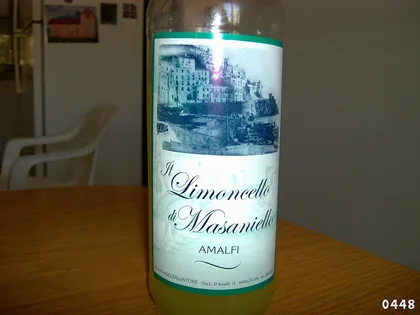 Oil and preservesLimoncelloLimoncello is made from lemon peel steeped in alcohol, never from the juice.
 CheeseBuffalo MozzarellaMozzarella di Bufala Campana DOP is made from the whole raw milk of Italian Mediterranean water buffalo…Vegetables and fruitPiennolo TomatoPiennolo tomatoes grow on the volcanic ash of Vesuvius with no irrigation at all, are cut in whole bunches in…
 Vegetables and fruitSan Marzano TomatoesSan Marzano is a long, thin-skinned plum tomato grown in the volcanic plain between Naples and Salerno, and…Vegetables and fruitChestnutsFor a thousand years the Apennines made bread from them rather than dessert: Castanea sativa was the tree…Vegetables and fruitFriarielliAround Naples this turnip never reaches the root stage, because what matters grows above it.
 Vegetables and fruitPaestum ArtichokeThe Paestum artichoke is round, tightly closed, completely spineless and dimpled at the tip: it takes a…
 Vegetables and fruitCilento White FigThe Cilento white fig is a Dottato fig dried in the sun on cane racks in the hills south of Salerno.