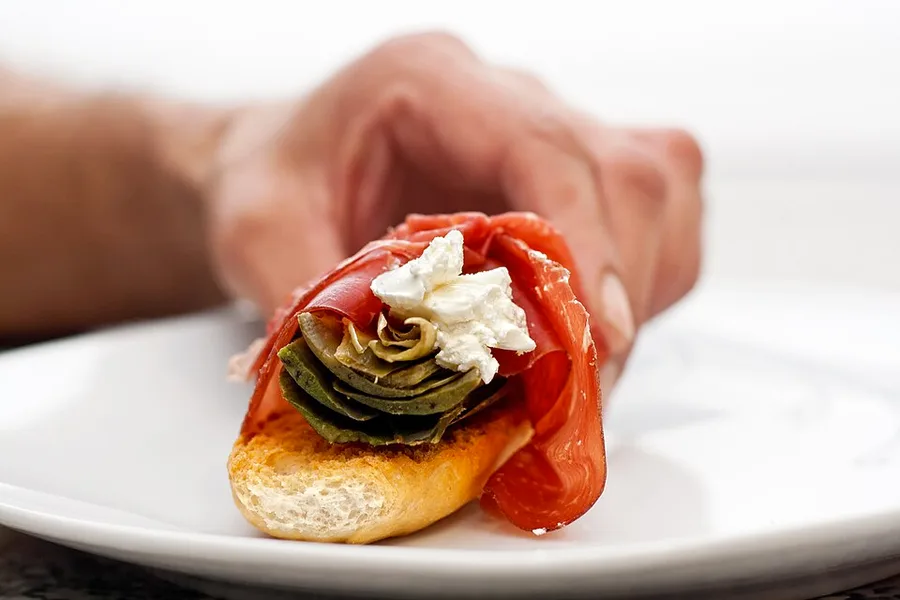
What is Paestum Artichoke?
Carciofo di Paestum is a protected geographical indication, registered in 2004, covering artichokes of the Tondo di Paestum variety grown in the Piana del Sele in the province of Salerno. The variety is a local selection from the Romanesco family, bred on the plain over generations.
The head is spherical and tight, with bracts pressed hard against each other and a distinct dimple at the apex, the single easiest way to identify it. Colour is green with violet shading at the base of the bracts, and the main head weighs 150 to 300 grams.
The quality that matters most does not show in photographs: it has no spines at all, neither on the bracts nor on the leaves. Preparing one means removing two or three rings of outer bracts and trimming the stem. No gloves, no patience required, and a far higher edible yield than any spiny variety.
The other defining feature is earliness. In the Piana del Sele the crop starts in late February, when most of Italy has nothing, and runs into late April. Heads cut early have barely any choke and bracts that stay tender almost to the outside, which is why they can be eaten raw.
What does it taste like?
Clean, green and nutty, with the pleasant bitterness that defines artichokes and a mineral finish. Less grassy than a globe artichoke and noticeably less bitter than a spiny Sardinian one, with a sweetness that comes forward when the head is roasted or braised.
The texture is the argument for it. Tight young heads are tender through most of their bracts, and the heart is dense and creamy rather than fibrous. The peeled stem eats like an extension of the heart, so never throw it away.
One effect worth knowing: artichokes contain cynarin, which temporarily suppresses sweetness receptors, so whatever you drink immediately afterwards tastes sweeter and flatter than it is. This is why artichokes have a reputation for wrecking wine, and why it is not the wine's fault.
How to use it
Cleaning is trivial precisely because there are no spines. Pull off two or three rings of outer bracts, trim the tip, peel the stem with a vegetable peeler and drop everything into cold water with lemon juice so it does not brown. Do not leave it soaking for hours, though: flavour leaches out.
Raw is the Piana del Sele trick with early heads: shave them wafer-thin on a mandoline and dress with olive oil, lemon, salt and shavings of pecorino or parmesan. It only works with young, tightly closed artichokes.
Roasting on embers is the traditional local method and requires no cleaning at all. Put the whole head straight on the coals, let the outside char, then peel back the burnt bracts and eat the heart with oil, salt, garlic and parsley.
Stuffed the Campanian way: open the bracts, pack in breadcrumbs, garlic, parsley, pecorino and sometimes anchovy, stand the heads upright in a pan with a finger of water and oil, cover and cook gently for forty minutes.
Also excellent battered and fried, baked into a frittata-like tortino with eggs, stewed with potatoes, or preserved in oil after a short boil in water and vinegar. The peeled stem is as tender as the heart.
How long it keeps
An artichoke is an unopened flower and it goes on transpiring after it is cut, losing water and turning fibrous as it does. A long stem is a reservoir, which is why heads sold with the stalk still on last much longer than trimmed ones. In the vegetable drawer, wrapped in a damp cloth or perforated bag, they run four or five days. The trick that works better is to stand them in a glass of water like cut flowers, stem submerged, which gets them close to a week before the bracts start to slacken and splay.
Once trimmed the cut surfaces darken within minutes, so pared hearts go into cold water sharpened with lemon or vinegar; leave them soaking too long, though, and flavour leaches out with the colour. Raw artichoke does not freeze, turning spongy on thawing, so blanch three or four minutes in acidulated water first, or freeze it already cooked, in wedges, for six months. Under oil is the old method: blanched hearts dried thoroughly, jarred and covered completely, a year sealed in the dark and about a month refrigerated once opened, oil always over everything.
Spot the real thing
The head should be a closed sphere with a dimple at the crown, never conical or drawn out, and the bracts should have no spines at all: a pricking hook at the tip puts you in front of a Sardinian spinoso or a violetto instead. Buy it with several centimetres of stem attached, firm rather than spongy, and bend the stem to test it, because it should break clean while a stem that simply flops has already lost its water. Weigh the head in your hand: a good one feels dense and tight and squeaks slightly when squeezed.
On a crate tag or a pack look for Carciofo di Paestum IGP with the EU logo and the Consortium; carciofo campano and carciofo tondo are not the denomination. Browning at the cut end of the stem is oxidation, the same reaction that darkens a cut apple, and is different from dry yellowed bract tips or wilted stem leaves. The round green heads sold in the US and Britain are usually Green Globe, close in shape and a different variety. Paestum rarely travels fresh and turns up mostly as preserved hearts.
How to pronounce Paestum Artichoke
kar-CHOH-foh dee PAH-eh-stoom
Carciofo has a soft 'ci', as in 'church': kar-CHOH-foh. Paestum in Italian is three syllables with the stress on the first, PAH-eh-stoom, not the two-syllable 'PESS-tum' used in English archaeology books.
Paestum Artichoke compared
vsRomanesco (mammola)
Paestum descends from the Romanesco family, so they are relatives rather than rivals. The Roman mammola is larger, rounder and later; the Paestum is smaller, tighter, dimpled at the tip and weeks earlier. Both are spineless, and either can be used where a recipe calls for the other.
| This | Romanesco (mammola) | |
|---|---|---|
| Head | Spherical, tight, dimple at the apex | Larger, rounder, no dimple |
| Weight | 150-300 g | 300-450 g |
| Season | Late February to late April | March to May |
| Spines | None | None |
| Classic dish | Roasted on embers, stuffed, raw sliced | Carciofi alla romana, alla giudia |
| Where | Piana del Sele, Campania | Lazio, around Rome and Ladispoli |
vsVioletto (Sant'Erasmo, Chioggia, Liguria)
The violet artichokes of the northern lagoons and Liguria are a different proposition: small, elongated, purple, harvested young and often eaten raw. They are more bitter and more perfumed, with a firmer bite. Paestum is rounder, milder and better suited to cooking whole.
| This | Violetto (Sant'Erasmo, Chioggia, Liguria) | |
|---|---|---|
| Shape | Round and closed | Elongated, tapering, often open |
| Colour | Green with violet at the base | Strongly purple |
| Size | 150-300 g | 60-150 g |
| Spines | None | Small spines on some ecotypes |
| Flavour | Mild, nutty, moderately bitter | Sharper, more aromatic, more bitter |
| Best use | Roasted, stuffed, braised whole | Raw in salad, fried, preserved in oil |
vsSpiny artichokes (Spinoso Sardo, Violetto di Sicilia)
The practical gap is bigger than the flavour gap. Spiny varieties are intensely flavoured and prized for preserving in oil, but they are armed, they oxidise fast and after trimming barely a third of the weight is left. A Paestum yields around half, and takes a minute to clean.
| This | Spiny artichokes (Spinoso Sardo, Violetto di Sicilia) | |
|---|---|---|
| Spines | None at all | Sharp hooks on bracts and leaves |
| Prep | One minute, bare hands | Slow, gloves advisable |
| Edible yield | 45-55% of the weight | 30-35% |
| Choke | Minimal in early heads | Well developed |
| Flavour | Nutty and moderate | Intense and markedly bitter |
| Best use | Everything, including raw | Preserving in oil, long braises |
Paestum Artichoke substitutes
- Roman mammola or Romanesco
The nearest relative and the obvious swap. Slightly larger, so use fewer heads for the same weight, and allow a few more minutes of cooking.
1:1 by weight; about 3 heads for every 4 Paestum - Green Globe artichokes (California, Brittany)
Widely available and structurally similar, but bigger, coarser and with a full choke that must be scooped out. Best for braising and stuffing rather than raw.
1:1 by weight; 1 large globe for 2 Paestum - Baby artichokes
The best supermarket stand-in for raw or fried preparations, since they have almost no choke and tender bracts. Trim harder than you think and keep them in lemon water.
3 or 4 baby heads per Paestum - Violetto or purple artichokes
Sharper and more perfumed. Excellent shaved raw with lemon and cheese; go lighter on other bitter elements in the dish to compensate.
2 violetti per Paestum - Artichoke hearts in oil, drained
For stuffing, tarts, pasta and pizza when fresh heads are out of season. Drain thoroughly and skip added salt: the oil and brine already carry plenty.
280 g drained jar per 4 fresh heads
Where to buy it
Fresh Paestum artichokes rarely leave Italy, and the season is short. In Italy they appear from late February in markets across the south and, at a fifty per cent premium, in northern cities. Buy heads with several centimetres of stem attached: the stem is both a freshness indicator and the best part.
Abroad, the realistic purchase is preserved hearts in oil from Campanian producers, sold by Italian delicatessens and importers such as Eataly and Gustiamo in the US and Sous Chef in the UK. Expect 8 to 14 dollars or 7 to 12 pounds for a 280-300 g jar, which works out at roughly 12 to 20 dollars per pound of drained artichoke.
Look for the full wording Carciofo di Paestum IGP with the EU mark. Carciofo campano and carciofo tondo are not the designation. For fresh heads, judge weight against volume, check the head squeaks when squeezed, and reject any that have started to open.
Where to eat it in Italy
Capaccio Paestum and the surrounding plain from March to April, when the artichoke festivals fill the tables with roasted, stuffed and fried heads. It is also the moment to see the landscape: artichoke fields to the horizon with three Greek temples standing in the middle of them.
Trattorie between Capaccio, Agropoli and Battipaglia serve them the traditional ways, and many farms in the plain sell direct and run small restaurants, often alongside the buffalo mozzarella made a few hundred metres away.
Salerno, on the seafront and in the old town, puts them on spring menus. The best single day out anywhere in the area is the obvious one: the archaeological site at Paestum, a buffalo dairy, and a plate of artichokes roasted over embers, all within ten kilometres of each other.
Further reading
Frequently asked questions
Why does the Paestum artichoke have no spines?
Because of the variety. Tondo di Paestum is a local ecotype of the Romanesco group, selected on the plain precisely for its spineless bracts and tight spherical head. It is not a matter of harvesting young or trimming, and it means a one-minute prep and an edible yield of roughly half the weight, against a third for spiny varieties.
When are they in season?
Late February to late April. They are the earliest artichokes in Italy, thanks to the mild climate of the Piana del Sele and a technique called risveglio anticipato: the plants are irrigated in high summer to break their natural dormancy and start growing again in autumn.
Can you eat them raw?
Yes, with young tightly closed heads. Shave them very thin on a mandoline and dress with olive oil, lemon and shaved pecorino. Early-season heads have almost no choke. Later, more open heads are better cooked.
Why do artichokes ruin the taste of wine?
Cynarin, a compound in the artichoke, temporarily blocks the sweetness receptors on the tongue, so anything drunk immediately after tastes sharper and thinner. Dry, saline, unoaked whites cope best: Fiano di Avellino, Greco di Tufo and Falanghina are the local answers.
How do I stop them turning black?
That is polyphenol oxidation, the same reaction you see in a cut apple. Drop trimmed pieces into cold water with lemon juice or vinegar as you work. Do not leave them there for hours, or you will wash out the flavour along with the discolouration.
Sources
Where to check what you just read.
- 1
Il regolamento del 12 marzo 2004 che iscrive «Carciofo di Paestum» come indicazione geografica protetta, con la domanda presentata dall'Italia.
- 2
Il disciplinare in PDF: ecotipo Tondo di Paestum, comuni della Piana del Sele ammessi, calibri e periodo di raccolta del capolino.
- 3Consortium · interested partyConsorzio Carciofo tondo di Paestum IGP
L'area di produzione e i produttori aderenti secondo il consorzio: utile per capire quanta parte del carciofo salernitano è davvero certificata.
Related foods
 CheeseBuffalo MozzarellaMozzarella di Bufala Campana DOP is made from the whole raw milk of Italian Mediterranean water buffalo…Vegetables and fruitFriarielliAround Naples this turnip never reaches the root stage, because what matters grows above it.
 Vegetables and fruitSan Marzano TomatoesSan Marzano is a long, thin-skinned plum tomato grown in the volcanic plain between Naples and Salerno, and…Vegetables and fruitChestnutsFor a thousand years the Apennines made bread from them rather than dessert: Castanea sativa was the tree…
 Vegetables and fruitSorrento LemonThe Sorrento lemon is a rifiorente femminello grown under chestnut-pole pergolas on the cliffs south of…Vegetables and fruitPiennolo TomatoPiennolo tomatoes grow on the volcanic ash of Vesuvius with no irrigation at all, are cut in whole bunches in…
 Vegetables and fruitCilento White FigThe Cilento white fig is a Dottato fig dried in the sun on cane racks in the hills south of Salerno.
 Pasta and breadSpaghettiA solid round strand of durum semolina and water, 1.7 to 2.0mm across. It looks like the most neutral pasta…