What is Cilento White Fig?
Fico Bianco del Cilento has been a protected DOP since 2006, and the protection covers the dried fruit: what is certified is the dried fig, whole with its skin or peeled, rather than the fresh fruit.
There is a single cultivar, Dottato, locally Ottato, a Ficus carica variety with thin, pale greenish-yellow skin and amber flesh containing very few achenes, the little seeds. That scarcity of seeds is exactly what makes Dottato the drying fig: a seedy variety turns gritty as it dries.
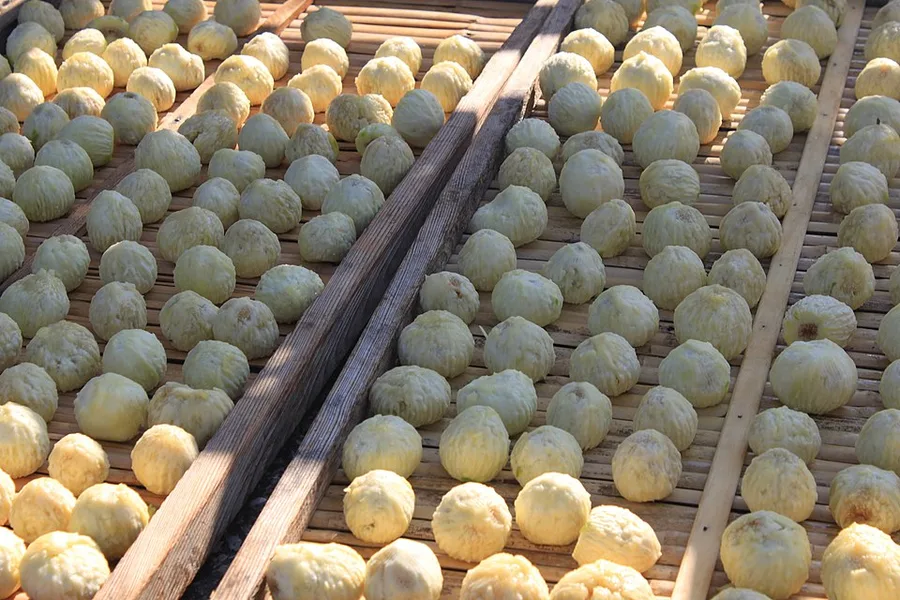
The white in the name refers to the pale skin of the fresh fruit, not to the finished product, which dries to a golden amber.
Sugar is the whole story. A fresh Dottato is about 18 to 20 per cent sugar; dried, it comfortably exceeds 50 per cent, and the fruit becomes a concentrate. It tastes of acacia honey and almond, with a faint vanilla note and almost no acidity.
Alongside the DOP there is a Slow Food presidium for figs dried by the traditional method, created to keep alive the hand processing and the old preparations (crocette, stuffed mbottunati, plaited strings) that the bulk dried-fig trade had all but wiped out.
What does it taste like?
Honey first, then almond. A good Cilento fig is intensely sweet without being cloying, because there is no added sugar and no glucose syrup coating, and the sweetness has a floral rather than a caramel character.
The texture is the giveaway. It is soft and elastic, yielding under the finger and springing back, and the flesh is smooth: you should barely register seeds at all. Commodity dried figs, made from seedier varieties, crunch.
Stuffed and baked, it changes again: the surface sugars caramelise and turn slightly bitter, and the walnut inside cuts the sweetness. Under dark chocolate it becomes a confection rather than a fruit.
How to use it
Start by eating them as they are, at the end of a meal or at breakfast. This is one of the few Italian sweet products that needs no recipe at all.
The traditional preparation is the fico mbottunato: split the fig without separating the halves, tuck in a walnut half or a toasted almond with a few wild fennel seeds and a shred of citrus peel, close it up and bake at 150°C for about ten minutes. The oven melts the sugars and caramelises the outside.
Crocette are made by opening two figs and laying them across each other in a cross with nuts in between, then baking and storing in tins.
On the savoury side they belong with cured meat and cheese: on a board with capocollo, wrapped in a slice of prosciutto, beside an aged pecorino or a fresh goat's cheese. In main courses they go into roast pork and duck, soaked first in white wine or warm water.
In baking, chop them into cakes and biscuits, use them in the fillings of Campanian Christmas pastries, and pair them with dark chocolate at 70 per cent, which suits them far better than milk.
One practical rule that changes the result: if you need the fig soft inside a dish, soak it for twenty minutes in warm water, milk or Marsala. If you want it whole and caramelised, bake it dry with no liquid at all.
How long it keeps
Dried but not bone dry, these still hold a fifth or so of their weight as water, and that is what storage has to manage. An airtight jar or tin in a cool, dark, dry cupboard is right, and unopened packs usually carry a producer date about a year out. Left in a paper bag on a shelf they go on losing water and harden noticeably within weeks. In a humid kitchen the opposite happens and they turn tacky and stick to each other. The fridge in a sealed box slows both and stretches them to several months, though they gather condensation each time the box comes out.
The visible changes are gradual: glucose migrates to the surface and settles as a white powdery crystal bloom, the flesh deepens from straw through amber towards brown as the sugars slowly darken, and the honeyed aroma flattens. Nut filled ones move faster, because the nut oils oxidise, and chocolate coated ones develop grey streaks on the coating when the temperature swings. They freeze six to twelve months well wrapped with little change in texture.
Spot the real thing
The colour is the first test and the reason for the name: a proper dried Dottato fig from the Cilento is pale straw to light amber, never the dark leathery brown of most dried figs. The skin is thin and finely wrinkled, the flesh inside is honey coloured and translucent at the edges, and the seeds are small enough not to feel gritty. The traditional formats are two figs pressed face to face, figs threaded onto sticks or strings, peeled ones sold as monnati, and figs filled with walnuts, almonds and fennel seed. The DOP allows no added sugar.
The imported figs on most shelves are easy to tell apart once you look. Turkish figs are bigger, rounder and much paler, sold in flat rings or blocks; Greek ones are darker and often dusted with rice flour; Californian Mission figs have near black skins. A white powdery bloom on the surface is sugar crystallising out of the flesh rather than anything added. Price separates them too: the DOP runs 18 to 30 euro a kilo against 6 to 10 for supermarket dried figs.
How to pronounce Cilento White Fig
FEE-koh bee-AHN-koh del chee-LEN-toh
Fico is two syllables with a hard c: FEE-koh. Cilento takes a soft c, as in 'cheese': chee-LEN-toh, stress on the second syllable. The stuffed version, mbottunati, is a dialect word: em-bot-too-NAH-tee.
Cilento White Fig compared
vsTurkish dried figs
Turkey, and specifically the Aydın province around Izmir, supplies well over half of the world's dried figs, and a Turkish fig is what almost everyone outside Italy has actually eaten. They are a different variety, machine-processed at scale, flattened into discs and often treated to stay soft. Perfectly good food, and a completely different product.
| This | Turkish dried figs | |
|---|---|---|
| Variety | Dottato, few seeds | Sarilop / Smyrna type, seedier |
| Drying | Sun on cane racks, turned by hand | Sun and industrial tunnel drying |
| Shape | Whole, teardrop, or split and stuffed | Pressed flat into a disc |
| Texture | Elastic, smooth, low crunch | Chewier, noticeably seedy |
| Treatments | None beyond drying and baking | Often sulphured or humectant-treated |
| Price | EUR 18-28/kg | EUR 8-14/kg |
vsFresh figs
The same fruit at a different moment, and the comparison matters because they are not interchangeable in a recipe. Fresh figs are 80 per cent water and last three days; dried figs are a concentrate that keeps a year. Four kilos of fresh fruit make one kilo of dried.
| This | Fresh figs | |
|---|---|---|
| Water content | About 20 per cent | About 80 per cent |
| Sugar | Over 50 per cent | 18-20 per cent |
| Shelf life | 12 months | 2-4 days |
| Season | All year once dried | June breba, August-September crop |
| Best with | Cured meat, aged cheese, chocolate | Prosciutto, soft cheese |
vsFichi di Cosenza DOP
Calabria's protected dried fig, also made from Dottato, and the closest Italian comparison. The difference is largely in tradition and format: Cosenza is known for figs threaded onto skewers and pressed into shapes, and its production is larger. Where Cilento leans on stuffing and chocolate, Cosenza leans on decorative pressed forms.
| This | Fichi di Cosenza DOP | |
|---|---|---|
| Region | Cilento, province of Salerno | Province of Cosenza, Calabria |
| Cultivar | Dottato | Dottato |
| Signature format | Mbottunati, crocette, chocolate | Skewered, plaited, pressed |
| Protection | DOP since 2006 | DOP since 2011 |
Cilento White Fig substitutes
- Fichi di Cosenza DOP
The nearest equivalent by some distance: same cultivar, same sun-drying principle, a different set of traditional shapes. Use one for the other without adjustment.
1:1 - Good Turkish dried figs
Widely available and cheap. Choose unsulphured ones and expect more seeds and a chewier bite. If you are stuffing and baking them, the gap narrows considerably.
1:1 by weight - Californian Mission or Calimyrna figs
The standard US options. Calimyrna is the Smyrna type and closer in colour and sweetness; Mission is darker, more jammy and more acidic. Calimyrna is the better match.
1:1 - Dried dates (medjool)
Not a fig, but it works where you need a soft sweet fruit to stuff or to serve with cured meat. Sweeter and more caramelised, with no floral note.
0.8:1 by weight - Dried apricots plus a walnut
For the stuffed-fruit format when figs are unavailable. Tarter and firmer, which some people prefer on a cheese board, but a different dish rather than a substitute.
1:1 by piece
Where to buy it
This is a small designation with a few dozen certified producers, so it does not travel widely. Outside Italy, look to Italian specialist importers and online Italian food retailers rather than to supermarkets. In the US, expect roughly 14 to 25 dollars a pound for the plain dried figs and considerably more for stuffed or chocolate-coated boxes; in the UK, 25 to 40 pounds a kilo through Italian delicatessens. In Italy itself the plain dried DOP figs run 18 to 28 euros a kilo, mbottunati and crocette 28 to 40, chocolate-covered 35 to 50.
The reference points on the label are the EU DOP mark, the wording Fico Bianco del Cilento, and the control body. Bulk figs sold loose as Cilento figs carry no guarantee at all.
What to look for in the fruit: even pale amber colour, not brown or blackish; soft and elastic to the touch, springing back when pressed; smooth flesh without a gritty bite. Sharp or alcoholic notes mean the fruit fermented on the drying racks.
And do not be put off by a white powdery bloom on the surface. That is crystallised sugar, not mould. Real mould is green or grey, damp and furry.
Where to eat it in Italy
The hill towns of the inner Cilento (Prignano Cilento, Rutino, Torchiara, Ogliastro, Perito, Stella Cilento) where from late August through September the drying racks are laid out in the sun on the open ground in front of the houses, and producers sell direct.
Prignano Cilento is the town most identified with the fig and holds a late-summer festival for it: the best single opportunity to taste mbottunati, crocette and pressed figs made by very small producers.
Roccadaspide and Capaccio, out towards the Sele plain, are worth combining with the area's other products, artichokes from Paestum in spring and buffalo mozzarella all year, and with the Greek temples at Paestum itself.
Vallo della Lucania is the main town of the inner Cilento and the easiest place to find certified production from several farms in one shop.
Go in September, when drying is in full swing and fresh figs are still on the trees, so a single trip shows you both ends of the same product. The stuffed and chocolate-coated versions, by contrast, appear mainly between November and January, because they are Christmas gifts.
Further reading
Frequently asked questions
Why is it called a white fig when it is amber?
White refers to the pale greenish-yellow skin of the fresh Dottato fruit, not to the dried product, which turns golden amber as it loses water. The name describes the tree, not the finished fig.
What are fichi mbottunati?
Dried figs split open and stuffed (mbottunati is dialect for 'filled') with a walnut half or an almond, wild fennel seeds and a piece of citrus peel, then closed and baked. It is the traditional Cilento preparation, and along with crocette it is what the Slow Food presidium set out to preserve.
Is the white powder on dried figs mould?
Almost always no. It is crystallised sugar migrating to the surface: dry, powdery, and increasingly common as the figs age. It is sugar that has migrated to the surface, and it disappears in a warm oven. Real mould is green or grey, damp and velvety.
When are Cilento figs harvested?
From mid-August to the end of September, sometimes into early October. The main crop is used, not the June breba figs, and picking is repeated every two days because each fruit has a two- or three-day window of ripeness. Sun-drying follows immediately, in the same months.
Why do they cost so much more than ordinary dried figs?
It takes four kilos of fresh figs to make one kilo of dried. Picking is repeated every two days for six weeks across trees scattered along terraces and olive groves rather than in dense orchards. And sun-drying needs space, daily handling by hand, and weather nobody controls.
Sources
Where to check what you just read.
- 1
L'atto del 10 marzo 2006 che ha iscritto «Fico Bianco del Cilento» fra le DOP ortofrutticole, nello stesso regolamento della Melannurca Campana.
- 2
Il PDF del disciplinare vigente, dove si verificano la cultivar Dottato, i comuni ammessi e le regole su essiccazione e tipologie di presentazione.
Related foods
 Vegetables and fruitPaestum ArtichokeThe Paestum artichoke is round, tightly closed, completely spineless and dimpled at the tip: it takes a…
 CheeseBuffalo MozzarellaMozzarella di Bufala Campana DOP is made from the whole raw milk of Italian Mediterranean water buffalo…Vegetables and fruitChestnutsFor a thousand years the Apennines made bread from them rather than dessert: Castanea sativa was the tree…
 Vegetables and fruitSan Marzano TomatoesSan Marzano is a long, thin-skinned plum tomato grown in the volcanic plain between Naples and Salerno, and…
 Vegetables and fruitSorrento LemonThe Sorrento lemon is a rifiorente femminello grown under chestnut-pole pergolas on the cliffs south of…Vegetables and fruitFriarielliAround Naples this turnip never reaches the root stage, because what matters grows above it.Vegetables and fruitPiennolo TomatoPiennolo tomatoes grow on the volcanic ash of Vesuvius with no irrigation at all, are cut in whole bunches in…
 Pasta and breadSpaghettiA solid round strand of durum semolina and water, 1.7 to 2.0mm across. It looks like the most neutral pasta…