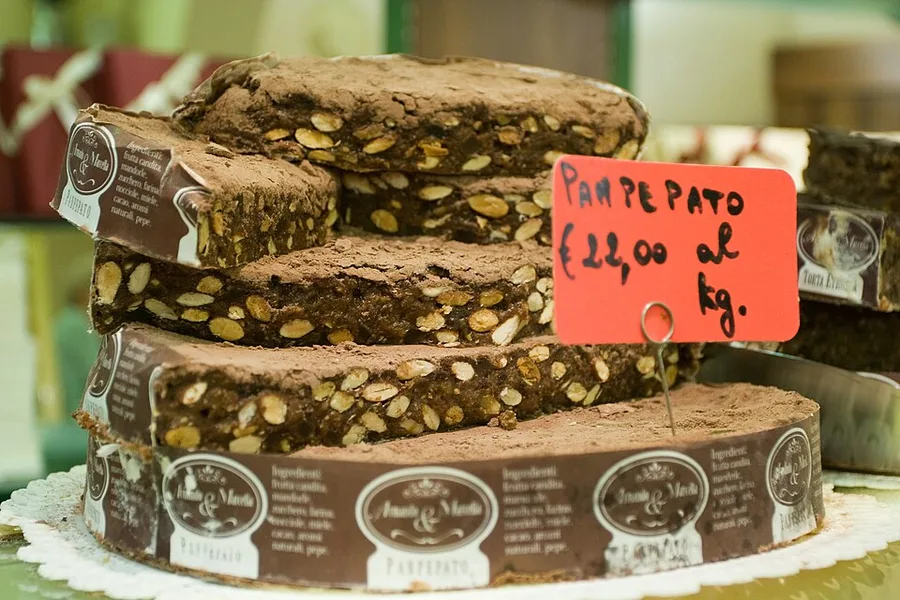
What is Panpepato?
Panpepato is cooked honey, whole toasted almonds and hazelnuts, candied fruit, cocoa and spices, held together by very little flour, pressed into a low round and baked slowly. It slices into thin wedges and keeps for months.
The name names the ingredient that separates it from everything else in the Italian Christmas repertoire: black pepper, which is not a background note here but a warmth that arrives at the end of every bite. That is exactly where panpepato parts company with panforte, whose best-selling version dropped both the pepper and the cocoa to become pale and sweet.
Structurally it is not a cake. There is no leavening, no eggs, no butter. Sugar cooked with honey to the soft-ball stage cements the nuts as it cools; the flour is a binder and accounts for less than a tenth of the weight in a good one.
It is baked on a sheet of ostia, an edible starch wafer that stops the mass sticking and stays fused to the base. It is a medieval detail that survived unchanged, and you eat it.
Three towns make three different versions. Siena's is a low disc dusted with ground spice. Terni's is a dome coated in dark chocolate, with walnuts, pine nuts, cooked must and coffee in the mix. Ferrara's is shaped like a bishop's mitre and also chocolate-coated. All three are called panpepato or pampepato, and knowing one gives you no idea of the other two.
What does it taste like?
Honey first, then dried fruit, then a slow build of spice, and finally the pepper, which lands at the back of the throat about two seconds after you swallow. It is warmth rather than heat, and it is the reason people who find panforte cloying tend to prefer this.
Underneath there is bitter cocoa, the tannic edge of almond skins, the resin of pine nuts in the Umbrian versions, and sharp bursts of candied citron. The sweetness is high but the finish is dry and bitter, which keeps it in balance.
Texture is the shock for anyone expecting cake: dense, chewy, verging on hard, with whole nuts to work through. A wedge takes real chewing. This is deliberate: the sweet was built to be nutritious, expensive and long-lasting, and softness was never part of the brief.
The chocolate-coated versions from Terni and Ferrara read differently: rounder, more obviously dessert-like, with the coffee and cooked must adding a dark, almost savoury depth.
How to use it
Cut it into thin wedges, no more than half a centimetre, with a smooth blade warmed under hot water and dried. A serrated knife drags the nuts out instead of cutting them. Twenty to thirty grams is a portion: this is a tasting sweet, not a slice of cake.
Serve at room temperature. Straight from a cold larder it is rock hard and the spices go mute; half an hour out fixes it.
The most interesting use is savoury. Shaved thin over aged pecorino toscano, gorgonzola or a blue goat's cheese, panpepato works the way a fruit paste does but with more going on: the pepper and cocoa bridge the honey and the salt. Tuscans have done this for a long time.
Chopped coarsely it makes granella for semifreddo or fiordilatte gelato. Crumbled into sweetened ricotta with a thread of honey it becomes a spoon dessert in five minutes.
How long it keeps
It sits at room temperature, wrapped in its own paper or closed in a tin, for four to six months. There is very little free water in the dough and the cooked sugar holds what there is, which is why it was built to last a winter in an unheated house. Across those months it keeps drying and hardening, and the spices settle into one another, so the pepper reads rounder in February than it did in December. The date on the box is the maker's own reference point.
Chocolate-coated versions run shorter, three or four months, because chocolate takes up the smells around it and above roughly 25 °C the fat migrates and surfaces as white patches. The fridge is the wrong answer: its damp air makes the surface tacky and the cold takes the dough past the point where it slices cleanly. Once the disc has been cut, cover the cut face with film and leave it in the cupboard. Freezing adds nothing, since the cupboard already spans the whole life of the thing.
Spot the real thing
Hold a cut slice up to the light. A good panpepato is almost entirely nuts and candied peel held together by a thin veil of dark dough, and if you see a lot of paste and few almonds, flour was used to bring the cost down. The hazelnuts and almonds should be whole and toasted, since nut rubble means processing offcuts went in. On the base there should be a sheet of wafer, the ostia, stuck firmly to the dough; versions without it exist and are almost always industrial.
Taste the finish, because that is where the name is earned. Honey and dried fruit come first, then a warm, faintly biting tail of pepper a beat later. With no pepper at all you are holding a dark panforte under a borrowed name, which is what a good many boxes sold abroad contain. Panforte Margherita is the pale cousin dusted with icing sugar, and German Lebkuchen, stacked in the same aisle at Christmas, is softer and cakey by comparison.
How to pronounce Panpepato
pahn-peh-PAH-toh
Four syllables, stress on the third. Every vowel is pronounced cleanly: pahn, not 'pan' as in English. The variant spelling pampepato is pronounced the same way and is standard in Terni and Ferrara. The plural is panpepati, pahn-peh-PAH-tee.
Panpepato compared
vsPanforte
The same tradition split by a marketing decision made in 1879. Until then, the Sienese Christmas sweet was dark, peppered and cocoa-laced. That year a Sienese pastry shop made a milder version without pepper or cocoa, dusted in icing sugar, for the visit of Queen Margherita of Savoy; the panforte Margherita became the standard and the pepper version kept the older name. In many Sienese shops today panforte nero and panpepato are the same product under two labels. If you have only eaten the pale, sugar-dusted panforte, panpepato will taste like a completely different sweet: darker, drier, spicier and considerably less sugary.
| This | Panforte | |
|---|---|---|
| Pepper | Central, 3-5 g per kilo | None in the Margherita type |
| Cocoa | In the mix | None in the Margherita type |
| Colour | Dark brown to near-black | Pale amber under white sugar |
| Finish | Dusted with spice, or chocolate-coated | Thick icing sugar |
| Sweetness | Lower, bitter finish | Higher, rounder |
| Age of the recipe | Documented from the Middle Ages | 1879 in its current form |
| Wafer base | Ostia | Ostia |
vsPain d'épices
The French spiced honey bread, and the comparison worth making because both descend from the same medieval honey-and-spice tradition that ran across Europe. But pain d'épices is a leavened bread: rye flour, honey, aniseed and cinnamon, baked in a loaf tin, soft, sliceable and often eaten with butter or foie gras. Panpepato has almost no flour, no leavening and is up to half nuts by weight. Pain d'épices is a breakfast loaf; panpepato is closer to a confection you slice like a truffle.
| This | Pain d'épices | |
|---|---|---|
| Base | Nuts and candied fruit | Rye flour and honey |
| Flour content | Under 10% of the weight | The main ingredient |
| Leavening | None | Chemical raising agent |
| Lead spice | Black pepper | Aniseed and cinnamon |
| Texture | Dense, chewy, nutty | Soft, sliceable, bread-like |
| Served | Thin wedges after dinner | Sliced and buttered at breakfast |
vsTerni and Ferrara versions
Worth knowing before you order, because the chocolate-coated versions are a different eating experience from the Sienese disc. Terni's pampepato, protected as an IGP since 2021, is domed and enrobed in dark chocolate, and carries walnuts, pine nuts, raisins, cooked grape must and coffee alongside the almonds and hazelnuts. Ferrara's pampapato takes the shape of a bishop's mitre, is also chocolate-coated, and traces its recipe to a seventeenth-century convent. Both are richer and less austere than the Sienese type, and both are noticeably darker and more bitter.
| This | Terni and Ferrara versions | |
|---|---|---|
| Shape | Low disc (Siena) | Dome (Terni), mitre (Ferrara) |
| Finish | Ground spice and sugar | Tempered dark chocolate |
| Extra ingredients | Almonds, hazelnuts, citron | Walnuts, pine nuts, raisins, coffee, cooked must |
| Protection | Traditional regional product | IGP for Terni since 2021 |
| Keeps | Four to six months | Three to four months |
Panpepato substitutes
- Panforte nero
The closest thing on any shelf, and in several Sienese pastry shops it is literally the same product under a different label. Look for the dark version with cocoa listed in the ingredients rather than the white Margherita. Use it anywhere you would use panpepato.
1:1 - Elisenlebkuchen
The German nut-heavy grade of Lebkuchen, and the best supermarket stand-in outside Italy at Christmas. Very high nut content, low flour, similar spicing, but softer and usually bound with egg white, and without the pepper. Grind a little black pepper over it and the resemblance jumps.
1:1 by weight - Homemade version
Genuinely achievable. Cook 250 g honey with 150 g sugar to 118 C, stir in 300 g toasted whole almonds and hazelnuts, 200 g diced candied citron and orange, 60 g flour, 30 g cocoa and a heaped teaspoon of mixed cinnamon, nutmeg, cloves, coriander and 4 g coarsely ground black pepper. Press into a lined 20 cm ring about 2 cm deep and bake at 150 C for 40 minutes. Rice paper stands in for ostia.
Makes about 950 g - Pan di fichi
The Calabrian and Apulian dried-fig cake: figs, almonds and spices pressed into a block that keeps for months. Sweeter and figgier, with no pepper and no cocoa, but it slices the same way, keeps the same way and suits the same cheeses and wines.
1:1, cut slightly thinner - Maple or agave syrup for the honey
The only route to a vegan panpepato, since honey is structural rather than incidental here. Cook the syrup with the sugar to the same soft-ball temperature. Agave is cleaner and more neutral; maple brings its own flavour, which sits well with the spices. It remains a wheat product either way.
1:1 by weight
Where to buy it
Artisan panpepato runs 20 to 35 euro a kilo in Italy; the chocolate-coated Terni and Ferrara versions reach 38 to 45, because the coating adds both a process and an ingredient. Sizes run from 250 g to a kilo, with the 500 g gift format the most common.
The price is mostly nuts. Almonds and hazelnuts are the dominant cost and exceed forty per cent of the weight in a well-made one; honey is second. Anything under fifteen euro a kilo has cut both: more flour, sugar instead of honey, flavourings instead of ground spice, and you can see it in the cut face before you taste it.
Abroad, Italian delis and online grocers carry it from November to January at roughly 18 to 28 dollars a pound in the US and 28 to 45 pounds a kilo in the UK. It ships extremely well, which makes it one of the safest Italian Christmas sweets to order by post.
Read the label for pepe nero and cacao. Without both, you are buying a dark panforte with the wrong name on the box.
Where to eat it in Italy
Siena, where the historic pastry shops along via di Città and around the Campo sell panforte and panpepato side by side. Tasting them together is the fastest way to understand the split. The season runs from late November to January, though Siena sells it year-round.
Terni, in Umbria, where pampepato is the city's own Christmas sweet and fills every pastry-shop window in December. The Marmore waterfall is a few kilometres away and the Valnerina starts just beyond it, which makes the detour easy to justify.
Elsewhere in Umbria, Perugia and the Apennine villages make plainer, uncoated, often peppery home-style versions.
Ferrara completes the picture outside both regions: its mitre-shaped pampapato is sold in the pastry shops of the Este old town and differs enough from the other two to be worth the trip. In all three cities, the Christmas markets are when the small producers without shopfronts appear.
Further reading
Frequently asked questions
What is the difference between panpepato and panforte?
Panpepato is the older form: dark, with cocoa and a real dose of black pepper. The panforte most people know is the Margherita, created in 1879 without pepper or cocoa and dusted with icing sugar. In many Sienese shops, panforte nero and panpepato are the same product under two names.
Does panpepato actually taste of pepper?
Yes, at the finish. Three to five grams of coarsely ground black pepper per kilo of mix means it arrives a beat after the sweetness, as a warmth at the back of the throat rather than a burn. A version with no perceptible pepper is not a panpepato.
Do you eat the paper on the bottom?
That is not paper, it is ostia, an edible wafer of starch and water used to stop the mixture sticking to the tin. It stays fused to the base and is eaten with the sweet. Rice paper is the standard substitute for home bakers.
How long does panpepato keep?
Four to six months at room temperature in a tin, three to four for the chocolate-coated versions. There is no free water in it and cooked sugar acts as a preservative. It hardens with age without spoiling; a short spell in a very low oven makes it sliceable again.
How do you pronounce panpepato?
pahn-peh-PAH-toh, stress on the third syllable, every vowel sounded. The spelling pampepato, standard in Terni and Ferrara, is pronounced the same way.
Related foods
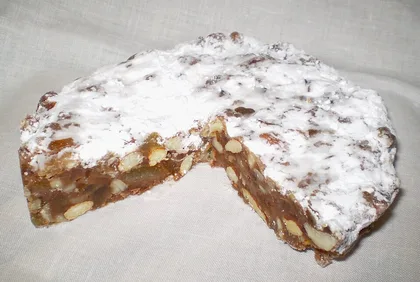 SweetsPanfortePanforte is a dense, chewy Sienese disc of candied fruit, almonds, honey and spices, only 2-3 cm thick and…
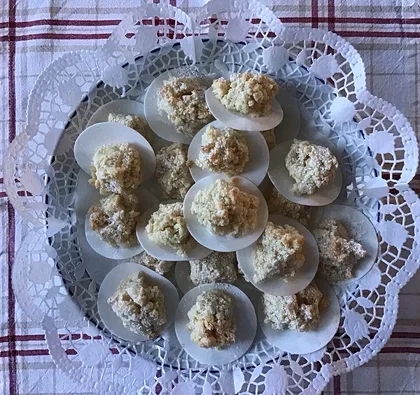 SweetsRicciarelliRicciarelli are Siena's almond biscuits: sweet almond paste, sugar and egg white, shaped into soft ovals…
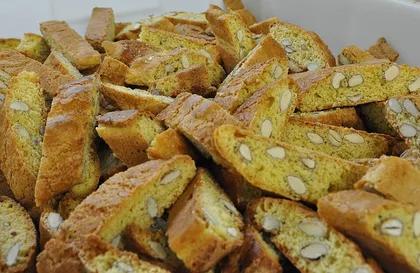 SweetsCantucciCantucci are hard, twice-baked Tuscan almond biscuits. A log of dough is baked, sliced on the diagonal while…SweetsTorcolo di San CostanzoPerugia's own ring cake: a lightly sweetened yeasted dough with candied citron, raisins, pine nuts and whole…
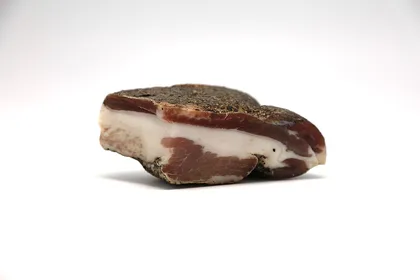 Cured meatsGuancialeGuanciale is cured pork jowl: unsmoked, rubbed with salt and pepper, aged for one to three months.
 WineChianti ClassicoChianti Classico is the Black Rooster wine: at least 80 per cent Sangiovese from nine communes between…
 Cured meatsPorchettaSix to eight hours in a wood oven to reach two opposite textures in one piece of meat: skin that shatters…
 WineBrunello di MontalcinoBrunello di Montalcino is pure Sangiovese aged five years, at least two of them in oak, made only in the…