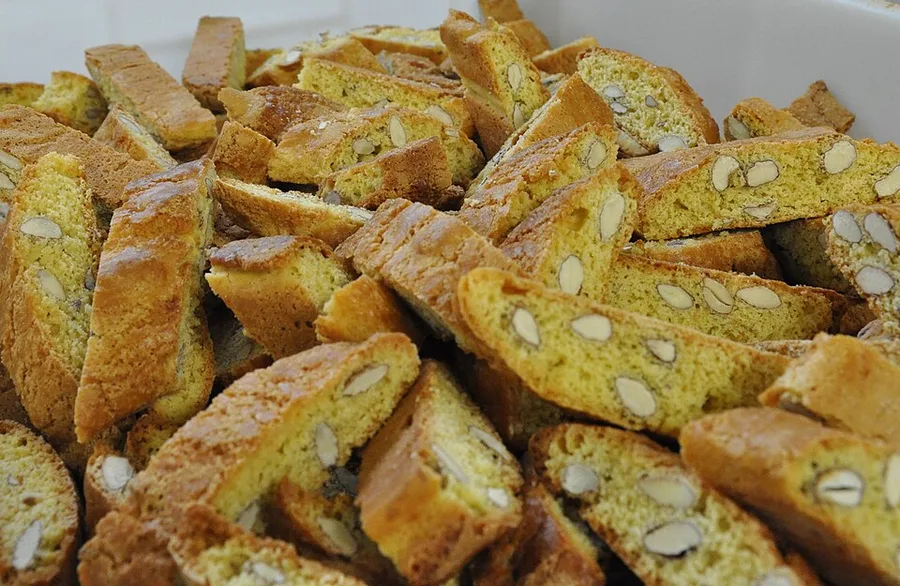
What is Cantucci?
A cantuccio is a dry biscuit studded with whole, unpeeled almonds, cut at an angle so the slices are long and lozenge-shaped. Biscotto means twice-cooked, and that is exactly the method: bake a flat log, cut it diagonally the moment it leaves the oven, lay the slices down and dry them for a few more minutes a side.
The historic Prato recipe is austere: flour, sugar, eggs, whole almonds with their skins on, pine nuts. No butter, no oil, no leavening, no liquid other than the eggs. The absence of fat is what makes the biscuit rock-hard and effectively imperishable: nothing to go rancid, and not enough moisture for mould.
Two protected names now coexist. Cantuccini Toscani IGP covers production across Tuscany; Biscotti di Prato IGP is tied to the historic formula of the town that invented them. Both set a minimum almond content of roughly twenty per cent. In practice the dividing line is butter: the Prato recipe has none, much modern Tuscan production does, and the two biscuits behave differently in the glass. One softens, the other dissolves.
What does it taste like?
Toasted almond first, then a restrained sweetness, then the faint bitterness of almond skin. There is no vanilla, no butter richness, no chocolate: a proper cantuccio tastes of about four things, and the pine nuts, which most people never notice on the label, supply a resinous note at the end.
The texture is the whole argument. It is genuinely hard: you snap it rather than bite through it, and the fracture is clean and loud. That is not a flaw and not staleness. Dipped for two seconds, the outer millimetre turns to a sweet paste while the middle stays crisp, and the biscuit becomes a delivery system for whatever it was dipped in.
Buttered supermarket cantuccini taste sweeter, softer and much rounder. They are pleasant biscuits. They also crumble into your wine, which the original is engineered not to do.
How to use it
Hold the biscuit by one end, dip it in Vin Santo for two or three seconds, and eat it. That is the entire ritual, and the timing is the only part people get wrong: leave it in the glass and it disintegrates, taking the wine down with it.
One warning worth having. Vin Santo is not always sweet. It is made from Trebbiano and Malvasia grapes dried on racks until winter, then sealed for years in small barrels in the vinsantaia, the loft under the roof, where they go through hot summers and cold winters. Styles run from properly sweet to nearly dry, and a dry one makes for a disappointing dip. For the ritual, buy a sweet one; for drinking, the drier ones are often the more interesting wines.
Beyond the ritual: dunk them in milk or a caffè latte at breakfast, which is what Tuscans actually do most mornings. Crush them coarsely for a cheesecake or icebox-cake base: they already contain almonds and sugar, so all you add is melted butter. Crumble them over vanilla gelato or almond semifreddo for texture. Ground fine, they can replace up to a third of the flour in a fruit tart base.
How long it keeps
The second baking exists to drive the water out, so these are among the driest biscuits there are, and the whole job of storage is keeping that dryness. An airtight tin or a clip-top jar in a dry cupboard at room temperature is right; an unopened bag usually carries a producer date six to twelve months out. Once the bag is open they start pulling humidity out of the air, and in a damp kitchen the hard snap gives way to a bendy chew within a few days. Five to ten minutes in a low oven drives that moisture back off.
The fridge works against them, being both humid and cold, and they soften there faster than on a shelf. Over months the almond oil oxidises and the aroma flattens towards paper, which is why nut heavy biscuits change sooner than plain ones; versions made with butter go the same way faster still. They freeze for several months in a rigid container so they do not break, and thaw best uncovered so no condensation lands on the surface.
Spot the real thing
Look at the cut face before anything else. A Prato cantuccio is packed with whole almonds, skins on, at something like a quarter of the weight, so the cross section is more nut than dough. The shape follows from the method: the dough is baked as a log, sliced on the diagonal while warm and baked again, which gives a lozenge with two flat cut faces and a domed crust. The strict Prato recipe is flour, sugar, eggs and almonds, with no butter and no raising agent, and the result is pale gold and genuinely hard.
Abroad the word biscotti covers the whole family, which is where the confusion starts: American style biscotti are usually bigger, softer, made with butter, often flavoured with anise or dipped in chocolate. Cantuccini is simply the smaller size, not a different biscuit. The protected name to look for is Cantucci Toscani IGP or Cantuccini Toscani IGP, which fixes the minimum almond proportion. Prices run about 12 to 20 euro a kilo in Tuscany and $10 to $16 for a 250 to 300g bag in an Italian deli abroad.
How to pronounce Cantucci
kahn-TOO-chee
Three syllables, stress on the second. The double 'c' before 'i' is soft: 'chee' as in 'cheese', never a hard 'k'. One biscuit is a cantuccio, kahn-TOO-cho. The diminutive cantuccini is kahn-too-CHEE-nee. All final vowels are pronounced; nothing is silent.
Cantucci compared
vsBiscotti di Prato
The same biscuit under its older, stricter name. Prato is where the thing was invented and the town has never called it cantucci: locals say biscotti, full stop. As protected names, Biscotti di Prato IGP follows the historic butterless formula fixed by Antonio Mattei in 1858, while Cantuccini Toscani IGP covers a broader range of Tuscan production that commonly includes butter. If you want the original, buy the Prato name.
| This | Biscotti di Prato | |
|---|---|---|
| Name used | Commercial and export name | Historic name, still used in Prato |
| Butter | Often present | Not in the historic recipe |
| Texture | Firm to crumbly | Hard, snaps cleanly |
| Almonds | 20% minimum | 20% minimum, usually more |
| Pine nuts | Optional | Part of the 1858 formula |
| Dipping | Can dissolve if buttery | Softens without collapsing |
vsAmerican 'biscotti'
Two different products that share a borrowed word. In Italian, biscotti simply means biscuits or cookies, all of them. In American cafés, 'a biscotti' means a large, sweet, twice-baked bar made with butter and baking powder, often flavoured and half-dipped in chocolate, sold to go with coffee. It descends from the cantuccio and has drifted a long way.
| This | American 'biscotti' | |
|---|---|---|
| The word | Italian for 'biscuits', any kind | One specific café product |
| Fat | None in the original | Butter, often generous |
| Leavening | None | Baking powder |
| Size | 8–10 cm, thin | Up to 15 cm, thick |
| Flavourings | Almond, pine nut | Chocolate, anise, cranberry, pumpkin spice |
| Drunk with | Vin Santo | Coffee, usually latte |
| Texture | Hard, snaps | Crisp but yielding |
vsRicciarelli
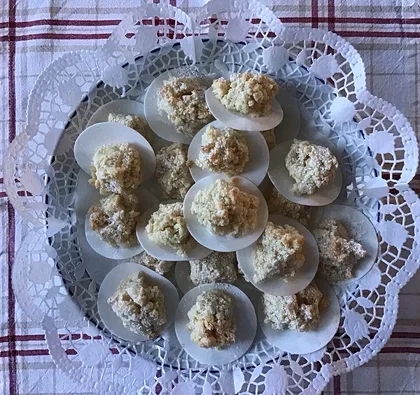
Tuscany's other great almond biscuit, from Siena, and the exact opposite in construction. Ricciarelli are made from almond paste with egg white and no flour to speak of, baked once and briefly, and they come out soft, chewy and crackled under a layer of icing sugar. Cantucci are a flour dough baked twice until they are hard. Same nut, opposite intention.
| This | Ricciarelli | |
|---|---|---|
| Base | Flour dough with whole almonds | Ground almond paste, no flour |
| Bakes | Twice | Once, briefly |
| Texture | Hard and dry | Soft and chewy |
| Shape | Diagonal slices | Oval lozenges |
| Keeps | Weeks | About a week |
| Town | Prato | Siena |
Cantucci substitutes
- Mandelbrot
The closest relative outside Italy: an Ashkenazi twice-baked almond biscuit built on the same logic. It usually contains oil and sometimes baking powder, so it is a little softer and dips faster, so pull it out of the glass after one second, not three.
1:1 - Carquinyolis (Catalan)
Catalonia's version, near-identical in method and almost always butterless. Slightly smaller and often made with toasted almonds, which makes the flavour more forward. The best available swap for the dipping ritual.
1:1 - Supermarket cantuccini with butter
Fine for eating with coffee, unreliable for Vin Santo. If dipping, reduce the time to a single second and expect sediment. In crumbed bases they work better than the originals because the fat is already there.
1:1, minus the melted butter in a crumb base - Almond biscotti, homemade without butter
Trivially easy and better than most shop-bought: 300 g flour, 200 g sugar, 2 eggs, 200 g whole unpeeled almonds, a pinch of salt. Bake the log 20 minutes at 180°C, slice hot, dry the slices 8–10 minutes at 160°C.
Makes about 30 biscuits - Paximadia or dry rusks
For crumb bases only. They bring the dryness but none of the almond or sugar, so add 30 per cent ground almonds and a spoon of sugar to compensate.
100 g rusks plus 30 g ground almonds per 130 g cantucci
Where to buy it
The historic Prato bakery on via Ricasoli ships internationally, and its blue paper bags are recognisable across Italy. Elsewhere, Eataly and specialist Italian grocers carry IGP cantuccini in both countries; in the UK, Waitrose and Ocado stock them year-round and reliably at Christmas.
Read two things on the pack. First, the almond percentage: good producers state it, and it should be at least twenty per cent, ideally thirty. Second, the fat: if butter or vegetable oil appears high in the ingredient list, you have the softer modern style, which is a legitimate biscuit but not the dipping one.
Look for either protected name, Cantuccini Toscani IGP or Biscotti di Prato IGP. Prices run roughly 12 to 22 dollars a pound in the US and 16 to 30 pounds a kilo in the UK, against 14 to 24 euro a kilo in Tuscany and over 30 at the historic Prato bakeries.
Where to eat it in Italy
Prato, twenty minutes by train from Florence and skipped by almost every visitor. The old biscuit shop on via Ricasoli sits near the Duomo, whose outdoor pulpit was designed by Michelozzo with reliefs by Donatello, and the Castello dell'Imperatore built for Frederick II. It is a serious town with a serious textile history and almost no crowds.
In Florence, cantucci and a small glass of Vin Santo arrive at the end of dinner in most traditional trattorie, frequently on the house.
To understand the pairing, go up into Chianti (Greve, Panzano, Radda, Castellina) where many estates will show you the vinsantaia, the loft where the sealed barrels sit for three to five years through the seasons. Seeing the room explains the wine faster than any tasting note.
Siena, an hour south, offers the natural comparison: ricciarelli, the soft almond biscuit, sold in the same shops as panforte.
Further reading
Frequently asked questions
What is the difference between cantucci and cantuccini?
Nothing substantial. Cantuccini is the diminutive and has become the standard commercial name outside Tuscany and abroad; the Tuscan IGP uses it. In Prato itself the biscuits are called biscotti, or biscotti di Prato.
Are cantucci the same as biscotti?
In Italian, biscotti just means biscuits of every kind. Cantucci are one specific twice-baked almond biscuit from Prato. What English speakers call 'biscotti' in a café is a descendant of the cantuccio, usually larger, softer, made with butter and baking powder.
Why are cantucci so hard?
Two bakes and no fat. The second bake drives off the remaining moisture, and with no butter or oil there is nothing to keep the crumb tender. The hardness is the point: it is why they keep for weeks and why they survive being dipped.
How long should you dip a cantuccio in Vin Santo?
Two or three seconds, holding it by the end. The surface should soften while the centre stays crisp. Any longer and it collapses into the glass.
How do you pronounce cantucci?
kahn-TOO-chee, with the stress on the middle syllable and a soft 'ch' sound as in 'cheese'. A single one is a cantuccio, kahn-TOO-cho.
Sources
Where to check what you just read.
- 1
Il regolamento del 19 gennaio 2016: registra come IGP entrambe le forme del nome, «Cantuccini Toscani» e «Cantucci Toscani».
- 2
Le misure che un cantuccio IGP deve rispettare: mandorle intere non pelate, peso non superiore a 15 grammi, lunghezza massima 10 cm e umidità fra il 3 e il 7%.
- 3Consortium · interested partyAssocantuccini — Consorzio di tutela
Le aziende toscane autorizzate a usare la IGP e i dati di produzione ed export dichiarati dal consorzio.
Related foods
 SweetsRicciarelliRicciarelli are Siena's almond biscuits: sweet almond paste, sugar and egg white, shaped into soft ovals…
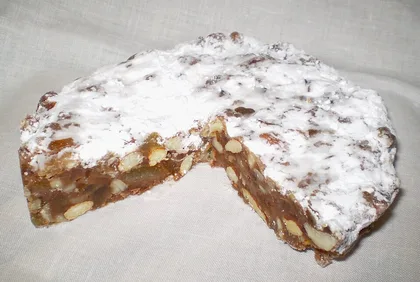 SweetsPanfortePanforte is a dense, chewy Sienese disc of candied fruit, almonds, honey and spices, only 2-3 cm thick and…
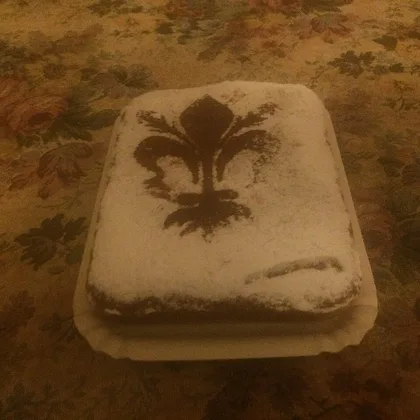 Pasta and breadSchiacciataThe name is the gesture: schiacciare means to squash, which is what the baker's fingertips do to the dough…
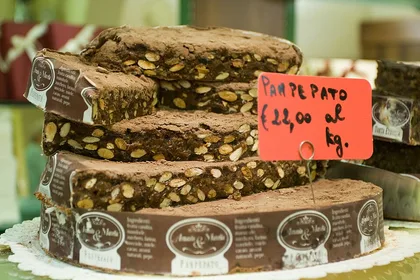 SweetsPanpepatoHoney, whole nuts, candied peel, cocoa and black pepper pressed into a dense disc and cut into thin wedges.
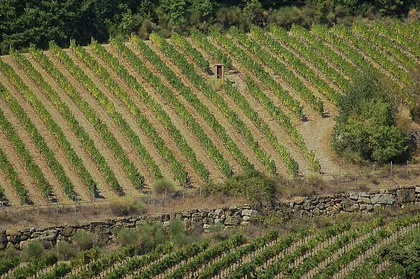 WineChianti ClassicoChianti Classico is the Black Rooster wine: at least 80 per cent Sangiovese from nine communes between…
 WineBrunello di MontalcinoBrunello di Montalcino is pure Sangiovese aged five years, at least two of them in oak, made only in the…
 Pasta and breadPappardelleRibbons of egg pasta two to three centimetres wide, the widest pasta you still eat twirled on a fork.Vegetables and fruitChestnutsFor a thousand years the Apennines made bread from them rather than dessert: Castanea sativa was the tree…