What is Ricciarelli?
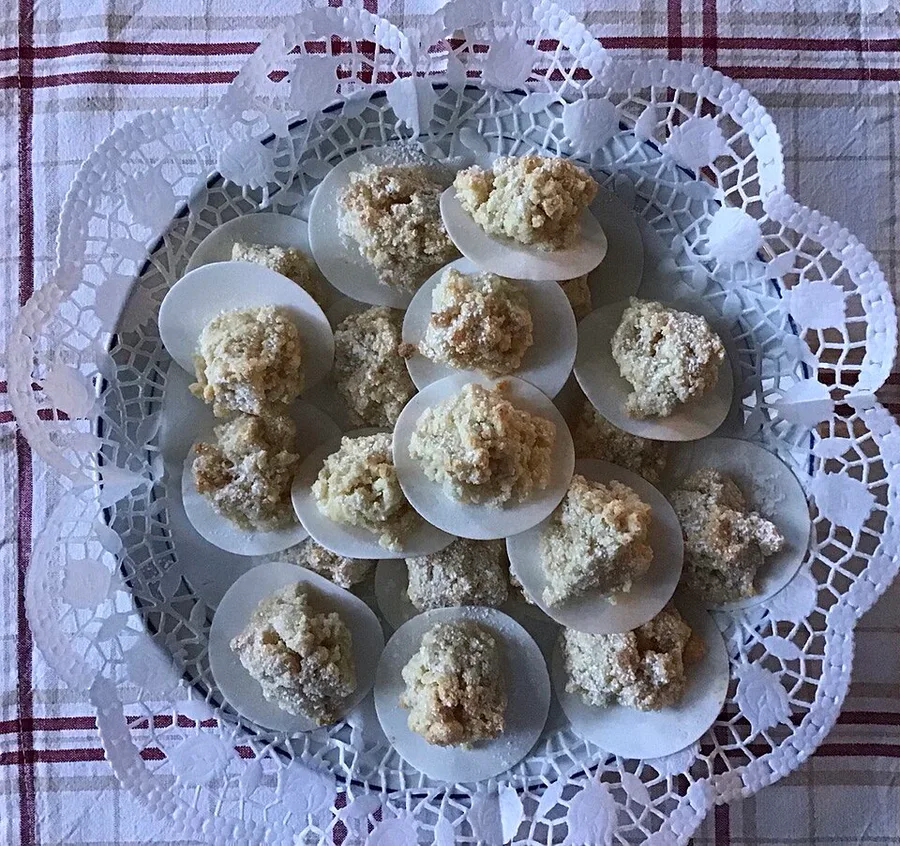
Ricciarelli are almond biscuits made without butter and, in the traditional recipe, without flour. Blanched sweet almonds are ground fine with sugar, bound with whipped egg white, scented with orange zest and vanilla, shaped into blunt-cornered ovals, laid on a sheet of edible wafer paper, coated in icing sugar and baked briefly at low heat.
The defining detail is the surface. The icing sugar dries into a thin crust during a rest before baking, then splits as the biscuit rises, leaving a network of white fissures. Underneath, the paste stays moist and slightly elastic, a texture closer to marzipan than to a cookie.
Since 2010 the name Ricciarelli di Siena has been a Protected Geographical Indication. The rules set a minimum almond content, prescribe the shape and the wafer base, and prohibit added fats. That is why a real one costs more than twice as much as a generic almond biscuit.
What does it taste like?
Intensely almond, sweet but not cloying, with a citrus lift from orange zest and a faint bitter-almond edge in the background. There is no butter and no flour, so nothing dilutes the almond: it is essentially marzipan that has been aerated and baked.
The eating experience runs in two stages. First a thin, sugary crust that shatters, then a dense, damp, faintly chewy centre that clings slightly to the teeth. A well-made one is still soft in the middle a week later.
Compared with a French macaron it is coarser, less sweet and far more almond-forward; compared with an amaretto it is softer, milder and much less bitter.
How to use it
Eat them as they are, at the end of a meal, one or two per person, because they are more filling than their size suggests. December is the traditional season, but Sienese pastry shops make them all year.
They take a short dip in Vin Santo well, but keep it short. Unlike Prato's cantucci, which are engineered for soaking, ricciarelli are already moist and will collapse in about ten seconds.
Crumbled, they make an excellent base for a no-bake cheesecake or the crunch layer in a semifreddo, bringing almond perfume that plain biscuits cannot. Scattered over vanilla ice cream or panna cotta they beat any commercial nut brittle.
Chocolate-dipped versions are common outside Siena. They are pleasant, but the chocolate buries the orange and the almond, so taste the plain ones first.
If they have hardened in the tin, five minutes in a 100 C oven and a full cooling restores most of the softness.
How long it keeps
Almost every producer wraps them one by one in cellophane, and that wrapper is doing real work: it holds in the moisture that keeps the centre chewy. Boxed and unopened they sit in a cool dry cupboard on the producer date, usually three to six months out. Once a wrapper is opened the biscuit starts giving that moisture up to the air, the inside firms within a day or two and the icing sugar on top sets into a crust, so anything unwrapped belongs in an airtight tin rather than on a plate.
A damp kitchen does the opposite and is just as visible: the icing sugar draws in water, turns glassy and translucent and the surface goes sticky. The fridge combines cold and humidity and produces both problems at once. Over several months the almond oil oxidises and the aroma flattens from marzipan towards something duller. They freeze two to three months still wrapped, and thawing them in the wrapper keeps the condensation on the cellophane instead of the sugar.
Spot the real thing
A ricciarello is a plump diamond or elongated oval, five to seven centimetres long and thick enough to dome, buried under a heavy dusting of icing sugar. The surface should be crazed with a fine network of cracks that opens through the sugar as it bakes: a smooth uncracked top usually means a different formula. Inside it is soft and chewy the whole way through, and that is the single clearest test, because the Sienese almond biscuits it gets shelved beside are crisp. The dough is ground almonds, sugar and egg white, with a hint of bitter almond or orange, and traditionally no butter and no flour.
Abroad the usual mix-ups are with amaretti, whether the crisp Saronno kind in twisted paper or the soft Sassello type, with French macarons, and with plain marzipan sweets. Cheaper versions lean on apricot kernel paste or a large share of flour, and they read denser and less aromatic. The protected name is Ricciarelli di Siena IGP. In Siena they run 20 to 30 euro a kilo; abroad a 150 to 200g box is £5 to £9 or $10 to $18.
How to pronounce Ricciarelli
reet-chah-REL-lee
Five sounds, stress on the fourth syllable. The 'cci' is a soft ch, as in 'church', and the double consonants are held slightly. Common mistakes: 'rick-ee-uh-RELL-ee' with a hard k, and 'ri-see-ar-EL-i'. The singular is ricciarello.
Ricciarelli compared
vsAmaretti
Both are Italian almond biscuits and they are routinely confused. The split is sweet almond versus bitter: ricciarelli are made with sweet almonds and stay soft, amaretti include bitter almonds or apricot kernels and are usually baked crisp.
| This | Amaretti | |
|---|---|---|
| Almond | Sweet almonds only | Sweet plus bitter almonds or kernels |
| Texture | Crisp shell, chewy centre | Crisp through, or soft in the Sassello style |
| Shape | Blunt oval or diamond, 7-8 cm | Small dome, 3-4 cm |
| Surface | Icing sugar, cracked | Cracked but bare, sometimes sugar-topped |
| Flavour | Sweet, orange-scented | Marked bitter-almond aroma |
| Home | Siena, Tuscany | Saronno in Lombardy, Sassello in Liguria |
| Used in cooking | Rarely | Often: in pumpkin tortelli, casoncelli, stuffings |
vsMarzipan
Same two core ingredients, different destinations. Marzipan is a raw, mouldable paste with a high sugar-to-almond ratio; ricciarelli are that idea lightened with egg white and baked. Historically they are the same tradition, and in Siena they were once sold under the marzipan name.
| This | Marzipan | |
|---|---|---|
| Egg white | Whipped in, for lift | None, or minimal binder |
| Baked | Yes, 10-15 min at 140-150 C | No, eaten raw |
| Texture | Cracked crust, chewy inside | Uniform, dense, pliable |
| Sugar ratio | Lower relative to almond | Often 1:1 or sugar-dominant |
| Shelf life | 2-3 weeks in a tin | Months, wrapped |
| Eaten as | A biscuit with dessert wine | A confection or a cake covering |
vsPanforte
The other great Siena Christmas sweet, and its natural table companion. Both come from the same medieval spice-trade tradition and are sold in the same shops, but panforte is a dense slab of candied fruit, nuts and spice, and ricciarelli are light by comparison.
| This | Panforte | |
|---|---|---|
| Base | Ground almonds and sugar | Candied fruit, nuts, honey, flour |
| Spice | None, beyond citrus zest | Cinnamon, cloves, nutmeg, pepper |
| Density | Light and porous | Very dense: a slice is enough |
| Form | Individual biscuits | A flat round cake, cut in wedges |
| Wafer base | Yes | Yes |
| Keeps | Weeks | Months |
Ricciarelli substitutes
- Soft amaretti (amaretti morbidi)
The closest widely available biscuit: same chewy almond paste, smaller and with a bitter-almond edge. Sassello and Sardinian versions are the softest. Serve two per person as you would ricciarelli.
2 small amaretti per ricciarello - Pignoli cookies
The Italian-American pine nut cookie is almond paste, sugar and egg white: structurally the same dough with pine nuts on the outside instead of icing sugar. Easy to find in any Italian bakery in the US.
1:1 by piece - French macaron shells, unfilled
Same three ingredients, different technique. Shells alone are sweeter, lighter and glossier, and lack the citrus. A workable stand-in when you need something to serve with dessert wine.
2 shells per ricciarello - Homemade, from almond paste
The fastest route to a genuine result: work 200 g of good almond paste with 60 g of icing sugar and one whipped egg white plus orange zest, shape, coat heavily in icing sugar, rest two hours uncovered, bake at 150 C for twelve minutes.
Makes about 12 - Vegan version with aquafaba
Egg white is the only animal ingredient, and chickpea water whipped to stiff peaks replaces it convincingly. Use three tablespoons of aquafaba per egg white and rest the shaped biscuits a little longer before baking.
3 tbsp aquafaba per egg white - Spanish almond cookies (pastissets, almendrados)
Sold across Spain and Latin America, often at Christmas, and built on the same almond-sugar-egg logic. Drier than ricciarelli but the right flavour and the right role at the end of a meal.
1:1 by piece
Where to buy it
In Siena, buy them loose by weight from a pastry shop rather than pre-boxed: 28 to 42 euro per kilo, which works out at roughly one euro per biscuit, and they will be days rather than weeks old. Gift boxes of 200 to 300 grams cost 8 to 14 euro.
Abroad, Italian delis, Eataly and online importers carry boxed ricciarelli, mostly from October to January. Expect 18 to 32 dollars per pound in the US and 20 to 35 pounds per kilo in the UK.
Read the ingredient list: almonds should be first. Flour, vegetable oil, margarine or glucose syrup near the top means an imitation. Look for the Ricciarelli di Siena IGP mark, which is the quickest single check.
Good blanched sweet almonds cost 12 to 20 euro per kilo wholesale and make up more than a third of the biscuit's weight, so arithmetic rules out anything sold at 9 euro per kilo. Price is a genuine signal here.
Where to eat it in Italy
Siena inside the walls is the place: the historic pasticcerie along Via di Città and Banchi di Sopra sell them loose. Buying four from two or three different shops in an afternoon costs almost nothing and is the fastest way to learn how much they vary.
Around the province (Monteriggioni, Colle di Val d'Elsa, Montalcino, Montepulciano) bakeries make them to the same recipe at slightly lower prices, often alongside their own Vin Santo.
December is the moment. Sienese windows fill with ricciarelli, panforte, cavallucci and copate, and the whole quartet gets served together at the end of Christmas meals, each with a different texture.
Florence and Lucca stock them easily, though usually as packaged Sienese product. The difference between a two-day-old ricciarello and a two-week-old one is obvious, so buy them at source if you can.
Further reading
Frequently asked questions
What are ricciarelli?
Soft almond biscuits from Siena in Tuscany, made from ground sweet almonds, sugar and egg white, with no flour and no butter. They are coated in icing sugar, baked on wafer paper at low heat, and have a cracked crust with a chewy centre. The name has been IGP-protected since 2010.
How do you pronounce ricciarelli?
reet-chah-REL-lee, with the stress on the fourth syllable. The 'cci' is a soft ch as in 'church', never a hard k.
Are ricciarelli gluten free?
The traditional recipe contains no flour, so in principle yes. But some industrial versions add flour or starch, and bakeries that are not dedicated carry a contamination risk. Anyone with coeliac disease should check the label for an explicit declaration.
What is the white paper on the bottom?
Edible wafer paper, called ostia, the same material used under panforte. It stops the sticky paste from welding itself to the tray and is required by the IGP rules. You eat it with the biscuit.
What is the difference between ricciarelli and amaretti?
Ricciarelli use only sweet almonds and stay moist and chewy; amaretti include bitter almonds or apricot kernels and are usually baked crisp with a pronounced bitter aroma. Ricciarelli are Sienese; the best-known amaretti come from Lombardy and Liguria.
Sources
Where to check what you just read.
- 1
L'atto del 18 marzo 2010 che iscrive «Ricciarelli di Siena» fra le IGP: la data esatta del riconoscimento e la classe di prodotto.
- 2
Da qui si scarica il PDF del disciplinare dei Ricciarelli di Siena, con le percentuali obbligatorie di mandorle, zuccheri e albume e la zona di lavorazione.
Related foods
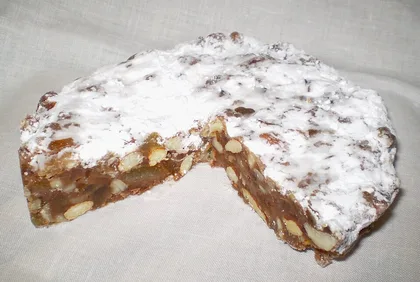 SweetsPanfortePanforte is a dense, chewy Sienese disc of candied fruit, almonds, honey and spices, only 2-3 cm thick and…
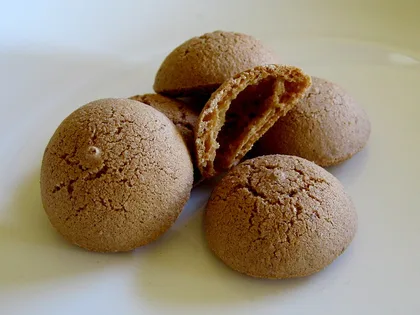 SweetsAmarettiAmaretti are flourless almond cookies whose bitter edge comes from apricot kernels, not almonds.SweetsTorroneHoney and sugar go over a water bath and stay there for hours, sometimes twelve, while someone keeps stirring.
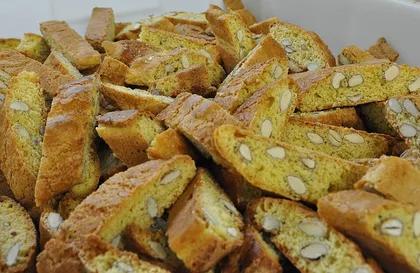 SweetsCantucciCantucci are hard, twice-baked Tuscan almond biscuits. A log of dough is baked, sliced on the diagonal while…
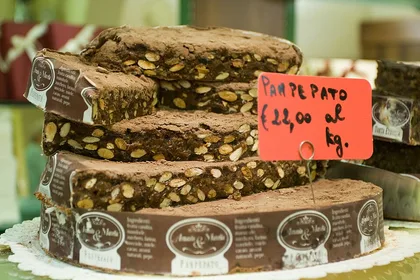 SweetsPanpepatoHoney, whole nuts, candied peel, cocoa and black pepper pressed into a dense disc and cut into thin wedges.
 WineChianti ClassicoChianti Classico is the Black Rooster wine: at least 80 per cent Sangiovese from nine communes between…
 WineBrunello di MontalcinoBrunello di Montalcino is pure Sangiovese aged five years, at least two of them in oak, made only in the…
 Pasta and breadPappardelleRibbons of egg pasta two to three centimetres wide, the widest pasta you still eat twirled on a fork.