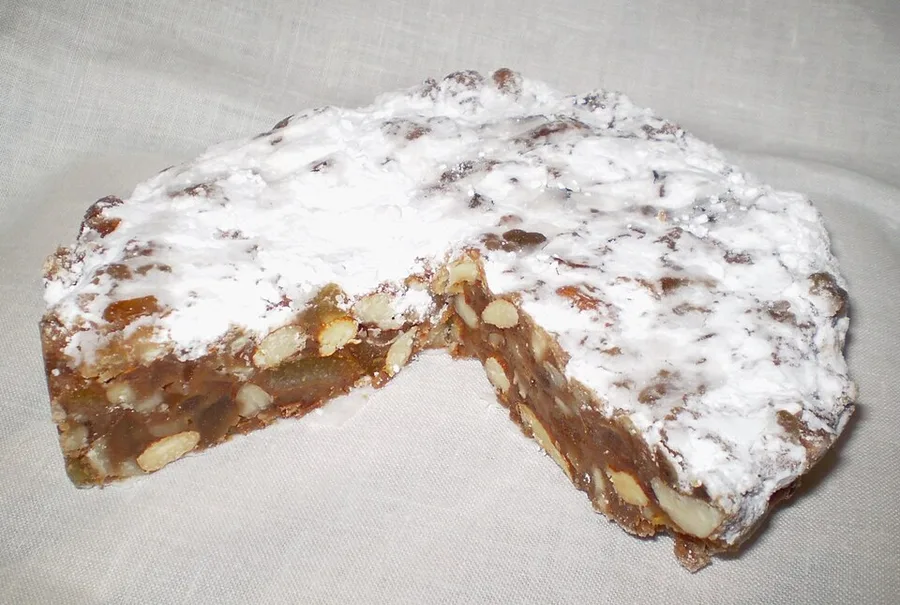
What is Panforte?
Panforte is one of the oldest documented sweets still made in Europe, and one of the hardest to file under a familiar category. It is not a cake, because nothing in it rises. It is not a biscuit, because it never dries out. It is closest in structure to nougat or to a very dense fruit-and-nut bar: candied citrus peel and whole almonds bound by honey and sugar cooked to the soft-ball stage, with just enough flour to hold everything together and a spice blend doing the heavy lifting on flavour.
The finished object is a low disc, 2 to 3 cm high, baked in a ring on a sheet of ostia, the unleavened wafer used for communion hosts and for Italian nougat. The wafer stays attached to the base, appears as a thin white film on every slice, and is meant to be eaten. A standard 250 g disc is about 15 cm across and feels startlingly heavy for its size.
Panforte di Siena was registered as a Protected Geographical Indication by the European Union in 2013, with production limited to the province of Siena. The recipe is medieval in origin: documents from 1205 record honeyed and peppered breads, pani melati and panes pepatos, being handed over as tribute to the nuns of the monastery of Montecelso near Siena. The spices came through the city with the pilgrim traffic of the Via Francigena, and the Sienese apothecaries who controlled them were a powerful guild long before panforte had its modern name.
You will hear that panforte contains seventeen ingredients, one for each of the seventeen contrade of Siena. It is a lovely story and it is a story: no rule in the IGP specification prescribes a symbolic number, and several historical recipes count differently. Treat it as civic folklore rather than as a formula.
What does it taste like?
The first impression is honey rather than sugar: rounder, slightly floral, with the resinous depth that comes from cooking honey rather than simply stirring it in. Then the candied citron and orange arrive, and they are the reason panforte works: real candied peel is faintly bitter and resinous, and it cuts the sweetness rather than adding to it. Cheap panforte skips this and tastes flatly sugary.
The spices come next and they are warm rather than hot: cinnamon and nutmeg forward, cloves and mace behind, coriander giving a citrus lift you notice without identifying. In panpepato the black pepper hits at the end, a real prickle at the back of the throat, and the balance shifts from perfumed to almost savoury.
Texture is the part nobody expects. Panforte is chewy, properly chewy, the way a fresh nougat is, with resistance that makes you slow down, and then the almonds snap through it. It is emphatically not soft, not crumbly and not cakey. A sliver of it lasts a surprisingly long time.
Panforte Margherita, the pale version dusted in icing sugar, is the gentler entry point: less spice, no pepper, more citrus. Panpepato is the one to try second, once you know what the structure is doing.
How to use it
Serve it at room temperature and cut it with a smooth-bladed knife. A serrated blade tears the candied fruit and shreds the edge; a smooth blade warmed under hot water and dried goes through cleanly. Cut from the centre outward into thin wedges, about 5 mm at the widest point. That looks mean and is correct: panforte is dense enough that a sliver is a portion.
Its natural place is the end of a meal, with coffee or a glass of sweet wine, and it needs nothing else alongside. The one variation worth making a habit of is a cheeseboard: a wedge of panpepato next to an aged pecorino, a mature blue or a soft washed-rind cheese does exactly what a fruit paste or mostarda does, with more spice and more texture. This is how it is most often eaten in Siena outside of Christmas.
Do not cook with it. Heat melts the sugar structure and destroys the point. The two exceptions are dicing it small through vanilla or fior di latte gelato, and toasting crumbs of it briefly in a dry pan to scatter over panna cotta or fresh ricotta.
It also happens to be one of the best edible things to travel with: it survives a suitcase, a warm climate and weeks in a cupboard without changing. That durability is not a modern convenience, it is the reason the sweet exists.
How long it keeps
Panforte was built to keep and it keeps. Whole and sealed it holds six months or more at room temperature, and industrial packs often carry a date a year out; the only care it needs is distance from direct heat and from damp. Once opened, wrap it tight in baking paper and then foil, or put it in a tin, and reckon on three or four weeks. The cut face is the weak point: exposed to air it dries and hardens, so press the paper against it.
The fridge is the common mistake. Cold sets the cooked sugar hard enough to make the disc difficult to cut, and the damp in a fridge makes the sugared surface tacky. If it has been in the cold, leave it an hour at room temperature before the knife goes in. A disc that has hardened softens with ten seconds in a warm oven or a hot knife. If the surface turns damp and sticky instead, that is humidity in the cupboard: dust it with fresh icing sugar and move it to an airtight box. The freezer does nothing for it.
Spot the real thing
Judge the slice, not the box. In a good panforte the candied pieces and the almonds are individually visible: cubes of citron and orange with the peel still readable, almonds whole or in halves. A section that is uniformly brownish, with indistinct specks drowned in a compact mass, means offcut candied fruit and very few nuts; in the best versions almonds approach a fifth of the weight. Weight is the second check: a 250 g disc should feel heavier than its size suggests, since a light one is full of air and flour.
The label is the third. Real ingredients are named one by one, candied citron, candied orange, almonds, honey, cinnamon, nutmeg, and they sit at the top of the list. Read carefully when glucose syrup comes before honey, when spices turn into generic flavourings, or when vegetable fats appear. Panforte di Siena IGP carries the geographical indication and the European mark on the pack. Underneath there should be a wafer base, white, thin and stuck fast. Panpepato, its darker cousin with pepper and cocoa, and British Christmas cake are different sweets that often sit on the same shelf.
How to pronounce Panforte
pahn-FOR-teh
Three syllables, stress on the second. The final 'e' is pronounced as a short, clear 'eh': it is never silent and never a diphthong. The two mistakes English speakers reliably make are 'pan-FORT', which swallows the ending, and 'PAN-fort-ay', which moves the stress and turns the vowel into an English long 'a'. The name means strong bread: forte refers to the aggressive spicing and to the black pepper of its ancestor panpepato, though some sources connect it instead to bread that had turned sour, and so gone strong.
Panforte compared
vsGingerbread
The comparison English speakers reach for first, and it is misleading in almost every respect. Gingerbread is a leavened, baked dough enriched with butter, eggs and molasses, dominated by ginger, and eaten either soft and cakey or crisp as a biscuit. Panforte has no leavening, no eggs, no butter and no dominant ginger: it is fruit and nuts compacted into a honey-sugar matrix, chewy rather than crumbly, and cut in slivers rather than squares.
| This | Gingerbread | |
|---|---|---|
| Structure | Unleavened, compacted disc 2-3 cm high | Leavened dough, risen and baked |
| Fat | None added: only what the almonds carry | Butter or shortening, often generous |
| Eggs | None | Usually present |
| Sweetener | Honey and sugar cooked to soft-ball stage | Molasses, treacle or golden syrup |
| Dominant spice | Cinnamon, nutmeg, cloves, mace; pepper in panpepato | Ginger, with cinnamon behind it |
| Bulk ingredients | Candied citron and orange, whole almonds | Flour |
| Texture | Dense, chewy, crunchy from almonds | Soft and cakey, or crisp and snapping |
| Served | Slivers 5 mm thick, at the end of a meal | Squares, slices, or cut-out biscuits |
vsPanforte Margherita vs Panpepato
Two versions of the same sweet, separated by about seven centuries and one royal visit. Panpepato is the medieval ancestor: dark, heavily spiced, sharpened with black pepper and sometimes cocoa. Panforte Margherita was created in 1879 for the visit of Queen Margherita of Savoy to Siena: paler, dusted with icing sugar, with the pepper removed and the spicing softened. If you are buying panforte abroad, you are almost certainly buying a Margherita.
| This | Panforte Margherita vs Panpepato | |
|---|---|---|
| Age | Created 1879 | Medieval, documented from 1205 as panes pepatos |
| Colour | Pale gold, dusted with icing sugar | Dark brown, sometimes near black |
| Black pepper | None | Central to the flavour |
| Cocoa | Never | In some producers' recipes |
| Spice level | Gentle: cinnamon, nutmeg, coriander | Assertive: cloves, mace, pepper |
| Candied fruit | Citron and orange forward | Same base, buried under spice |
| Best with | Vin Santo, Moscadello di Montalcino | Aged passito, aged rum, strong cheese |
| Start here if | It is your first panforte | You already know you like the pale one |
vsBritish and American Christmas fruitcake
Both are dense, both are spiced, both keep for months, and there the similarity stops. Fruitcake is a leavened, egg-and-butter batter loaded with dried fruit and fed with brandy or rum, which is what preserves it. Panforte contains no alcohol, no butter, no eggs and no raisins or currants, and it keeps for months purely because of the sugar and honey concentration.
| This | British and American Christmas fruitcake | |
|---|---|---|
| Alcohol | None, at any stage | Brandy or rum, often repeatedly fed |
| Fruit | Candied citron, orange, sometimes melon | Raisins, currants, sultanas, glace cherries |
| Fat and eggs | Neither | Butter and eggs, in quantity |
| Leavening | None | Baking powder or creamed butter |
| Keeping | Months, on sugar concentration alone | Months to years, on alcohol |
| Shape | Flat disc, 2-3 cm high | Deep loaf or round, often iced |
| Portion | A 5 mm sliver | A proper slice |
Panforte substitutes
- Panpepato
Not so much a substitute as the other half of the same tradition, and widely available wherever panforte is sold. Darker, peppery, sometimes with cocoa. Use it anywhere you would use panforte, but expect it to dominate a cheeseboard rather than sit alongside the cheese.
1:1 - Pan di fichi (Calabrian or Apulian fig cake)
The closest Italian relative in structure: dried figs, almonds and spices pressed into a dense block that keeps for months. Sweeter and figgier, with none of the candied-citrus bitterness, but it slices and serves the same way and pairs with the same wines and cheeses.
1:1, cut slightly thinner - Homemade honey, nut and dried fruit cake
Genuinely achievable and closer than any shop-bought stand-in. Cook 200 g honey with 200 g sugar to about 118 C, stir in 250 g toasted almonds, 250 g diced candied peel, 90 g flour and a heaped teaspoon of mixed cinnamon, nutmeg, cloves and coriander. Press into a lined 20 cm ring 2-3 cm deep and bake at 150 C for 30-35 minutes. Use rice paper if you cannot find ostia wafer.
Makes about 900 g - German Lebkuchen (Elisenlebkuchen)
The nearest northern-European equivalent, and the best supermarket substitute in the UK and US at Christmas. High nut content, similar spice profile, though it is softer, usually contains egg white and is often chocolate-coated. Buy the Elisen grade, which carries the most nuts and the least flour.
1:1 by weight - Spanish turron duro (Alicante)
Shares the honey-and-almond core and the ostia wafer base, so it looks and cuts remarkably similarly. What it lacks entirely is the candied fruit and the spice, so it reads as sweeter and simpler. Good for the texture, wrong for the flavour.
1:1 - Vegan version
Traditional panforte is already free of eggs, milk and butter, which is unusual for a Christmas sweet, but it is not vegan, because the honey is structural rather than incidental. Replace it with maple syrup or agave syrup at the same weight, cooking the syrup with the sugar to the same soft-ball temperature. Agave gives a cleaner, more neutral result; maple adds its own flavour, which suits the spices. It is still not gluten-free: the flour is doing real work and cannot simply be removed.
1:1 by weight for the honey
Where to buy it
In the US, Italian importers and specialists such as Eataly, Gustiamo and Market Hall Foods carry it year-round, and it turns up in Whole Foods and gourmet grocers from November onward. Expect roughly $13-20 for a 8 oz (227 g) disc of a good imported panforte, which works out to about $26-40 per pound; supermarket versions of the Margherita run closer to $9-12.
In the UK, Italian delicatessens and online shops such as Sous Chef and Natoora stock it, and Waitrose and Ocado carry it seasonally. A 250 g disc costs about £8-14, so £32-48 per kilo, with mass-market Margherita nearer £5-7.
Read the label the way you would read one in Siena. The Panforte di Siena IGP mark tells you the province of origin. The ingredient list should name candied citron and candied orange peel, almonds and honey near the top; glucose syrup ahead of honey, generic 'flavourings' instead of named spices, and vegetable fat of any kind are all signs of a cheaper product. Look at the cut face through the wrapper if you can: distinct, identifiable pieces of fruit and nut are what you are paying for.
One practical note for gift-buying: panforte ships well and needs no refrigeration, which makes it the easiest Italian sweet to send internationally. It is also naturally free of eggs and dairy, which solves a surprising number of dietary problems at a Christmas table, though never gluten, and never vegan, because of the honey.
Where to eat it in Italy
Siena is the whole answer. In the historic centre, the axis of Via Banchi di Sopra and Via di Città, running from the Duomo down to the shell-shaped Piazza del Campo, is lined with the pasticcerie and old grocers that sell panforte cut from a whole disc, and most will let you taste before you buy. The city's historic producers, Sapori, Nannini, Fiore and Parenti among them, span everything from small-batch to export-scale.
The month before Christmas is the peak, when production is highest and the discs in the windows are freshly made. But panforte is sold in Siena all year, and finding it in a July window is normal rather than suspicious.
Siena is an easy day trip from Florence: a little over an hour by the fast coach, and the more comfortable option than the train, which requires a change. Build the day out with Montalcino for Moscadello and Brunello, Montepulciano, or San Gimignano, with the Crete Senesi in between.
Time your visit carefully around the Palio, run on 2 July and 16 August. The horse race in the Campo is extraordinary and the city is unmanageable for anything else on those two days, including buying a disc of panforte in peace. Buy it the day before.
Further reading
Frequently asked questions
How long does panforte keep?
Whole and sealed, six months or more at room temperature, and commercial packs often declare a full year. Once cut, wrap it tightly in baking paper and foil or keep it in a tin, and eat it within three or four weeks. Keep it out of the fridge, which hardens the sugar and makes the surface sticky.
Is panforte gluten-free or vegan?
Neither. It contains wheat flour, so it is not suitable for coeliacs, and it contains honey, which rules it out of a vegan diet. It is, however, naturally free of eggs, butter and milk, which makes it one of the few traditional Italian Christmas sweets that works for lactose intolerance or an egg allergy. It always contains almonds.
What is the difference between panforte and panpepato?
Panpepato is the older, darker version, made with black pepper, a much heavier spice load and sometimes cocoa. Panforte Margherita is the pale 1879 version created for the visit of Queen Margherita of Savoy to Siena: no pepper, gentler spicing, dusted with icing sugar. Same technique and structure, very different intensity.
How do you cut and serve panforte?
At room temperature, with a smooth-bladed knife rather than a serrated one, in thin wedges of about 5 mm cut from the centre outward. Warming the blade under hot water helps with a very dense disc. The thin white wafer on the base is edible and stays on.
Does panforte really have seventeen ingredients, one per contrada?
No, that is civic folklore, not a rule. The IGP specification sets no symbolic ingredient count, and historical recipes vary. The story is genuinely Sienese and worth knowing, but it should not be repeated as fact about how the sweet is made.
Sources
Where to check what you just read.
- 1
Il regolamento del 7 maggio 2013 che registra «Panforte di Siena» come IGP: la protezione è recente, il dolce no.
- 2
La distinzione fra versione bianca (copertura di zucchero a velo) e versione nera (copertura di spezie), con dimensioni, pesi ammessi e composizione dell'impasto.
Related foods
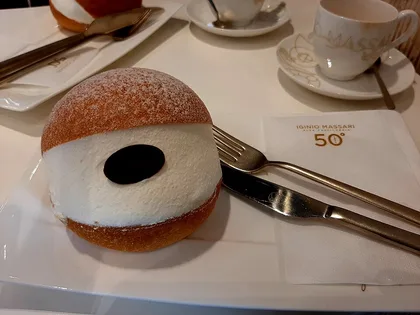 SweetsMaritozzoIn Rome this is breakfast at seven in the morning and nobody finds it odd: a soft, lightly sweet bun split…
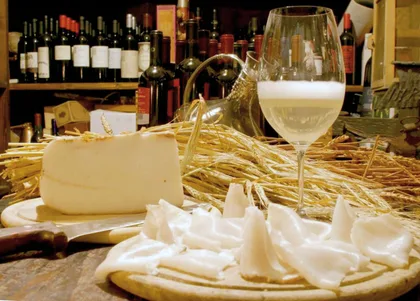 Cured meatsLardo di ColonnataLardo di Colonnata IGP is cured pork back fat, aged at least six months inside vats carved from Carrara…
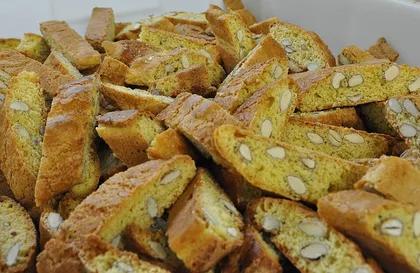 SweetsCantucciCantucci are hard, twice-baked Tuscan almond biscuits. A log of dough is baked, sliced on the diagonal while…
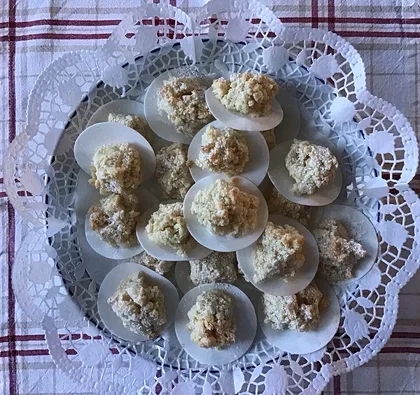 SweetsRicciarelliRicciarelli are Siena's almond biscuits: sweet almond paste, sugar and egg white, shaped into soft ovals…
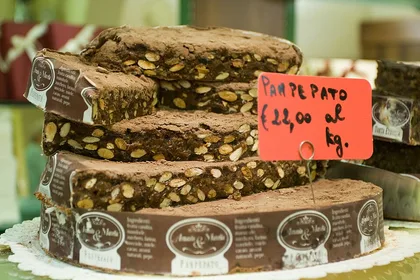 SweetsPanpepatoHoney, whole nuts, candied peel, cocoa and black pepper pressed into a dense disc and cut into thin wedges.
 WineChianti ClassicoChianti Classico is the Black Rooster wine: at least 80 per cent Sangiovese from nine communes between…
 WineBrunello di MontalcinoBrunello di Montalcino is pure Sangiovese aged five years, at least two of them in oak, made only in the…