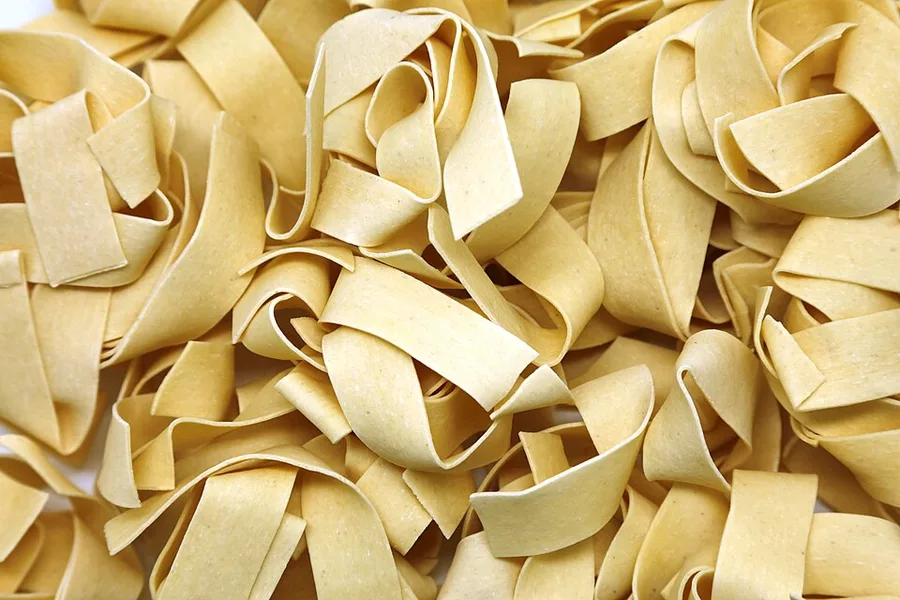
What is Pappardelle?
Pappardelle are egg pasta cut into ribbons 20 to 30mm wide and 0.8 to 1mm thick. They have the highest surface-to-weight ratio of any long pasta in Italian cooking, and that single fact explains everything about how they are used.
A wide ribbon works by draping, not by clinging. Where a spaghetto needs a sauce that forms a film, and a ridged tube needs a sauce that parks in its grooves, a pappardella physically wraps the piece of meat: the ribbon folds around a chunk of boar or a thick slice of porcini and holds it by contact. It is the only Italian shape that carries a coarsely chunky ragù without the sauce sliding off and pooling.
The trade-off is that pappardelle need fat. Two broad faces of egg pasta pressed together with nothing between them weld into a single mass, which is why a lean or watery sauce produces a compacted, unpleasant plate. The Tuscan ragùs served with them (boar, hare, duck, rabbit) are all long-simmered sauces full of dissolved collagen and suspended fat. That is not a coincidence of tradition. It is a mechanical requirement.
The name comes from pappare, to eat with relish, and appears in Tuscan writing as early as the sixteenth century. It is festival food from a farming kitchen: eggs, flour, and whatever game there was.
What does it taste like?
Rich, eggy and substantial. Because the ribbon is thicker than tagliatelle, you get a real chew, and because it is wide you get a mouthful of pasta and sauce in the same bite rather than a strand carrying a coating. The egg comes through clearly: good pappardelle taste faintly of custard before the sauce takes over.
Hand-rolled sfoglia has a matte, slightly rough surface, and Tuscan and Emilian cooks hold that it takes the sauce better than smoother machine-laminated sheets.
The wavy edge you often see is not only decorative. Cut with a fluted wheel, it adds surface and helps stop the ribbons welding to each other, which is a real problem with a shape this wide.
How to use it
Fresh pappardelle cook in two to four minutes, dried egg nests in five to eight. Use plenty of salted water and drop the nests in whole: they open by themselves within thirty seconds.
Do not tip them into a colander. Lift the ribbons out with tongs or a carving fork straight into the pan of sauce, carrying a little cooking water with them.
The pan stage is short but essential: thirty to forty seconds over a lively flame, moving the pan, with a ladle of pasta water to melt the ragù's fat and emulsify it. That film of emulsified fat is what keeps the ribbons from welding together, which on a shape this wide is the difference between a plate of pasta and a single mass.
Use long-simmered, fatty, chunky meat sauces. Wild boar cooked two or three hours with red wine, juniper and bay. Hare, which is the oldest version. The Aretine duck ragù. Rabbit, lamb, oxtail. In autumn, thick-sliced porcini in butter and garlic, which work better on a wide ribbon than on any other shape.
What fails is anything thin, lean or finely chopped: clams, aglio e olio, fresh tomato. There is nothing for the ribbon to wrap, the plate stays dry and the pasta sticks to itself.
How long it keeps
Dried egg nests in a sealed box keep to the best before date printed on the pack, usually one to two years out, stored in a dry cupboard away from heat and light. Once the box is open, move what is left into an airtight jar: the ribbons are hygroscopic and pull moisture out of a humid kitchen, which softens them and makes them fray in the water. Fresh refrigerated pappardelle are a different animal, sold with a short date and kept cold in the sealed pack, with a matter of days once opened.
Egg pasta changes in ways plain semolina does not. The fat in the yolk oxidises slowly, so a very old box smells faintly of cardboard, and the yellow fades towards beige. Nests left loose become brittle and shatter into fragments when handled. Fresh sheets and ribbons are best frozen rather than refrigerated for long: dust them with semolina, coil them into loose nests, freeze on a tray until firm, then bag them, and cook from frozen with an extra minute. They hold two to three months that way. The date on the pack is the reference.
Spot the real thing
Width is the first check: pappardelle run two to three centimetres, roughly an inch, which is visibly wider than tagliatelle at six to eight millimetres and wider than fettuccine. Anything narrower on a pack labelled pappardelle is mislabelled. In Tuscany one long edge is often fluted rather than straight, cut with a fluted wheel; both versions are traditional. The surface tells you about the die: a rough, chalky, matte finish means bronze extrusion, while a smooth glassy ribbon has come off a teflon die.
Then read the ingredients. Real egg pasta lists soft wheat flour or durum semolina plus eggs, and the Italian benchmark is 200 grams of egg per kilo of flour, about four eggs. Colour is not proof: a deep orange ribbon can come from many yolks or from added carotene, so check whether the list ends at flour and eggs. Fresh refrigerated packs, dried nests and artisanal dried boxes are all legitimate, but priced differently. In the US, supermarket nests run $3 to $5 for 250 grams while bronze die Tuscan brands sit at $8 to $14.
How to pronounce Pappardelle
pahp-pahr-DEL-leh
Four syllables, stress on the third. Both double consonants are genuinely held: 'pahp-pah', not 'pa-pa', and 'DEL-leh' with a lingering l. The final 'e' is pronounced as a short 'eh', never silent and never 'ay'. It is already plural: one ribbon is a pappardella.
Pappardelle compared
vsTagliatelle
The same idea at a quarter of the width, and the width decides the sauce. Bologna takes tagliatelle seriously enough that the Accademia Italiana della Cucina deposited an official width with the Chamber of Commerce in 1972: 7mm cooked, about 8mm raw. At that size the ribbon clings to a finely minced sauce: the classic ragù alla bolognese is chopped small precisely so it can sit on a narrow ribbon. Put that same minced ragù on pappardelle and it falls off, because there is nothing for the wide ribbon to wrap around. Put a chunky boar ragù on tagliatelle and the ribbons tear.
| This | Tagliatelle | |
|---|---|---|
| Width | 20-30mm | 7-8mm |
| Thickness | 0.8-1mm | 0.6-0.8mm |
| Region | Tuscany | Emilia-Romagna |
| Sauce logic | Wraps around chunks | Clings to fine mince |
| Classic dish | Boar, hare or duck ragù | Ragù alla bolognese |
| Cook time (fresh) | 2-4 minutes | 2-3 minutes |
vsFettuccine
The Roman ribbon, and narrower than most people outside Italy assume: 5 to 7mm, against the 20 to 30mm of pappardelle. What distinguishes fettuccine from tagliatelle is not really width but thickness: Roman dough is rolled heavier, around 1mm, which gives a sturdier, chewier ribbon built for butter-and-cheese emulsions rather than for meat. Fettuccine Alfredo, in its original Roman form, is nothing but pasta, butter and Parmigiano, and it needs a ribbon thick enough to survive the vigorous tossing that emulsifies it. Pappardelle would tear.
| This | Fettuccine | |
|---|---|---|
| Width | 20-30mm | 5-7mm |
| Thickness | 0.8-1mm | About 1mm, the sturdiest of the three |
| Region | Tuscany | Lazio and Rome |
| Best sauce | Chunky game and mushroom ragù | Butter emulsions, cream, chicken livers |
| Tolerates hard tossing | No, tears | Yes, built for it |
vsDried egg pappardelle (nests)
Dried nests are not a compromise; they are a different tool with an advantage. Italian law requires dried egg pasta to contain at least four eggs per kilo of semolina, and good producers use seven or eight. Because dried pappardelle are made with durum semolina rather than soft wheat, they have more backbone and survive a two-hour boar ragù without softening into shreds, something fresh pasta struggles with. Fresh is more tender and absorbs more sauce, which suits very fatty ragù. Choose by sauce, not by prestige.
| This | Dried egg pappardelle (nests) | |
|---|---|---|
| Flour | Fresh: soft wheat, sometimes part semolina | Dried: durum semolina |
| Eggs | Fresh: 1 egg per 100g flour | Dried: 4 per kilo by law, 7-8 in good brands |
| Cook time | 2-4 minutes | 5-8 minutes |
| Holds up in heavy ragù | Softens faster | Keeps its structure |
| Portion | 120-150g per person | 80-100g per person |
Pappardelle substitutes
- Tagliatelle
The most available stand-in, at roughly a quarter of the width. Chop the sauce finer than you would for pappardelle, because a chunky ragù will slide off narrow ribbons. Same cook time fresh, a minute less dried.
1:1 - Mafaldine or reginette
Dried semolina ribbons about 12-15mm wide with ruffled edges. The ruffles catch fat well and they are sturdier than egg pasta, so they take a long-simmered ragù comfortably. Cook 8-10 minutes.
1:1 - Fresh lasagne sheets, cut by hand
The best emergency substitute and effectively the same product. Buy fresh sheets, stack them lightly floured and cut into 2.5cm ribbons with a knife. They cook in two to three minutes.
1:1 by weight - Maltagliati
Irregular offcuts of egg pasta, traditional in Emilia. Different geometry, with no ribbon to wrap, but the same dough, and they suit bean and mushroom sauces well. Not a good match for a chunky game ragù.
1:1 - Gluten-free tagliatelle or fettuccine
Wide gluten-free ribbons are fragile, since the dough has no gluten network to stretch, so pappardelle-width versions are rare. Jovial and Rummo make workable narrower egg-style ribbons. Cook a minute short, sauce them off the heat, and use a fatty sauce, which helps prevent sticking.
1:1
Where to buy it
In the US, dried egg pappardelle from De Cecco, Delverde and Rustichella d'Abruzzo run $5 to $9 a pound in supermarkets and Italian groceries; artisan nests from Cipriani, Morelli and Martelli go for $10 to $18 a pound at Eataly, Gustiamo and Market Hall Foods. Fresh pappardelle from a pasta counter costs $8 to $16 a pound.
In the UK, Waitrose and Ocado stock dried egg pappardelle at £8 to £14 per kilo, and Natoora, Vorrei and Italian delis sell artisan nests and fresh ribbons at £16 to £30 per kilo.
In Italy, fresh pappardelle from a pastificio cost €8 to €16 per kilo, supermarket dried egg pasta €4 to €7, and artisan dried nests €8 to €16.
On dried pasta, look for the number of eggs per kilo on the label, where four is the legal minimum and seven or eight signals a serious product, and for durum semolina as the base. Check the nests through the window: cracks along the outer folds mean the pasta was dried too fast and will break apart in the pot.
Where to eat it in Italy
In Chianti and the Maremma, where the autumn wild boar festivals between October and November are still the best place to eat them. Village associations in Cinigiano, Roccastrada, Greve and Panzano roll them by hand in industrial quantities and serve them at canteen prices.
In Arezzo and the Valdichiana for pappardelle sulla nana, the muscovy duck version, which is almost impossible to find outside the province and remains the Sunday dish in village trattorie.
In the Casentino, the inland valley above Arezzo, hare ragù is still the most traditional version and the hunting season dictates the menus.
At San Miniato, between Florence and Pisa, during the November white truffle fair, pappardelle become the vehicle for the local truffle: butter, almost nothing else, and shavings in quantity.
Frequently asked questions
How wide are pappardelle?
Between 20 and 30mm. For comparison, Bolognese tagliatelle are 7 to 8mm and Roman fettuccine 5 to 7mm but thicker. The width is what lets the ribbon wrap around the chunks in a game ragù.
Why do my pappardelle stick together?
Because two broad faces of egg pasta weld unless there is fat between them. You need a sauce with body and a proper pan finish with pasta water, which emulsifies the fat into a film that keeps the ribbons apart. A lean sauce will not work on this shape.
What sauce goes with pappardelle?
Long-simmered chunky meat sauces: wild boar, hare, duck, rabbit, lamb, or thick-sliced porcini. Thin or finely minced sauces do not suit them: there is nothing for the ribbon to wrap around, and a minced ragù simply falls off.
How do you pronounce pappardelle?
pahp-pahr-DEL-leh, stress on the third syllable, with both double consonants genuinely held and the final 'e' pronounced as a short 'eh'. One ribbon is a pappardella.
Related foods
 Vegetables and fruitWhite truffleThe Italian white truffle, Tuber magnatum Pico, is the most expensive of Italy's truffles: in 2025 the Alba…
 Pasta and breadPiciPici are fat, hand-rolled spaghetti from southern Tuscany, made from nothing but flour and water.
 Pasta and breadTajarinTajarin are the Piedmontese answer to tagliolini: hand-cut egg noodles barely a millimetre and a half wide…
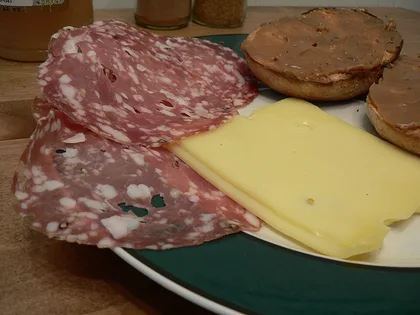 Cured meatsFinocchionaFinocchiona is Tuscany's fennel salami: coarsely ground pork seasoned with wild fennel seeds and flowers…
 Pasta and breadSchiacciataThe name is the gesture: schiacciare means to squash, which is what the baker's fingertips do to the dough…
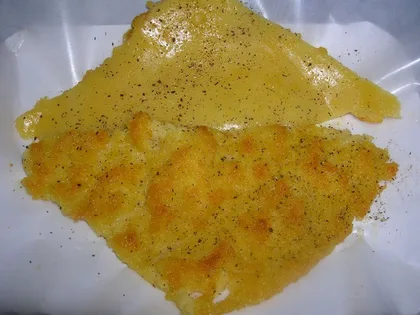 Pasta and breadTorta di Ceci (Cecina)Chickpea flour, water, olive oil and salt, baked in a wide copper pan in a fierce wood oven.
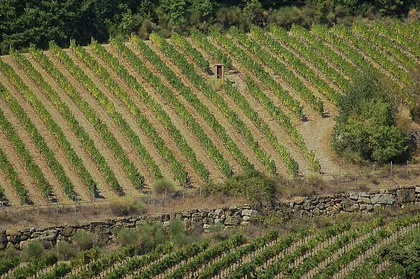 WineChianti ClassicoChianti Classico is the Black Rooster wine: at least 80 per cent Sangiovese from nine communes between…
 WineBrunello di MontalcinoBrunello di Montalcino is pure Sangiovese aged five years, at least two of them in oak, made only in the…