What is Torcolo di San Costanzo?
The torcolo di San Costanzo is a ring of yeasted dough about six or seven centimetres tall and twenty across, golden outside and dry inside. Candied citron, raisins, pine nuts and whole anise seeds go into it, and nothing else that would distract from those four.
It is not a sweet cake. There is sugar, but it sits behind the aniseed, which is the first thing you taste and the last thing to leave, and behind the citron, which brings the acidity. Anyone expecting the richness of a panettone finds it lean; the people who love it love it for exactly that.
Five cuts are scored across the top. They are neither decorative nor merely technical: they stand for the five historic districts of Perugia (Porta Sole, Porta Sant'Angelo, Porta San Pietro, Porta Eburnea and Porta Santa Susanna) and to a Perugian, a torcolo with any other number of cuts is simply wrong.
The name is traced either to the Latin torquis, a neck-ring, or to the act of twisting the dough into a circle. The ring shape reads as a crown, and local tradition links it to the floral offerings once brought to the saint.
It is a city cake in the strictest sense. A few kilometres outside Perugia it disappears, and in Umbria you either buy a torcolo in Perugia or you do not buy one.
What does it taste like?
Aniseed first, and more of it than most people expect from an Italian cake: not the sugary anise of liquorice sweets but the drier, greener flavour of whole seeds you occasionally bite into. It arrives immediately and lingers.
Behind it: the floral sharpness of candied citron, sweet bursts from the raisins, and the soft resinous richness of pine nuts. There is no vanilla, no butter perfume and no citrus zest, which is what keeps it so distinct from the northern Italian festive breads.
The crumb is close, pale and noticeably dry, closer to a lean brioche or a Jewish challah than to panettone. It is not a fault and it is not staleness: the recipe is built with little fat and little sugar, and moisture was never the aim.
Sweetness is low throughout. A slice with black coffee tastes almost like breakfast bread, and that is how most of Perugia eats it.
How to use it
Slice it around the ring and eat it at breakfast or in the afternoon. In Perugia it is above all a dunking cake: in milk in the morning, in vin santo in the evening.
It is dry by design, and that is worth using. Day-old slices toast beautifully, a minute a side in a dry pan or straight into a toaster, and go well with bitter orange marmalade or fresh ricotta.
After dinner, serve it in thin slices with a glass of sweet wine. It needs no cream and no custard; its role is to clear the palate rather than add to the meal.
A less obvious but sensible use: stale torcolo makes an excellent base for a trifle or a spoon dessert, because it absorbs liquid without disintegrating the way sponge does.
Do not refrigerate it, and do not reheat the whole ring in the oven, because a second bake dries the crumb further and scorches the pine nuts on the surface.
How long it keeps
A lean, dry, yeast raised cake keeps far better than a buttery one, and torcolo is built for it. Left whole and wrapped in a cloth or a paper bag on the counter, or in a tin, it holds a week to ten days at room temperature. A cut ring goes faster, so lay a piece of foil or paper against the cut face. Never the fridge: cold accelerates staling, and a day in there does more to the crumb than three on the counter.
What happens is simple drying, and Perugians treat it as part of the plan. The crumb firms and becomes more crumbly, the aniseed and candied citron come forward as the bread notes recede, and by day three or four the slices are made for dunking in milk or vin santo, or for toasting. The pine nuts on top are what changes first, since nut oils oxidise and the flavour flattens. A whole ring freezes well wrapped tight, or sliced for taking out a piece at a time, and holds two to three months.
Spot the real thing
It is a ring, twenty to twenty five centimetres across and low, with a modest hole in the middle, and the surface carries five diagonal cuts, one for each of the five medieval gates of Perugia. Those cuts are the signature. The crust is matte and pale gold rather than glossy, studded with pine nuts and showing pieces of candied citron and raisin through it. Break a slice and the crumb is tight, dry and slightly crumbly, not soft or springy, and it smells of aniseed.
It is easy to mistake for a ciambellone, the soft Italian breakfast sponge ring, and the difference is fundamental: torcolo is yeast leavened and lean, made with lard or oil rather than butter and eggs, so it is dry on purpose. Read the ingredients for aniseed, pine nuts, candied citron and sultanas; a version without all four is a ciambella wearing the name. Panettone, which people also reach for as a comparison, is a different world of butter and eggs. In Perugia it appears around 29 January, the feast of San Costanzo, and rings run 12 to 20 euro.
How to pronounce Torcolo di San Costanzo
TOR-koh-loh dee sahn koh-STAHN-tsoh
Torcolo takes the stress on the first syllable, which trips up most non-Italians: TOR-koh-loh, not 'tor-KOH-lo'. In Costanzo the 'z' is a hard 'ts' sound, as in 'cats': koh-STAHN-tsoh. The plural is torcoli, TOR-koh-lee.
Torcolo di San Costanzo compared
vsCiambellone
The generic Italian ring cake, and the thing a torcolo gets mistaken for at a glance. Ciambellone is a household sponge: eggs, sugar, flour, oil or butter and baking powder, whipped and poured into a ring tin, soft, sweet and often flavoured with lemon zest. The torcolo is a yeasted dough left to rise twice, far less sweet, drier, and defined by aniseed, citron and pine nuts rather than by citrus zest. One is a fast cake anyone can make on a weekday; the other is a bakery product tied to a specific saint's day.
| This | Ciambellone | |
|---|---|---|
| Leavening | Baker's yeast or sourdough, two risings | Baking powder, no rising time |
| Eggs | Few or none | Central to the structure |
| Sweetness | Low | High |
| Flavouring | Aniseed, candied citron | Lemon zest, vanilla |
| Inclusions | Raisins, pine nuts, citron | Usually none, sometimes chocolate chips |
| Texture | Dry, close crumb, bread-like | Soft, open, cake-like |
| Occasion | 29 January, feast of San Costanzo | Any weekday breakfast |
vsPanettone
The comparison to make if you want to understand what the torcolo is not. Both are yeasted, both carry dried and candied fruit, and a low torcolo looks vaguely like a flattened panettone. But panettone is one of the most enriched doughs in European baking, with three long leavenings, egg yolks, a great deal of butter, sugar syrup and candied orange, engineered for a feathery, moist, shreddable crumb. The torcolo has almost no egg, modest fat and a fraction of the sugar, and it is meant to be dry enough to dunk. Think of it as the austere, provincial, everyday cousin.
| This | Panettone | |
|---|---|---|
| Fat | Lard or butter, modest | Very high butter content |
| Egg | Little or none | Yolks, in quantity |
| Rising | Two risings, 3-4 hours | Three risings, 24-36 hours |
| Candied fruit | Citron | Orange |
| Aromatics | Whole aniseed | Vanilla, citrus zest, honey |
| Crumb | Close, dry, pale | Open, moist, shreddable |
| Keeps | Five to seven days | Two to three weeks |
vsCiaramicola
Perugia's other ring cake, and the one that completes the pair. The ciaramicola is the Easter version: the dough is dyed scarlet with alchermes liqueur, baked as a ring with five arms, then covered in white meringue and coloured sprinkles. Where the torcolo is dry, golden and aniseed-scented, the ciaramicola is bright, sweet and theatrical. The colours are said to stand for the same five districts the torcolo scores into its crust. Between them they cover the Perugian year: late January and Easter.
| This | Ciaramicola | |
|---|---|---|
| Feast | 29 January, San Costanzo | Easter |
| Colour | Golden brown | Scarlet crumb, white meringue |
| Flavouring | Aniseed, citron, raisins, pine nuts | Alchermes, lemon zest |
| Topping | None, or an egg wash | Baked meringue with sprinkles |
| Sweetness | Low | High |
Torcolo di San Costanzo substitutes
- Fennel seed for aniseed
The nearest aromatic and easier to find in most countries. Fennel is rounder and less penetrating than anise, so use slightly more, and crush a third of the seeds lightly to release oil while leaving the rest whole for the bursts of flavour that define the cake.
1.3:1 - Candied orange peel for candied citron
Citron is milder, more floral and harder to source outside Italy. Good candied orange is a fair substitute; supermarket mixed peel is not, because the artificial colour and the tiny dice give you sweetness with no citrus character at all.
1:1 - Butter for strutto
Traditional recipes use lard, which gives a shorter crumb and a longer shelf life. Butter is the usual modern swap and works directly, producing a slightly softer, more perfumed cake. Olive oil also appears in Umbrian home versions and makes the driest result of the three.
1:1 - Chopped almonds for pine nuts
Pine nuts are the single most expensive ingredient and industrial bakeries cut them first. Almonds give crunch but not the soft resinous quality; if you swap, keep them coarse and untoasted so they do not dominate.
1:1 by weight - Panettone or a plain brioche as a stand-in
Neither is close, but each covers part of the gap. A plain, low-sugar brioche loaf with raisins gets you the yeasted structure; add whole aniseed and diced candied citron and you are much of the way there. Panettone is far too sweet and too rich to read as a substitute.
1:1
Where to buy it
In Perugia's bakeries and pastry shops, at 12 to 20 euro a kilo. A 500 g ring, the commonest size, runs 7 to 12 euro; a kilo ring reaches 18 to 20. It is cheap compared with other Italian celebration cakes because the dough is lean and the process, though slow, is nothing like the multiple leavenings of a panettone.
The price differences between one bakery and another come down almost entirely to pine nuts, which cost three or four times more if they are Italian, and to the quality of the candied citron. Cheaper versions cut both.
Outside Umbria it is rare and mostly sold online, shipped by Perugian bakeries with ten to fifteen euro added for logistics. Abroad it is close to unobtainable: a handful of US Italian delis carry it in January at 14 to 22 dollars a pound, and it barely appears in the UK at all.
If you are buying in person, count the cuts and look for visible whole anise seeds in the crumb before you pay.
Where to eat it in Italy
Perugia on 29 January, along Borgo XX Giugno, where the San Costanzo fair runs the length of the street up to the basilica at the far end and every bakery in the city puts torcoli in the window. It is worth the trip simply to see how completely a cake can hold a city together for a day.
Outside that date, the bakeries of the old town make it year-round: around Corso Vannucci, along via dei Priori and on the lanes dropping towards Porta Sant'Angelo you will find it without looking.
Perugia is a vertical city, walked between the escalators that tunnel through the Rocca Paolina, the Fontana Maggiore in Piazza IV Novembre and the Galleria Nazionale dell'Umbria. Torcolo is sold by the slice and eaten while walking, which is its ordinary use.
Come back at Easter for the ciaramicola, the city's other ring cake, scarlet with alchermes under a white meringue, which together with the torcolo makes the Perugian pair.
Further reading
Frequently asked questions
Why does the torcolo have five cuts?
They stand for the five historic districts of Perugia: Porta Sole, Porta Sant'Angelo, Porta San Pietro, Porta Eburnea and Porta Santa Susanna. They also let steam escape during baking, but the number is not technical: a torcolo with four or six cuts is wrong.
When is the torcolo di San Costanzo eaten?
On 29 January, the feast of Saint Constantius, first bishop and patron of Perugia, when a street fair fills Borgo XX Giugno in front of his basilica. Perugian bakeries sell it year-round, but the volume is concentrated in the last week of January.
What does a torcolo taste like?
Dry and only lightly sweet, led by whole anise seeds and the sharp floral note of candied citron, with raisins and pine nuts filling in. There is no vanilla and no butter perfume. It is much leaner than any northern Italian festive bread.
What is the difference between torcolo and ciaramicola?
They are Perugia's two ring cakes, tied to two different feasts. The torcolo is January: golden, dry, with aniseed, citron, raisins and pine nuts. The ciaramicola is Easter: dyed scarlet with alchermes and covered in baked white meringue and sprinkles.
How do you pronounce torcolo?
TOR-koh-loh, with the stress on the first syllable, a common trap since most people guess the second. San Costanzo is sahn koh-STAHN-tsoh, with the 'z' pronounced 'ts'.
Related foods
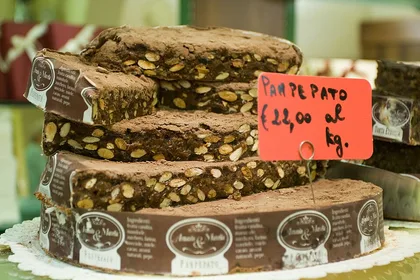 SweetsPanpepatoHoney, whole nuts, candied peel, cocoa and black pepper pressed into a dense disc and cut into thin wedges.
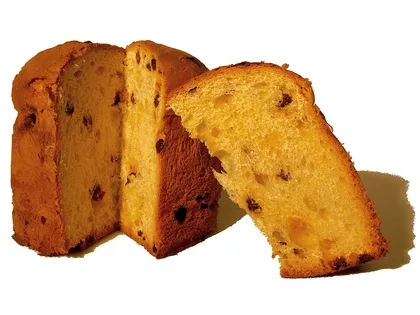 SweetsPanettonePanettone is Milan's Christmas bread: a tall, domed sourdough cake with butter, egg yolk, sultanas and…
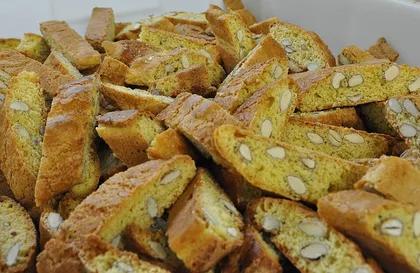 SweetsCantucciCantucci are hard, twice-baked Tuscan almond biscuits. A log of dough is baked, sliced on the diagonal while…
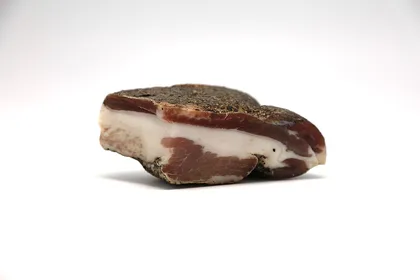 Cured meatsGuancialeGuanciale is cured pork jowl: unsmoked, rubbed with salt and pepper, aged for one to three months.
 Cured meatsPorchettaSix to eight hours in a wood oven to reach two opposite textures in one piece of meat: skin that shatters…
 Cured meatsSalsicciaCoarsely ground pork, salt, pepper, wine and usually garlic, packed into natural hog casing and sold raw.
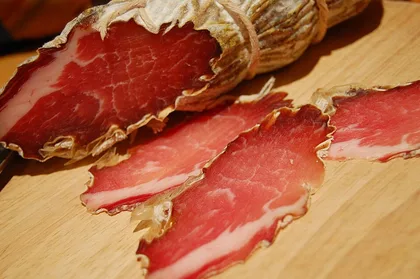 Cured meatsLonzinoLonzino is whole pork loin, dry-salted and air-cured for two to four months: the leanest cut on the animal…
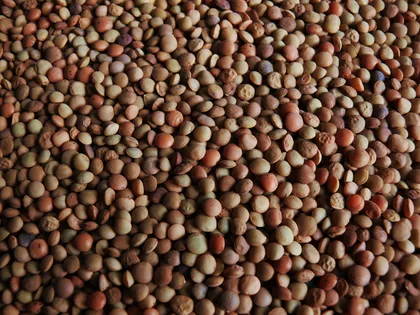 Vegetables and fruitCastelluccio LentilsCastelluccio lentils grow at 1,400 metres on the Pian Grande, a treeless karst plateau inside the Sibillini…