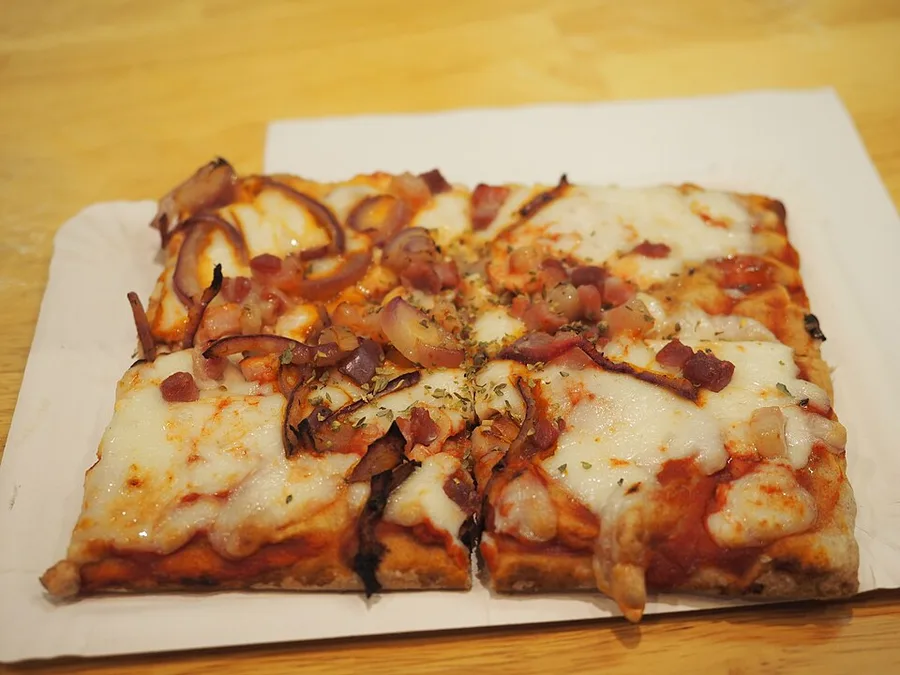
What is Pizza al Taglio?
Pizza al taglio (properly, pizza in teglia alla romana) is a high-hydration dough pressed into a rectangular metal pan, topped, and baked in an electric oven at around 300°C. It is sold by weight: you indicate the piece you want, it is cut with scissors or a spatula, weighed, and priced per hundred grams.
The structure is what distinguishes it. The base sits in a generously oiled pan and effectively fries, coming out crisp and golden. The interior is open and airy, with irregular holes, some of them large. The top carries toppings without going soggy. A good slice folds in half without cracking and without collapsing.
It is not a round pizza cut into squares. The dough is different (far more water, far more time, often a blend of stoneground flours) and so is the baking. Most shops par-bake the plain base, rest it, then top and finish it to order. That started as a commercial necessity and turned out to make a better crust.
There is no fixed portion. You buy a hundred grams or half a kilo, one flavour or four, and that flexibility is exactly why the format won as street food.
What does it taste like?
The crust is the flavour. Long fermentation, usually 24 to 72 hours in the cold, gives it a faintly sour, bready depth closer to good sourdough than to fast pizza dough, and the oiled base adds a fried, almost savoury-biscuit note along the bottom.
The texture contrast is the whole experience: a crisp, slightly greasy underside, then a light interior full of air that gives way immediately, then whatever is on top. Because the crumb is so open, a slice weighs much less than it looks like it should.
Toppings run from stark to elaborate. The two Roman benchmarks are the simplest: rossa, which is nothing but tomato, oil and oregano, and bianca, which is oil, salt and sometimes rosemary. Bread, essentially, and the fastest way to judge a shop. Beyond those, potato and rosemary is the classic, courgette flowers with anchovy is the summer one, and mortadella laid on the hot slice after baking is the combination Romans argue about most affectionately.
It is not the chewy, blistered, wet-centred experience of Neapolitan pizza. Nobody eats this with a knife and fork.
How to use it
Buy it, fold it in the paper, eat it standing. That is the design intent, and pizza al taglio deteriorates fast enough that the walk to a table is already a compromise.
At the counter, you can point at the slab and move your hands to show how big a piece you want. It is weighed after cutting, so ask for more or less before it goes on the scale. Two or three flavours in one purchase is normal and expected. A hundred and fifty to two hundred and fifty grams is a lunch.
If you are making it at home: use at least 75% hydration, ferment cold for a day or more, and oil the pan generously. The oil is an ingredient, not a release agent. Stretch by hand from the centre outwards; a rolling pin destroys the gas structure that took two days to build.
Par-bake the base at your oven's maximum with bottom heat for eight to ten minutes, let it rest, then top and finish. Keep toppings to two or three things and pre-cook or drain anything wet (courgettes, tomatoes, fresh mozzarella) or the water will ruin the crumb.
Delicate items go on after baking, never before: mortadella, prosciutto, burrata, raw courgette flowers, rocket. Reheat leftovers in a dry non-stick pan with a lid over medium-low heat for four or five minutes.
How long it keeps
This is not a keeping product. Within an hour and a half of leaving the oven the structure is already going: steam escapes the crumb while water from the toppings travels down into the base, so it softens from below and dries from within at the same time. Leftovers go into the fridge covered with baking paper rather than cling film pressed on the surface, which traps condensation, and the tray is meant for the next day. Overnight at 4 C the starch retrogrades and the crumb turns firm and cottony even as the base gets damper.
Bringing it back is a matter of heat plus a little steam: a non-stick pan with a lid, no added fat, medium-low for four or five minutes, and the base crisps while the crumb relaxes. An oven at 200 C for five to seven minutes straight on the rack works too and comes out drier. Plain pre-baked bases freeze properly: cool them, wrap each one, two months. Topped pizza does not, because the water in the toppings crystallises and shreds the open crumb as it thaws.
Spot the real thing
Look at the cut edge, not the top. A good tray pizza shows an irregular open crumb, bubbles of different sizes with some large voids, which is what high hydration and a long fermentation leave behind. A tight, even crumb with identical small holes came from a dough rushed with yeast. The base should be golden, faintly oily and crisp under the fingers; pale, floppy or rubbery means the pan was not hot enough or there was no oil in it. There is no cornicione here: the edge is where the dough climbed the tin, and it should still be soft enough to eat.
Abroad the category blurs. A New York slice is round and sold by the piece, a Sicilian or grandma square is thicker and denser, Detroit style has a fried cheese edge. The Roman version is sold by weight, cut with scissors and priced per kilo, and a fixed price per slice nearly always marks a place aimed at tourists. In the display case, be wary of trays all topped identically with industrial melting cheese and of any tray that has sat for hours under a lamp.
How to pronounce Pizza al Taglio
PEET-tsah ahl TAH-lyoh
Four syllables in 'al taglio', stressed on TAH. The 'gl' is a single sound like the 'lli' in 'million' or the 'll' in Spanish 'llave', never a hard g, so not 'TAG-lee-oh' and not 'TAL-yo'. In 'pizza' the double z is a held 'ts', not the English 'z'. The phrase means 'by the cut'. A related sign you will see is a taglio or al trancio, which mean the same thing.
Pizza al Taglio compared
vsPizza tonda romana
Rome makes two completely different pizzas and locals never confuse them. The tonda is thin, round, cracker-crisp (scrocchiarella), baked in a wood oven and served whole on a plate at dinner. Al taglio is thick, airy, rectangular, sold by weight, eaten standing at lunch.
| This | Pizza tonda romana | |
|---|---|---|
| Shape | Rectangular slab, cut to order | Round, individual, whole |
| Hydration | 75–90% | 50–58% |
| Thickness | 2–3 cm | 2–3 mm |
| Oven | Electric deck, ~300°C, metal pan | Wood-fired, on the stone |
| Texture | Crisp base, open airy crumb | Crisp throughout, snaps |
| Sold | By weight | By the pizza |
| Eaten | Standing, folded in paper | Sitting, with a knife and fork |
vsPinsa romana
Pinsa is the oval, very light Roman flatbread that appeared in the 1990s and is often marketed with a Roman-imperial backstory it does not have. The real difference is in the flour: pinsa uses a blend of wheat with rice and soy flour, which is what makes it so light and so pale.
| This | Pinsa romana | |
|---|---|---|
| Flour | Wheat, often stoneground blends | Wheat plus rice and soy flour |
| Shape | Rectangular pan slab | Oval, individual |
| Hydration | 75–90% | 75–80% |
| Fermentation | 24–72 hours cold | 48–120 hours cold |
| Sold | By weight, cut | Whole, per portion |
| Age of the format | Post-war Rome | 1990s, a commercial invention |
| Crumb | Open and irregular | Very light, drier, finer |
vsNew York square slice (Sicilian / grandma)
The nearest American analogue, and a genuinely different animal. Square slices in New York descend from Sicilian sfincione, are cut into fixed portions, and lean on mozzarella. Roman al taglio is sold by weight, uses far wetter dough and treats cheese as one option among many.
| This | New York square slice (Sicilian / grandma) | |
|---|---|---|
| Ancestry | Roman bakery pizza, post-war | Sicilian sfincione, via immigration |
| Sold | By weight, any size | By the fixed square |
| Cheese | Often absent entirely | Nearly always mozzarella |
| Base | Fried crisp in olive oil | Oiled, softer, more bread-like |
| Toppings added raw after baking | Common: mortadella, burrata, greens | Rare |
| Typical price | €12–35 per kg | $3–6 per slice |
Pizza al Taglio substitutes
- Focaccia, for the eating occasion
If you want the same role, a savoury slab eaten in the hand and sold by weight, good focaccia is the closest thing available almost everywhere. It is less crisp underneath and carries fewer toppings, but the format matches.
1:1 by weight - Detroit-style pizza, for the technique
American Detroit pizza uses the same core idea: wet dough, oiled steel pan, crisp fried base. It is cheesier and has caramelised cheese edges that Roman pizza never has, but a Detroit pan is the best vessel a US home cook can use for al taglio.
1:1 - Bread flour plus fine semolina, for the dough
Roman shops use stoneground type 1 flour, which is hard to buy abroad. A blend of strong bread flour with some fine semolina and a little wholemeal gets close on both flavour and colour.
80% bread flour, 15% fine semolina, 5% wholemeal - A heavy steel baking sheet plus a pizza stone
You do not need a professional teglia, but you do need bottom heat. Put a steel sheet or anodised pan directly on a preheated pizza stone or steel: the base has to fry, and a thin insulated tray will never do it.
- Sourdough starter for commercial yeast
Many Roman shops use lievito madre. If you keep a starter, use it at around 15% of flour weight and drop the cold ferment to 24–36 hours, since the starter works faster than the tiny quantity of fresh yeast otherwise used.
150 g active starter per 1 kg flour - Vegan version
The dough itself is already vegan: flour, water, salt, yeast, olive oil. Roman classics that need no substitution at all: rossa (tomato and oregano), bianca (oil and salt), and potato with rosemary. Cheese is genuinely optional in this format.
Where to buy it
In the US, Roman-style pizza al taglio has spread well beyond Italian neighbourhoods. Shops explicitly advertising 'pizza al taglio' or 'Roman pizza by the slice' exist in New York, Chicago, San Francisco, Austin, Portland and Washington DC, and several were founded by people who trained in Rome. Expect 12 to 22 dollars per pound, which is roughly 4 to 8 dollars for a lunch portion. Anything sold as a fixed square for a fixed price is probably a New York slice with an Italian name.
In the UK, London has a growing number of Roman-style teglia shops in Soho, Shoreditch and Peckham, generally 22 to 40 pounds per kilo. Outside London the format is still rare, and what is labelled 'pizza slice' is usually round pizza cut up.
For equipment and ingredients: an anodised aluminium or blue steel rectangular teglia costs 25 to 60 pounds or dollars and lasts a lifetime. Italian type 1 stoneground flour is stocked by online flour specialists. A baking steel is the single biggest upgrade for a home oven.
In Rome itself, the price per kilo is posted on the counter: 12 to 22 euros for classic toppings, 20 to 35 for the gourmet shops.
Where to eat it in Italy
Rome, where the format was invented and where it is on every other street. Because it is everywhere, choosing matters. The neighbourhoods with the highest concentration of good shops are Prati, Trastevere, Pigneto, San Lorenzo and Testaccio, where fifty-year-old bakeries sit alongside places that came out of the high-hydration movement of the 2000s.
A practical test: look at the window mid-morning. A few pans rather than twenty, irregular gaps where pieces have already sold, a price per kilo posted, and toppings that change through the day. Order the bianca, plain and oiled and salted, because with no topping there is nothing to hide behind.
For the everyday version Romans actually grew up on, walk out to the residential quarters: the neighbourhood forni of Tuscolano, Garbatella and Monteverde sell it at half the centre's prices, and it is often just as good.
Elsewhere in Italy, Roman teglia has established real schools in Emilia, Milan and Abruzzo, and several Roman names have opened branches in other cities. What you will not find is pizza al taglio in Naples, which has its own format and no interest in this one.
Recipes with it
Frequently asked questions
What is pizza al taglio?
Roman pizza baked in a rectangular pan and sold by weight. The dough is very wet, 75 to 90% hydration, and cold-fermented for one to three days, then baked in an oiled metal pan so the base fries crisp while the crumb stays open and airy.
How do you pronounce pizza al taglio?
PEET-tsah ahl TAH-lyoh. The 'gl' is one sound, like the 'lli' in million, so it is never 'TAG-lee-oh'. The phrase literally means 'by the cut'.
How do you order it in Rome?
Point at the slab and indicate with your hands how big a piece you want. It is cut with scissors, weighed and priced per hundred grams, so you can ask for more or less before it goes on the scale. Buying two or three different flavours at once is completely normal.
Is pizza al taglio the same as Sicilian pizza?
No. Both are rectangular, but Sicilian sfincione and the American square slice descend from a different tradition, are sold in fixed portions and rely on cheese. Roman al taglio is wetter, airier, sold by weight, and frequently has no cheese at all.
How much should I order?
About 150 to 250 grams per person for a meal, or 100 grams for a snack. The crumb is very open, so a piece weighs less than it looks, and you can always go back for more.
Related foods
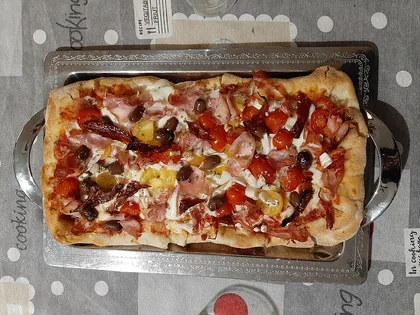 Pasta and breadPinsa RomanaIt is not pizza, and the difference starts with the flour: wheat, rice and soy blended together, hydration…
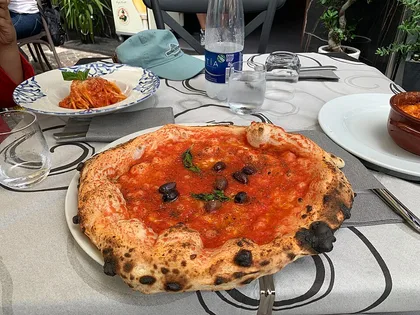 Pasta and breadNeapolitan PizzaNeapolitan pizza has been an EU-registered Traditional Speciality Guaranteed since 2010: four ingredients in…
 SweetsMaritozzoIn Rome this is breakfast at seven in the morning and nobody finds it odd: a soft, lightly sweet bun split…
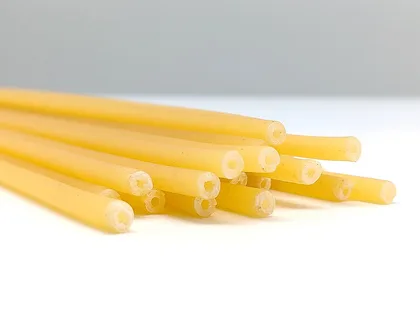 Pasta and breadBucatiniBucatini are thick spaghetti with a hole running through the middle.
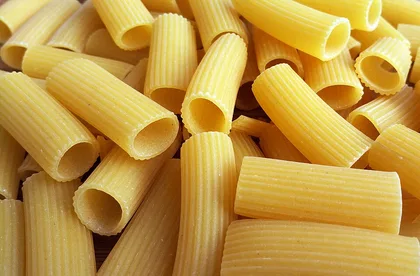 Pasta and breadRigatoniWide ridged tubes of durum semolina, cut straight across. The ridges and the square cut are engineering, not…
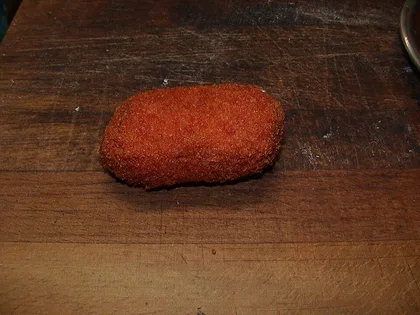 Pasta and breadSupplìSupplì are Rome's fried rice croquettes: rice cooked in tomato sauce, moulded around a plug of mozzarella…
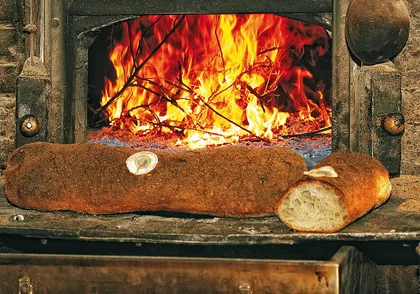 Pasta and breadPane di Genzano (Genzano Bread)Pane di Genzano is a sourdough loaf from the Alban Hills south of Rome, baked in a wood oven on a bed of bran…
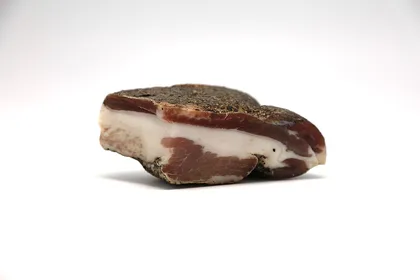 Cured meatsGuancialeGuanciale is cured pork jowl: unsmoked, rubbed with salt and pepper, aged for one to three months.