Cotechino and zampone are the same mixture: only the casing changes
The two PGI specifications call for the same mixture and the same numbers. The difference is the skin of the pig's foreleg, and «Modena» covers twenty-one provinces.
By the Agrofood.it editorial team · 9 November 2026 · 5 min read · 3 sources
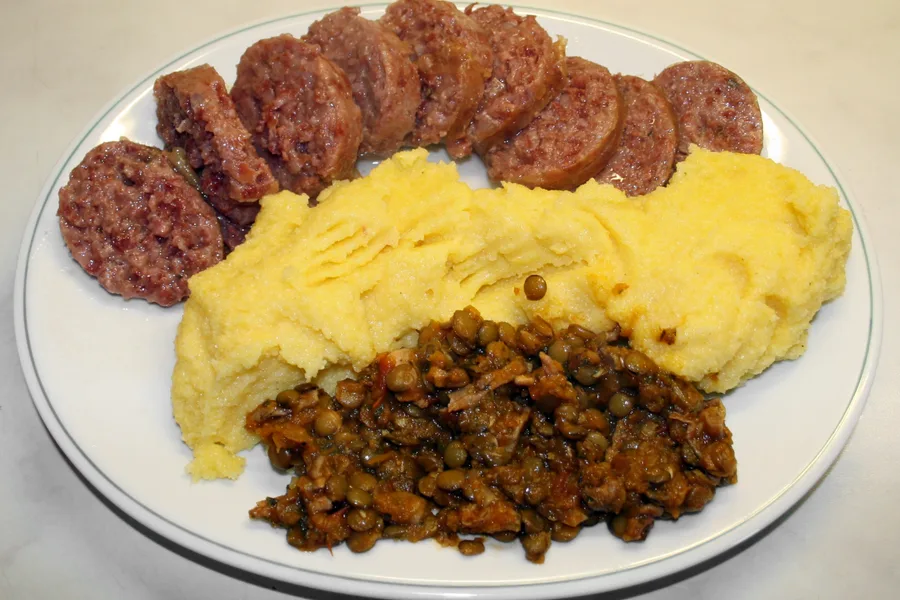
The same mixture, word for word
The two specifications were published together, in the Italian official gazette of 20 April 1999, one after the other. Read in sequence, the striking thing is that the part about the mixture is identical.
Both say the product consists of a mixture of pork obtained from striated muscle, pork fat, rind, salt and pepper, whole or in pieces. Both allow the same optional ingredients: wine, water according to good industrial practice, flavourings other than smoke flavourings, spices and aromatic plants, sugar or dextrose, fructose or lactose, sodium or potassium nitrite, ascorbic acid and its sodium salt, monosodium glutamate.
No different meat, no different percentage, no spice reserved to one or the other. Anyone looking for the difference inside the sausage is looking in the wrong place.
The difference arrives one line later, where the two texts say what that mixture goes into.
| Item | Zampone Modena PGI | Cotechino Modena PGI |
|---|---|---|
| Mixture | Pork from striated muscle, pork fat, rind, salt, pepper | Pork from striated muscle, pork fat, rind, salt, pepper |
| Casing | The skin of the pig's front leg, complete with the distal phalanges | Natural or artificial casings |
| Total protein | Minimum 17% | Minimum 17% |
| Fat to protein ratio | Maximum 1.9 | Maximum 1.9 |
| Collagen to protein ratio | Maximum 0.5 | Maximum 0.5 |
| Water to protein ratio | Maximum 2.70 | Maximum 2.70 |
| Area | Twenty-one provinces across Emilia, Lombardy and Veneto | The same twenty-one provinces |
| On sale | Raw, or precooked in a sealed pack | Raw, or precooked in a sealed pack |
| Name on the label | «Zampone Modena», not to be translated | «Cotechino Modena», not to be translated |
The skin of the foreleg against the casing
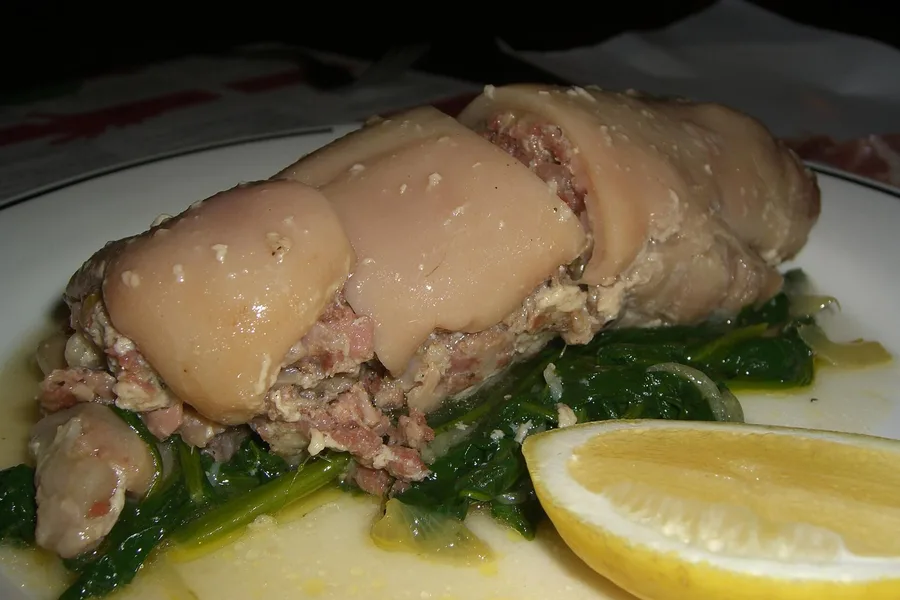
The zampone text is precise down to the bone, literally: the mixture «is stuffed into natural casings consisting of the skin of the pig's front leg, complete with the distal phalanges and tied at the upper end».
Three things sit in that line. The casing is skin, not gut. It comes from the front leg. And it stays attached to the distal phalanges, the toes, which is why a cooked zampone keeps the trotter shape everyone recognises.
At the same point in its text, cotechino says something else: the mixture «is stuffed into natural or artificial casings». No anatomy, no trotter.
Everything else follows from there, including price and cooking time, which the specification does not set: filling a leg and sewing it shut is craft work, filling a casing is a production line. And so does the look on the plate: a slice of zampone carries the rind of its casing, a slice of cotechino does not.
The numbers are identical, and they are taken on the cooked product
The two specifications set four parameters, and they match: total protein at least 17%, fat to protein no higher than 1.9, collagen to protein no higher than 0.5, water to protein no higher than 2.70.
The collagen to protein ratio is the most interesting of the four, because it caps how much connective tissue, rind included, can go in relative to muscle. It is the parameter that holds together a traditional recipe that calls for rind and a limit on how much of it there can be.
The point that often escapes notice is when the measurement is taken. The specification describes the product «cooked, at the moment of release for consumption»: the figures are read on the finished product, not on the raw mixture as stuffed.
For a shopper that means the limits apply both to the precooked sausage in its sealed pack and to the raw one, once cooked as intended.
«Modena» covers twenty-one provinces, from Varese to Rimini
The most surprising part of the two texts is the area. Despite the name, Zampone Modena and Cotechino Modena may be produced across the whole territory of twenty-one provinces: Modena, Ferrara, Ravenna, Rimini, Forlì, Bologna, Reggio Emilia, Parma, Piacenza, Cremona, Lodi, Pavia, Milan, Varese, Como, Lecco, Bergamo, Brescia, Mantua, Verona and Rovigo.
Three regions, then: Emilia-Romagna, Lombardy and Veneto. A cotechino made in Varese or Rovigo can lawfully be called Cotechino Modena, and that is not a loophole: it is the processing area written into the specification.
It is also the clearest way to explain what a PGI protects. The name points to a tradition and a processing area rather than to the town in the name, and it does not require the raw material to come from there.
Anyone after a tight link with one place has to look elsewhere on the label, at the address of the plant, which is a different piece of information and usually set in small type.
Precooked or raw, two products on the same shelf
Both specifications provide for two commercial forms. The mixture may undergo «precooking, generally in water» and be sold in sealed packs, or stay raw and go on sale fresh, loose or packaged.
That is the difference a reader actually meets in December: the foil pack that heats through in minutes and the raw sausage that asks for hours. The specification sets no cooking times for either, so the instructions on the pack come from the maker.
One thing the specification does demand is that the label say what you are buying. The designation has to be applied in clear, indelible characters, plainly distinguishable from any other wording, and immediately followed by the required mention.
This site does not say whether precooked or raw is better: they are two products with different timings, and the choice depends on how you cook, not on the rule.
Why «cotechino» on its own says very little
The article on designation carries a rule that applies to both: the name «may not be translated». There is no official English or French version, and exporters have to leave it as it is.
The more useful consequence runs the other way. The protected name is «Cotechino Modena», not «cotechino»: the word on its own stays a common name, and a cotechino made outside those provinces or to another recipe can be called cotechino without breaking anything.
The same goes for zampone. It is the mechanism this site describes elsewhere: protection attaches to the full name, while the generic term stays available. Checking whether «Modena» and the PGI mark sit next to the word is the only test needed.
Outside Italy this explains the zamponi and cotechini on the shelves of Italian delis abroad: they may be local products using the generic name, or the protected product, and the full wording is what tells them apart.
What the specification does not say
Neither text contains a word about lentils, mashed potato, capon or New Year's Eve. The specification describes a cured meat product, not a meal: the lentils are a tradition, and traditions do not need a decree.
There is no rule on size, on price or on the time of year either. Cotechino and zampone can be made and sold in any month; it is consumption that bunches up in the last weeks of the year.
And there is no verdict, of course. The specification sets thresholds and ratios, it does not say which cotechino is good. The editorial team stays out of that: we read the texts, not the brands.
One methodological note to close. The figures quoted here come from the specifications published in 1999, which we read in the official gazette; designations can be amended over time, and the right place for an up-to-date check is the ministerial list of specifications in force.
The short of it
- The specifications for Zampone Modena PGI and Cotechino Modena PGI describe the same mixture, with the same optional ingredients.
- The difference is the casing: the skin of the pig's front leg with the phalanges for zampone, natural or artificial casing for cotechino.
- The same four parameters apply to both: protein at least 17%, fat to protein up to 1.9, collagen to protein up to 0.5, water to protein up to 2.70.
- Those parameters are measured on the cooked product, at the moment it is released for consumption.
- The processing area covers twenty-one provinces across Emilia-Romagna, Lombardy and Veneto, from Varese to Rimini.
- Both exist raw and precooked in sealed packs, and the specification sets no cooking times.
- The protected name is «Cotechino Modena» or «Zampone Modena»: the word alone remains a common name.
Frequently asked questions
What is the difference between cotechino and zampone?
The casing. The two PGI specifications describe the same mixture of pork from striated muscle, fat, rind, salt and pepper, but zampone is stuffed into the skin of the pig's front leg complete with the phalanges, while cotechino goes into natural or artificial casings.
Is Zampone Modena PGI made only in Modena?
No. The processing area covers twenty-one provinces: Modena, Ferrara, Ravenna, Rimini, Forlì, Bologna, Reggio Emilia, Parma, Piacenza, Cremona, Lodi, Pavia, Milan, Varese, Como, Lecco, Bergamo, Brescia, Mantua, Verona and Rovigo.
What do the specification's numbers mean?
Total protein of at least 17%, a fat to protein ratio no higher than 1.9, collagen to protein no higher than 0.5 and water to protein no higher than 2.70. They are measured on the cooked product at the moment of release for consumption, and they are identical for both.
Is precooked cotechino allowed by the specification?
Yes. The text provides for the mixture to be precooked, generally in water, and packed in sealed wrappings, or to stay raw and be sold fresh, loose or packaged.
Is a cotechino without the word «Modena» a fake?
No. The protected name is «Cotechino Modena»: on its own, «cotechino» is a common name and can be used for products made elsewhere or to another recipe. What counts on the label is the full name with the PGI mark.
Does the specification say to serve it with lentils?
No. The two texts describe a cured meat product and say nothing about what to serve with it: lentils are a New Year tradition, not a written rule.
Sources
Where to check what you just read.
- 1
I due testi pubblicati uno dopo l'altro, alle pagine 43 e 45: impasto, involucri, parametri chimici del prodotto cotto, zona di elaborazione e regole di designazione.
- 2
Il punto da cui verificare se un disciplinare è stato modificato dopo il 1999: l'elenco ministeriale dei testi in vigore.
- 3
Cosa protegge una IGP e in che cosa differisce da una DOP: la pagina della Commissione, resa lato server e quindi leggibile, al contrario del registro eAmbrosia.
The foods behind this
 Cured meatsCotechinoCotechino is a large fresh pork sausage from Emilia-Romagna, made with pork meat, fat and rind, and always…
 Cured meatsZamponeZampone Modena IGP is spiced pork and rind forcemeat stuffed into a boned pig's trotter: same filling as…
 Vegetables and fruitCastelluccio LentilsCastelluccio lentils grow at 1,400 metres on the Pian Grande, a treeless karst plateau inside the Sibillini…