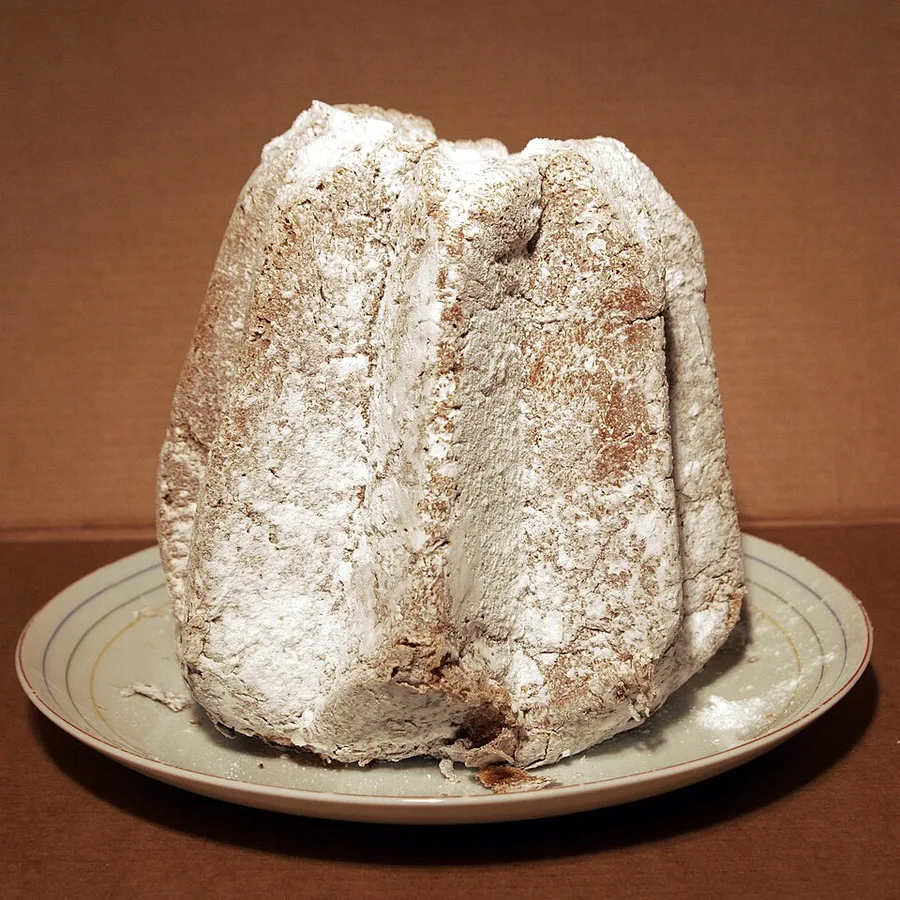
What is Pandoro?
Pandoro is a tall, star-shaped sweet leavened cake from Verona, baked in a rigid metal mould and finished with a shower of vanilla-scented icing sugar. There is no fruit in it, no raisins and no candied peel and no chocolate, and that absence is the definition rather than an omission.
The same 2005 Italian decree that governs panettone sets pandoro's rules: natural sourdough leavening, at least 20% butter and at least 4% egg yolk, with candied fruit and raisins expressly forbidden.
The crumb is deep yellow, fine and much softer than panettone's. It slices cleanly instead of pulling into strands, and it tastes of butter and vanilla rather than citrus and sourdough. Its name comes from pan de oro, golden bread.
What does it taste like?
Close to a very good brioche, but lighter and sweeter: buttery, vanilla-heavy, with almost no acidity. Where panettone tastes like enriched bread, pandoro tastes like cake, and it dissolves rather than chews.
The icing sugar is not decoration. It is vanilla-scented and comes in its own sachet, and shaking the cake in the bag coats every ridge of the star, so each mouthful gets a dusting of sweetness against the plain crumb.
Italians who dislike candied peel, a large and vocal group, choose pandoro for exactly this reason. It is also the one children reach for, which tells you where it sits on the sweetness scale.
How to use it
Take the cake out of its bag, drop it back in with the sachet of vanilla icing sugar, close the top and shake. That is genuinely the instruction, and in Italy it is usually given to a child.
Serve at room temperature, never chilled. Cut it horizontally into discs about two centimetres thick, so every slice comes out as a star; stack the discs back up with each one rotated slightly and you get the Christmas tree that appears on Italian tables every December.
Pandoro takes fillings far better than panettone. Mascarpone cream, whipped chantilly, warm zabaglione or a slab of vanilla gelato between the discs all work, and a filled pandoro is a serious dessert rather than a novelty.
Stale pandoro is excellent in trifle and tiramisù: it soaks up liquid better than sponge fingers and brings its own butter and vanilla.
How long it keeps
Unopened, the cellophane bag does the preserving and the maker prints a date on it, often several months ahead; that date is the reference and nothing about the loaf tells you more. Store the box upright somewhere cool and dark, 15 to 20 C, away from the oven and off a sunny shelf, because warmth is what pushes the butter toward a flat, papery smell. Leave the icing sugar sachet sealed and separate until the moment of serving, since the sugar draws moisture out of the crumb on contact and goes damp and grey.
After cutting, pandoro dries faster than panettone because it carries no fruit to hold water. Slice it horizontally through the star, press the loaf back together, and keep it in its own bag with the top folded and clipped; at room temperature the crumb stays soft for two to three days and then stiffens and crumbs at the edges. The fridge accelerates that, so the counter is the better place. Wrapped slices keep about three months at minus 18 C and are warmed briefly in a low oven.
Spot the real thing
The shape settles it: a tall truncated eight-pointed star, moulded rather than baked in paper, with sharp ridges and a deep golden crust, and a small sachet of vanilla icing sugar tucked into the bag. Cut across, the crumb is fine, even and strongly yellow from egg yolk, and it tears into silky strands instead of crumbing. On the ingredients, look for lievito madre or natural sourdough, butter and egg yolk near the top; Italian rules set minimums for butter and yolk before the name pandoro can be used, so margarine, palm oil and added flavouring describe a different sweet loaf.
Abroad the two Christmas loaves get shelved together and treated as versions of each other. Panettone is domed, baked in its paper mould, and full of candied peel and raisins; pandoro has no fruit at all, and that is the whole point of it. Star-shaped sponge cakes in plastic clamshells with a shelf life measured in a year are a supermarket product borrowing the outline. A pandoro from a named Veronese bakery costs several times an industrial box of the same weight.
How to pronounce Pandoro
pahn-DOH-roh
Three syllables, stress on the second. Every vowel is short and clean, the 'r' is tapped, and the final 'o' is fully pronounced. Not 'PAN-door-oh' and not 'pan-DOOR-oh'. The plural is pandori, 'pahn-DOH-ree'.
Pandoro compared
vsPanettone
The December argument in every Italian household. Pandoro is Veronese, star-shaped, butter-rich and completely fruit-free; panettone is Milanese, domed, breadier and legally required to contain at least 20% raisins and candied citrus. Pandoro is the easier cake; panettone is the more interesting one.
| This | Panettone | |
|---|---|---|
| City | Verona | Milan |
| Shape | Eight-pointed star, baked in a metal mould | Tall dome, baked in a paper case |
| Fruit | None, forbidden by the recipe | Sultanas and candied orange and citron, min 20% |
| Butter | Minimum 20% | Minimum 16% |
| Crumb | Fine, soft, slices cleanly | Stringy, elastic, pulls apart in threads |
| Finish | Vanilla icing sugar, shaken on in the bag | Plain, or an almond and sugar glaze |
| Cooling | Cools upright in its mould | Hung upside down for 8-12 hours |
| Best filled? | Yes: cream, zabaglione, gelato | No, best eaten plain |
vsNadalin
Verona's older Christmas cake and pandoro's direct ancestor, documented from the thirteenth century and linked to the Della Scala family. Also star-shaped, but low, dense and covered in almonds and sugar rather than leavened tall and dusted. Veronese bakeries still make it every December, and tasting the two together explains the whole family tree.
| This | Nadalin | |
|---|---|---|
| Age | Patented 1894 | Documented from the 1200s |
| Height | Tall, 15-20 cm | Low, 5-6 cm |
| Texture | Airy and soft | Dense, close, faintly crumbly |
| Top | Vanilla icing sugar | Baked crust of almonds, pine nuts and sugar |
| Points on the star | Eight | Usually five to eight, hand-shaped |
vsBrioche and pound cake
Pandoro sits between the two and is neither. It is leavened like brioche, with a sourdough starter and long risings, but sweeter and lighter; it looks like a cake and is used like one, but there is no chemical raising agent in it at all. That is why an ordinary brioche loaf substitutes tolerably and a sponge cake does not.
| This | Brioche and pound cake | |
|---|---|---|
| Raising | Sourdough starter, 30+ hours | Brioche: yeast. Pound cake: baking powder |
| Butter | 20% or more | Brioche: 25-50%. Pound cake: about 25% |
| Sugar | Moderate in the crumb, sweet on the outside | Brioche: low. Pound cake: high |
| Structure | Airy, elastic, holds a tall shape | Brioche: elastic. Pound cake: dense and tight |
| Eaten | Christmas dessert | Breakfast, or afternoon cake |
Pandoro substitutes
- Panettone
The direct swap, on the same shelf at the same time of year. Less butter, more chew, and a lot of candied fruit, which is exactly the thing pandoro buyers are usually avoiding, so check before you substitute.
1:1 by weight - Veneziana
The most accurate answer for anyone who wants panettone dough without fruit: a Milanese sweet loaf with the same sourdough base, no raisins or peel, topped with a sugar-and-almond glaze and pearl sugar. Sold from November alongside the others.
1:1 - Brioche loaf or challah
For layered puddings, trifles and French toast it behaves almost identically. Add a split vanilla pod to whatever cream or custard you serve it with, since the vanilla is doing a lot of the work in the original.
1:1 by weight - Colomba pasquale
Panettone dough shaped as a dove for Easter, with candied orange but no raisins and a crackly almond glaze. Between February and April it is the only thing on the shelf in this family.
1:1 - Madeira or pound cake, for the shape
If the point is the star-shaped Christmas-tree presentation rather than the flavour, bake a butter cake in a pandoro tin, sold cheaply in Italy and online. It will be denser, so slice it thinner.
1 kg batter per 1 litre mould - Gluten-free pandoro
Easier to get right than gluten-free panettone, because the fine crumb of pandoro is less dependent on a long gluten network. Several Italian producers make a credible one; it is worth buying rather than baking.
Where to buy it
Anywhere Italian food is sold, from November. Supermarkets in the US and UK stock the big Veronese brands (Melegatti, Bauli, Paluani) at roughly $10-18 or £7-14 for a kilo, and Italian delicatessens carry artisan versions at $40-80 or £28-45.
Because pandoro contains no fruit and a lot of butter, quality differences show up in the fat rather than in the inclusions: read the label for burro and reject anything listing margarine or vegetable oils, and look for real vanilla rather than vanillin.
The supermarket product is honestly decent here, because the gap between industrial and artisan is narrower than it is for panettone, because there is no candied peel to get wrong.
After 26 December prices collapse everywhere, in Italy and abroad. Pandoro keeps for weeks, so late December is the rational time to buy.
Where to eat it in Italy
Verona in December, where you can eat pandoro and its ancestor on the same afternoon: bakeries in the historic centre still make nadalin, the low, almond-crusted star that predates the pandoro patent by six centuries.
The city's Christmas markets fill piazza dei Signori from late November, and a comet-shaped sculpture descends into the Roman Arena for the season. In Bovolone, half an hour away, the Perbellini pastry house has made its Offella d'Oro since 1891, the artisan cousin of pandoro, and three years older than the patent.
Verona is also the industrial capital of Italian Christmas: Melegatti, Bauli and Paluani are all Veronese companies, which is why the city smells of butter and vanilla in November.
For a direct comparison, do Verona and Milan in the same week. Pandoro in one, panettone in the other, and the argument settles itself.
Frequently asked questions
What is pandoro?
A tall, star-shaped Christmas cake from Verona, naturally leavened and made with at least 20% butter and 4% egg yolk, with no candied fruit or raisins. It is served dusted with the vanilla icing sugar that comes in the packet.
How do you pronounce pandoro?
pahn-DOH-roh, with the stress on the second syllable and the final 'o' clearly sounded. The name means golden bread, from pan de oro. The plural is pandori.
Pandoro or panettone: what is the difference?
Pandoro has more butter, no fruit, a star shape and a soft, fine crumb; panettone has candied orange and citron, sultanas, a domed shape and a chewy, stringy crumb. Pandoro is from Verona, panettone from Milan. Pandoro is sweeter and simpler, panettone more complex.
How do you cut and serve pandoro?
Slice it horizontally into two-centimetre discs so each piece is a star, then restack the discs rotated to make a tree. Serve at room temperature, and shake the cake with its sachet of vanilla icing sugar first.
How long does pandoro keep?
An artisan one lasts 30 to 45 days sealed in its bag at room temperature; industrial ones with preservatives keep five or six months. It freezes well for three months. Do not refrigerate it.
Related foods
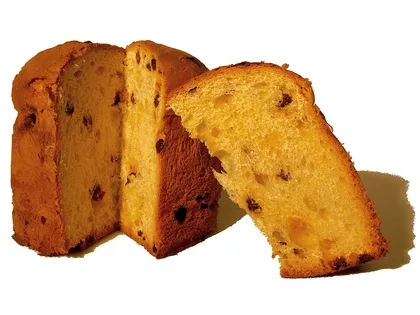 SweetsPanettonePanettone is Milan's Christmas bread: a tall, domed sourdough cake with butter, egg yolk, sultanas and…
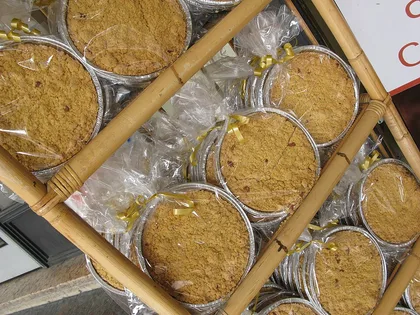 SweetsSbrisolonaSbrisolona is the crumbly almond and cornmeal cake of Mantua, and the only Italian cake you are supposed to…
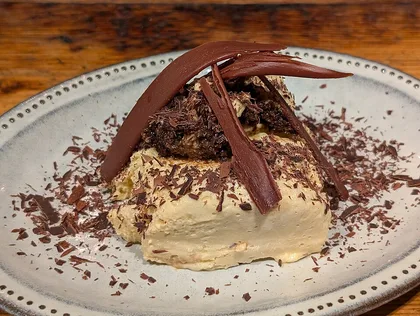 SweetsTiramisuNothing here goes near an oven. Savoiardi dipped in cold espresso, raw egg yolk whipped with mascarpone…Pasta and breadGnocchiGnocchi are small boiled dumplings, in their modern form made of potato bound with a little flour.
 WineProseccoProsecco is made from Glera grapes by the Martinotti tank method, not the traditional bottle method used for…
 CheeseAsiagoOne name covers two cheeses nobody would mistake for each other at the counter.
 CheeseGrana PadanoNine months is the floor the specification sets before a wheel may carry the name.
 CheeseProvoloneProvolone is a stretched-curd cow's milk cheese from northern Italy, rope-tied and hung to age in shapes from…