What is Salame Napoli?
Salame Napoli is a pure pork salami, ground medium-fine, seasoned with salt, pepper, chilli and often sweet paprika, stuffed into narrow natural casing and aged for thirty to sixty days.
Two things define it. The first is the shape: four to six centimetres in diameter and up to fifty long, weighing between half a kilo and a kilo and a half. A narrow calibre dries fast, which means a short cure, a direct flavour and none of the deep cellar notes that thicker salami develop over months.
The second is smoke. In the traditional method the salami spends two to four days in cold smoke from hardwood (beech or oak, depending on the house) which dries the surface, keeps unwanted moulds off and leaves a hearth aroma that hits before the meat does. It is the only major Italian salami that is smoked as a matter of tradition rather than northern-European borrowing.
The slice is darker than any northern salami: brick red rather than pink, from the combination of chilli, paprika where it is used, and smoke.
Like Milano, it carries no PDO or PGI. The name describes a method and a market, not a protected place of production.
What does it taste like?
Smoke first, then heat, then pork. The smoke is the opening note and it is real wood smoke rather than the sweet, bacon-like smoke Americans expect: drier, more like a chimney than a barbecue.
The chilli builds rather than strikes. Most versions sit at a warm background heat that accumulates over three or four slices; a few producers push it much further. Paprika, where present, contributes colour and a faint sweetness rather than any real flavour.
The texture is firmer and slightly springier than a northern salami, because a narrow salami dries fast and loses more water. The fat is in small distinct pieces, so it melts in points rather than as a sheet.
If pepperoni is your reference, this is the older, drier, less sweet original: less paprika, more actual smoke, coarser grain and a longer cure. Anyone who eats it expecting pepperoni will find it saltier and considerably less soft.
How to use it
Slice it around two millimetres, slightly thicker than you would cut a northern salami. The medium grind and the chilli both want a slice with some body.
Its most Neapolitan use is baked, not raw. Casatiello, the Easter bread of Naples, a rich lard-enriched dough studded with cured pork and cheese and crowned with whole eggs, is built around diced salame Napoli, along with pecorino, provolone and pork cracklings. The unsweetened, eggless version is called tortano and is eaten year-round. This is the clearest explanation of why the salami is smoked: inside a baked dough, smoke is the one thing that survives.
In a sandwich it goes with provolone del Monaco or a semi-aged caciocavallo. On a frisella soaked in water and topped with tomato it makes a whole meal.
For pizza, add it in the last seconds or after the oven. A Neapolitan wood oven runs at 450 °C and will scorch it.
One local combination worth copying: pan-fried with friarielli, the bitter Neapolitan broccoli greens, where the heat of the salami and the bitterness of the greens hold each other in check.
How long it keeps
A whole salame hangs in a cool, ventilated place between 12 and 16 °C. The narrow calibre dries quickly, and unlike a Milano, which spends months getting better, a Napoli left hanging simply goes hard, so a couple of months is the sensible span. Once you cut into it, cover the cut face and reckon on two weeks; when the exposed surface hardens and darkens, take half a centimetre off and carry on. In the fridge it goes on the least cold shelf, wrapped in greaseproof paper or a tea towel, never with cling film against the meat, because the smoke and fat react with the plastic and pick up a stale smell.
Vacuum packs hold to the date printed on them, but open one at least half an hour before serving: smoke shut in a bag turns acrid and needs air to disperse. Diced, the salame freezes well for cooking, up to about three months, though the fat comes back slightly grainy. There is little point freezing slices meant to be eaten as they are, since thawed slices weep and lose the springiness that makes them worth slicing thin.
Spot the real thing
Start with the calibre: a Napoli is a narrow salame, four to five centimetres across. A fat stick seven to nine centimetres wide is some other spicy salame, however hot it tastes. On the cut face the red should be brick rather than pink, nowhere near as dark as bresaola, with the fat in small pieces you can pick out rather than smeared into a paste. The texture is firm and slightly springy: soft means short curing, snapping when you bend it means it dried too fast.
The outside of a genuinely smoked salame is amber and faintly glossy, not chalked over with white bloom like a northern one. A piece covered in white mould that smells of smoke has had the smoke added as a flavouring. On the nose the smoke should arrive first but never alone: pepper, chilli and meat sit underneath it. On the label, chilli and paprika belong among the ingredients rather than folded into a line about flavourings, and smoke flavouring says plainly that the salame never went near a smokehouse. Do not confuse it with American pepperoni, its descendant, or with soppressata.
How to pronounce Salame Napoli
sah-LAH-meh NAH-poh-lee
The stress in Napoli falls on the first syllable: NAH-poh-lee, not na-POH-lee, which is the single most common English mistake. Salame ends in 'e' because it is singular; salami is the Italian plural. Neapolitans themselves often say sa-LAH-mm' with the final vowel swallowed.
Salame Napoli compared
vsPepperoni
Pepperoni is what happened to this salami after it emigrated. Italian-American butchers in New York, working from the spicy salami of the Italian south, ground it finer, pushed the paprika up, cut the ageing down and added dairy and dextrose for softness, producing something engineered for melting on a pizza rather than slicing onto a board. The family resemblance is unmistakable and the differences are all in the direction of American taste: sweeter, softer, redder, milder in smoke, hotter in surface heat.
| This | Pepperoni | |
|---|---|---|
| Grind | Medium-fine, 4-6 mm | Very fine, emulsified feel |
| Paprika | Optional, mainly for colour | Central to flavour and colour |
| Smoke | Real cold smoke, 2-4 days | Usually smoke flavouring, if any |
| Ageing | 30-60 days | Often under 3 weeks |
| Texture | Firm, springy, dry | Soft, pliable, oily when heated |
| Meat | Pork only | Usually pork and beef |
| Primary use | Sliced, or baked into bread | Pizza topping |
vsSalame Milano
The two poles of the Italian salami trade, and both named after cities that sold rather than made them. Milano is thick, mild and evenly ground to a rice-grain texture, cured up to three months, and designed to be sliced thin and eaten in quantity. Napoli is thin, hot and smoked, cured in half the time, and designed to assert itself. Put them on the same board and Milano tastes of almost nothing; put Milano on its own and it tastes fine. That is not a criticism of either, but it is a reason to serve them in the right order.
| This | Salame Milano | |
|---|---|---|
| Diameter | 4-6 cm, dries fast | 7-9 cm, dries slowly |
| Heat | Chilli, mild to hot | None |
| Smoke | Traditional cold smoke | Never |
| Grind | Medium-fine, visible fat | Fine and uniform, rice grain |
| Ageing | 30-60 days | 30-90 days |
| Serving order | Last on the board | First on the board |
| Cooking | Excellent, smoke survives heat | Good, fat renders evenly |
vsSalame Felino IGP
The widest gap in the Italian salami world. Felino is built by removal: coarse grain, natural casing, no chilli, no smoke, barely any garlic, dry white wine and enough ageing for the pork itself to become the flavour. Napoli is built by addition: chilli, paprika, pepper and days of wood smoke, on a short cure. Felino is protected by PGI and tied to the hills above Parma; Napoli is a generic name made across Campania and beyond. Tasting them side by side is the fastest education in what Italian salami actually covers.
| This | Salame Felino IGP | |
|---|---|---|
| Design principle | Addition: spice and smoke | Subtraction: pork and pepper |
| Grain | Medium-fine | Medium-coarse, some knife-cut fat |
| Colour of slice | Brick red | Ruby red with white fat |
| Shape | Long, thin, straight | Short, curved, uneven |
| Protection | None | PGI, province of Parma |
| Best with | Provolone, friselle, strong reds | Fried dough, butter, white bread |
Salame Napoli substitutes
- Soppressata piccante (Calabrian)
The closest southern relative and often easier to find abroad. Coarser grain, flatter shape, more chilli and no smoke. Use it anywhere Napoli would go, accepting that the smoke is missing.
1:1 - Pepperoni (dry stick, not pizza slices)
Its own descendant, so the logic is sound. Buy the whole dry stick from a deli rather than the pre-sliced pizza packs, which are softer and much sweeter. Reduce any added chilli in the dish, since pepperoni carries its own.
1:1 - Spanish chorizo (cured, picante)
Similar role and similar colour, but pimentón is the dominant flavour and it is smokier and sweeter. Excellent in cooked dishes such as baked pasta or stuffed breads; on a board it reads as clearly Spanish.
1:1 in cooking, 0.8:1 raw - Ventricina teramana or salame piccante di Calabria
Both southern, both chilli-driven, both available through Italian importers. Ventricina is much coarser and more perfumed with wild fennel; the Calabrian salame piccante is the closer match on grain.
1:1 - Halal or no-pork: beef sujuk or halal beef pepperoni
Turkish sujuk is spiced with cumin, garlic and paprika and is firm and dry, so it is better cooked than raw, and works well diced into a stuffed bread. Halal beef pepperoni is closer for pizza and baking.
1:1 in cooked dishes - Smoked paprika and mushrooms, for a meat-free version
Nothing replicates cured pork, but thickly sliced king oyster mushrooms seared hard with smoked paprika, chilli and olive oil deliver the same three signals (smoke, heat, savoury fat) in a casatiello or a baked pasta.
Where to buy it
In the US, Italian delis and importers carry it, though domestic spicy soppressata and pepperoni take up most of the shelf. Expect roughly 14 to 26 dollars per pound whole. Neighbourhoods with deep Italian-American roots (Arthur Avenue in the Bronx, South Philadelphia, the North End in Boston) are the reliable places to find a real smoked one.
In the UK, Italian delicatessens stock it at about 22 to 38 pounds per kilo; supermarkets rarely carry it under this name and sell generic "spicy Italian salami" instead.
The label test is simple. Chilli and paprika should be listed as ingredients rather than hidden under "flavourings", and "smoke flavouring" in the list means the salami has never seen a smokehouse.
Look at the surface. A genuinely smoked salami is amber and faintly glossy, not chalky white with bloom. A white, mould-covered salami that smells strongly of smoke has been flavoured rather than smoked.
Buy a whole piece: at half a kilo to a kilo and a half it is a manageable size, and unlike a fat Milano it will not outlast you.
Where to eat it in Italy
Naples, at the delicatessens of the Pignasecca and the market stalls of Porta Nolana and Antignano in the Vomero, where salami still hangs above the counter and is sold by the piece.
Bakeries and rosticcerie sell casatiello and tortano all year rather than only at Easter, and eating a slice of either is the fastest way to understand the salami in context.
The hinterland is where it is made and where it is best. In Irpinia (Montella, Bagnoli Irpino, Mugnano del Cardinale) village butchers still cure their own. In the Sannio, around Cusano Mutri and Pietraroja, the mountain butchery tradition is old and intact.
Autumn is the season to go. The Irpinian chestnut and black truffle festivals around Bagnoli and Montella bring out the small producers and the previous year's salami at the same time.
Further reading
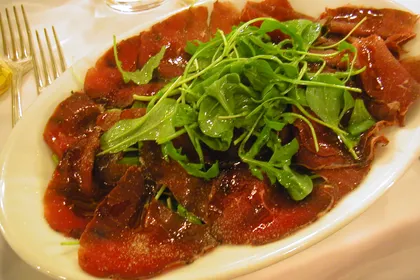
Frequently asked questions
Is salame Napoli spicy?
Usually, but moderately. Chilli is almost always in the mix, frequently alongside sweet paprika used mainly for colour. Intensity varies widely between producers, from a warm note at the back of the palate to a genuinely hot salami.
Is pepperoni the same as salame Napoli?
No, but it descends from it. Italian-American butchers in New York adapted the spicy salami of southern Italy, Naples chief among them, by grinding it finer, increasing the paprika, shortening the cure and softening the texture. Pepperoni is this salami rebuilt for the American market.
Why is salame Napoli smoked when other Italian salami are not?
Climate. Southern winters are mild and damp, and a narrow salami hung in a kitchen was vulnerable to the wrong moulds. Cold smoke from the hearth dried the surface and protected it. The technique stayed even after curing chambers made it unnecessary.
What is casatiello?
A rich Neapolitan bread made with lard and filled with diced cured pork (salame Napoli, cracklings) plus pecorino and provolone, with whole eggs set into the crust. It is an Easter speciality, and the eggless everyday version is called tortano.
How do you pronounce salame Napoli?
sah-LAH-meh NAH-poh-lee, with the stress on the first syllable of Napoli. English speakers habitually say na-POH-lee, which is wrong in Italian.
Related foods
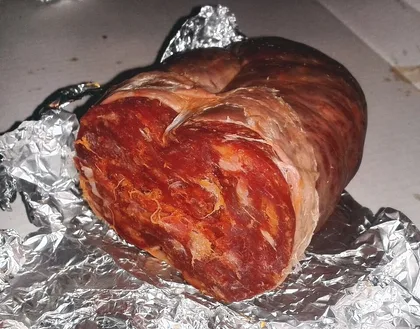 Cured meatsSoppressataSoppressata is a coarse-ground dry salami from southern Italy, pressed flat between boards while it dries…
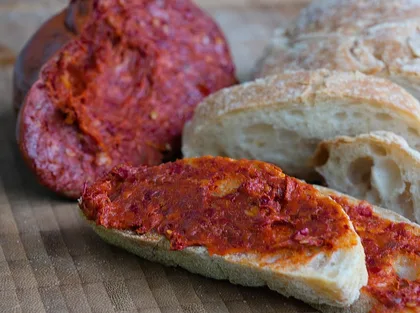 Cured meats'Nduja'Nduja is a soft, spreadable Calabrian pork salume that is up to 40% chilli.
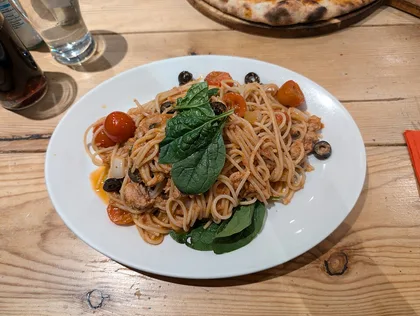 Pasta and breadSpaghettiA solid round strand of durum semolina and water, 1.7 to 2.0mm across. It looks like the most neutral pasta…
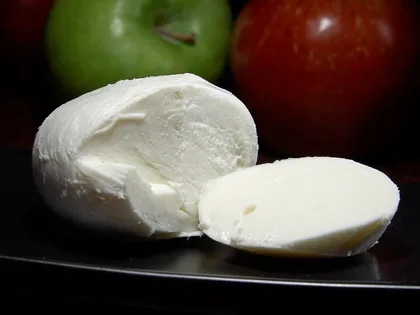 CheeseMozzarellaThe name is a verb before it is a cheese: mozzare means to lop off, which is what the cheesemaker does by…
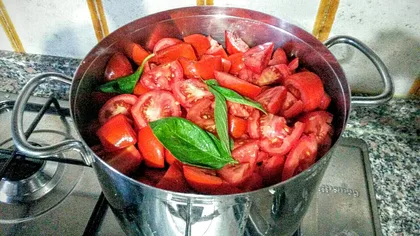 Vegetables and fruitSan Marzano TomatoesSan Marzano is a long, thin-skinned plum tomato grown in the volcanic plain between Naples and Salerno, and…
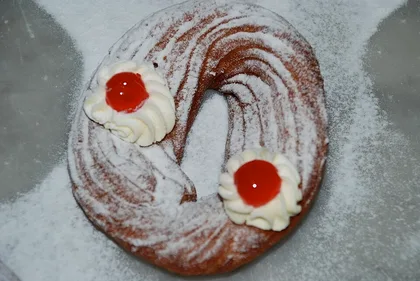 SweetsZeppoleZeppole are Naples' feast-day pastry for Saint Joseph on 19 March: a piped choux ring, fried or baked, filled…
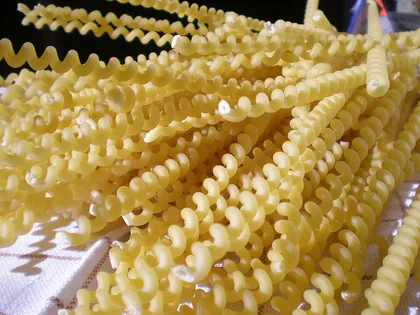 Pasta and breadFusilliTwo different pastas share this name. The industrial spiral is solid and holds sauce on its outside surface…