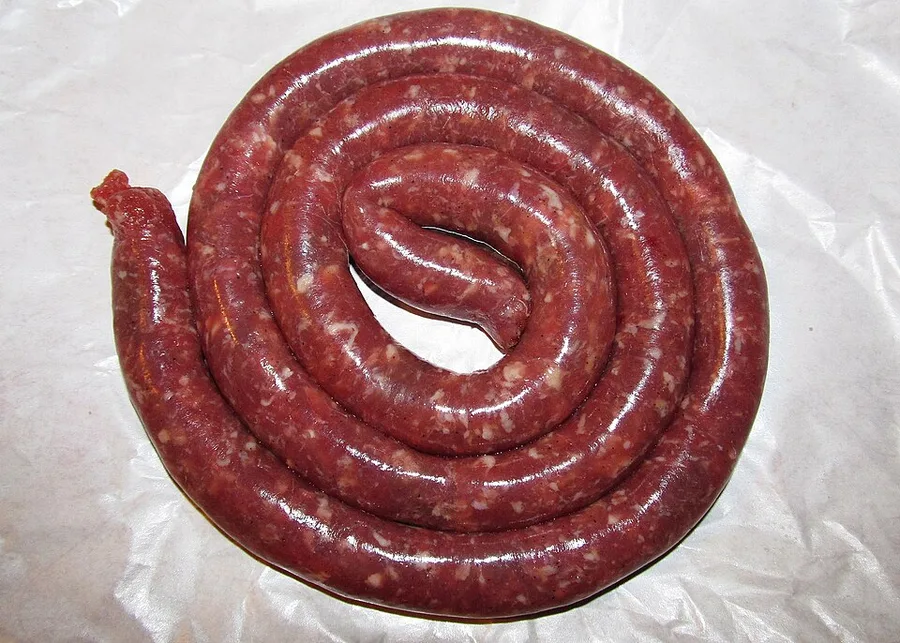
What is Salsiccia di Bra?
Salsiccia di Bra is a fresh sausage of young beef (veal or yearling of the Piedmontese breed) finely minced, seasoned and stuffed into thin sheep casing. It is sold coiled in a spiral, bought by weight, and eaten raw: you split the casing, squeeze the meat onto bread and add olive oil and pepper.
In Italy this is an anomaly. Sausage means pork, and lean beef is considered unsuitable because it lacks the fat that binds. Bra does the opposite and gets away with it because the Piedmontese breed yields exceptionally tender meat, and because lamb casing is thin enough to disappear in the mouth.
The reason it exists is local history. Bra tradition holds that in the nineteenth century the town's butchers obtained an authorisation, an exception to rules in the Kingdom of Sardinia that reserved sausage for pork, specifically so they could supply the Jewish community of Cherasco, eight kilometres away, which did not eat pork.
One honest clarification: that permission concerned the raw material, not religious compliance. Many modern recipes add five to fifteen per cent pork lard to bind the mince, though some butchers make an all-beef version. And in either case this is not a certified kosher product: kashrut requires ritual slaughter and rabbinic supervision, which the butchers of Bra do not have. If it matters to you, ask what is in it and buy certified products instead.
What does it taste like?
Clean, sweet and surprisingly delicate, nothing like the fatty, fennel-heavy Italian sausage most people know. Raw, it eats like a seasoned tartare: soft, cool, faintly mineral from the beef, with nutmeg and white pepper lifting it and no sourness or funk at all, because it is neither fermented nor aged.
The texture is the point. The mince is ground fine, twice in some shops, so the meat is smooth rather than fibrous, and the small amount of fat keeps it from feeling dry. On bread with olive oil it almost spreads.
Cooked, it turns into something else: leaner, firmer and quicker than pork sausage, closer to a beef banger, and easy to overcook. Two or three minutes a side is the limit. The raw version is what people travel to Bra for.
How to use it
Raw is the traditional way. Slit the casing with a knife tip, squeeze the meat onto bread or a breadstick, add a thread of olive oil and a twist of pepper. That is the standard aperitivo in a Bra osteria, with a glass of Barbera or Arneis.
Still raw, you can dress it like a tartare: olive oil, salt, a squeeze of lemon or a drop of vinegar, shavings of Parmigiano and, in autumn, white truffle from Alba, which is how restaurants in the area serve it.
Cooked it loses what makes it unusual but remains good: grilled for a couple of minutes a side, pan-fried with peppers, or squeezed out of the casing into a risotto or a pasta sauce. Because it is lean it cooks in a third of the time a pork sausage takes and goes from pink to dry very quickly.
One sensible precaution: this is raw minced beef. Buy it the day you eat it, keep it cold, and eat it soon. Anyone pregnant, very young, elderly or immunocompromised should cook it rather than eat it raw.
How long it keeps
In Bra it is bought and used the same day, which is why butchers there make it in the morning. Keep it in the coldest part of the fridge, between 0 and 4°C (32 and 39°F), laid on a plate without being pressed and covered without being sealed. The butcher who made it, or the date on the pack, is the reference for how long they intend it to be held, and buying small amounts often is how the product is designed to work.
What changes over hours is visible. Mincing exposes an enormous surface to the air, so the bright red darkens towards brown and grey at the edges within a day and the flavour takes on a metallic edge. The casing slackens and the coil loses its tension.
Freezing changes the texture: ice crystals rupture the cells, the meat gives up water on thawing and the mince goes softer and looser, so frozen sausage is worked into cooked dishes, within about two months. Vacuum packing slows the colour shift but does not stop the clock.
Spot the real thing
The colour should be a bright, vivid, even red. Raw beef oxidises quickly, so a spiral turning brown or greyish at the edges was made the day before rather than that morning. The casing is pale, thin and clinging to the meat; thick, opaque or ballooned casing is not sheep gut. The coil should be taut, since a slack casing means loose stuffing and trapped air.
Under the fingers it should feel soft and yielding, never springy or rubbery. The nose is fresh meat and nutmeg and nothing more: this is not a fermented product, so a sour or fermented note is out of place.
At a counter, two questions do the work: when it was made, and what is in it. The first answer should be this morning. The second tells you whether pork lard was worked into the mince, which is the historic Bra variable and which butchers state without fuss. Abroad the coil gets read as merguez or Cumberland, both of which are pork or lamb and both cooked. This is beef in a sheep casing, sold fresh and unsmoked.
How to pronounce Salsiccia di Bra
sal-SEE-chah dee BRAH
Salsiccia has three syllables in speech, sal-SEE-chah, with the 'cci' as the 'ch' of 'church'. Bra rhymes with 'spa', with a rolled r; it is the name of the town, not the English word, and the Piedmontese say it short and flat.
Salsiccia di Bra compared
vsPork sausage (salsiccia di maiale)
Every other Italian sausage is pork, usually 70 to 80 per cent lean with 20 to 30 per cent fat, coarsely ground, stuffed into pig casing, and either cooked or dried. Bra's is young beef, ground fine, with a small amount of fat, in thin lamb casing, and eaten raw on the day it is made. The practical consequences: it cooks in a third of the time, dries out much faster, and keeps for a day rather than a week.
| This | Pork sausage (salsiccia di maiale) | |
|---|---|---|
| Meat | Veal or young beef, Piedmontese breed | Pork |
| Fat | 5–15%, sometimes pork lard | 20–30%, pork fat |
| Grind | Fine, sometimes twice | Coarse |
| Casing | Thin sheep casing | Pig casing |
| Eaten | Raw, on bread | Cooked, or dried first |
| Keeps | 24 hours | Several days fresh, months dried |
vsSteak tartare and carne cruda all'albese
Bra sausage is closest, in eating terms, to raw beef preparations rather than to charcuterie. Carne cruda all'albese, the Piedmontese dish from nearby Alba, is lean beef chopped by knife and dressed with oil, salt, lemon and sometimes white truffle; steak tartare is minced beef bound with egg yolk and sharp seasonings. Bra sausage is seasoned and cased at the butcher rather than dressed at the table, which means the flavour is decided by the shop and the spice mix is warm rather than sharp: nutmeg and white pepper instead of capers and Worcestershire.
| This | Steak tartare and carne cruda all'albese | |
|---|---|---|
| Preparation | Minced, seasoned and cased at the butcher | Chopped or minced, dressed at the table |
| Seasoning | Salt, white pepper, nutmeg | Oil, lemon, capers, egg yolk, mustard |
| Texture | Smooth, almost spreadable | Coarse and separate (albese) or bound (tartare) |
| Added fat | Yes, in the mix | None beyond the dressing |
| Served | Squeezed onto bread or grissini | Plated, with toast alongside |
vsBra DOP cheese
A search-engine problem worth solving: Bra is also the name of a protected cow's-milk cheese, made in the mountains of the province of Cuneo and sold as Bra tenero or Bra duro. It has no connection to the sausage beyond the town whose market once traded it. If you are looking for one and finding the other, add the word salsiccia or the word formaggio to your search.
| This | Bra DOP cheese | |
|---|---|---|
| What it is | Fresh raw veal sausage | Cow's-milk cheese, DOP |
| Where made | Bra, by town butchers | Cuneo province dairies, mostly mountain |
| Ageing | None: eaten same day | 45 days (tenero) to 6 months (duro) |
| Protection | None | DOP |
Salsiccia di Bra substitutes
- Carne cruda all'albese
The nearest experience you can build at home: very fresh lean beef, chopped fine by knife, dressed with good olive oil, salt and pepper. Add a grating of nutmeg to move it towards the Bra flavour profile.
1:1 - Certified kosher beef sausage
If the pork-free aspect is what brought you here, this is the reliable answer. Produced under supervision with a named certifying authority, widely available in the US and UK. It is cooked or cured rather than eaten raw.
1:1 - Certified halal beef or veal sausage
Same reasoning. Halal butchers often make fresh veal sausage that is close in composition; ask for a fine grind and low fat, and cook it rather than eating it raw unless the butcher explicitly says otherwise.
1:1 - Fresh Italian pork sausage
For cooked dishes only, and it changes the character: fattier, richer, slower to cook. Choose a plain one without fennel or chilli, which would overwhelm the delicate seasoning Bra uses.
1:1 - Make your own
Genuinely easy without casings. Mince 900 g of very fresh lean veal with 100 g of fat, season with salt, white pepper and grated nutmeg, chill for an hour and serve spooned onto grissini. Buy the meat the same day and keep everything cold.
9 parts lean veal to 1 part fat - Merguez or fresh lamb sausage
Not a flavour match, since it is spicier and more assertive, but the right idea for anyone who wants a pork-free fresh sausage from a butcher who can tell them exactly what is in it.
1:1
Where to buy it
Effectively, in Bra and the surrounding towns of the province of Cuneo. It costs 14 to 22 euro per kilo at a butcher's counter, an everyday product rather than a luxury one, with the all-beef versions slightly dearer. Outside Piedmont, specialist Italian delis charge 22 to 30 euro per kilo and usually receive it a day late, which matters for something eaten raw.
It is essentially unexportable. Fresh, unaged raw beef does not travel under the rules that let cured meats cross borders, so what you find abroad labelled Bra sausage will be cooked, frozen or an imitation, at roughly 18 to 28 dollars per pound or 25 to 40 pounds per kilo.
At the counter, ask two questions: when it was made, and what is in it. The answer to the first should be 'this morning', and the second tells you whether pork lard was used.
Where to eat it in Italy
Bra itself: thirty thousand people, an hour from Turin, with historic butchers in the centre and osterie under the arcades that serve the raw sausage as an antipasto alongside grissini and vitello tonnato. The town is walkable in an hour, and the Zizzola tower on the hill above it is the local landmark.
Pollenzo, a district of Bra built on the Roman town of Pollentia, houses the University of Gastronomic Sciences and Italy's wine bank. Cherasco, eight kilometres south, is the country's snail capital and preserves the eighteenth-century synagogue of the Jewish community whose needs the sausage was created to meet.
Bra is also where Slow Food was founded in 1986, and every other September it hosts Cheese, the international raw-milk cheese fair, which fills the streets with stalls. Alba and its truffle market are fifteen minutes away, and the Barolo hills start immediately after that.
Further reading
Frequently asked questions
Is Salsiccia di Bra really eaten raw?
Yes, and that is the traditional way: split the casing, squeeze the meat onto bread, dress with olive oil and pepper. It works because the sausage is made from very fresh lean veal and sold the same day it is made. Cooked it is pleasant, but it becomes an ordinary sausage.
Is it safe to eat raw?
It is raw minced beef, with all that implies. In Bra it is made in the morning and eaten the same day, kept cold throughout. Buy it fresh from a butcher who can tell you when it was made, eat it within a day, and cook it if you are pregnant, elderly, very young or immunocompromised.
Does it contain pork?
The meat is entirely beef, but most butchers add five to fifteen per cent pork lard to bind the mince. Some make an all-beef version. Ask at the counter: it is a routine question in Bra and the answer is given freely.
Is it kosher?
No. Its origin lies in supplying the Jewish community of Cherasco with a pork-free sausage, but today's product carries no certification: kashrut requires ritual slaughter and rabbinic supervision, which these butchers do not have, and many recipes contain pork lard in any case.
How do you pronounce Salsiccia di Bra?
sal-SEE-chah dee BRAH. The 'cci' is the 'ch' of 'church', and Bra rhymes with 'spa' with a rolled r.
Related foods
 Cured meatsSalsicciaCoarsely ground pork, salt, pepper, wine and usually garlic, packed into natural hog casing and sold raw.Cured meatsPiedmontese Fattened OxBue grasso is a castrated Piedmontese ox, fattened slowly for three or four years to well over a thousand…
 Pasta and breadTajarinTajarin are the Piedmontese answer to tagliolini: hand-cut egg noodles barely a millimetre and a half wide…Cured meatsTesta in CassettaTesta in cassetta is pig's head simmered until tender, boned while hot, seasoned with spices and pressed into…
 Oil and preservesGiardinieraGiardiniera means two very different jars. In Italy it is a mild mix of vegetables pickled in wine vinegar…
 CheeseGorgonzolaThe green veining is the product, not a flaw anyone tolerates: it grows from a mould added to the milk and…
 CheeseGrana PadanoNine months is the floor the specification sets before a wheel may carry the name.
 Pasta and breadAgnolottiAgnolotti are Piedmont's stuffed pasta: thin egg dough around a filling of roasted meat, not ricotta.