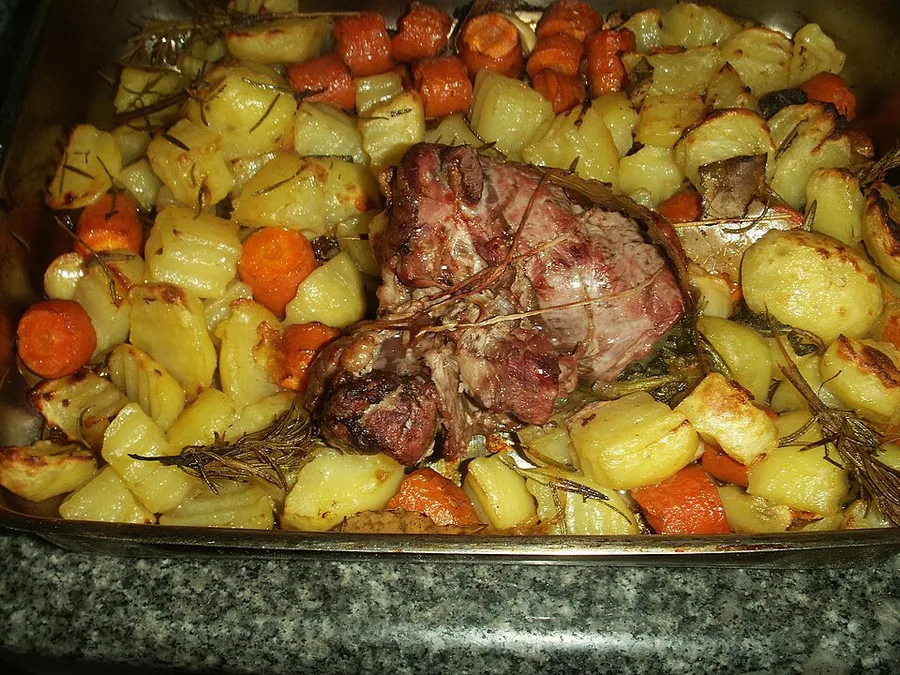
What is Sardinian Lamb?
Agnello di Sardegna has held IGP protection since 2001. It covers lamb from Sarda-breed sheep born, raised and slaughtered on Sardinia, an island with over three million sheep and the centre of Italian production of Pecorino Romano, Pecorino Sardo and Fiore Sardo.
That context explains the product. The lamb is not the point of the farm, it is the consequence: a ewe must lamb in order to give milk, and the lamb is taken off early because the milk is wanted for cheese. Calendars, slaughter weights and prices all follow from that.
The rules define three categories by carcass weight. Agnello da latte, 5 to 7 kg, fed exclusively on its mother's milk. Agnello leggero, 7 to 10 kg, which has begun to graze. Agnello da taglio, 10 to 13 kg, raised on milk and natural pasture.
Those are carcass weights, not liveweights: a 6 kg milk-fed carcass comes from an animal of roughly thirty to forty days. The meat is pale pink, almost white, with firm white fat.
What does it taste like?
Mild to the point of surprising people. Milk-fed Sardinian lamb has almost none of the strong, woolly, faintly barnyard character that defines lamb for most British and American eaters, because those compounds build up with age and with a grass diet, and a five-week-old milk-fed animal has not had time to develop them.
What is left is delicate, sweet and clean, closer to very good veal or rabbit than to a leg of hogget. The texture is soft and fine-grained, and the fat is mild rather than tallowy.
The heavier categories move along the scale. Agnello leggero and agnello da taglio have grazed, and they pick up a gentle grassy edge, more colour and more chew: still far milder than a six-month lamb, but with actual lamb character.
Roasted over wood with myrtle branches, the meat takes on a resinous, slightly bitter perfume that is the signature of Sardinian cooking and does not exist anywhere else.
How to use it
Roast it fast and season it lightly. Milk-fed lamb has very little fat and almost no collagen, so long cooking dries it out, the opposite of what a shoulder of ordinary lamb wants. Salt, olive oil, maybe rosemary or a myrtle branch, a hot oven, and take it out when the juices still run pink at the bone.
Spit-roasting over wood embers is the island's own method, and the one that justifies buying a whole animal.
Agnello con i carciofi is the Easter dish: brown the pieces, add spiny Sardinian artichokes, white wine and parsley, and in some versions finish with beaten egg and lemon. Su succhittu, from the Barbagia, stews the lamb in a sauce thickened with bread, garlic and pecorino. Cordula, a plait of offal wrapped in intestine, grilled or cooked with peas, is the most local preparation and the hardest to find off the island.
Chops go straight on the embers, two minutes a side, and are eaten with your hands. The heavier categories, having grazed, take a slow oven far better and are the ones to buy for a braise.
How long it keeps
Fresh cuts keep two to three days in the coldest part of the fridge, covered but not pressed tight under cling film, since trapped moisture makes the surface slippery and grey at the edges. A whole quarter under vacuum runs to eight or ten days on the date the butcher gives it. What changes over those days is water: the surface dries and darkens, the flesh firms, and any exposed fat picks up fridge smells. Beyond that window the date on the pack and the butcher who sold it are the reference.
It freezes better than most meat, because young lamb is lean and low in connective tissue. Portion it first, chops, shoulder, leg, into separate bags, and reckon on six months. Thaw in the fridge, twenty four hours for a large piece: at room temperature the outside warms long before the centre and the meat sheds liquid onto the plate. Roast leftovers hold a couple of days and reheat poorly whole, which is why the Sardinian answer is to bone them, cut them small and fry them with potatoes.
Spot the real thing
The Agnello di Sardegna IGP mark is stamped on the carcass and carried onto the label of packed cuts along with the abattoir code, and it is the only reference that means anything, because the phrase Sardinian lamb on its own is not protected. The colour is a very pale pink, close to white in the milk fed grades, darkening in the heavier ones. The fat is bright white, firm and dry. Red flesh or fat turning yellow belongs to an older animal.
Raw, it barely smells of anything, and that is the sharpest difference from the lamb most British and American shops sell. New Zealand, Australian and British lamb carries a woolly, pungent smell you can identify across a room, produced by compounds that build up with age and grass feeding, and in an animal a month old they have not had time to form. Size tells the same story: a hind quarter of Sardinian milk lamb weighs barely a kilo and a half, so a four kilo leg is something else. The nearest thing abroad is Spanish lechazo, or milk fed lamb from a specialist butcher.
How to pronounce Sardinian Lamb
ah-NYEL-loh dee sar-DEH-nyah
The 'gn' in both words is the sound in 'onion' or in Spanish 'senor': ah-NYEL-loh, sar-DEH-nyah. Stress on the second syllable of each. Never 'ag-nello' with a hard g, and Sardegna is three syllables, not four.
Sardinian Lamb compared
vsNew Zealand lamb
New Zealand lamb dominates the European and British market and is a completely different product. Those animals are pasture-raised for five to eight months, weigh three times as much, and taste strongly of lamb, the character most people mean by the word. Sardinian milk-fed lamb is a month old, weighs five to seven kilos on the carcass, is barely coloured and barely flavoured. New Zealand lamb is cheaper, more available, better for a slow-roasted shoulder and much more forgiving. Sardinian lamb is the one to buy if the strong flavour is exactly what you have always disliked.
| This | New Zealand lamb | |
|---|---|---|
| Age at slaughter | 4-10 weeks | 5-8 months |
| Carcass weight | 5-13 kg | 15-20 kg |
| Diet | Mother's milk, then pasture | Grass throughout |
| Meat colour | Pale pink to white | Deep red |
| Flavour | Very mild, sweet | Strong, grassy, distinctly lamb |
| Price in Italy | EUR 14-22 per kg | EUR 8-14 per kg |
| Best cooking | Fast roasting, grilling | Slow roasts, braises, curries |
vsBritish spring lamb
British lamb sits between the two. Spring lamb sold from April onwards is typically three to five months old, grass-fed, with real lamb flavour but far less than hogget or mutton. Compared with Sardinian milk-fed lamb it is larger, redder, more assertive and considerably better value; compared with New Zealand lamb it is fresher and usually more expensive. If a recipe calls for Sardinian lamb and you are in the UK, the youngest early-season British lamb you can find is the sensible substitute.
| This | British spring lamb | |
|---|---|---|
| Age | 4-10 weeks | 3-5 months (spring lamb) |
| Feeding | Milk, minimal grazing | Ewe's milk plus grass |
| Flavour | Very mild | Moderate, grassy |
| Leg weight | 1-1.5 kg | 2-2.5 kg |
| Price | Not exported | GBP 12-20 per kg for leg |
vsAbbacchio Romano IGP
The closest Italian equivalent and the most useful comparison for anyone shopping in Italy. Abbacchio Romano, from Lazio, is also milk-fed and killed young, at a carcass weight of up to 8 kg, and it is cooked in similar ways. The differences are breed and terrain: Lazio uses Sarda, Comisana, Sopravissana and Massese sheep on Apennine pasture, and the Roman kitchen finishes lamb with rosemary, anchovy and vinegar where the Sardinian one uses myrtle, wild fennel and artichoke.
| This | Abbacchio Romano IGP | |
|---|---|---|
| Region | Sardinia | Lazio |
| Carcass weight | 5-13 kg across three categories | Up to 8 kg |
| Breeds | Sarda | Sarda, Comisana, Sopravissana, Massese |
| Classic treatment | Spit-roast with myrtle, or with artichokes | Roasted with rosemary, garlic, anchovy, vinegar |
Sardinian Lamb substitutes
- Milk-fed lamb from any source
Sold as agneau de lait in France, lechazo in Spain and abbacchio in central Italy. Same animal at the same age, same handling, same mildness. This is the substitution that actually works.
1:1 - The youngest spring lamb available
In the UK and US, ask a butcher for the earliest, smallest lamb of the season rather than anything on a supermarket shelf. Look for pale meat and white fat; red meat means an older animal.
1:1, reduce cooking time slightly - Kid goat (capretto)
Milk-fed kid is comparable in size, tenderness and mildness, and is easier to find than milk-fed lamb in much of the US. Slightly leaner, so watch it does not dry out.
1:1 - Rose veal
Not lamb at all, but for the specific quality of pale, delicate, fine-grained meat in a fast roast or a fricassee with artichokes, it delivers the same result. Useful when no young lamb exists.
1:1 - Rabbit, for the artichoke and lemon dishes
In agnello con i carciofi the lamb is a mild carrier for artichoke, wine and parsley. Rabbit does the same job convincingly and is available where milk-fed lamb is not.
1:1
Where to buy it
Very little Sardinian lamb leaves Italy. There is no meaningful export chain to the US or UK, and what is sold abroad as Italian lamb usually is not IGP-certified. If you want the milk-fed style outside Italy, look for Spanish lechazo, French agneau de lait or a domestic butcher who can source genuinely young lamb.
In Italy, buy it at a butcher's counter rather than a supermarket, by the quarter or as a whole carcass. Expect 14 to 22 euros a kilo, rising to 25 or 30 in the weeks before Easter and Christmas when national demand peaks. Packaged chops in supermarkets run 28 to 35 euros a kilo.
Check for the Agnello di Sardegna IGP mark, stamped on the carcass and printed on packaged cuts with the abattoir code. The phrase 'Sardinian lamb' on its own is not protected.
Size is the quickest sanity check. A hind quarter of milk-fed Sardinian lamb weighs well under two kilos; anything the size of a four-kilo leg is a different animal.
Where to eat it in Italy
The Barbagia, the mountainous interior around Nuoro, is where this is best understood. Orgosolo, Oliena, Mamoiada and Fonni still spit-roast whole lambs over wood at village feasts and in agriturismi, and cordula appears on menus without having to be ordered in advance.
Ogliastra, on the east coast between Tortoli, Ulassai and Baunei, and the Sarcidano around Laconi have the same tradition with fewer visitors. In the Marmilla and the Campidano, lamb comes with artichokes and broad beans more often than on a spit.
In Cagliari, the San Benedetto market is the place to look at the cuts and ask where they came from. Sassari and Oristano butchers work almost exclusively local lamb.
The season decides the trip: December to April, with Easter as the week when the whole island cooks the same thing. Come in summer and there is lamb, but less of it and dearer.
Further reading
Frequently asked questions
What are the three categories of Agnello di Sardegna?
Milk-fed (agnello da latte), 5 to 7 kg carcass weight, raised only on its mother's milk; light (leggero), 7 to 10 kg, which has begun grazing; and cutting lamb (da taglio), 10 to 13 kg, raised on milk and natural pasture. All are carcass weights, not liveweights.
Why does Sardinian lamb taste so mild?
Because the animal is only weeks old and has drunk milk rather than eaten grass. The compounds responsible for the strong, woolly flavour people associate with lamb accumulate with age and grazing. This is the lamb to try if you have always disliked lamb.
How is it different from New Zealand lamb?
Age and size, mainly. New Zealand lamb is slaughtered at five to eight months and weighs three times as much, with deep red meat and a strong grassy flavour. It is also about half the price, because there is far more saleable meat per animal.
When is it available?
Mostly December to April. Sardinian ewes lamb in autumn and early winter because the milk is destined for pecorino, so lambs come to market in that window, peaking at Christmas and Easter.
Is it ethical to eat lamb this young?
That is a judgement, not a technical question, and it deserves a straight answer: a milk-fed lamb is a little over a month old. The practice exists because the ewe's milk goes to cheese, and it is long established across the Mediterranean. Anyone uncomfortable with it can choose the leggero or da taglio categories, which are older animals that have grazed.
Sources
Where to check what you just read.
- 1
L'atto del 2001 che iscrive «Agnello di Sardegna» fra le IGP nella categoria carni ovine.
- 2
Le tre tipologie previste dal disciplinare con i pesi esatti della carcassa: da latte 4,5-8,5 kg, leggero 8,5-10 kg, da taglio 10-13 kg.
- 3Consortium · interested partyCO.N.T.A.S. — Consorzio di tutela
Il consorzio con sede a Macomer che gestisce il marchio: indicazioni per allevatori, macellai e consumatori su come riconoscere l'IGP.
Related foods
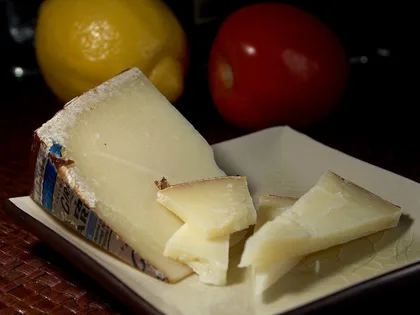 CheesePecorino SardoPecorino Sardo DOP is Sardinia's table cheese: whole sheep's milk, calf rennet, two official types.
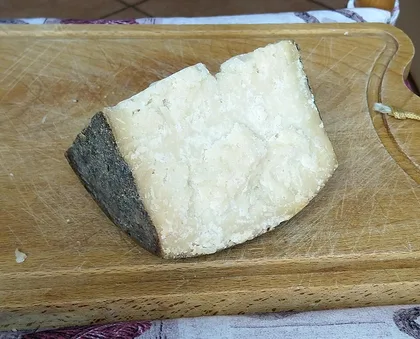 CheeseFiore SardoFiore Sardo DOP is the shepherd's pecorino of Sardinia: raw sheep's milk, lamb rennet paste, an uncooked…
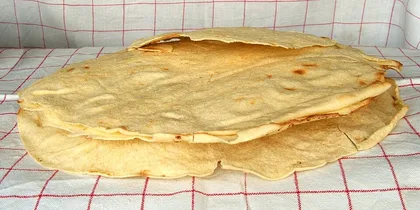 Pasta and breadPane carasauBaked twice because it had to survive months in a shepherd's saddlebag: a paper-thin disc of durum semolina…
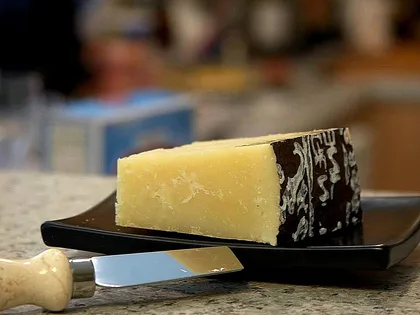 CheesePecorino RomanoPecorino Romano DOP is a hard, dry-salted sheep's milk cheese aged at least five months, made in Sardinia…
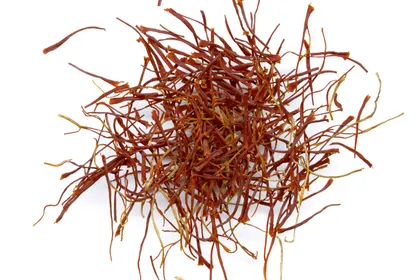 Oil and preservesSaffronOne kilo takes between 150,000 and 200,000 flowers, and every flower gives up three stigmas that have to be…
 Fish and seafoodBottargaFifteen grams a head is enough, and that is not meanness: bottarga is the salted, pressed, air-dried roe sac…
 CheeseCasu MarzuCasu marzu is a Sardinian sheep's cheese whose ripening is carried on by the larvae of the cheese fly.