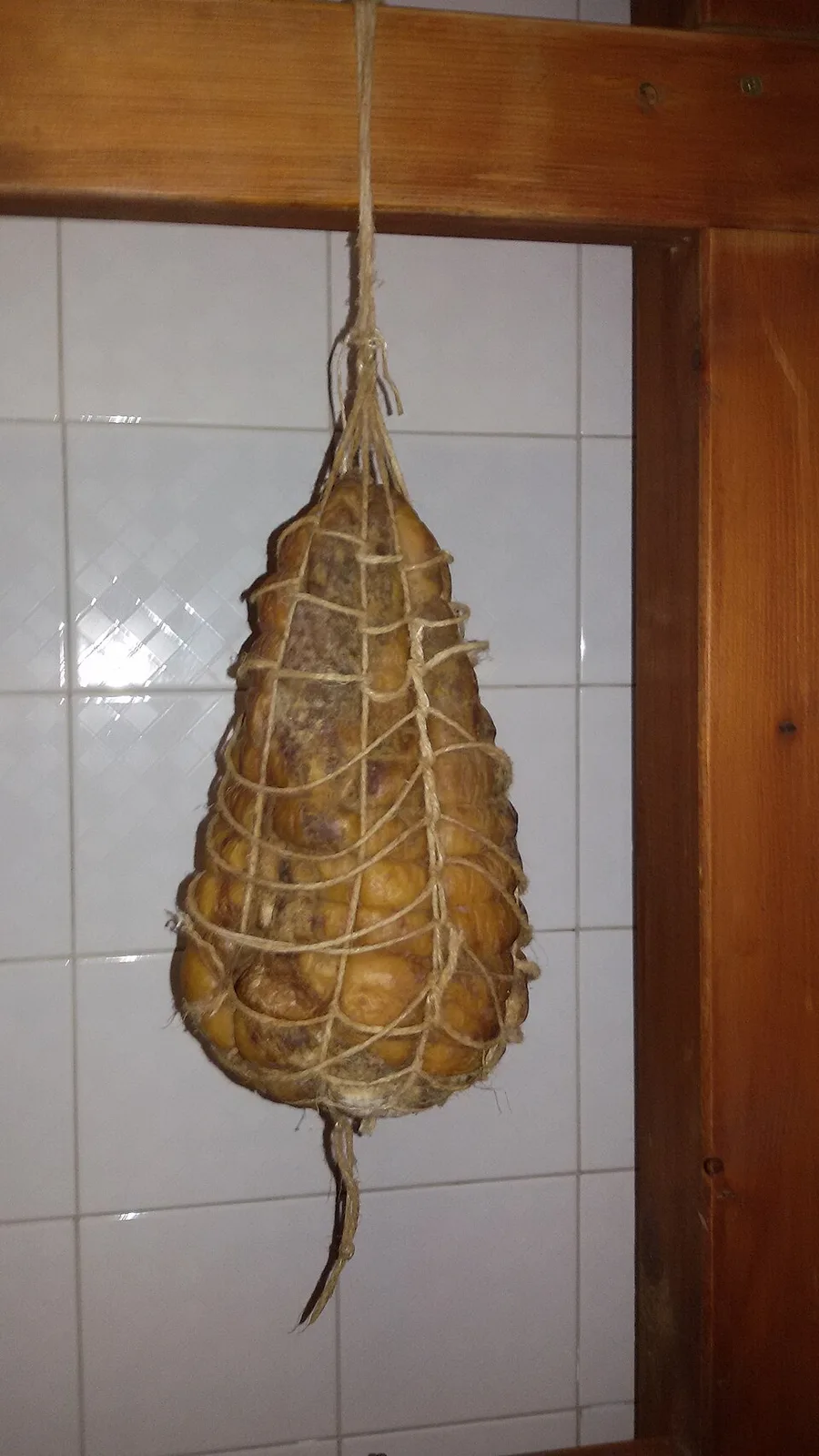
What is Spalla Cruda?
Spalla cruda is the front leg of the pig, the shoulder rather than the ham, boned, dry-salted, massaged with white wine, garlic and pepper, cased, tied and aged for twelve to eighteen months in the damp cellars of the Bassa Parmense. It is the culatello method applied to a different cut.
The cut changes everything. A shoulder is a working limb: more connective tissue, several muscle groups running in different directions, and fat marbled through the lean rather than sitting outside it. The result is more savoury and more sinewy than prosciutto, less velvety than culatello, with a sweetness underneath that a plain cured ham does not have.
There are two versions and they get confused constantly. Spalla cruda is the aged one, sliced and eaten raw like prosciutto. Spalla cotta di San Secondo is a separate product: same cut, but soaked and boiled, then served hot in thick slices with fried dough. The cooked one is the version Verdi wrote about.
At Palasone, a hamlet of Sissa in the lowlands, spalla cruda has always been made, and the place name has become shorthand for the most traditional style. There is no DOP: just a handful of producers, a shared method and an area of a few dozen square kilometres.
What does it taste like?
Savoury, faintly funky and more assertive than any supermarket prosciutto. The first impression is salt and cellar, a note of damp stone and noble mould that comes from ageing in a lowland basement rather than a climate-controlled room, followed by sweet pork and a lingering trace of garlic and white wine.
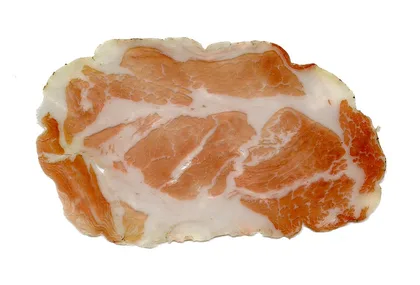
Texture is the thing people notice. The slice is not a uniform pink sheet: it is a mosaic of muscle bundles in slightly different shades, separated by fine seams of fat and translucent connective tissue. It chews rather than melts, in a good way, and each part of the piece tastes marginally different from the last.
Set against culatello, spalla is louder and rougher. Set against Parma ham, it is deeper, saltier and more animal. Long-aged pieces develop nutty, almost cheese-like notes from the mould on the outside, and the exterior edge is always more concentrated than the centre.
How to use it
Slice it by hand with a long knife, thin but not translucent, changing the angle as you work through the piece: the muscle bundles run in different directions and a fixed angle gives you tough slices from some of them. This is why the Bassa cuts spalla by knife and culatello even more so.
The canonical partner is torta fritta: squares of dough fried in lard, served hot, with the meat laid on top so its fat softens. Locally it is never called gnocco fritto, which is the Modena name for the same idea. On ordinary bread it works, but the pairing loses its point.
Unlike culatello, spalla takes company well. Pickled vegetables, salted butter on bread, mostarda, a wedge of Parmigiano Reggiano: all fine. Trimmings and the concentrated outer edge go into pasta sauces and into the filling for anolini.
Serve at room temperature and slice to order. Straight from the fridge, a cured shoulder gives you salt and very little else.
How long it keeps
A whole piece that has not been started hangs in a cool damp cellar, where it goes on ageing and losing weight. In a fridge, wrap it in a tea towel rather than film, which takes away the dry protective surface it has spent months building. Once you cut into it, cover the face with greaseproof paper or a sheet of its own fat and work through it over four to six weeks, taking off the outer veil each time, because that layer has oxidised and gone dark.
Vacuum-packed it holds around six months to the date on the pack, and it wants opening two days before you slice it: vacuum compresses the aromas and leaves a closed smell that disperses on its own in the fridge. Already sliced, it oxidises within hours like every long-fibre salume, the red dulling towards brown at the edges, so it is bought in small amounts and laid flat between sheets of paper. White and grey bloom outside is normal and wanted, wiped off with a cloth dampened in white wine before slicing; anything else is a question for the shop and the label.
Spot the real thing
The cut face is uneven and it is meant to be. Muscle bundles of different colours sit side by side, separated by thin lines of fat and connective tissue, the opposite of the uniform slice a prosciutto gives and the first thing telling you which of the two you bought. The colour runs from red to dark red, deepest towards the outside. The fat is white and should stay on the slice, since it is sweet and carries the aroma; the connective veins should be thin and translucent, and thick white ones that stay chewy mean bad trimming.
On the nose expect damp cellar, noble mould and earth over the cured meat, with wine and garlic underneath; a clean, neutral smell points to ageing in a climate-controlled chamber, correct but less interesting. The texture is soft with sinew behind it. Hard, and slices that snap, means it aged too long or too dry; slippery and slack means a long spell in vacuum. Look on the label for the comune: Sissa, Palasone, San Secondo, Roccabianca or Colorno. Do not confuse it with the cooked spalla cotta from the same town.
How to pronounce Spalla Cruda
SPAH-lah KROO-dah
Four syllables, stress on the first of each word. The double l in spalla is held a beat longer than an English l: SPAHL-lah. Cruda has a rolled r and a long 'oo': KROO-dah. It simply means 'raw shoulder', which is why you will also see spalla cotta, KOT-tah, the cooked version.
Spalla Cruda compared
vsCulatello di Zibello
Same cellars, same fog, same technique, different piece of the animal, and about double the price. Culatello is the heart of the hind leg, boned and skinned, sewn into a pig's bladder and aged at least ten months; it is the most prized cured meat in Italy and eats like silk. Spalla is the front leg, with more connective tissue and a more complicated internal structure, aged the same way. If culatello is the aria, spalla is the working orchestra: less refined, more substance, far more affordable.
| This | Culatello di Zibello | |
|---|---|---|
| Cut | Front leg (shoulder) | Heart of the hind leg |
| Casing | Natural casing, netted and tied | Pig's bladder, hand-tied |
| Ageing | 12–18 months | 10 months minimum, often 18–36 |
| Texture | Fibrous, multi-muscle, chewy | Uniform, silky, melting |
| Flavour | Savoury, rustic, garlicky | Sweet, delicate, perfumed |
| Protection | None | DOP since 1996 |
| Price at source | 28–42 €/kg | 60–90 €/kg |
vsProsciutto crudo (Parma ham)
The obvious reference point for anyone who has never seen a cured shoulder. Parma ham is the hind leg, bone-in, cured with nothing but sea salt, aged at least twelve months in the hills south of the city, and deliberately sweet and mild. Spalla cruda comes from the plain north of the city, is seasoned with pepper, garlic and wine, and is boned before curing. Expect a stronger, saltier, more textured product from a much smaller number of makers.
| This | Prosciutto crudo (Parma ham) | |
|---|---|---|
| Cut | Shoulder, boned | Hind leg, bone-in |
| Seasoning | Salt, pepper, garlic, white wine | Sea salt only |
| Curing zone | Po lowlands, humid and foggy | Hills south of Parma, ventilated |
| Slice | Uneven, multi-muscle | Uniform |
| Flavour | Savoury, cellar notes | Sweet, clean |
| Availability | Rare outside Emilia | Everywhere |
vsSpalla cotta di San Secondo
Worth separating clearly, because searching for one turns up the other. Spalla cotta is the same shoulder, salted and cased, but then soaked in water and simmered for hours, and it is served hot and thickly sliced with torta fritta. It is soft, juicy and closer to a boiled ham than to a cured one. This is the version Verdi bought, gave away and wrote cooking instructions for in an 1872 letter to the conductor Angelo Mariani.
| This | Spalla cotta di San Secondo | |
|---|---|---|
| Preparation | Air-dried 12–18 months | Soaked, then simmered for hours |
| Served | Raw, thin slices, room temperature | Hot, thick slices |
| Texture | Firm, fibrous | Soft, juicy, ham-like |
| Keeps | Months | Days, once cooked |
| Verdi's letter | Not this one | This one |
Spalla Cruda substitutes
- Culatello di Zibello
The upgrade rather than the substitute: same cellars, finer cut, roughly double the price. Use it anywhere spalla is called for, but serve it alone and unadorned: it is too delicate for pickles or butter.
1:1 - Paleta ibérica or paleta serrana
Spain does exactly the same thing: paleta is the cured front leg, sold alongside the jamón from the hind leg and always cheaper. Structurally the closest substitute in the world, and far easier to find in the US and UK.
1:1 - Prosciutto di Parma or Toscano
Widely available and reliable. Parma is sweeter and more uniform, Toscano saltier and herbal. Neither has the cellar funk of a good spalla, so serve them with something sharp, pickled vegetables or mostarda, to fill the gap.
1:1 - Coppa or capocollo
The cured neck: another multi-muscle cut with marbled fat and a similar mosaic slice. More spiced than spalla and softer, but it eats the same way, on a board with fried dough or bread.
1:1 - Speck Alto Adige
Only when smoke is acceptable. It brings the savoury, juniper-and-pepper side and the firm chew, and it is stocked almost everywhere. It will not give you the damp-cellar note that defines spalla.
1:1 - Pork-free: bresaola or cured beef shoulder
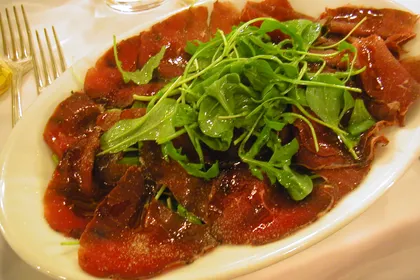
Bresaola is air-dried beef, lean and clean; a few Italian producers also cure beef shoulder in a similar style. Both are much leaner, so dress the slices with olive oil and cracked pepper before serving.
1:1
Where to buy it
In Italy, buy from producers in Sissa Trecasali, Palasone, San Secondo Parmense, Roccabianca and Colorno, or from delicatessens in Parma. A whole boned piece runs 28 to 42 euro per kilo at source; sliced at a counter, 45 to 60. That is roughly half the price of culatello of the same age, which is the strongest argument for it.
Outside Italy it is scarce. When US importers list it, expect 34 to 48 dollars per pound; in the UK, 48 to 65 pounds per kilo through Italian specialists. European buyers do best ordering vacuum-packed pieces directly from Bassa producers.
When buying, look for the town on the label and for a cut face that shows several muscle groups and fine seams of fat. A perfectly uniform slice suggests a leg product sold under the wrong name.
Where to eat it in Italy
Sissa Trecasali and its hamlet of Palasone, where the most traditional version is made, and San Secondo Parmense, the shoulder town proper, whose annual fair, held between late August and September, is dedicated to the cooked version.
Along the culatello road through Roccabianca, Zibello, Polesine Parmense and Busseto, every trattoria puts spalla on the board next to culatello, fiocco and strolghino. The whole circuit is about twenty kilometres and makes an easy day out from Parma.
Busseto and Roncole are Verdi country: his birthplace, the small theatre named for him, and a few kilometres away at Sant'Agata di Villanova sull'Arda the villa where he lived for fifty years. Eating spalla and fried dough after the visit is what everyone does, and it is the right instinct.
Recipes with it
Further reading
Frequently asked questions
What is spalla cruda?
The pig's shoulder, boned, dry-salted with pepper, garlic and white wine, cased and aged twelve to eighteen months in the humid cellars of the Bassa Parmense north of Parma. It is cured and sliced like prosciutto, but from the front leg rather than the hind.
How is it different from culatello?
Different cut, same technique. Culatello is the heart of the hind leg, aged in a pig's bladder, uniform and silky, DOP protected and expensive. Spalla is the front leg, more fibrous and more savoury, with no DOP, at roughly half the price.
Is this the ham Verdi wrote about?
Not quite. Verdi's famous 1872 instructions to the conductor Angelo Mariani describe cooking spalla cotta di San Secondo, the soaked-and-simmered version served hot. Spalla cruda is the air-dried version of the same cut, eaten raw. Verdi bought and gifted the shoulders of San Secondo regularly; his village, Roncole di Busseto, is a few kilometres away.
Why is the slice uneven?
Because a shoulder is made of several muscle groups running in different directions, separated by fat and connective tissue. That mosaic is characteristic of the cut, not a flaw, and it is why the meat is sliced by hand with a changing angle.
How do you pronounce spalla cruda?
SPAH-lah KROO-dah, stress on the first syllable of each word, with the double l held slightly longer than in English and a rolled r in cruda.
Related foods
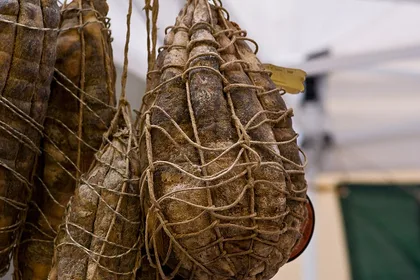 Cured meatsCulatello di ZibelloCulatello di Zibello is the heart muscle of a pork leg, boned out, sewn into a pig's bladder, tied by hand…
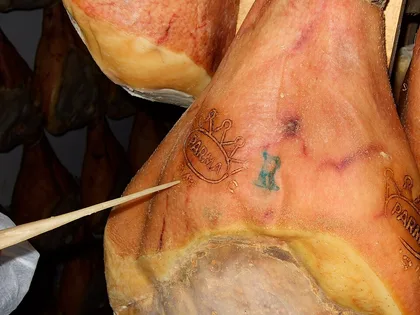 Cured meatsProsciutto di ParmaProsciutto di Parma DOP is Italian ham made from three things only: pork, sea salt and at least 400 days.
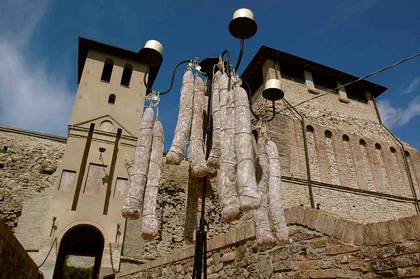 Cured meatsSalame FelinoSalame Felino IGP comes from a village of four thousand people in the hills above Parma.
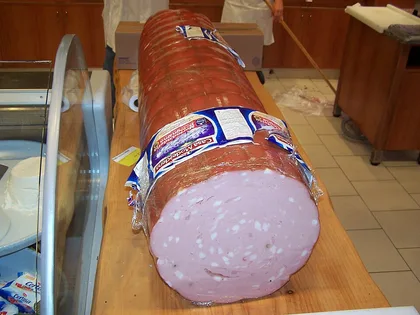 Cured meatsMortadellaThe white cubes are not just any fat: they are jowl, the firmest part of the pig, and they stay whole…Cured meatsPancettaPancetta is Italian cured pork belly: salt, pepper and warm spices, dried for months, never smoked.
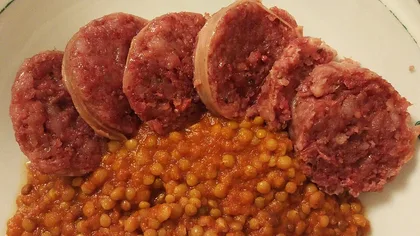 Cured meatsCotechinoCotechino is a large fresh pork sausage from Emilia-Romagna, made with pork meat, fat and rind, and always…
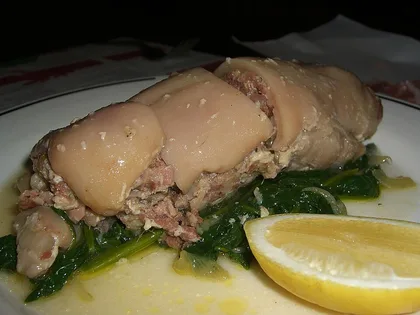 Cured meatsZamponeZampone Modena IGP is spiced pork and rind forcemeat stuffed into a boned pig's trotter: same filling as…
 Cured meatsCoppa PiacentinaCoppa Piacentina is dry-cured pork neck from the province of Piacenza, seasoned with cloves, cinnamon and…