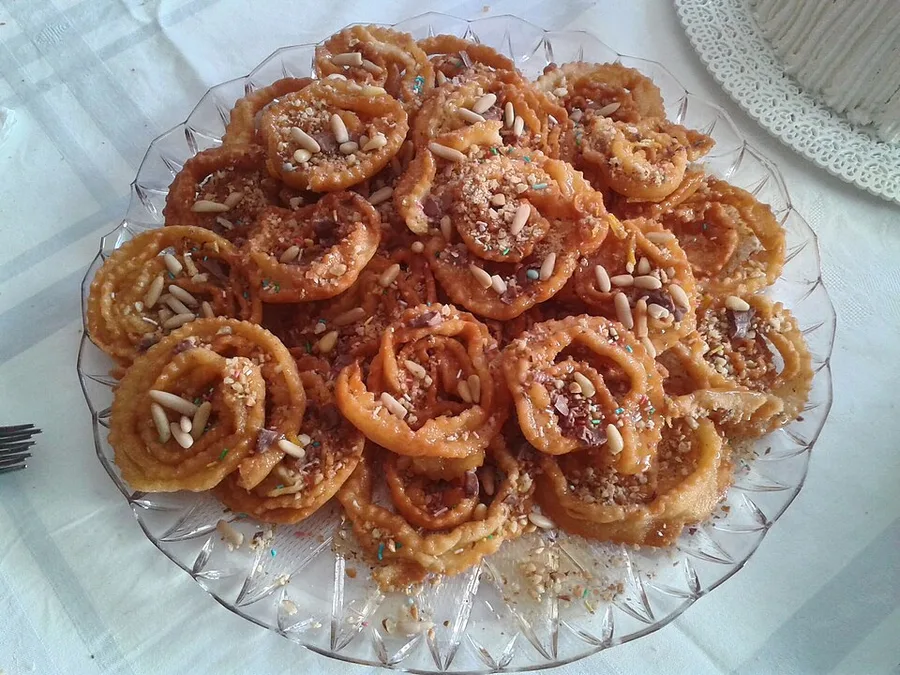
What is Cartellate?
Cartellate are strips of dough rolled to a millimetre or less, folded lengthwise, pinched at regular intervals to create a row of little windows, then coiled into a rose six to eight centimetres across. They are fried, then dipped while still warm into vincotto (grape or fig must cooked down to a syrup) or into warmed honey.
The dough is deliberately poor and eggless: flour, extra virgin olive oil, warm white wine, a pinch of salt. No sugar goes into it at all, because all the sweetness arrives at the end. This matters more than it sounds: the pastry stays neutral and brittle, and the syrup runs through it without meeting any competing sweetness.
The shape is functional, not decorative. Those pinched windows create dozens of small pockets that trap syrup, which is why a properly made cartellata keeps releasing vincotto for two or three days after dipping, while a flat fried ribbon sheds it onto the tray within an hour.
They are strictly seasonal. Production starts around 8 December, the feast of the Immaculate Conception, and stops after Epiphany. Outside those weeks, almost nobody in Puglia makes them.
What does it taste like?
The first impression is texture, not flavour: a shattering, blistered crispness on the ridges and a soft, syrup-soaked centre where the pockets have filled. Because the dough itself is unsweetened, the sweetness arrives in a single wave and then recedes.
With grape vincotto the flavour is dark and faintly sour, closer to balsamic vinegar or pomegranate molasses than to sugar syrup: raisin, fig, a tannic edge at the back. With fig vincotto it is rounder, jammier, more obviously sweet. With honey it is floral and lighter, and the fried dough comes through much more clearly.
There is a savoury undertow throughout, from the olive oil in the dough and the olive oil they are fried in. It stops the sweetness from becoming cloying and is the reason two or three cartellate feel like a reasonable portion rather than one.
Eaten on the day they are made they are crisp and a little hollow; on day three they are at their best, the syrup having migrated inward and the pastry softened without collapsing.
How to use it
Serve them at room temperature, on a flat tray, ideally in a single layer. They are fragile and they stick, so stacking crushes the ridges and welds the roses together.
Eat them with your fingers, and give them two or three days. This is the one fried sweet in the Italian repertoire that improves with time: the syrup migrates into the pockets, the pastry softens just enough, and the flavour rounds out. Straight from the vincotto bath they are good; on day three they are what they are supposed to be.
Decoration stays minimal: ground cinnamon, chopped toasted almonds, grated orange zest, or the coloured aniseed sprinkles Apulians call diavolilli. Icing sugar has no place here and dissolves into streaks on the syrup.
If you are making them, fry a batch and set it aside undipped: undipped cartellate stay crisp in a tin for three or four weeks and can be steeped on demand, which is how Apulian households keep a fresh tray going from Christmas to Epiphany. Leftovers break into shards over fresh sheep's ricotta or fiordilatte gelato.
How long it keeps
There are two states and they keep completely differently. Fried but undipped, cartellate are dry pastry: an airtight tin at room temperature holds them crisp for three or four weeks, which is how Apulian households ration them from Christmas to Epiphany, steeping a fresh tray as needed. Dipped in vincotto or honey they go into a covered container in a single layer, with baking paper between layers if you must stack, and they sit at room temperature rather than in the fridge, reckoned locally at about two weeks.
Dipped, they change for the better for a while and then keep changing. Over the first two or three days the syrup works into the pockets and the pastry softens from brittle to yielding, which is when Apulians consider them ready; after a week or two it has gone all the way and the rose is soft throughout, with the fried notes faded. The syrup itself darkens and thickens as water leaves it. Undipped ones simply stale, losing their snap and taking up humidity from the air. Neither version wants the fridge, which softens pastry fast, and neither freezes usefully.
Spot the real thing
A cartellata is a rose: one long strip of thin dough with a fluted edge, pinched shut at intervals so the strip forms a chain of open pockets, then wound into a spiral about six to eight centimetres across. Those pockets are the whole design, because they hold the syrup. The dough carries no eggs, only flour, white wine and olive oil, so it fries pale gold and stays hard rather than puffing. Under vincotto it turns glossy dark brown; under honey, amber and lighter.
In an Italian bakery abroad it sits next to things it is not. Chiacchiere or frappe are flat ribbons under icing sugar, struffoli are small honey coated balls from Naples, and Greek diples are rolled ribbons. Read the coating on the box: vincotto, cooked grape must, is the Apulian original and tastes bittersweet with an edge, while honey versions are simply sweet, and a fig syrup version exists too. Baked rather than fried ones are dry and matte. Boxes from Puglia run $16 to $30 a kilo and appear only from late November.
How to pronounce Cartellate
kar-tel-LAH-teh
Four syllables, stress on the third. The double 'l' is held slightly longer than an English 'l'. The final 'e' is pronounced as a short 'eh', never 'kar-tel-LAYT' or 'kar-tel-LAH-tay'. The singular is cartellata, kar-tel-LAH-tah. Vincotto is veen-KOT-toh.
Cartellate compared
vsStruffoli
The two great Christmas fried sweets of southern Italy, and they are not variations on each other. Struffoli are Neapolitan: small balls of egg-rich dough, fried and tossed in honey, then piled into a mound and covered in sprinkles and candied peel. Cartellate are Apulian: eggless ribbons rolled paper-thin, shaped by hand into individual roses, and steeped in vincotto. Struffoli are a communal mound you spoon from; cartellate are counted out one per person, and are noticeably less sweet.
| This | Struffoli | |
|---|---|---|
| Region | Puglia | Campania, above all Naples |
| Dough | Flour, olive oil, white wine (no eggs) | Flour, eggs, butter or lard, sugar |
| Shape | Coiled rose, 6-8 cm, one per person | Pea-sized balls, piled in a mound |
| Syrup | Vincotto, or honey | Mild honey, always |
| Decoration | Cinnamon, almonds, aniseed sprinkles | Diavulilli sprinkles, candied peel |
| Best eaten | Two to three days after making | Within a day or two, while glossy |
| Sweetness | Moderate, with a sour edge | High, honey-forward |
vsChiacchiere
Same family, different feast, opposite finish. Chiacchiere (also called frappe, bugie, crostoli and a dozen other regional names) are Carnival sweets: flat rectangles of egg-and-butter dough fried until blistered and dusted with icing sugar. They are dry, light and eaten by the handful. Cartellate are Christmas, shaped rather than cut, and wet with syrup. The giveaway is the finish: nothing steeped in vincotto is a chiacchiera.
| This | Chiacchiere | |
|---|---|---|
| Season | Christmas to Epiphany | Carnival, before Lent |
| Dough | Eggless, oil and wine | Eggs, butter, sugar, often liqueur |
| Shape | Pinched ribbon coiled into a rose | Flat rectangles, often slashed |
| Finish | Steeped in vincotto or honey | Dusted with icing sugar |
| Texture | Crisp ridges, syrup-soaked centre | Dry, blistered, shattering |
| Shelf life | Ten to fifteen days | Three or four days at best |
vsVincotto vs honey
The choice to make before you buy, because it produces two genuinely different sweets. Grape vincotto is must from Negroamaro, Primitivo or local table grapes cooked down to a third of its volume: dark, thick, faintly sour, with a tannic finish. Fig vincotto, common in the Salento, is made from dried figs and is sweeter and jammier. Honey, favoured around Foggia and the Gargano, gives a lighter and more floral result in which the fried dough stays audible. Anyone making a large batch usually splits it and does both.
| This | Vincotto vs honey | |
|---|---|---|
| Colour | Almost black (grape), deep brown (fig) | Amber, translucent |
| Flavour | Raisin, sour edge, tannic finish | Floral, straightforwardly sweet |
| Regional home | Bari, Murgia, Salento | Foggia, Gargano |
| Sweetness | Moderate | High |
| Keeps | Ten to fifteen days | Around a week |
Cartellate substitutes
- Pomegranate molasses for vincotto
The closest widely available stand-in, and closer than most Italian cooks would admit. It has the same dark colour, the same syrupy body and the same sour-sweet balance. It is more acidic than grape vincotto, so soften it with a spoonful of honey before warming.
1:1, plus 1 tbsp honey per 200 ml - Saba or mosto cotto
Emilia-Romagna and Sardinia both produce cooked grape must under different names, and it is technically the same product as Apulian vincotto. Sold in Italian delis year-round and often easier to find than vincotto itself. Use it exactly as it comes.
1:1 - Date syrup or fig syrup
The best substitute for the Salento fig version. Thinner than fig vincotto, so reduce it gently for five minutes before dipping, and add a strip of lemon peel to the pan to cut the sweetness.
1:1, reduced by about a fifth - Honey thinned with orange juice
Not a substitute for vincotto but the second traditional finish in its own right. Warm mild honey (acacia or wildflower, never chestnut) with a spoonful of orange juice or water so it flows into the pockets instead of sitting on the surface.
3 parts honey to 1 part juice - Dry vermouth for the white wine
The warm wine in the dough does real work: the alcohol relaxes the gluten and evaporates in the fryer, making the pastry blister. Dry vermouth or dry marsala both work; water alone gives a tougher, flatter result. Note that the dough is already vegan, so with vincotto rather than honey the whole sweet is too.
1:1
Where to buy it
In Puglia, from any pasticceria between 8 December and Epiphany, at 20 to 32 euro a kilo. A half-kilo tray is fifteen to twenty roses and costs 12 to 16 euro. Outside those weeks, they simply are not sold.
Abroad they are rare and strictly seasonal. Italian delis in the US stock them in December at roughly 16 to 26 dollars a pound; in the UK expect 28 to 45 pounds a kilo, usually in gift tins. Online Italian grocers ship them from Puglia in December, and they travel well because the vincotto acts as a preservative.
Vincotto itself is far easier to find than the pastry: Italian specialists in London and New York carry Apulian grape and fig vincotto year-round at 8 to 16 euro for half a litre. Read the label: anything listing glucose syrup and caramel colour instead of cooked must tastes flat and is a different product.
Where to eat it in Italy
Bari in December is the obvious place: the pasticcerie of the old town and of via Sparano fill their windows with trays from 8 December onwards, and the Murgia towns inland (Altamura, Gravina, Bitonto) do the same.
In the Salento, around Lecce, Nardò and Maglie, the standard finish is fig vincotto, darker and deeper than the grape version used further north. Tasting both on one trip is the quickest way to understand the sweet.
The Christmas markets in Lecce and the village fairs across the Murgia in mid-December are the best chance to watch cartellate being pinched and coiled by hand, which explains the price better than any label can.
Further reading
Frequently asked questions
What are cartellate made of?
Flour, extra virgin olive oil, warm white wine and salt: no eggs, no sugar, no butter. The dough is rolled paper-thin, pinched into pockets, coiled into roses, fried, and then steeped in vincotto or honey, which supplies all the sweetness.
What is vincotto?
Cooked must: grape juice (usually Negroamaro or Primitivo) simmered down to about a third of its volume into a dark, syrupy, faintly sour reduction. A fig version, made from dried figs, is common in the Salento. It is not a wine and contains almost no alcohol. Pomegranate molasses and saba are the closest substitutes.
Why do cartellate have to dry before frying?
The dough has to lose surface moisture so the coil holds. A freshly shaped cartellata unwinds in the first seconds in the oil. Twelve hours resting on a floured cloth is the minimum, twenty-four in humid weather.
How long do cartellate keep?
Ten to fifteen days in a tin at room temperature once steeped, and three to four weeks if fried but left undipped. Never refrigerate them: the cold turns the pastry leathery overnight and condensation ruins the surface.
How do you pronounce cartellate?
kar-tel-LAH-teh, stress on the third syllable, with the final 'e' clearly sounded. One of them is a cartellata, kar-tel-LAH-tah.
Related foods
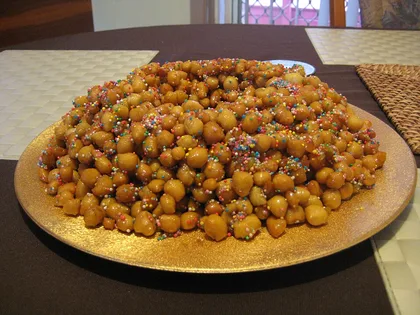 SweetsStruffoliStruffoli are tiny balls of fried dough tumbled in warm honey, heaped into a ring and scattered with candied…
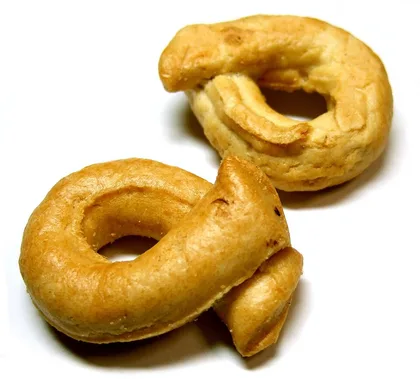 Pasta and breadTaralliTaralli are small, crunchy savoury rings from Puglia in southern Italy, made from just flour, dry white wine…
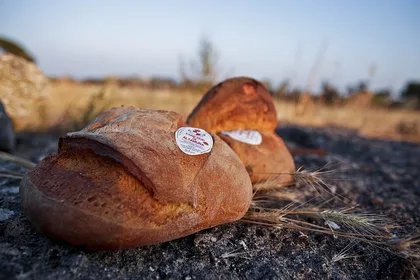 Pasta and breadPane di AltamuraPane di Altamura is a durum-wheat sourdough from the Murgia plateau in Puglia, and in 2003 it became the…
 SweetsCotognata (Quince Paste)Cotognata is quince pulp cooked with sugar and then air-dried for days in moulds until it sets into a firm…
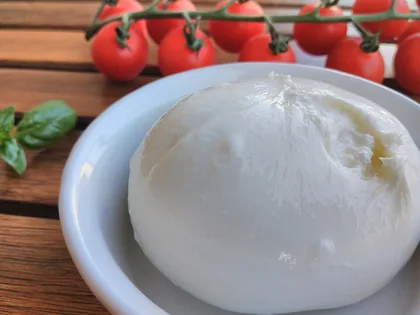 CheeseBurrataIt began as a way of using offcuts: leftover shreds of pasta filata, drowned in cream and sealed inside a…
 CheeseMozzarellaThe name is a verb before it is a cheese: mozzare means to lop off, which is what the cheesemaker does by…
 Pasta and breadOrecchietteOrecchiette are Puglia's handmade pasta: semolina and water, no egg, dragged with a knife and flipped over a…
 Cured meatsCapocolloCapocollo is the pork neck muscle, salted whole and aged in casing.