What to eat in Bergamo
Bergamo eats casoncelli dressed with melted butter, crisp pancetta and sage, polenta taragna beaten with mountain cheese, and scarpinocc from Parre. The province has more protected cheeses than any other in Europe (taleggio, strachitunt, Formai de Mut, gorgonzola), and stracciatella ice cream was invented here in 1961.
Bergamo is two cities stacked on each other and it eats in two ways. The lower town is Lombard plain: maize, cured meats, a kitchen that looks like Brescia's and Milan's. The upper town, inside Venetian walls that became a UNESCO site in 2017 and reachable by a funicular running since 1887, faces the valleys, which means butter, cheese and stale bread. Milan's reference dish is yellow risotto, Brescia's is the spit roast; here filled pasta is almost never served with tomato but with browned butter, crisp pancetta and sage.
The reason is milk. Nine protected cheeses are made in this province: Taleggio, Strachitunt, Formai de Mut dell'Alta Valle Brembana, Quartirolo Lombardo, Gorgonzola, Bitto, Salva Cremasco, Provolone Valpadana and Grana Padano, a count with no equal in Europe. The Val Taleggio, a side valley of the Brembana a few dozen kilometres wide, gave taleggio its name and makes strachitunt, the two-curd blue from which gorgonzola descends. Above Branzi and Valtorta, Formai de Mut is still made with summer pasture milk. The valleys do not resemble each other: the Brembana of mountain cheeses, the Seriana of scarpinocc and the spiny maize of Gandino, the Val di Scalve, the Valle Imagna of capù.
The dishes of Bergamo
Casoncelli alla bergamasca
Half-moon ravioli with a filling that surprises anyone meeting it for the first time: beef, sausage, Grana Padano, breadcrumbs, and then crushed amaretti, raisins and pear, which pull the whole thing towards sweet and sour. The dressing is fixed and involves no sauce: melted butter, thickly cut pancetta crisped in the pan, sage, grated cheese. They are served counted out, seven or nine a head.
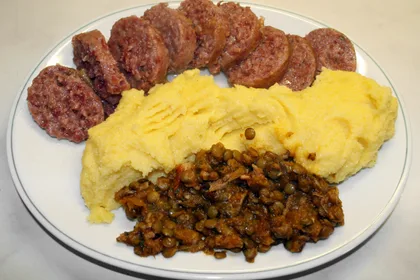
Polenta taragna
Maize flour mixed with buckwheat, which gives it the dark colour and the toasted taste, cooked for an hour and then beaten with butter and chunks of valley cheese, young Branzi or Formai de Mut. The name comes from the tarèl, the long stick you stir it with without stopping. Eat it on its own in a deep plate, or under a braise.
Scarpinocc di Parre
Filled pasta from the Val Seriana shaped like a clog pinched at the sides, which is what the dialect name means. The filling has no meat: stale bread, cheese, butter, nutmeg and cinnamon, the legacy of a valley where meat was rare. They are dressed with melted butter and grana, and the August festival at Parre cooks them by the hundredweight.
Taleggio from the Val Taleggio
A square washed-rind cheese, soft under the rind and firmer in the middle, that smells far stronger than it tastes. In the valley that named it, it is still aged in the natural caves around Vedeseta, where cold draughts hold the humidity steady. In the kitchen it ends up melted over polenta or inside capù; at the table it goes with chestnut honey.
Strachitunt, the father of gorgonzola
It is made in the Val Taleggio by layering the evening curd over the morning one, leaving gaps where the mould grows by itself without being injected: this is how blues were made before industry, and gorgonzola descends from the technique. It has been DOP since 2014 and only a handful of dairies between Taleggio and Vedeseta make it.
Uccelli scappati
Skewers of pork, pancetta and sage cooked in butter, invented as a stand-in for small birds once hunting became rare or banned: the name, escaped birds, says exactly that. They are served on polenta, which takes up the pan juices. They have replaced the savoury polenta e osei on trattoria menus.
Capù of the Valle Imagna
Rolls of cabbage leaf, or chard in summer, filled with stale bread soaked in milk, cheese, eggs, salame and nutmeg, tied and stewed in butter with a little broth. They are the clearest example of how old bread was never thrown away here. Eat them hot, two or three a head, as a single course.
The Bergamo cheese board
Ordering one in an upper-town trattoria brings five or six pieces that each stand for a valley: young Branzi, mountain-pasture Formai de Mut, ripe taleggio, strachitunt, a goat's cheese from Valtorta. They come with mostarda and chestnut honey.
Local products
The nine protected cheeses are the real capital: Taleggio and Strachitunt from the Val Taleggio, Formai de Mut from the upper Valle Brembana, Quartirolo Lombardo, Gorgonzola, Bitto, Salva Cremasco, Provolone Valpadana and Grana Padano. Beside them are undenominated cheeses that are worth as much: Branzi FTB, used to finish taragna, Agrì di Valtorta and the old-style stracchino of the Orobie valleys, both Slow Food Presidia. The formaggelle change name from valley to valley and are only sold in the dairies.
On the land the identity crop is the spiny maize of Gandino, an old Val Seriana variety brought back by a handful of growers in the 2000s: it gives a more fragrant polenta and also goes into bread and biscuits. On wine the province plays two distant cards: Valcalepio DOC from the hills towards Lake Iseo, and Moscato di Scanzo DOCG, a red passito from grapes dried on racks, made on a little over thirty hectares in the single municipality of Scanzorosciate.
Sweets and pastries
Sweet polenta e osei is the city's edible souvenir: a dome of sponge and buttercream coated in yellow marzipan, with three chocolate birds on top imitating spit-roasted songbirds over polenta. Buy it at Cavour 1880 on via Gombito. Torta Donizetti is the breakfast cake: a tall ring with candied pineapple and apricot in the batter and no icing, created by Pasticceria Balzer and dedicated to the composer, who was from here.
The most exported contribution, though, is stracciatella ice cream, invented in 1961 by Enrico Panattoni at La Marianna in Colle Aperto: fiordilatte with hot dark chocolate poured over it, which sets on contact with the cold and shatters into splinters. Up in the valleys the salvage sweets remain: bread cake with raisins, and biscuits made with Gandino maize.
Where to try them
Bergamo has no historic covered market like the Emilian cities: serious shopping happens in the valley dairies and in the shops along the Corsarola, the via Gombito and via Colleoni axis that crosses the upper town. There you find Cavour 1880 for polenta e osei, Al Donizetti for cheese and salumi boards, and Vineria Cozzi, open since 1848, where Valcalepio is drunk at the counter. Da Mimmo on via Colleoni has made casoncelli and pizza for decades; Trattoria del Teatro in piazza Mascheroni keeps the classic Bergamo menu; the Circolino, built into the former Sant'Agata prison, is where locals eat in the courtyard in summer. In the lower town the reference trattoria is Ol Giopì e la Margì in Borgo Palazzo, and Pasticceria Balzer is under the arcades of the Sentierone.
For cheese you have to climb: the Latteria Sociale of Branzi sells Branzi FTB where it is made, the cooperative dairies of the upper Valle Brembana still work their members' milk, and in the Val Taleggio the dairies show their ageing caves. Anyone who wants to see it all at once waits for October and goes to Forme, the cheese festival that takes over the upper town for a few days.
When to go
Summer is the season of the high pastures: from June to September the huts of the upper Valle Brembana and the Val di Scalve make Formai de Mut with pasture milk, and many can be visited. In August the scarpinocc festival fills Parre; in early September the Fiera di Sant'Alessandro is still an agricultural fair with animals and machinery; in the second week of September Scanzorosciate opens its cellars for the Moscato di Scanzo feast.
October is the month of Forme and of mushrooms in the valleys. From November to February the cooking is at its best: taragna, casoncelli, braises, and the Christmas markets in the upper town with the walls lit. On 31 January at Ardesio, in the Val Seriana, the Scasada del Zenerù drives winter out with cowbells.
Food tours and classes here
Recipes from here
Guides that cover this city
Frequently asked questions
What dish is Bergamo known for?
Casoncelli alla bergamasca, half-moon ravioli filled with meat, amaretti and raisins, dressed with melted butter, crisp pancetta and sage. Next comes polenta taragna, maize and buckwheat, beaten with butter and valley cheese. Anyone short of time orders both with a cheese board and has seen most of it.
How do Bergamo casoncelli differ from the Brescia ones?
In the filling and the shape. The Bergamo version has amaretti, raisins and sometimes pear, so a clear sweet-and-sour base, and is folded into a half-moon. Brescian casoncei have a leaner filling of bread, cheese and meat with nothing sweet, and are often shaped like a wrapped sweet. The butter, pancetta and sage dressing is common to both.
Why does Bergamo have so many protected cheeses?
Because the province has five Alpine valleys with high summer pastures and a dairy plain a few dozen kilometres away, and it kept its cooperative dairies where elsewhere they disappeared. Nine protected cheeses are made here, plus dozens of undenominated formaggelle you can only find up the valleys.
Was stracciatella really invented in Bergamo?
Yes, and the address is known: the La Marianna gelateria in Colle Aperto, at the entrance to the upper town, where in 1961 Enrico Panattoni poured hot dark chocolate into churning fiordilatte and got the shards. The name comes from Roman stracciatella soup, because of how it looks. The place is still there.