What is Marzolino?
Marzolino is a soft to semi-hard sheep's milk cheese from Tuscany, tied by name and by season to the month of March. The shape identifies it instantly: not a straight-sided cylinder like standard pecorino toscano, but an ovoid, a flattened egg or a small elongated loaf, weighing from half a kilo to about one and a half.
The rind is the other marker. In the classic Chianti version it is rubbed with tomato concentrate thinned with olive oil, which turns it orange to brick red. Elsewhere producers use oil and ash, or morchia, the thick sediment from the bottom of olive oil.
It is eaten young. Twenty to thirty days is typical, with a white, soft, springy, distinctly sweet paste; some wheels go to sixty or ninety days and firm up, but marzolino is not built for long ageing and does not pretend to be.
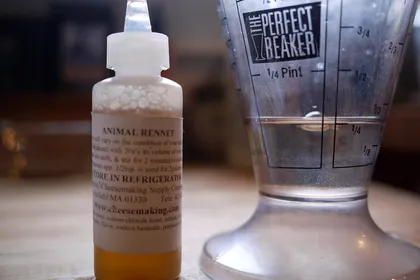
What makes it worth seeking out beyond Tuscany is the rennet. Traditionally, marzolino is coagulated with a vegetable rennet made from the dried flowers of the wild cardoon, Cynara cardunculus, exactly as in Portugal and Extremadura. Many producers now use animal rennet, but the farms that kept the cardoon make a sheep's cheese with no animal ingredient in it at all, something close to unique in Italy.
What does it taste like?
Sweet and lactic, with cream, fresh grass and a faint almond note. This is sheep's milk before it develops any of the sharpness people associate with pecorino: no salt bite, no lanolin, no piquancy. If you have only ever eaten aged pecorino, marzolino will not read as the same animal.
The texture is soft and yielding without being creamy, springy under the knife, and it melts on the tongue rather than crumbling. Cardoon-set wheels are noticeably softer and more soluble in the mouth, and they tend to slump slightly at the centre as they mature.
The cardoon shows up at the finish: a clean vegetal bitterness, herbal rather than harsh, that arrives after the sweetness and lingers for a few seconds. It is the same signature you find in Portuguese Serra da Estrela and Spanish Torta del Casar, and it is the most reliable evidence of which rennet was used. People meeting it for the first time occasionally mistake it for a fault. It is not.
At two or three months the cheese firms up and turns saltier and nuttier, closer to a young pecorino toscano, and the bitterness recedes.
How to use it
Marzolino is a table cheese, and the correct way to use it is mostly not to. Thick slices, unsalted Tuscan bread, new olive oil, a turn of pepper. With fresh broad beans in April and May, the same month and the same fields, it is a complete course.
It crumbles well over vegetables at the end of cooking: artichokes, peas, wild asparagus, or onto a farro soup or a bread and vegetable zuppa. In spring salads with raw broad beans, mint and oil it holds its own without dominating.
Shaved thin with a peeler over raw baby artichokes, with lemon and oil, it makes one of the simplest and best Tuscan seasonal dishes.
It is not a cooking cheese. Cardoon-set paste in particular melts untidily and turns stringy and sticky. If it must go into a hot dish, add it off the heat at the last moment.
With acacia or chestnut honey, and fig or onion jam, it closes a meal without needing anything else.
How long it keeps
In the fridge, wrapped in greaseproof paper inside a container that is not airtight, on the least cold shelf. It holds two or three weeks that way, but the whole point of this cheese is eating it early: after about ten days the paste begins to dry, the texture tightens and the sweetness that makes it worth buying starts to fade. The rind treated with tomato and oil needs to breathe, and cling film pressed against it makes it sweat, with damp growth appearing on the surface within a few days.
If the cut face dries out, scrape a millimetre off and the surface underneath is the one you bought. Dry white bloom comes away with a cloth dampened in vinegar, while green, black or pink growth is an alteration of a different kind, and there the date on the pack and the cheesemaker are the reference. It does not freeze: a fresh soft paste cheese comes back from the freezer as a grainy mass with nothing left of the original. Half an hour out of the fridge before serving is not optional, because cold marzolino has almost no flavour at all.
Spot the real thing
The oval shape is the first and most reliable sign: a cylinder is not a marzolino, it is a pecorino toscano. The red orange rind of the Chianti version is the second, and it wants a close look, because tomato conserve rubbed on by hand leaves a matte, uneven surface rather than a smooth uniform varnish. Cut, the paste is white, soft without being creamy, with sparse irregular eyes. Wheels set with thistle rennet are visibly slacker and tend to open towards the centre as they age.
The taste is sweet and lactic, with cream and fresh grass. In the thistle versions a clear bitter vegetal note closes the mouthful, and that note is the surest evidence of which rennet went in, so a cheese sold as thistle set with no trace of it is worth asking about. On the label, look for the explicit words caglio vegetale or caglio di cardo, which is also what makes a wheel suitable for vegetarians. The word marzolino on its own implies nothing at all: it is not a protected denomination, and most wheels on sale use animal rennet and are made all year round.
How to pronounce Marzolino
mar-tsoh-LEE-noh
Four syllables, stress on the third. The 'z' in Italian is a 'ts' sound, as in 'pizza': mar-tsoh, never 'mar-zoh' with an English z. The final 'o' is short and clear. The name comes from marzo, March.
Marzolino compared
vsPecorino Toscano DOP
The cheese marzolino is most often confused with, and in some cases legally overlaps with. Pecorino Toscano is a protected designation with a written specification: cylindrical wheels, a defined zone across Tuscany and small parts of Umbria and Lazio, ageing from twenty days for the soft type to over four months for the aged. Marzolino is a traditional style rather than a designation: egg-shaped, eaten young, often tomato-rubbed, sometimes cardoon-set. Some marzolini also meet the DOP rules; many do not.
| This | Pecorino Toscano DOP | |
|---|---|---|
| Protection | None as such, a PAT traditional product | DOP since 1996 |
| Shape | Ovoid, egg or small loaf | Cylinder with straight sides |
| Rennet | Animal or cardoon, depending on maker | Animal rennet |
| Vegetarian versions | Yes, where cardoon rennet is used | No |
| Typical age | 20-30 days, up to 90 | 20 days (soft) to 4 months and beyond (aged) |
| Flavour | Sweet, milky, sometimes bitter finish | Sweet young, nutty and savoury when aged |
vsRicotta
Two fresh white sheep's milk products that share a shelf and nothing technical. Ricotta is not cheese in the strict sense: it is made by reheating the whey left over from cheesemaking until the residual proteins coagulate, with no rennet involved. Marzolino is a rennet-set curd, drained, moulded, salted and rinded. Ricotta is grainy, wet and unsalted; marzolino is firm, sliceable and lightly salted.
| This | Ricotta | |
|---|---|---|
| Made from | Whole sheep's milk | Whey left over from cheesemaking |
| Coagulation | Rennet, animal or cardoon | Heat and acid, no rennet |
| Texture | Firm, springy, sliceable | Soft, grainy, spoonable |
| Salt | Lightly salted | Usually unsalted |
| Shelf life | 2-3 weeks | 2-3 days |
| Vegetarian | Only with cardoon rennet | Usually yes |
vsSerra da Estrela and Torta del Casar
The comparison that explains what cardoon rennet actually does. These Portuguese and Spanish sheep's cheeses are the world's most famous thistle-set cheeses, and they take the technique to its logical end: the paste breaks down so far that the cheese is eaten with a spoon through a hole cut in the top. Marzolino uses the same coagulant but is drained and pressed more firmly, so it stays sliceable: the same herbal bitterness in a completely different format.
| This | Serra da Estrela and Torta del Casar | |
|---|---|---|
| Rennet | Cardoon flower, in traditional versions | Cardoon flower, always |
| Texture | Firm and sliceable | Runny to spoonable at the centre |
| Served | Cut in slices or shaved | Lid cut off, scooped out |
| Bitterness | Light, at the finish | Pronounced |
| Vegetarian | Yes, with cardoon | Yes |
Marzolino substitutes
- Pecorino Toscano DOP, the young soft type
The obvious swap and easy to buy abroad. Same milk, same region, similar sweetness; it is cylindrical, firmer and set with animal rennet, so it is not a vegetarian option and has no bitter finish.
1:1 - Fresh primosale, sheep or mixed milk
Sold across central and southern Italy and structurally close: rennet-set, lightly salted, eaten within days. Milder and wetter than marzolino, and it grills better than it slices.
1:1 - Torta del Casar or Queijo Serra da Estrela
If what you want is the cardoon-rennet character rather than the format, these deliver it in concentrated form and are far easier to find in the US and UK. Both are vegetarian. They are spoonable, so use them as a spread, not as slices.
0.7:1, and rethink the presentation - Fresh sheep's ricotta
Only where the cheese is being crumbled over vegetables or soup rather than sliced. It brings the same sweet sheep's milk flavour with none of the structure, and most ricotta is vegetarian.
1:1 by weight, expect a wetter dish - For a guaranteed vegetarian cheese
Marzolino is the rare Italian sheep's cheese that can be vegetarian, but only when it is cardoon-set, so check the label for 'caglio vegetale' or 'caglio di cardo'. Where you cannot verify it, the Iberian thistle cheeses above are vegetarian by definition, as are English Berkswell and Spenwood, which use microbial rennet.
Where to buy it
In Tuscany, look for it in cheese shops and farm dairies across the Chianti, the Val d'Elsa and the Sienese hills, at EUR 16 to 24 per kilo for the animal-rennet version and EUR 24 to 32 for cardoon-set artisan wheels. Whole cheeses run from five hundred grams to about a kilo, so buying the whole thing and finishing it within a week is realistic.
Abroad it is uncommon. In the US it appears occasionally through importers of Tuscan cheese at roughly USD 18 to 30 per pound; in the UK, GBP 24 to 36 per kilo at specialist cheesemongers. In both cases the imported version is almost always animal-rennet.
If the cardoon version is the reason you want it, and for vegetarians it is the only reason that matters, you will need to buy in Tuscany or have it shipped, and you should ask the producer directly. Look for 'caglio vegetale' or 'caglio di cardo' on the label, and treat the absence of those words as meaning animal rennet.
One last check: the shape. If it is a cylinder, it is pecorino toscano. Marzolino is an egg.
Where to eat it in Italy
The Chianti is the heartland: Greve in Chianti with its arcaded square and butchers, Panzano, Radda, Gaiole, Castellina, Castelnuovo Berardenga. Many estates there make sheep's cheese alongside wine and sell at the gate.
West of Florence, the Val d'Elsa hills between Certaldo, Montespertoli and San Gimignano keep the tradition of the marzolino di Lucardo, one of the named historical versions.
South, in the Crete Senesi and the Val d'Orcia, Pienza is the recognised capital of Tuscan sheep's cheese, and the shops there let you taste marzolino next to a row of cylindrical pecorini and understand the difference in one sitting. Volterra and the upper Val di Cecina still have substantial flocks and small dairies working local milk.
Go in March, April or May. The wheels made from that milk are the reason the cheese has its name, and the same weeks bring broad beans, fresh peas and artichokes, everything that belongs beside it.
Further reading
 ExplainerWhich Italian cheeses contain no lactoseItaly sets a legal threshold, and long-aged cheeses clear it on their own, with no treatment involved.
 GuideHow long food keeps once openedThe date on the label describes the sealed package. After that, four things govern everything: water, salt…
 InvestigationWhich Italian cheeses are vegetarianWe counted what rennet the 43 cheeses in our atlas declare: 35 out of 43 say animal, none say otherwise.
Frequently asked questions
Why is it called marzolino?
From marzo, March. The ewes have lambed a few weeks earlier, the pasture has restarted and the milk is abundant and rich. Before refrigeration this was the moment when a cheese could be made to eat immediately rather than to keep, which is why marzolino is fresh while most pecorini are built to age. Many producers now make it year-round, but March and April wheels are still the best.
Is marzolino vegetarian?
Only when it is made with cardoon rennet, and not all of it is. Producers who keep the traditional method say so on the label: look for 'caglio vegetale' or 'caglio di cardo'. Versions set with calf or lamb rennet are not vegetarian.
How is it different from Pecorino Toscano DOP?
Pecorino Toscano is a protected designation with a written specification and cylindrical wheels. Marzolino is a traditional style with no protection of its own: egg-shaped, eaten young, often with a tomato-rubbed rind, and sometimes set with cardoon rennet. Some marzolini also comply with the DOP rules; many do not.
What does cardoon rennet actually do?
It coagulates the milk more slowly than animal rennet and breaks the proteins down differently, producing a softer, more soluble paste and a clean vegetal bitterness at the finish. It is the same coagulant behind Portuguese Serra da Estrela and Spanish Torta del Casar.
How do you pronounce marzolino?
mar-tsoh-LEE-noh, with the stress on the third syllable. The Italian 'z' is a 'ts' sound, as in 'pizza', not an English z.
Related foods
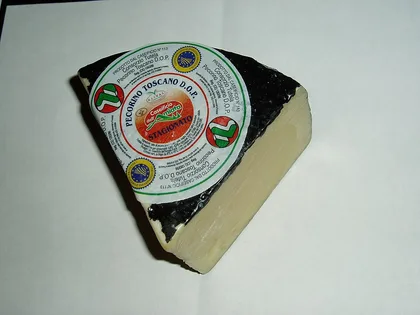 CheesePecorino ToscanoPecorino Toscano DOP is the mild one. Whole sheep's milk, calf rennet, a brief salting: soft-paste wheels…
 CheeseRicottaRicotta is not a cheese. It is a dairy product made from whey, the liquid left over after cheese has been…
 WineChianti ClassicoChianti Classico is the Black Rooster wine: at least 80 per cent Sangiovese from nine communes between…
 CheesePecorino RomanoPecorino Romano DOP is a hard, dry-salted sheep's milk cheese aged at least five months, made in Sardinia…
 WineBrunello di MontalcinoBrunello di Montalcino is pure Sangiovese aged five years, at least two of them in oak, made only in the…
 Pasta and breadPappardelleRibbons of egg pasta two to three centimetres wide, the widest pasta you still eat twirled on a fork.
 SweetsCantucciCantucci are hard, twice-baked Tuscan almond biscuits. A log of dough is baked, sliced on the diagonal while…Vegetables and fruitChestnutsFor a thousand years the Apennines made bread from them rather than dessert: Castanea sativa was the tree…