What is Treviso Radicchio?
Radicchio Rosso di Treviso is a chicory, Cichorium intybus, protected as an IGP since 1996. The rules cover two distinct products under one name: Precoce, the early type, and Tardivo, the late one.
The Precoce reaches the market from September. It has a full, closed head with broad fleshy leaves, deep red with a white midrib, and a moderate bitterness. It is blanched in the field, either by tying the leaves shut or covering the plant so the heart sees no light.
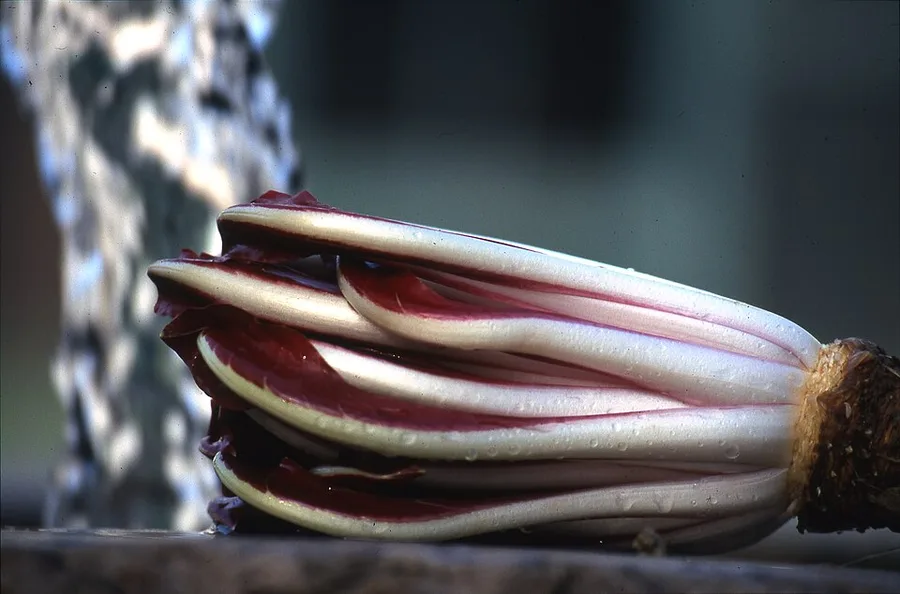
The Tardivo is something else entirely. The head is open, the leaves narrow and elongated, curving inward like claws; the white rib is thick and makes up most of the bulk; the blade is thin and wine-red. It snaps like celery, tastes sharply bitter, and keeps its long taproot attached and whittled to a point.
That shape does not occur in nature. It is the result of forcing and blanching, a post-harvest process that creates the vegetable rather than finishing it. Skip the process and you have a greenish, inedible chicory.
A third, frequently confused product sits alongside them: Variegato di Castelfranco IGP, a separate designation, which forms a pale rose-shaped head speckled with red and purple.
The bitterness in all of them comes from chicory's sesquiterpene lactones, chiefly lactucopicrin, and concentrates in the green parts and outer leaves.
What does it taste like?
Clean, assertive bitterness with a mineral edge, closer to Belgian endive than to any lettuce, but sharper and much crunchier. The white ribs are watery, sweet and almost saline; the red blades carry most of the bitterness.
Grilled, it changes completely: the sugars in the rib caramelise, the bitterness recedes, and the charred tips taste nutty. Cooked into a risotto it turns earthy and slightly sweet, and it stains the rice a dusty violet-pink.
The Precoce is milder, softer and juicier; the Tardivo is the one worth eating raw.
How to use it
Raw is the Treviso default: quarter the head lengthwise, dress with good olive oil, salt and a little vinegar, or pour over a warm dressing of pancetta rendered and deglazed with vinegar. The fat softens the bitterness without cooking the leaves.
Grilling is the signature preparation. Halve the heads, oil and salt them, and put them on a very hot grill or griddle for a few minutes a side, until the ribs take colour and the tips char. Do not cook it long: it wilts and turns sour.
Beyond that, risotto: add it halfway through and finish with butter and Grana, or a spoonful of gorgonzola; pasta with radicchio and sopressa; whole leaves fried in batter; braised in the pan with beans and served with polenta.
Two rules. Do not soak it for long, or the ribs go limp. And manage the bitterness with fat, salt and sweetness (butter, pancetta, blue cheese, walnuts, a drop of balsamic) rather than with longer cooking, which makes it worse.
The taproot is edible and is the best part: peel it, slice it thin, and eat it raw.
How long it keeps
Treviso is a winter vegetable and behaves like one: it wants cold and dark, which in a domestic kitchen means the salad drawer of the fridge. Keep the head whole and unwashed, wrapped loosely in a sheet of paper or a paper bag rather than sealed plastic, which traps the moisture the leaves give off and makes the ribs slick. Whole and unwashed, the Tardivo holds a week to ten days; the Precoce, softer leaved, more like four to six days. Wash it only at the moment of cooking.
The change is water loss. The white ribs lose turgor first, so the snap goes and the leaf bends; then the red edges darken towards brown and the cut base oxidises and dries. Bitterness increases as the head ages and the sugars go. Trimming a thin slice off the base and standing the head briefly in cold water restores some crispness. Do not freeze it raw, because the cell walls collapse and it thaws to a wet rag; if you want to keep it, grill or braise it first and freeze the cooked result, which holds two to three months.
Spot the real thing
In most shops abroad, radicchio means the round purple ball, which is Chioggia, a different variety. Treviso is elongated. The Tardivo is the one to know: separate long narrow leaves, deep wine red with a broad white central rib that takes up most of the leaf, tips hooked and curled backwards, and the taproot left on and trimmed to a white point. It snaps rather than bends. The Precoce is a closed elongated head that looks like a red romaine, softer leaved and less crunchy.
Both carry Radicchio Rosso di Treviso IGP on a paper tag or sleeve with the consortium mark, and the tag says Tardivo or Precoce. Season is a check in itself: Tardivo appears from November and runs to February or March, so a Tardivo in July has come from somewhere else. Do not confuse it with Variegato di Castelfranco IGP, which is a cream coloured rosette speckled with red. Price follows the labour, since Tardivo is forced in spring water for weeks: expect $8 to $16 a pound abroad against $3 to $5 for Chioggia.
How to pronounce Treviso Radicchio
rah-DEE-kyoh dee treh-VEE-zoh
The 'cchi' is a hard k: 'rah-DEE-kyoh', never 'ra-DITCH-ee-oh'. Treviso takes the stress on the middle syllable and a soft, voiced s: treh-VEE-zoh. Tardivo is 'tar-DEE-voh'.
Treviso Radicchio compared
vsRadicchio di Treviso Precoce
Same IGP, same species, two different vegetables. The Precoce is blanched in the field under its own tied leaves and behaves like a firm red lettuce; the Tardivo is lifted after frost and forced in spring water for weeks, which builds the claw shape, the crunch and the price.
| This | Radicchio di Treviso Precoce | |
|---|---|---|
| Blanching method | Forced in tanks of spring water, in darkness | Tied or covered in the field |
| Trigger | Two or three frosts, then lifting | None: harvested from September |
| Time after harvest | 15-25 days in the forcing shed | None |
| Shape | Open head, narrow claw-like leaves | Closed, compact head, broad leaves |
| Root | Attached, trimmed to a point | Cut off |
| Texture and taste | Very crunchy, sharply bitter | Softer, juicier, milder |
| Season | December to early February | September to December |
| Price | EUR 8-20/kg | EUR 3-6/kg |
vsVariegato di Castelfranco IGP
A separate protected designation from the town of Castelfranco Veneto, and the sweetest of the group. Also forced and blanched, but it opens into a pale rose rather than a bundle of claws, and it is a salad vegetable rather than a grilling one.
| This | Variegato di Castelfranco IGP | |
|---|---|---|
| Designation | Radicchio Rosso di Treviso IGP | Variegato di Castelfranco IGP |
| Shape | Elongated, claw-like, upright | Round, open like a rose |
| Colour | White rib, wine-red blade | Cream to pale yellow, speckled red and violet |
| Bitterness | Pronounced | Mild and sweet |
| Best use | Raw, grilled, risotto, fried in batter | Almost always raw |
| Season | December to February | December to February |
vsRadicchio di Chioggia (the round supermarket one)
This is what most people outside Italy mean by radicchio: the dense purple ball sold year-round. It is a different variety from a different part of the Veneto, grown conventionally with no forcing, and it is more uniformly bitter with none of the Tardivo's crunch.
| This | Radicchio di Chioggia (the round supermarket one) | |
|---|---|---|
| Shape | Elongated, open, white-ribbed | Round, dense, ball-shaped |
| Forced | Yes, in spring water | No |
| Availability | December to February only | Year-round |
| Texture | Crisp ribs, thin blades | Tight, leathery leaves |
| Raw | Excellent | Harsh unless sliced very thin |
| Price | EUR 8-20/kg | EUR 2-4/kg |
Treviso Radicchio substitutes
- Belgian endive (witloof)
The closest match in structure and the same forcing principle, since the technique reached Treviso from Belgium. Less bitter and less red, so add a little lemon and accept a paler plate.
1:1 by weight - Radicchio di Chioggia
Widely available and genuinely usable, especially cooked. Raw, slice it far thinner than you would slice Tardivo and dress it with something fatty.
1:1, sliced thinner - Variegato di Castelfranco
If the tardivo has finished for the season, Castelfranco is in the shops at the same time. Sweeter and softer: use it raw and skip the grill.
1:1 raw only - Escarole or curly endive
Bitter, sturdy and good in the pan with beans and olive oil. It wilts far more than radicchio, so start with more of it.
1.5:1 by weight for cooked dishes - Puntarelle or catalogna chicory
Roman rather than Venetian, but the same family and the same crunch when the stems are shaved and soaked in iced water. The right choice for a raw salad.
1:1 raw
Where to buy it
Outside Italy this is a short, specific season: real Tardivo appears in December and disappears by early February, so it is a December-January purchase or nothing. In the US, Italian greengrocers and specialists such as Eataly and Gustiamo bring it in for a few weeks, and some farmers' markets in California and the Pacific Northwest now grow forced Treviso-type chicories. In the UK, Natoora supplies it to restaurants and sells direct in season, and Italian delicatessens carry it around Christmas.
Check for the taproot still attached and trimmed to a point, narrow leaves curving inward, a thick glossy white rib and no green at the base. A rib should snap cleanly when bent.
The crate or band should carry the EU IGP mark, the full designation with Precoce or Tardivo specified, and the consortium reference.
In Italy expect 8 to 15 euros a kilo locally and 12 to 20 outside the region, roughly 6 to 11 dollars a pound, or 12 to 20 pounds a kilo abroad. Precoce is a third of that. A trimmed head weighs 150 to 300 grams.
Where to eat it in Italy
Dosson di Casier, just outside Treviso, in December, for the main show of the season: growers' stalls, field kitchens grilling it over coals, and risotto served all day.
Zero Branco, Preganziol and Rio San Martino di Scorzè run their own exhibitions and radicchio dinners between December and January. These are the weeks when forcing sheds open to visitors, and thirty seconds looking at heads standing in the dark in running spring water explains the price better than any label.
Treviso itself, where every osteria in the centre puts it on the menu from December: grilled, in risotto, fried in batter, and paired with sopressa or with baccalà.
Castelfranco Veneto, a short drive west, for the Variegato, whose season runs at the same time.
Go in the second half of December. The Tardivo is at its peak, and the fog over the plain is part of the experience.
Further reading
Frequently asked questions
What is the difference between tardivo and precoce radicchio?
Precoce is blanched in the field by tying or covering the leaves and arrives from September: a compact head, broad leaves, moderate bitterness. Tardivo is harvested after the frosts and then forced for two to three weeks in tanks of spring water in the dark, where it grows new chlorophyll-free leaves: an open head of crunchy white-ribbed claws, sharply bitter, on sale from December and costing around three times as much.
What is forcing in spring water?
It is the step that creates the tardivo. Plants lifted with their roots are stood upright in tanks fed by resurgent spring water at a constant 11-15°C, in complete darkness, for 15 to 25 days. Deprived of light, the plant burns the reserves in its root and pushes out new leaves that cannot make chlorophyll: white in the rib, red in the blade.
Why is Treviso tardivo so expensive?
Every head is handled six or seven times, spends two to three weeks in the forcing tanks, and is trimmed by hand under running water in a process that discards about two thirds of the plant: a kilo lifted from the field yields 200 to 300 grams for sale.
Is Castelfranco radicchio the same thing?
No, it is a separate IGP. Variegato di Castelfranco forms a round, open head like a rose, cream to pale yellow speckled with red and violet, and it is far sweeter and more delicate. It is forced and blanched too, but it is eaten almost entirely raw.
How do I make radicchio less bitter?
Not by cooking it longer, which intensifies it, but with fat, salt and sweetness: pancetta, butter, blue cheese, walnuts, a drop of balsamic or a teaspoon of sugar in the pan. A brief dip in iced water helps and also restores crispness, but a long soak makes the ribs limp.
Sources
Where to check what you just read.
- 1
L'atto del luglio 1996 che iscrive «Radicchio Rosso di Treviso» fra le IGP italiane degli ortofrutticoli.
- 2
I parametri che separano tardivo e precoce (peso minimo, lunghezza del cespo, rese massime per ettaro) e come è regolata la forzatura-imbianchimento.
- 3Consortium · interested partyConsorzio di tutela
Il consorzio che dal 1996 tutela insieme il Rosso di Treviso e il Variegato di Castelfranco: elenco dei produttori e differenze fra le tre tipologie.
Related foods
 Fish and seafoodBaccalàBaccalà is North Atlantic cod preserved in salt. It is not the same thing as stoccafisso, which is the…
 CheeseAsiagoOne name covers two cheeses nobody would mistake for each other at the counter.
 Vegetables and fruitCarnaroli RiceCarnaroli is the risotto rice with the highest amylose content: it sheds enough starch to build a creamy…
 Vegetables and fruitBassano White AsparagusBassano white asparagus is white because it never sees daylight: the spear grows inside a ridge of soil and…
 Vegetables and fruitLamon BeansLamon beans are mountain-grown borlotti with a skin so thin it disappears in the mouth and flesh that turns…
 Vegetables and fruitFiolaro BroccoliFiolaro broccoli is not grown for its head but for the fioi, the side shoots that sprout along the stem.
 SweetsTiramisuNothing here goes near an oven. Savoiardi dipped in cold espresso, raw egg yolk whipped with mascarpone…Pasta and breadGnocchiGnocchi are small boiled dumplings, in their modern form made of potato bound with a little flour.