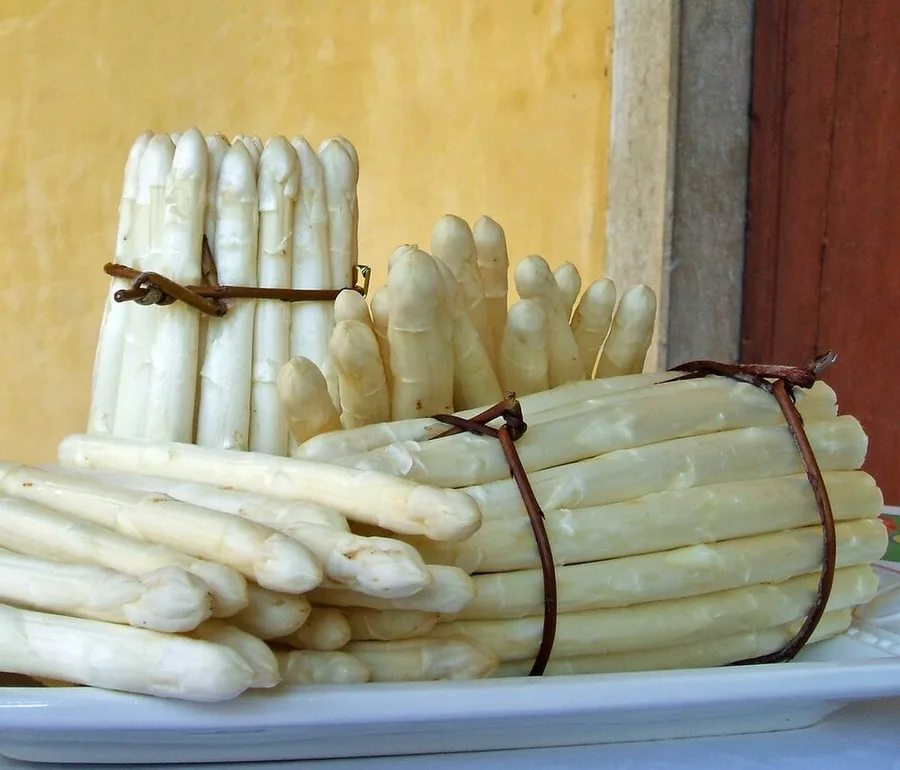
What is Bassano White Asparagus?
Asparago Bianco di Bassano is a protected designation of origin, granted in 2007. It covers spears of the local variety Comune di Bassano, also called Chiaro di Bassano, grown in about twenty communes on the Brenta plain around Bassano del Grappa in the Veneto.
The part you eat is the turione, the spear that rises from the underground crown of the plant. The specification requires spears at least eighteen centimetres long, straight, with a tightly closed tip, and thick enough to exclude thin grades. The colour must be uniformly white from base to tip: no green, no violet.
That colour requirement is the whole thing. The asparagus is white not because of the variety but because of the absence of light. The spear grows inside a mound of earth and, while it stays in the dark, produces no chlorophyll. If the tip breaks the surface and catches sun for even a few hours, it turns violet and then green, and it is out of the designation.
The practical consequence is that you cannot harvest this crop by looking at the plant. You look at the soil. Which is why the picking is entirely by hand and cannot be mechanised at all.
Compared with the white asparagus of Germany and the Netherlands, Bassano is more tender, less fibrous, and carries a distinct bitter finish that locally counts as a virtue rather than a fault.
What does it taste like?
Delicate and faintly sweet, with a clean vegetal body and a bitter edge at the finish that is the point of white asparagus rather than a defect. Nothing like the grassy, sulphurous punch of green asparagus: quieter, rounder, closer to an artichoke heart or a young broad bean.
The texture is the argument. Properly peeled and cooked upright, the spear is dense and buttery from base to tip, with almost none of the fibre you get in a thick green stalk. It should be firm enough to hold when lifted with a fork and yield without stringiness.
The bitterness varies through the season: sharper in the cold early spears of March, milder and sweeter in the peak of late April. And there is the well-known effect on urine, caused by asparagusic acid, which about half the population can smell and the rest cannot, and it has nothing to do with quality.
How to use it
Peel it. This is the step people used to green asparagus skip, and it ruins the dish: the skin of white asparagus stays tough however long you cook it. Lay the spear flat on the counter, run a vegetable peeler from two centimetres below the tip down to the base, rotating as you go, then trim a couple of centimetres off the bottom.
Cook it standing up. Tie the peeled spears into a bundle, stand them in a tall pan with salted water covering the lower two thirds, and let the tips steam above the water. Twelve to eighteen minutes depending on thickness. They are done when a knife slides into the base without force.
The Bassano dish is asparagi e uova. Hard-boil eggs, crush them roughly with a fork, dress with olive oil, vinegar, salt and pepper into a coarse sauce, and pour it over the warm spears. Nothing is blended and no mayonnaise is involved.
Other local uses: risotto, where the peelings and trimmings make the stock; spears with melted butter and grated Grana; under a poached egg; in a frittata; and with thin slices of sopressa, the local salami, which is the most Bassano thing on the list.
Waste nothing. Simmer the peelings and bases for half an hour, strain, and you have a sweet stock that is the foundation of the risotto.
How long it keeps
Not long, and it is worth knowing that before buying. A spear is a growing shoot that carries on burning its own sugars after cutting: sweetness drops noticeably after two days and the fibres toughen by around the fourth. The best method treats it like a bunch of flowers. Trim half a centimetre off the base, stand the bundle upright in a container with two fingers of cold water, drape a bag loosely over the tips and keep it in the fridge, where it holds four or five days without going limp. Wrapped in a damp cloth in the vegetable drawer it manages three.
A sealed plastic bag with no holes traps the moisture the spears give off and they soften from the tip downwards. For longer keeping, blanch three minutes in boiling salted water, drop straight into iced water, dry thoroughly and freeze spread on a tray: eight months, after which they suit soups and risotto rather than being served whole. Cooked spears keep two days covered in the fridge, and the cooking water is stock.
Spot the real thing
White the whole way. The spear should be ivory from base to tip: a pink or violet tip means it saw daylight before it was cut, and a green tip means a different asparagus altogether. The tip has to be closed and tight, since scales opening out like a flower show a spear that had already begun to elongate, and that one will be fibrous. The bundle tied with a willow withy is the signature of the DOP and is not easy to imitate. Bases are cut flat at a single height and should look wet and full rather than dry, spongy or hollow at the centre.
Two field tests settle it. Rub two spears together: fresh ones squeak, while spears that have lost water slide silently. Bend one and it should snap with a clean crack. On the tag, look for Asparago Bianco di Bassano DOP with the European logo, the grower's name and an identifying number. German and Dutch Spargel, the white asparagus most shops abroad stock in spring, is a fine vegetable but not this one.
How to pronounce Bassano White Asparagus
ah-SPAH-rah-goh dee bas-SAH-noh
Asparago is stressed on the second syllable, ah-SPAH-rah-goh, not on the third as in English 'asparagus'. Bassano holds the double 's': bas-SAH-noh. The full name is Asparago Bianco di Bassano; bianco is BYAN-koh, one syllable for 'bia'.
Bassano White Asparagus compared
vsGreen asparagus
Same plant, different farming. Green spears are allowed to grow above the soil and photosynthesise; white spears are kept buried. That single decision changes the flavour, the fibre, the preparation and the price: green needs no peeling and costs a third as much.
| This | Green asparagus | |
|---|---|---|
| How grown | Buried under a ridge of soil, no light | Above ground, in full sun |
| Colour | Ivory white throughout | Green, purple-tinged tips |
| Flavour | Delicate, sweet, bitter finish | Grassy, sulphurous, more assertive |
| Peeling | Essential: skin stays tough | Not needed, snap the woody base |
| Cooking | 12-18 minutes, upright | 4-8 minutes, any method |
| Harvest | Entirely by hand, twice daily | Hand-cut, but far faster |
| Price | 10-18 euro per kilo | 3-6 euro per kilo |
vsViolet asparagus of Albenga
The Ligurian violet asparagus is a genuinely different variety, not a colour stage: a tetraploid with thick purple spears, sweeter and more tender than either white or green. It is grown mounded like the white but allowed to colour. Albenga is sweeter; Bassano is more delicate and more bitter.
| This | Violet asparagus of Albenga | |
|---|---|---|
| Colour | White throughout | Deep violet, cream inside |
| Cause of colour | Grown in the dark | Genetic: the variety is violet |
| Thickness | Medium to thick | Very thick, up to 3 cm |
| Flavour | Delicate, bitter finish | Sweet, low bitterness |
| Raw | No | Yes, shaved thin |
| Season | Mid-March to 13 June | April to early June |
vsGerman or Dutch Spargel
The white asparagus most people abroad have eaten, grown at scale in Germany, the Netherlands and increasingly Peru. Same technique, different varieties and different soils. Northern European spears are typically thicker, blander and more fibrous; Bassano is thinner-skinned and more distinctly bitter.
| This | German or Dutch Spargel | |
|---|---|---|
| Variety | Comune di Bassano, local ecotype | Modern hybrids bred for yield |
| Soil | River sand of the Brenta plain | Sandy soils, often under plastic film |
| Texture | Tender, low fibre | Firmer, more fibrous at the base |
| Flavour | Marked bitter finish | Milder, sweeter |
| Bunching | Tied with a willow shoot, base cut flat | Elastic band or plastic wrap |
| Availability | Almost entirely local | Exported across Europe and beyond |
Bassano White Asparagus substitutes
- White asparagus from Germany, the Netherlands or Peru
The obvious swap and easy to find in spring. Usually thicker and more fibrous, so peel more generously and add three or four minutes to the cooking.
1:1 by weight - Asparago di Badoere or Cimadolmo IGP
Two other Veneto asparagus designations, both excellent and closer in variety and soil than anything from abroad. Badoere comes in white and green; take the white.
1:1 - Violet asparagus of Albenga
Sweeter, thicker and more tender. Works anywhere Bassano does and can also be shaved raw, which Bassano cannot. Peel it as well.
1:1 by weight, 2-3 minutes less - Green asparagus
Different dish, not a replacement, but perfectly good in a risotto or under eggs. Do not peel it, snap the woody base off, and cut the cooking to five minutes.
1:1 by weight - Navarra white asparagus in jars
The off-season answer for salads and the egg dressing. Already cooked and salted: drain, rinse briefly, add no salt.
One 400 g jar per 500 g fresh
Where to buy it
Fresh Bassano DOP asparagus essentially does not leave Italy: the season is twelve weeks, production is limited and almost all of it is eaten in the Veneto. In the growing area a one-kilo bunch runs 10 to 18 euro per kilo, opening high in March, dipping through the peak in April and May, then climbing again at the end.
Elsewhere in Italy it reaches 18 to 25 euro per kilo when it appears at all. Generic Veneto white asparagus without the designation sells for 4 to 8 euro per kilo, and the gap is real.
Abroad, what you will find in spring is German, Dutch, Spanish or Peruvian white asparagus at 6 to 12 dollars a pound in the US or 10 to 20 pounds a kilo in the UK. Italian delicatessens sometimes carry Navarra or Veneto spears in jars, which are the sensible off-season option.
When buying fresh, look for uniformly white spears with closed tips, a flat-cut base that is still moist rather than dry or hollow, and the willow tie that marks the DOP bunch. Rub two spears together: fresh ones squeak. And budget for the peelings: after trimming you keep 60 to 70 per cent of the weight, so a kilo feeds four, not six.
Where to eat it in Italy
Bassano del Grappa in April and May, when the trattorie of the town and the surrounding villages run asparagus menus and the growers' show brings the DOP producers together. The old centre, Palladio's covered wooden bridge and the arcaded osterie make the rest of the day easy.
The villages on the plain (Rosà, Cassola, Tezze sul Brenta, Pove del Grappa) hold spring festivals where the fixed dish is asparagi e uova. That is the preparation to order, far more than a cream soup or a risotto.
Many farms in the area sell direct during the harvest and some take visitors into the fields. Watching a picker read a crack in the soil, dig down and cut blind with a narrow gouge explains the price better than any description.
One date to respect: cutting stops on 13 June. Arrive in late June and you will find the plants left to grow and no fresh asparagus anywhere.
Further reading
Frequently asked questions
Why is Bassano asparagus white?
Because it grows entirely underground, inside a ridge of soil thirty to forty centimetres deep that is banked over the rows. Without light there is no photosynthesis and no chlorophyll, so the spear stays white. It is not a different plant from green asparagus: it is a different way of growing the same one.
When is the season?
Mid-March to 13 June, the feast of Saint Anthony, which local tradition fixes as the last cutting day. The peak is between mid-April and mid-May. Outside that window there is no fresh Bassano asparagus, whatever a label says.
Do you have to peel white asparagus?
Yes, always, and this is the main practical difference from green. The skin stays tough no matter how long you cook it. Peel from two centimetres below the tip down to the base with a vegetable peeler, then trim the bottom.
How do I know a bunch is the real thing?
Uniformly white with no green or violet shading, tips tightly closed, bases cut flat and still moist, and the bunch tied with a willow shoot rather than an elastic band. The tag should read Asparago Bianco di Bassano DOP with the EU mark and the producer's number.
Why is it more expensive than other white asparagus?
Because every spear is cut by hand, blind, after digging into the ridge and reading a crack in the soil, twice a day in warm weather, since a spear can grow ten centimetres in a day and any tip that emerges loses the designation. None of that can be mechanised.
Sources
Where to check what you just read.
- 1
Il regolamento del 12 settembre 2007 che iscrive «Asparago Bianco di Bassano» fra le DOP ortofrutticole, insieme a Café de Colombia e Castagna Cuneo.
- 2
L'ecotipo locale Comune o Chiaro di Bassano, il diametro centrale minimo di 11 millimetri e le tolleranze ammesse su colore rosato e spacchi laterali.
- 3Consortium · interested partyConsorzio Asparago Bianco di Bassano DOP
Il consorzio di Bassano del Grappa: testo del disciplinare, spiegazione del marchio DOP e le fasi dalla raccolta al confezionamento in mazzi.
Related foods
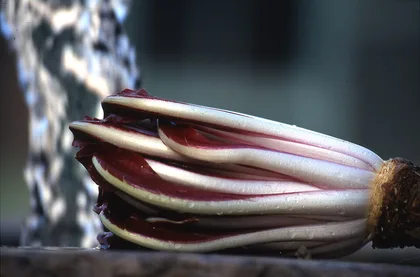 Vegetables and fruitTreviso RadicchioTreviso radicchio comes in two forms that are effectively different vegetables.
 WineProseccoProsecco is made from Glera grapes by the Martinotti tank method, not the traditional bottle method used for…
 Vegetables and fruitLamon BeansLamon beans are mountain-grown borlotti with a skin so thin it disappears in the mouth and flesh that turns…
 Vegetables and fruitFiolaro BroccoliFiolaro broccoli is not grown for its head but for the fioi, the side shoots that sprout along the stem.
 SweetsTiramisuNothing here goes near an oven. Savoiardi dipped in cold espresso, raw egg yolk whipped with mascarpone…Pasta and breadGnocchiGnocchi are small boiled dumplings, in their modern form made of potato bound with a little flour.
 CheeseAsiagoOne name covers two cheeses nobody would mistake for each other at the counter.
 CheeseGrana PadanoNine months is the floor the specification sets before a wheel may carry the name.