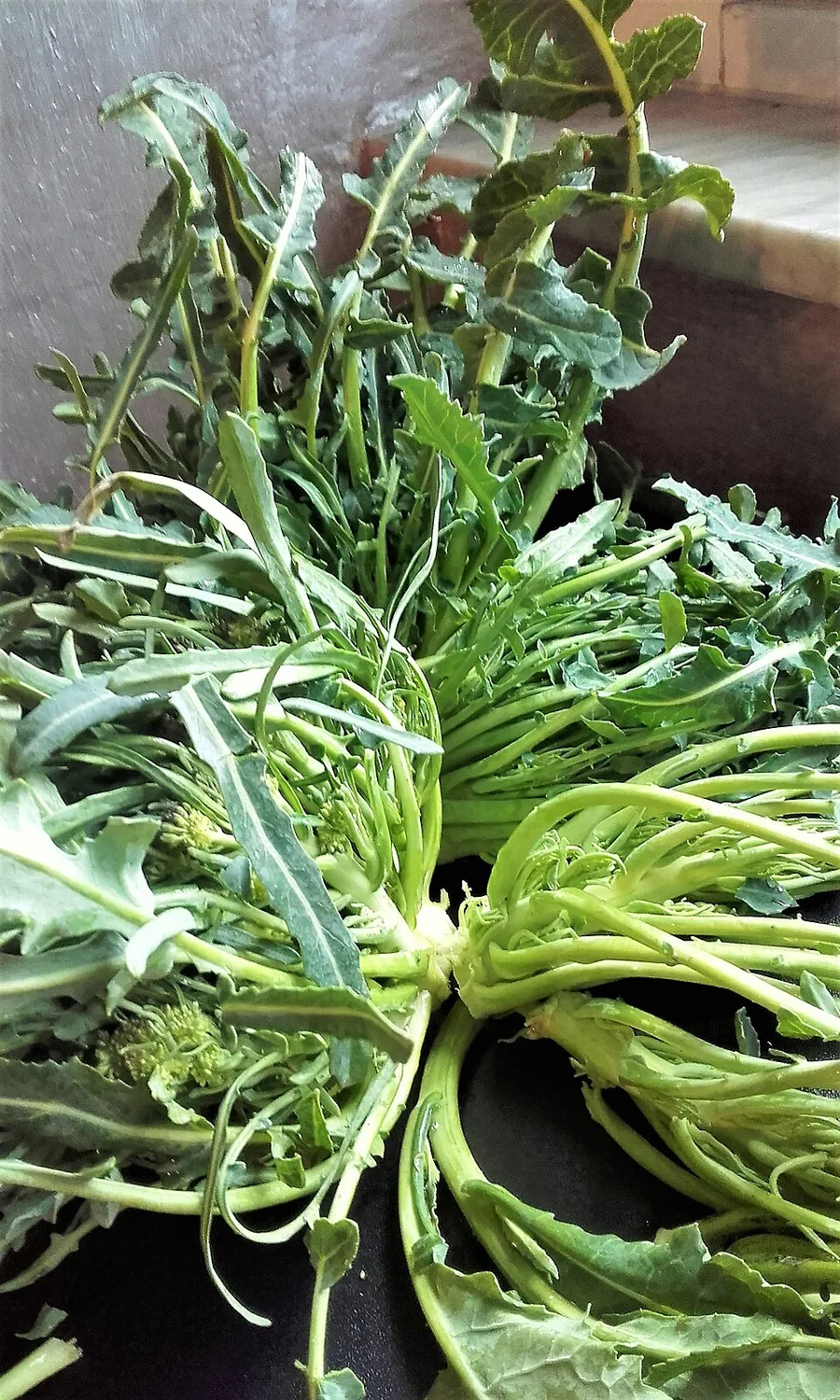
What is Fiolaro Broccoli?
Broccolo fiolaro is a local landrace of Brassica oleracea grown on the hills above Creazzo, a town of eleven thousand people on the western edge of Vicenza, in the Veneto. It is a Slow Food Presidium and a recognised traditional food product of the region.
It looks almost nothing like supermarket broccoli. Instead of one large tight head, it makes a small central crown and then dozens of leafy side shoots along the whole length of the stem, each with tender leaves and a barely formed flower bud. Those shoots are the fioi, Vicentine dialect for 'the sons', and they are what you eat. The name means, literally, the plant that has children.
That structure changes how it is harvested. Nobody cuts the plant and carries it away: growers go over the same plants repeatedly from December to February, picking the shoots as they form, and the plant keeps producing all through the cold months.
The defining trait is its relationship with frost. Fiolaro is not picked before the first hard freeze, and that is not folklore. Below zero the plant converts starch into sugars to protect its cells, and the shoots turn from bitter and grassy to sweet and tender. Picked in October it is a different and much worse vegetable, which is why nobody in Creazzo picks it then.
What does it taste like?
Sweet, which is not what anyone expects from a brassica. Behind the sweetness there is a hazelnut note and only a faint bitter edge, nothing like the aggressive bitterness of broccoli rabe, and rounder and softer than ordinary broccoli.
The leaves are tender enough to eat raw, and the small stems are crisp and juicy rather than woody. Cooked briefly they keep a slight bite; cooked long they collapse into something grey and dull, which is the one way to ruin them.
The sweetness is measurable and it is earned. Each frost the plant survives converts more starch to sugar, so a January picking tastes noticeably sweeter than a December one from the same field.
How to use it
Start with it raw, which is what surprises people. Slice the smallest shoots thin, dress with good olive oil, salt and a squeeze of lemon, and you have a sweet, crunchy winter salad. This is a Creazzo habit, not a restaurant idea.
Cooked, the rule is restraint. Blanch the shoots three or four minutes in salted water, drain, then finish in a pan with olive oil, garlic and, for the Vicenza version, an anchovy melted into the oil. Five minutes total. Long cooking turns it grey and destroys the sweetness that took three months of frost to build.
The local dish is risotto: a light soffritto, rice, stock, the chopped shoots added halfway, and a final beating of butter and Asiago. It works equally well in a simple soup with potatoes and raw olive oil poured over at the table.
With bigoli, the thick Vicentine pasta, a sauce of fiolaro, garlic and anchovy stands up to any Pugliese orecchiette. And next to baccalà alla vicentina, the city's salt cod dish, it is the standard vegetable, with polenta.
Do not throw away the thicker stem. Peel it with a vegetable peeler and either slice it into rounds to cook with the rest, or keep it for stock.
How long it keeps
Treat it as the leaf vegetable it is: three or four days in the refrigerator, wrapped in a damp cloth or a perforated bag. After that the leaves yellow at the edges and the flower buds, which arrive shut, begin to open and pale: the plant carrying on with its life. Do not wash it before putting it away, because free water sitting on the leaves speeds the breakdown of the tissue; rinse it at the moment you cook it. If the bunch still has a long stalk, stand it in a glass of water like a bouquet, in the fridge or a cold room, and it gains a couple of days.
Freezing works only after blanching. Two minutes in boiling salted water, straight into iced water, dried and bagged, and it holds six months. What comes out of the freezer belongs in soup or risotto rather than in a pan or a raw salad, because the cell walls have given up their structure and the shoots go slack. Cooked and dressed, it sits two days in the refrigerator and is best warmed in a pan at the last minute.
Spot the real thing
Look at the stalk, not the head. A real fiolaro reaches the stall as a length of stem with its side shoots, the fioi, still attached, and a compact round head is ordinary broccoli under the wrong name. The shoots should be small, ten to fifteen centimetres, the leaves tender and dark green with a bluish cast, the flower bud tiny and shut. Open yellow buds mean a late cut or a bunch that has been standing. The cut across the stalk should look pale and moist; dry, browned or stringy means days have gone by.
The calendar is a check in itself: fiolaro runs from December to February, so anything offered under the name in October or April has either not met the frost yet or already flowered. The simplest test is to pull off a leaf and eat it raw, since it should be sweet with a hazelnut base and only a whisper of bitterness, and a frankly bitter, pungent leaf has not had enough cold. English purple sprouting broccoli is the closest relative on a foreign stall; broccoli rabe and gai lan are cousins with different flavours.
How to pronounce Fiolaro Broccoli
BROK-koh-loh fyoh-LAH-roh
Broccolo has the stress on the first syllable, BROK-koh-loh and not 'bro-KOH-lo', and the final 'o' is short. Fiolaro is four sounds: fyoh-LAH-roh, with 'fio' as a single glide like the 'fio' in 'fiord'. Creazzo, the town, is kreh-AHT-tsoh, with the double 'zz' as a hard 'ts'.
Fiolaro Broccoli compared
vsStandard broccoli (calabrese)
The green dome sold everywhere is a different thing entirely. Calabrese is bred to put everything into one dense terminal head, harvested in a single cut, available year round. Fiolaro puts its energy into side shoots, is picked over three months by hand, and is sweet rather than green-tasting because of the frost.
| This | Standard broccoli (calabrese) | |
|---|---|---|
| Part eaten | Side shoots with leaves | One large terminal head |
| Harvest | Repeated picking, Dec-Feb | Single cut, year round |
| Frost | Required: it creates the sweetness | Irrelevant |
| Flavour | Sweet, nutty, barely bitter | Green, mildly sulphurous |
| Leaves | Eaten, tender | Discarded |
| Raw | Excellent sliced thin | Edible but tough |
| Cooking | 3-5 minutes | 5-8 minutes |
vsCime di rapa (broccoli rabe)
The comparison Italians make, and the one that reveals the most. They are different species, fiolaro being Brassica oleracea and cime di rapa Brassica rapa, and the flavours sit at opposite ends. Cime di rapa is assertively bitter and needs garlic, chilli and anchovy to tame it. Fiolaro after frost is sweet and needs almost nothing.
| This | Cime di rapa (broccoli rabe) | |
|---|---|---|
| Species | Brassica oleracea | Brassica rapa |
| Flavour | Sweet, faintly bitter | Markedly bitter |
| Region | Veneto, one hill | Puglia, Lazio, Campania |
| Season | December to February | November to April |
| Classic dish | Risotto, bigoli, raw salad | Orecchiette |
| Raw | Yes | Too bitter |
vsPurple sprouting broccoli
The closest relative on a British shelf and the best substitute anywhere. Both are sprouting brassicas grown over winter, both are picked as shoots over many weeks, and both are traditionally harvested after frost. Purple sprouting is thinner-stemmed and a little more bitter; fiolaro carries more leaf and more sweetness.
| This | Purple sprouting broccoli | |
|---|---|---|
| Type | Leafy side shoots | Slender flowering shoots |
| Colour | Dark blue-green | Green stems, purple buds |
| Season | December to February | February to April |
| Frost | Essential | Traditional, improves it |
| Leaf content | High | Low |
| Availability | Vicenza province only | UK-wide in season |
Fiolaro Broccoli substitutes
- Purple sprouting broccoli
The nearest thing by a distance, and easy to buy across the UK from February. Slightly more bitter and with less leaf, so add a pinch of sugar or a splash of sweet vinegar if you are chasing the fiolaro character.
1:1 by weight, same cooking time - Broccolini or tenderstem
Widely available in the US and the UK all year. Sweeter and more uniform than purple sprouting but with tougher stems and no real leaf, so trim the bases and expect a cleaner, simpler flavour.
1:1, cook 1 minute longer - Cime di rapa (broccoli rabe)
The right texture and the wrong flavour: much more bitter. Blanch for two minutes and discard the water before finishing in the pan, which takes the edge off without losing the structure.
1:1, blanch first - Gai lan (Chinese broccoli)
Structurally the closest match in an Asian grocery: thick leaves, slim stems, small flower buds. A little more bitter and more fibrous in the stem, so peel the thickest bases.
1:1 - Cavolo nero with broccoli stems
A build-your-own option that gets surprisingly close: cavolo nero for the leaf and the sweetness after frost, thinly sliced broccoli stems for the crunch. Best in soups and risotto rather than raw.
2 parts leaf to 1 part stem
Where to buy it
There is no way to sugar-coat this: fiolaro does not leave the province of Vicenza. It is a fresh winter vegetable with a three-month season, hand-picked on terraces, produced on a few dozen hectares, and there is no export chain at all. It is sold in bunches at markets in Creazzo and Vicenza between December and February, at 2.50 to 5 euro per kilo.
If you are in Italy in winter it is worth the detour. If you are not, buy the closest analogue rather than hunting for the name. Purple sprouting broccoli in the UK from February, broccolini or tenderstem anywhere year round, gai lan from a Chinese grocer. Expect 6 to 12 dollars per pound in the US, 8 to 14 pounds per kilo in the UK.
Whichever you buy, choose bunches with tight, unopened flower buds and moist cut stems. Yellow buds mean the vegetable has been sitting, and once a brassica shoot starts flowering it turns fibrous and loses its sweetness within a day or two.
Where to eat it in Italy
Creazzo holds its fiolaro festival in January and puts the whole repertoire on the table: risotto, soup, bigoli, frittate, and the raw shoots dressed as a salad for anyone who does not believe it works.
Vicenza, seven kilometres east, is where you will find it in restaurants from December to February, very often served alongside baccalà alla vicentina, the slow-cooked stockfish dish that is the city's culinary identity. Market stalls in piazza delle Erbe sell it in bunches all season.
It is worth widening the circle. The Berici hills to the south for Tai Rosso and cheese, the Asiago plateau to the north for the mountain cheese of the same name, Breganze and Gambellara for white wine. Forty kilometres holds a winter vegetable, a salt cod tradition, an alpine cheese and three wine denominations.
January is the month, without argument: the plants have taken several frosts by then, the shoots are at their sweetest and production is at its peak.
Frequently asked questions
What does fiolaro mean?
It comes from fioi, Vicentine dialect for 'sons': the side shoots that grow from the leaf axils along the stem. Those shoots are the crop, not the small central head. The name describes a plant that produces children.
Why does it have to be picked after a frost?
Because frost is what makes it sweet. Below freezing the plant turns starch into sugars to protect its cells, and the shoots go from bitter and grassy to sweet and tender. Every subsequent frost improves the crop, which is why January is the best month.
When is it in season?
December to February. Picking starts right after the first hard frost, usually in late November, and continues until the plants run to flower in late winter. Seed goes into a nursery bed in July and August and plants are set out in September.
Can you eat it raw?
Yes, and it is one of the best ways to eat it. Slice the smallest shoots thinly and dress them with olive oil, salt and lemon for a sweet, crunchy winter salad. It is a traditional preparation in Creazzo rather than a modern invention.
What can I use instead?
Purple sprouting broccoli is the closest, with a similar structure and a similar winter season. Broccolini or tenderstem is the easiest year-round option, and gai lan from a Chinese grocer is structurally very close. All three are a little less sweet.
Related foods
 CheeseAsiagoOne name covers two cheeses nobody would mistake for each other at the counter.Cured meatsSoppressa VicentinaSoppressa Vicentina is a large, coarse-grained Veneto salami made from heavy pigs born and raised in the…
 Vegetables and fruitTreviso RadicchioTreviso radicchio comes in two forms that are effectively different vegetables.
 Vegetables and fruitBassano White AsparagusBassano white asparagus is white because it never sees daylight: the spear grows inside a ridge of soil and…
 Vegetables and fruitLamon BeansLamon beans are mountain-grown borlotti with a skin so thin it disappears in the mouth and flesh that turns…
 SweetsTiramisuNothing here goes near an oven. Savoiardi dipped in cold espresso, raw egg yolk whipped with mascarpone…Pasta and breadGnocchiGnocchi are small boiled dumplings, in their modern form made of potato bound with a little flour.
 WineProseccoProsecco is made from Glera grapes by the Martinotti tank method, not the traditional bottle method used for…