What is Rotonda Red Eggplant?
Melanzana Rossa di Rotonda is a protected designation of origin, granted by the European Union in 2010. It covers fruit grown in four communes in the province of Potenza, Basilicata (Rotonda, Viggianello, Castelluccio Superiore and Castelluccio Inferiore) in the Mercure valley inside Pollino National Park.
The botany matters, because it explains everything else. This is not the aubergine sold everywhere else. The common eggplant is Solanum melongena; this is Solanum aethiopicum, a separate African species of the gilo group, related to the aubergine roughly the way a tomato is related to a potato.
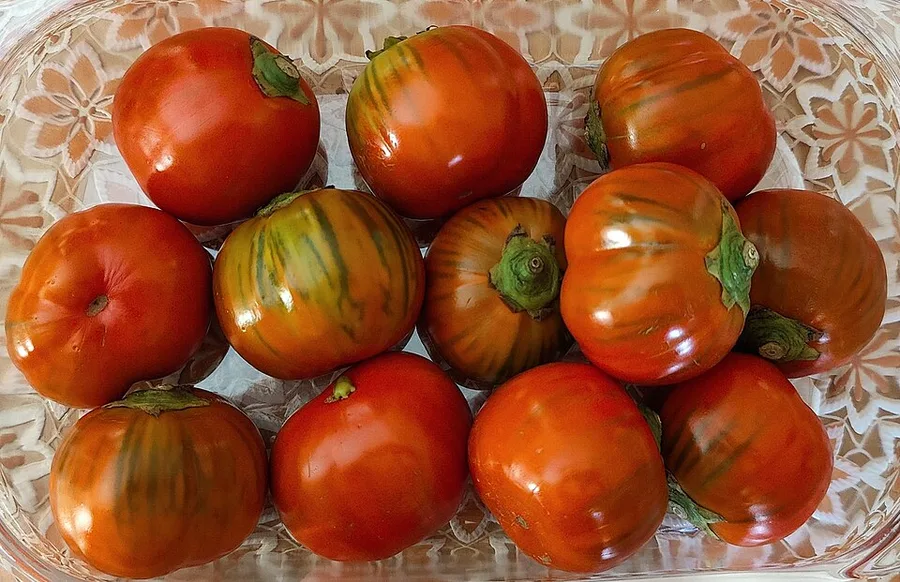
The fruit is round or slightly flattened, five to eight centimetres across, fifty to a hundred and fifty grams, with deep ribs running down from the stem. It turns from green to orange to full red as it ripens, and anyone seeing it for the first time takes it for a beefsteak tomato. Growers stopped correcting the mistake years ago.
Inside, the flesh is firm and cream-green, with seeds held in distinct chambers like a tomato rather than scattered through the flesh like an aubergine. The flavour is the real surprise: peppery-hot, with a clean bitter finish and an almost metallic edge closer to raw artichoke than to anything in the nightshade family. There is none of the sweet sponginess of a roasted aubergine. Local cooking has always treated it accordingly: blanched in vinegar and packed under oil, not grilled and dressed.
What does it taste like?
Hot, bitter and firm. The heat is a slow diffuse pepperiness, more like a radish or a turnip top than a chilli, and it builds rather than hits. Behind it comes a clear bitterness with a mineral, artichoke-like edge that stays in the mouth.
Texture is the other departure. Where a normal aubergine collapses and drinks oil, this one holds its shape, browns at the edges and stays almost crisp. Sliced thin and raw it eats like a firm, bitter salad vegetable.
Preserved in oil, the way most people meet it, the vinegar blanching rounds off the aggression and leaves something between a pickled artichoke heart and a mild giardiniera.
How to use it
Cut off the calyx with a knife every time: the spines on the green cap are real and sharp. Do not salt the fruit first: salting is the trick for removing bitterness from a common aubergine, and here the bitterness is the reason you bought it.
The simplest treatment is the best. Slice a centimetre thick, cook in a hot pan with olive oil, a crushed garlic clove and a chilli, five or six minutes a side. It will not soak up the oil and it will not collapse. Finish off the heat with a few drops of wine vinegar: the acidity is what balances the bitter edge.
Stuffed is the celebration version. Hollow the fruit leaving half a centimetre of flesh, fill with breadcrumbs, aged pecorino, garlic, parsley and, if you like, minced pork, sit them in a dish with a finger of water and bake forty minutes at 180 C.
Preserved in oil is how you will meet it outside Basilicata. Serve at room temperature, never fridge-cold, drained and given ten minutes to breathe: on bread with an aged sheep's cheese, in a sandwich with salami, or on an antipasto plate. Less obvious and very good: sliced paper-thin raw, dressed with olive oil, salt and oregano the way you would treat a raw artichoke.
How long it keeps
Fresh fruit is much firmer than a common aubergine and keeps accordingly: a week or two in a cool larder at 8 to 10°C, spread out rather than piled. A cold fridge works against it, because solanaceous fruit held much below 5°C develops chilling injury, with pitting and browning appearing on the skin within a few days. It also carries on ripening after picking, so the colour deepens from orange towards red, the flesh softens, the seeds harden and darken, and the bitterness intensifies. As it loses water through the skin the ribs sharpen and the surface wrinkles. Stringing the fruit up to hang is the traditional local method.
Jars in oil or vinegar sit in a dark cupboard until the producer date. Once opened they go in the fridge, and the practical point is to keep the pieces pushed under the liquid with a clean fork, since anything standing proud of the surface dries out and darkens. Oil clouds and thickens when cold and clears again at room temperature. Fresh fruit collapses if frozen raw, so grill or blanch it first, after which it holds around six months.
Spot the real thing
Nothing about it looks like an aubergine. It is round, five to eight centimetres across, ribbed like a small tomato, with a green calyx, and it turns from green through orange to bright scarlet as it ripens on the plant. Cut it open and the flesh is pale cream green, denser and firmer than a common aubergine, packed with small seeds, and the taste is bitter with a real peppery bite. Botanically it is Solanum aethiopicum rather than Solanum melongena, which is why it behaves so differently. The fresh season runs August to November around Rotonda, in the Pollino.
At a glance people take it for a tomato or a persimmon. The genuine relative is the gilo or jilo sold in African and Brazilian shops, the same species picked green and used differently. Thai eggplants are round but green and white streaked, and the ornamental Solanum integrifolium sold as pumpkin on a stick is a decoration. Most of what leaves Basilicata is jarred in oil or vinegar under the DOP mark. Fresh fruit is 4 to 8 euro a kilo locally; a 300g jar runs 7 to 12 euro.
How to pronounce Rotonda Red Eggplant
meh-lahn-TSAH-nah ROHS-sah dee roh-TOHN-dah
Melanzana has four syllables with the stress on the third, and the 'z' is a hard 'ts' as in 'pizza': meh-lahn-TSAH-nah. Rossa is ROHS-sah with a doubled, held 's'. Rotonda takes the stress on the middle syllable: roh-TOHN-dah, not 'ROH-ton-da'.
Rotonda Red Eggplant compared
vsCommon eggplant (aubergine)
Different species, not a different variety, and the kitchen consequences are real. The common aubergine is mild, spongy and absorbent, and it needs salting, oil and heat to become good. The Rotonda fruit is dense, bitter and hot, holds its shape, and is preserved rather than roasted. Swapping one for the other changes the dish completely.
| This | Common eggplant (aubergine) | |
|---|---|---|
| Species | Solanum aethiopicum | Solanum melongena |
| Shape | Round, ribbed, 5-8 cm | Elongated or globe, 15-25 cm |
| Colour ripe | Orange to deep red | Purple to black |
| Flavour | Peppery-hot, distinctly bitter | Mild, faintly sweet when cooked |
| Flesh | Firm, seeds in chambers | Spongy, seeds scattered |
| Salting first | Never: bitterness is the point | Often, to draw out bitterness |
| Oil uptake | Low, stays firm | High, collapses |
vsTomato
Nothing but appearance, and yet the confusion is universal. Both are nightshades, both are ribbed and red, and on a market stall they are indistinguishable at two metres. One bite settles it: there is no sweetness, no acidity and no juice. The flesh is dense and dry, and the finish is bitter.
| This | Tomato | |
|---|---|---|
| Look | Ribbed, red, 5-8 cm | Ribbed, red, similar size |
| Juice | Almost none, dry flesh | High, watery |
| Taste | Bitter and hot | Sweet and acidic |
| Raw use | Sliced thin, dressed like artichoke | Salads, anything |
| Calyx | Spiny, must be cut off | Soft green star |
vsAfrican gilo / jiló / scarlet eggplant
The same species, and the honest comparison. Solanum aethiopicum is a staple across West Africa and, via the Atlantic, in Brazil, where jiló is eaten green and bitter. The Rotonda fruit is the same plant after a century of selection in a cold mountain valley: larger, redder, fleshier, and grown to a specification. If you have eaten jiló, you already know the flavour.
| This | African gilo / jiló / scarlet eggplant | |
|---|---|---|
| Species | Identical | Identical |
| Eaten at | Orange to red, fully ripe | Green, unripe |
| Bitterness | Marked but rounded | Sharper, more aggressive |
| Typical use | Preserved in oil, stuffed, grilled | Stewed, fried, in sauces |
| Where to buy | Basilicata, specialist importers | African and Brazilian groceries |
Rotonda Red Eggplant substitutes
- Jiló or African garden egg
The same species under a different name, sold green in Brazilian and West African groceries. Bitterer and firmer because it is picked unripe, so cook it a couple of minutes longer and go easier on any added chilli.
1:1 by weight - Thai pea aubergine or green apple aubergine
Small, round, firm and bitter, and the closest thing on a Southeast Asian grocery shelf. Much smaller, so count pieces rather than weight and halve them rather than slicing.
1:1 by weight, halved not sliced - Artichoke hearts in oil
Not the same vegetable, but for the preserved version it lands in the same place on a plate: firm, bitter, acidic, garlicky. The best stand-in when the recipe is antipasto rather than cooking.
1:1 for antipasti only - Cardoon or young artichoke
For the stuffed and baked preparation, cardoon stems or halved young artichokes give you the bitterness and the structure, and behave better in the oven than any aubergine.
1:1 by weight, blanch first
Where to buy it
Fresh fruit essentially never leaves Basilicata. Total production is a few dozen hectares, harvested by hand over four months, and it is consumed locally or preserved. Do not expect to find it fresh in the US or the UK at any price.
What travels is the jar. Italian specialist importers and online food shops carry Melanzana Rossa di Rotonda DOP in oil in 280 to 300 gram jars; in the US expect 18 to 30 dollars per pound of drained product, in the UK 35 to 55 pounds per kilo. In Italy the same jar runs 8 to 14 euro, and fresh fruit at markets in the Pollino costs 4 to 8 euro per kilo in season.
Read the label rather than the picture. The words Melanzana Rossa di Rotonda DOP must appear in full, with the EU mark, the packer's name and a lot number. Jars labelled only 'red eggplants in oil' are unregulated and may be the same species grown anywhere, or ordinary aubergine coloured by the preserving liquid.
If the fresh vegetable is what you want, look for jiló in Brazilian groceries or garden eggs in West African shops: same species, different selection, a fraction of the price.
Where to eat it in Italy
Rotonda itself, in the province of Potenza, where a festival in mid-August serves the vegetable grilled, stuffed, preserved, baked into a parmigiana and, for anyone who wants to measure how far it is from an aubergine, raw in a salad.
The Mercure valley around it is the rest of the trip: Viggianello, Castelluccio Superiore and Inferiore, Terranova di Pollino, Episcopia. This is the Lucanian side of Pollino National Park, the largest in Italy, and thirty kilometres of mountain road here earn their keep on scenery alone.
September and October are the right months: the plants carry flowers and fruit at every stage of ripening at once, and restaurants put the vegetable on the menu fresh rather than out of a jar. August has the festival but most of the crop is still orange. Matera, two hours east, is the practical base for anyone not driving into the mountains: shops in the old town sell the DOP preserve alongside crusco peppers and the local bread.
Further reading
Frequently asked questions
Is the Rotonda red eggplant actually an eggplant?
It is a different species. Solanum aethiopicum is an African relative of the common aubergine, Solanum melongena, close enough to share a name in Italian, far enough apart to behave nothing like it in the pan. It is firm, bitter and hot rather than soft and mild.
Why does it look like a tomato?
Round, ribbed and deep red at full ripeness, five to eight centimetres across: a genuine visual twin of a beefsteak tomato. One bite tells them apart: no juice, no sweetness, no acidity, just dense flesh and a bitter finish.
How did an African vegetable end up in the Pollino mountains?
Seeds came home in the luggage of soldiers, colonists and migrants returning from Italian East Africa in the first half of the twentieth century. Families in Rotonda planted them, saved seed from the best fruit each year, and turned a tropical species into a mountain crop. The DOP arrived in 2010, three generations later.
Should I salt it before cooking, like an aubergine?
No. Salting draws bitterness out of a common aubergine, and bitterness is exactly what you are buying here. Trim the spiny calyx with a knife, slice, and cook it straight.
When is it in season?
The harvest runs from August to the end of November, picked over repeatedly because the plant flowers and fruits continuously until the first cold nights. September and October are the peak.
Sources
Where to check what you just read.
- 1
L'atto del 15 luglio 2010 che iscrive «Melanzana Rossa di Rotonda» fra le DOP degli ortofrutticoli: una delle pochissime verdure italiane con la DOP e non la IGP.
- 2
Da qui si scarica il disciplinare, che vincola la DOP all'ecotipo locale di Solanum aethiopicum e ai soli comuni del Pollino lucano.
Related foods
 Pasta and breadPane di MateraPane di Matera is a durum-wheat sourdough from Basilicata, IGP since 2008, leavened with a mother culture…
 Cured meatsSoppressataSoppressata is a coarse-ground dry salami from southern Italy, pressed flat between boards while it dries…
 CheeseCaciocavalloCaciocavallo is a stretched-curd cow's milk cheese from southern Italy, aged in a distinctive gourd shape…CheeseCaciocavallo PodolicoCaciocavallo Podolico is made from the milk of semi-wild Podolica cattle, a rustic grey breed that yields…Cured meatsPodolica BeefPodolica is the grey, lyre-horned cattle breed that lives outdoors year-round in the southern Italian…Cured meatsSalsiccia di FegatoSalsiccia di fegato is Italian pork liver sausage: coarsely chopped liver, pork fat, salt and spices in…
 Vegetables and fruitSan Marzano TomatoesSan Marzano is a long, thin-skinned plum tomato grown in the volcanic plain between Naples and Salerno, and…