What is Vino Nobile di Montepulciano?
Start with the confusion, because it is why half the people who buy this wine buy the other one. Vino Nobile di Montepulciano is made in Montepulciano, a town in the province of Siena in Tuscany, from Sangiovese. Montepulciano d'Abruzzo is made in Abruzzo, three hundred kilometres to the south-east, from a grape called Montepulciano. Two wines, two regions, two grapes, two price brackets. The Montepulciano grape is not grown in Montepulciano.
With that out of the way: Vino Nobile is a DOCG requiring a minimum of 70 per cent Sangiovese. In the Valdichiana the grape has been called Prugnolo Gentile for centuries, after the plum colour the berry takes on when ripe; it is the same variety that makes Chianti Classico and Brunello, with local clonal selections. The remaining 30 per cent may be other permitted red grapes: Canaiolo Nero, Mammolo, Colorino, or international varieties. White grapes, once allowed, are no longer permitted.
Minimum ageing is two years from 1 January following the harvest, with a compulsory period in wood; Riserva requires three years, at least six months of them in bottle. Alongside sits Rosso di Montepulciano DOC, from the same commune and the same grapes, released within months and costing about half.
Since 2021 there is a third category, Pieve: minimum 85 per cent Sangiovese, only native grapes in the balance, estate-grown fruit, longer ageing, and the name of one of twelve historic parishes on the label.
What does it taste like?
Violet and dried plum first, since the local grape name comes from the plum, then sour cherry, sweet tobacco, spice, and with age leather and undergrowth. It is a savoury wine, but rounder and more floral than Tuscany's other big Sangiovese.
Structurally it sits between Chianti Classico and Brunello: medium to full body, acidity slightly lower than Chianti Classico, tannin rounder and less gripping than Brunello. Alcohol is typically 13.5 to 14.5 per cent. That softness is the character of the place, deeper and more fertile Pliocene soils in a wetter valley, not a lack of ambition, and it makes Vino Nobile the easiest of the three to drink young.
Colour is medium ruby going garnet at the rim early, never opaque. A very dark, dense, vanilla-scented Vino Nobile usually means a large share of international grapes and new barriques: permitted within the 30 per cent, but a long way from the historic profile.
How to use it
Serve at 16-18°C in a medium to large glass. An Annata needs no decanting, since twenty minutes open is enough. A young Riserva or a Pieve is better for forty minutes in a decanter. Bottles over fifteen years old throw sediment and should be poured slowly straight from the bottle.
The local dish is pici all'aglione: thick hand-rolled eggless pasta in a tomato sauce made with aglione della Valdichiana, a giant mild garlic with cloves the size of a walnut that does not repeat on you. It is sharp, fragrant and cheap, and young Vino Nobile suits it precisely because the tannin is round rather than scouring.
Beyond that: grilled Chianina beef from the valley below, roast pork loin, lamb, sausages, rabbit, duck, bean and bread soups. For feathered game such as pigeon or guinea fowl, reach for the Riserva. Pecorino from Pienza, fifteen kilometres away, is the cheese: the fresh version with an Annata, the aged or pit-cured one with a Riserva.
It is also a good cooking wine for long braises and meat ragù, but use Rosso di Montepulciano for the pan and keep the Nobile for the glass. Avoid delicate fish, raw bitter greens, sweet-and-sour dishes and desserts.
How long it keeps
Unopened, the bottle wants to lie on its side at 12 to 15 °C, in the dark, at around 70 per cent humidity, away from vibration and from anything that swings hot and cold. Left standing upright for months the cork dries and shrinks. The drinking windows are generous: a standard vintage sits well between three and eight years from harvest, a Riserva between five and twelve, and a Pieve or a Riserva from a strong year runs fifteen to twenty. Across those years the colour moves from ruby towards brick, the tannin loosens its grip and fine sediment collects along the lower side of the bottle.
Serve at 16 to 18 °C in a medium wide glass: above 20 the alcohol takes over, below 15 the tannin tightens up. A young vintage needs nothing more than twenty minutes open, a young Riserva or a Pieve gains from forty minutes in a decanter, and anything past fifteen years gets poured slowly and straight, leaving the sediment behind. Opened and re corked in the fridge, a bottle holds about two days, and across them the fruit flattens and the wine turns towards cooked, oxidised cherry.
Spot the real thing
The exact wording on the label is Vino Nobile di Montepulciano DOCG, with a numbered state seal across the neck. The confusion that costs money in English speaking shops is Montepulciano d'Abruzzo: a different wine, from a different region, made from a different grape, and often a third of the price. Montepulciano is both a Tuscan town and a grape grown in Abruzzo, and this bottle is the town, made from Sangiovese. Rosso di Montepulciano is the junior denomination from the same hills, younger and lighter and much cheaper.
Two more words are worth finding. Riserva means a third year of ageing before release. Pieve, on labels from the 2021 vintage onwards, names one of the twelve historic subzones. In the glass the colour is medium ruby turning garnet early. The nose runs violet, cherry, dried plum, sweet tobacco and spice, with leather and undergrowth arriving with age, and the tannin is rounder than Brunello while the acidity sits a little below Chianti Classico. A very dark, dense, vanilla heavy bottle usually carries international grapes and new oak: legitimate, and far from the historic profile.
How to pronounce Vino Nobile di Montepulciano
VEE-noh NOH-bee-leh dee mon-teh-pool-CHAH-noh
Nobile stresses the first syllable: NOH-bee-leh, not noh-BEE-lay. In Montepulciano the ci is pronounced cha, so it ends pool-CHAH-noh, never pull-see-AH-no. Prugnolo Gentile is proo-NYOH-loh jen-TEE-leh: the gn sounds like the ni in onion. Valdichiana is val-dee-kee-AH-nah, with a hard k.
Vino Nobile di Montepulciano compared
vsMontepulciano d'Abruzzo
The single most useful comparison in Italian wine, because the names collide and the wines do not. Here Montepulciano is a Tuscan town and the grape is Sangiovese; there Montepulciano is the grape and the place is Abruzzo, three hundred kilometres away. Montepulciano d'Abruzzo is darker, softer, lower in acid and much cheaper: a good everyday red, but not a cheap version of Vino Nobile.
| This | Montepulciano d'Abruzzo | |
|---|---|---|
| Region | Tuscany, province of Siena | Abruzzo, Adriatic side |
| Grape | Sangiovese, min 70% | Montepulciano, min 85% |
| Meaning of the name | The town | The grape |
| Minimum ageing | 2 years (Riserva 3) | No minimum for the base wine |
| Profile | Violet, sour cherry, firm acidity | Dark plum, soft, low acidity |
| US price | USD 22-40 | USD 8-15 |
vsBrunello di Montalcino
Thirty kilometres apart, the same base grape, very different rules and prices. Brunello demands 100 per cent Sangiovese and five years of ageing; Vino Nobile asks 70 per cent and two. Brunello is denser, more tannic and built to wait; Vino Nobile is rounder and ready on release, at roughly a third of the money.
| This | Brunello di Montalcino | |
|---|---|---|
| Sangiovese | Minimum 70% | 100%, no exceptions |
| Minimum ageing | 2 years (Riserva 3) | 5 years (Riserva 6) |
| Soils | Pliocene sand and clay, 250-600 m | Galestro and marine sands, 120-600 m |
| Drink at | 3-12 years | 8-25 years |
| US price | USD 22-40 | USD 55-90 |
vsRosso di Montepulciano
The junior denomination from the same commune and the same vineyards, released within months instead of after two years. It is not a downgrade so much as a different job: fruit-forward, low in oak, made for the week rather than the occasion, at half the price.
| This | Rosso di Montepulciano | |
|---|---|---|
| Zone | Montepulciano commune | Montepulciano commune |
| Sangiovese | Minimum 70% | Minimum 70% |
| Ageing | 2 years, part in wood | A few months, oak optional |
| Drink at | 3-8 years | 1-3 years |
| US price | USD 22-40 | USD 14-22 |
Vino Nobile di Montepulciano substitutes
- Rosso di Montepulciano
Same commune, same grapes, months of ageing instead of years. The direct substitute when the occasion is a weeknight. USD 14-22, GBP 11-18.
- Chianti Classico Annata
Minimum 80 per cent Sangiovese from cooler hills further north: higher acidity, more herbal, similar weight and price. The closest like-for-like swap. USD 18-28, GBP 14-22.
- Rosso di Montalcino
Pure Sangiovese from Montalcino, aged one year. Slightly riper and more structured than Vino Nobile, a little dearer. USD 22-35, GBP 18-28.
- Morellino di Scansano
Sangiovese from the warm Maremma coast: fruitier, softer, lower acidity. The easiest Tuscan red to drink without food. USD 15-25, GBP 12-20.
- Carmignano
A small denomination west of Florence where Cabernet has been in the blend since the eighteenth century. Sangiovese-led but rounder, and a useful bridge for Bordeaux drinkers. USD 25-40, GBP 20-32.
Where to buy it
Vino Nobile is less widely distributed than Chianti Classico or Brunello, which works in the buyer's favour: it is consistently underpriced for the quality, and independent Italian merchants carry it precisely because it sells on recommendation rather than reputation.
In the US expect USD 22-40 for an Annata and USD 40-70 for a Riserva. In the UK, GBP 16-30 and GBP 30-55. The new Pieve bottlings start around USD 45 and GBP 35. Rosso di Montepulciano sits at USD 14-22 and GBP 11-18.
The one thing to check on the shelf: the label must read Vino Nobile di Montepulciano. A bottle marked only Montepulciano d'Abruzzo at USD 9 is a different wine from a different region: a decent everyday red, but not this. Rosso di Montepulciano is the junior wine from the same place.
What to look for beyond that: Riserva means a third year of ageing; Pieve names one of twelve historic parishes and guarantees estate fruit and 85 per cent Sangiovese. Recent vintages worth buying are 2019, 2020 and 2021; 2017 was hot and should be drunk now.
Where to eat it in Italy
Montepulciano is a ridge town of fourteen thousand people at 605 metres, an hour and a quarter south of Florence and forty minutes east of Montalcino. The walk is the point: from Porta al Prato the corso climbs a kilometre and a half between sixteenth-century travertine palaces to Piazza Grande at the summit, with Michelozzo's town hall, a cathedral whose façade was never finished, and the well crowned by griffins and lions.
Under those palaces are the historic cellars, cut into the soft tufo rock on two or three levels and holding 14-15°C all year. Contucci, De' Ricci with its monumental staircase, Talosa and the Cantine del Redi are all entered by walking down a staircase from a shop on the street, and they are the coolest place in town in August. A kilometre below the walls stands the Tempio di San Biagio, begun in 1518 by Antonio da Sangallo the Elder: a golden travertine Greek cross alone in a meadow, one of the purest Renaissance buildings in Tuscany.
The vineyards are in the hamlets of Gracciano, Valiano, Argiano, Cervognano, Sant'Albino and Ascianello, where the estates with the Valdichiana views are. Two dates: the Bravìo delle Botti on the last Sunday of August, when the eight contrade push eighty-kilo barrels uphill along the corso to Piazza Grande; and the Anteprima in February, when the Consorzio shows the new vintage. Pienza, Chianciano Terme, Montalcino and Lake Trasimeno are all within half an hour.
Further reading
Frequently asked questions
Is Vino Nobile di Montepulciano the same as Montepulciano d'Abruzzo?
No, and the difference is total. Vino Nobile is a Tuscan DOCG from the town of Montepulciano near Siena, made from at least 70 per cent Sangiovese. Montepulciano d'Abruzzo is an Abruzzese DOC made from the Montepulciano grape, three hundred kilometres away. The name is the only thing they share: in one it is a place, in the other a grape. Prices differ accordingly: USD 22-40 against USD 8-15.
What is Prugnolo Gentile?
The local name for Sangiovese in the Valdichiana, after the plum colour the ripe berry takes on. Genetic analysis confirms it is Sangiovese with local clonal selections, the same relationship Brunello has to Sangiovese Grosso in Montalcino.
What does Pieve mean on the label?
A category added to the rules in 2021: at least 85 per cent Sangiovese, only native grapes in the balance, estate-grown fruit, longer ageing, and the name of one of twelve historic parish districts on the label. It is Montepulciano's first attempt to map its sub-zones, comparable to the UGA of Chianti Classico.
How does it compare with Brunello?
Same base grape, thirty kilometres apart. Brunello requires 100 per cent Sangiovese and five years of ageing, and is denser, more tannic and slower. Vino Nobile requires 70 per cent and two years, and is rounder and drinkable on release. It costs roughly a third as much, which makes it the sensible everyday alternative.
Sources
Where to check what you just read.
- 1
Il testo integrale dei disciplinari: percentuale minima di Prugnolo Gentile, anni di invecchiamento del Nobile e della Riserva, gradazione e acidità minime.
- 2
Gli elenchi ministeriali dei vini: servono a non confondere il Vino Nobile di Montepulciano con il Montepulciano d'Abruzzo, che è un vitigno diverso.
- 3Consortium · interested partyConsorzio del Vino Nobile di Montepulciano
Il consorzio di Montepulciano: le quattro denominazioni del territorio e la menzione «Pieve», approvata dal ministero e in commercio dal 2025.
Related foods
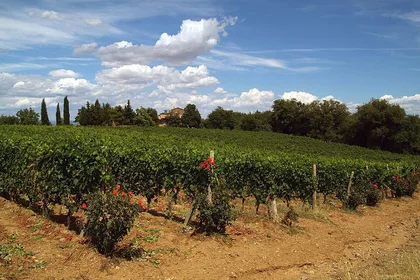 WineBrunello di MontalcinoBrunello di Montalcino is pure Sangiovese aged five years, at least two of them in oak, made only in the…
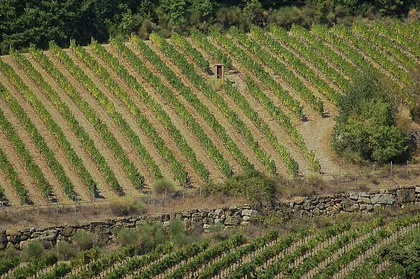 WineChianti ClassicoChianti Classico is the Black Rooster wine: at least 80 per cent Sangiovese from nine communes between…
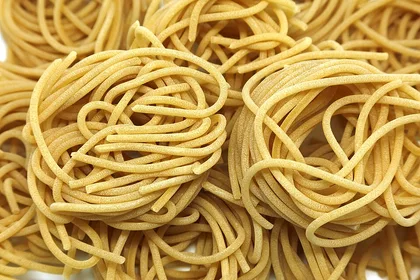 Pasta and breadPiciPici are fat, hand-rolled spaghetti from southern Tuscany, made from nothing but flour and water.
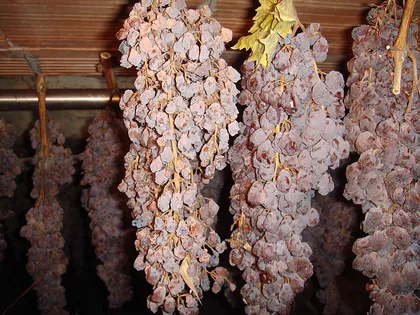 WineVin SantoVin Santo is Tuscany's dried-grape wine: Trebbiano and Malvasia laid on reed mats or hung from the rafters…
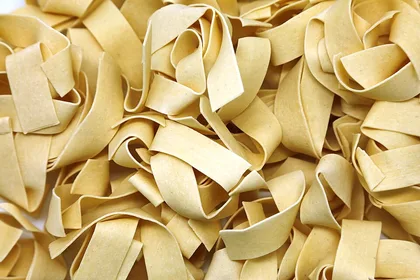 Pasta and breadPappardelleRibbons of egg pasta two to three centimetres wide, the widest pasta you still eat twirled on a fork.
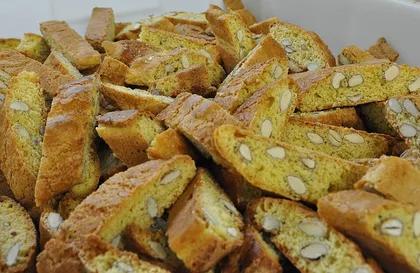 SweetsCantucciCantucci are hard, twice-baked Tuscan almond biscuits. A log of dough is baked, sliced on the diagonal while…Vegetables and fruitChestnutsFor a thousand years the Apennines made bread from them rather than dessert: Castanea sativa was the tree…
 Cured meatsFinocchionaFinocchiona is Tuscany's fennel salami: coarsely ground pork seasoned with wild fennel seeds and flowers…