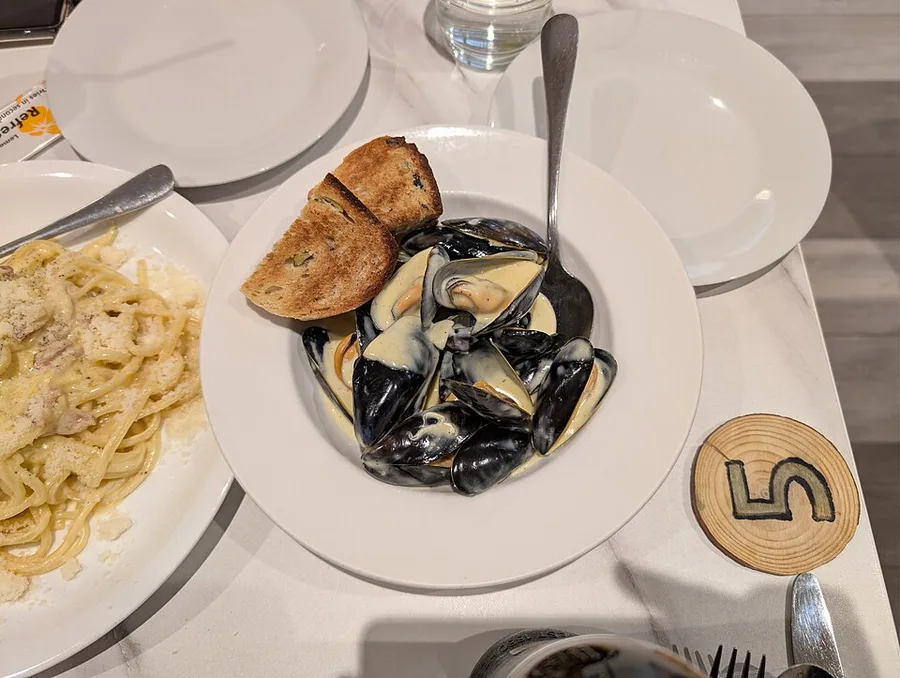
What is Taranto Mussels?
A Taranto mussel is Mytilus galloprovincialis, farmed in the two basins that wrap around the city: the Mar Piccolo, an inland lagoon of roughly twenty square kilometres split into two lobes, and the Mar Grande, the open roadstead sheltered by the Cheradi islands.
What makes the Mar Piccolo unusual are the citri, submarine freshwater springs that well up from the bottom, fed by the karst aquifer of the Murgia plateau. They lower the salinity and carry nutrients, and in that brackish water mussels grow fast and fill their shells.
You taste it. Taranto mussels are less salty than open-sea mussels, distinctly sweeter, with big soft meat, pale in the females and deep orange in the males. They are the exact opposite of the wild moscioli of the Conero coast, which are small, firm and iodine-heavy. Here the character is plumpness and sweetness.
None of this is new. Classical sources describe shellfish farming in these basins in Roman times, and the city lived on mussels and oysters for centuries. The cozza nera tarantina is listed among Puglia's traditional food products.
What does it taste like?
Sweet and mild, with far less of the saline slap most people expect from a mussel. The flavour is closer to a scallop than to an oyster: soft, slightly milky, with a gentle marine finish rather than a mineral one.
The texture is what farmed lagoon mussels do best. In season the meat is large, tender and juicy, and it fills the shell rather than rattling around inside it. Overcook it by a minute and it shrinks and toughens like any mussel, but it has more margin than a wild one.
The liquor is the giveaway: sweeter and less salty than the liquid from Atlantic or open-sea mussels, which is why Puglian cooking piles black pepper on it. The classic dish is called impepata for a reason: the pepper is there to give the sweetness something to push against.
Out of season, roughly November to March, they are noticeably leaner and less interesting. This is a summer mussel.
How to use it
Taranto mussels are big and sweet, so they take heavier treatment than a wild mussel does.
The simplest dish is impepata: mussels in a wide pan with oil, garlic, parsley and a great deal of coarsely ground black pepper, lid on, off the heat the moment they open. Strain the liquor and keep it: it is the sauce.
Arraganate are the baked version: half shells topped with breadcrumbs, garlic, parsley, oil and sometimes a piece of tomato, three minutes under a hot grill. Cozze ripiene alla tarantina are something else entirely: the shells are stuffed with a bread, egg and cheese mixture, tied shut and simmered in tomato sauce, which then dresses the pasta.
Then there is tiella: layers of rice, potato and mussels in a baking dish with onion, tomato, pecorino and parsley, an hour in the oven. Bari and Taranto both claim it and each insists the other ruins it.
Raw with lemon is a genuine Taranto habit, but raw bivalves are the commonest food source of hepatitis A and norovirus, and purification lowers that risk without removing it. Use only labelled, same-day shellfish if you do it, and skip it in pregnancy, in early childhood, and with any immune compromise.
How long it keeps
They stay alive until they go into the pan, and everything else follows from that. They sit in the least cold part of the fridge, in an open container, under a damp cloth. Never submerged in fresh water, which kills them within half an hour, and never sealed inside a closed bag. The working window is twenty four hours, forty eight at the outside, and the date on the dispatch centre label is the reference rather than the look of the shells. While they wait they lose the seawater held between the valves and grow noticeably lighter.
Clean them shortly before cooking rather than in advance: pull the byssus towards the pointed end, scrape off the encrustations and rinse under cold running water without leaving them to soak. Cooked, shelled and covered with their own filtered liquor, they hold a day or two in the fridge, and the flesh firms up as it sits. Freeze them only once cooked and shelled, for a couple of months. The filtered cooking liquor freezes in cubes and is the base of any seafood risotto.
Spot the real thing
The shell is blue-black turning violet, smooth and fairly thin, which is what suspended rope growing produces; a mussel scraped off rock is thicker and more encrusted. The size is generous and even, because they are graded as they come off the ropes. The real signal is yield: opened in season, a Taranto mussel fills its shell right to the edges, and a small piece of meat rattling around inside a large shell means either the wrong season or a different product. Weight should match size, since a very light one is hollow and a very heavy one is carrying sand.
Closed valves, or valves that close when tapped, tell you the animal is alive. Species matters abroad: this is Mytilus galloprovincialis, whereas northern shops mostly sell Mytilus edulis from Ireland, Holland or Canada, rounder and paler shelled, and New Zealand green-lipped mussels are a different genus again. The label from the depuration or dispatch centre carries the harvest area and the date, and it is the document worth asking for.
How to pronounce Taranto Mussels
KOT-tseh dee TAH-rahn-toh
Cozze is two syllables and the 'zz' is a 'ts', as in 'pizza': KOT-tseh, with the final 'e' pronounced. The singular is cozza, KOT-tsah. Taranto is stressed on the first syllable, TAH-rahn-toh, which is the mistake almost every English speaker makes; it is never 'ta-RAN-to'.
Taranto Mussels compared
vsCozza di Scardovari PDO
Italy's other great lagoon mussel, farmed in the Sacca di Scardovari in the Po delta and the only Italian mussel with a protected designation. The logic is the same (brackish water, slow exchange, high nutrients, a plump sweet mussel) but the Adriatic lagoon is colder and the result is more delicate and slightly less full. Taranto mussels are bigger and sweeter; Scardovari mussels are finer and, thanks to the PDO, more consistently traceable.
| This | Cozza di Scardovari PDO | |
|---|---|---|
| Water | Brackish lagoon with freshwater springs | Brackish delta lagoon, river-fed |
| Protection | Regional traditional product (PAT) | PDO since 2013 |
| Size | Large, generous meat | Medium, slightly leaner |
| Flavour | Sweet, low salt | Delicate, faintly sweet, cleaner |
| Peak season | May to August | June to September |
vsGalician rope mussels and New Zealand green-lipped
The two mussels most people outside Italy actually buy. Galician mussels grow on ropes hung from rafts in the rias and are the benchmark for size and meat yield; they are excellent, but open-Atlantic water makes them saltier and less sweet. New Zealand green-lipped mussels are a different species altogether, sold frozen on the half shell, large, soft and mild, and almost always pre-cooked: fine under breadcrumbs, wrong for anything where the mussel carries the dish.
| This | Galician rope mussels and New Zealand green-lipped | |
|---|---|---|
| Species | Mytilus galloprovincialis | M. galloprovincialis / Perna canaliculus |
| Method | Socks on floating longlines in a lagoon | Ropes from rafts / open-sea farms |
| Flavour | Sweet, low salinity | Saltier, more marine, milder respectively |
| Sold as | Live, in season | Live, or frozen half-shell |
| Best use | Impepata, tiella, stuffed in tomato | Moules mariniere / gratin |
vsWild moscioli di Portonovo
The wild counterweight. Moscioli settle by themselves on the rocks of the Conero headland and grow for two or three years in open surf, which gives a thick shell, under 20 per cent meat yield and a strongly saline, mineral flavour. A Taranto mussel is a farmed lagoon animal grown in under a year: three times the yield, a fraction of the salt, twice the sweetness. Neither replaces the other: one is for a dish built on plump meat, the other for a dish built on the sea.
| This | Wild moscioli di Portonovo | |
|---|---|---|
| Origin | Farmed on longlines | Wild, self-settled on rock |
| Growing time | 8-12 months | 2-3 years |
| Meat yield | About 30% | Under 20% |
| Flavour | Sweet, soft, low salt | Salty, firm, mineral |
| Season | April to September | May to September |
| Price | 3-6 EUR per kg | 10-18 EUR per kg |
Taranto Mussels substitutes
- Cozza di Scardovari PDO or other Italian lagoon mussels
The nearest match in character: brackish-grown, sweet and tender. Cook them a fraction less, since they are slightly smaller.
1:1 by weight - Bouchot mussels
Small, sweet and dense, with an excellent meat-to-shell ratio, and the closest widely available European mussel in flavour. You will need more shells for the same quantity of meat.
1.2:1 by weight - Galician, Cornish or Shetland rope mussels
Large, plump and reliable everywhere in the UK. Saltier, so taste the cooking liquor before adding any salt, and reduce it a little if you are dressing pasta with it.
1:1 by weight - Clams (vongole veraci or littlenecks)
For a pasta or a rice dish rather than for a bowl of mussels. Clams give a firmer bite and a saltier liquor, so cut back on seasoning elsewhere.
1 kg mussels = 800 g clams - New Zealand green-lipped mussels
The last resort, and only for gratins. Large, soft, mild and usually pre-cooked, so they cannot open in the pan and release liquor, and the whole basis of the Puglian dishes disappears.
Not recommended for impepata or tiella
Where to buy it
In Italy, any fishmonger from spring to early autumn: 3 to 6 euros a kilo in Taranto itself, 5 to 9 elsewhere, and 7 to 11 for cleaned vacuum packs. That is roughly 2 to 4 dollars per pound, or 3 to 8 pounds per kilo: mussels are a cheap food everywhere, and the variable is season, not price.
Outside Italy you will not find Taranto mussels as such; live shellfish with a two-day shelf life does not export well. Buy the best local live mussels instead and use the Puglian recipes, which is what the substitutes list is for.
What matters far more than provenance is the label. All live bivalves must carry a health mark from a purification or dispatch centre stating the species, the harvesting area and the packing date. That label is the entire traceability chain, and it is the reason to buy from a shop rather than from an informal stall.
In season, look for shells that are closed or that close when tapped, a heavy feel for the size, and no sand rattling inside. Buy them on the day you cook them.
Where to eat it in Italy
Taranto's old town sits on an island between the two seas, joined by two bridges, and it is where to eat: small trattorie, mussels in every form, fish landed from the Mar Grande. The national archaeological museum, MArTA, holds the extraordinary gold work of the Greek city of Taras and explains how rich this place once was.
Along the Mar Piccolo, the cozzaruoli still sell directly from stalls on the railing above the channel. It is the most Taranto scene there is, and you should buy from the ones with proper labelling.
In summer, mussel festivals run along the Ionian coast west and east of the city. Further afield, Puglia's other mussel grounds are at Varano and in the Gulf of Manfredonia, and Bari makes its own claim on the rice, potato and mussel bake that Taranto also considers its own.
Further reading
Frequently asked questions
Why are Taranto mussels sweeter than other mussels?
Because of the citri, freshwater springs rising from the bed of the Mar Piccolo out of the karst aquifer of the Murgia. They lower the salinity and add nutrients, so the mussels grow quickly, fill their shells and taste less salty and distinctly sweeter than open-sea mussels.
Are Taranto mussels safe, given the industry around the lagoon?
In 2011 mussels farmed in the inner lobe of the Mar Piccolo were found to exceed legal limits for dioxins and PCBs; the stock was destroyed and farming there was banned. Production moved to the outer lobe and to the open Mar Grande, often with seed grown in the lagoon and finished in open water. Harvesting areas are classified, monitoring by the regional environmental agency and the health authority is routine, and mussels reaching the market must pass through a purification or dispatch centre and carry a health label. In practice, labelled and traceable mussels are safe; unlabelled ones from informal sales are not. Anyone who still prefers to avoid them is making a reasonable choice, but the product on sale is monitored.
When is the season?
They are harvested year round, but the real season runs from April to September and peaks between May and August, when the meat fills the shell ahead of spawning. In winter the mussels are lean: you pay almost the same and eat half as much.
How do they differ from other mussels?
The brackish lagoon gives a large, plump, sweet mussel with low salinity. Scardovari PDO mussels from the Po delta are similar but more delicate; Galician rope mussels are bigger and meatier but saltier and less sweet; wild moscioli from the Conero are the opposite extreme: small, firm and strongly mineral.
Can I eat them raw?
It is traditional in Taranto, but raw bivalves are the most common food source of hepatitis A and norovirus, and depuration reduces that risk without eliminating it. If you do, use labelled shellfish bought and eaten the same day, and avoid it entirely in pregnancy, in young children, in the elderly and with a weakened immune system.
Related foods
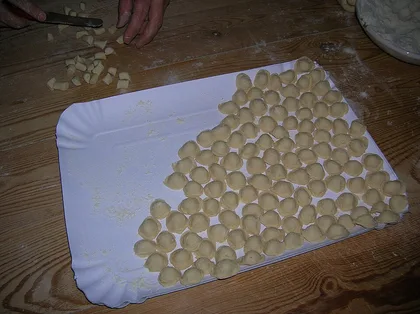 Pasta and breadOrecchietteOrecchiette are Puglia's handmade pasta: semolina and water, no egg, dragged with a knife and flipped over a…
 Pasta and breadPane di AltamuraPane di Altamura is a durum-wheat sourdough from the Murgia plateau in Puglia, and in 2003 it became the…
 Oil and preservesExtra Virgin Olive OilTwo exams have to be passed, and one of them is carried out by people.
 CheeseBurrataIt began as a way of using offcuts: leftover shreds of pasta filata, drowned in cream and sealed inside a…
 CheeseMozzarellaThe name is a verb before it is a cheese: mozzare means to lop off, which is what the cheesemaker does by…
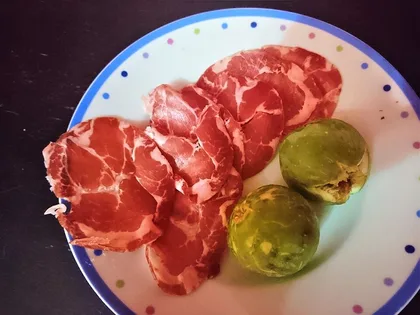 Cured meatsCapocolloCapocollo is the pork neck muscle, salted whole and aged in casing.
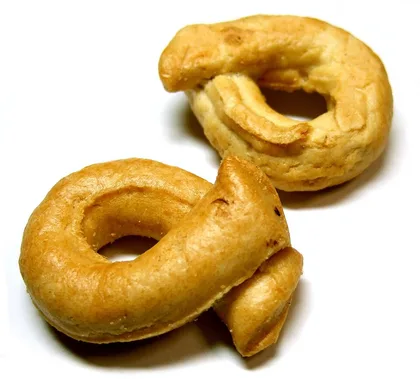 Pasta and breadTaralliTaralli are small, crunchy savoury rings from Puglia in southern Italy, made from just flour, dry white wine…
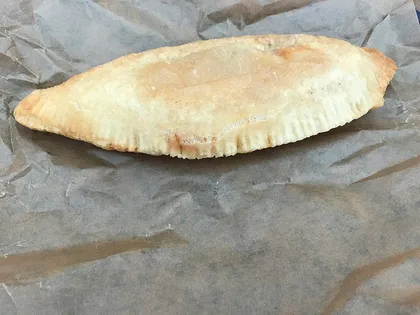 Pasta and breadPanzerottiThe oven never comes into it. A hand-sized half-moon of pizza dough, tomato and mozzarella sealed inside…