What to eat in Parma
Parma starts every meal with a board of cured pork: prosciutto crudo, culatello di Zibello, salame Felino and coppa, with hot torta fritta to wrap them in. Then filled pasta in broth, anolini at Christmas and tortelli d'erbetta in June, and Parmigiano Reggiano, which here is an ingredient rather than something grated on at the end.
Parma has more protected-name foods per square kilometre than any other Italian city, and the reason is geography rather than pride. The hills above Langhirano get a steady breeze and the kind of humidity that lets a ham dry without smoke; the Bassa, the flat damp country along the Po, gives culatello the fog it cannot be made without; the plain in between has the milk and the fodder for Parmigiano Reggiano. Three climates within fifty kilometres, three different foods.
The cooking follows from that. It is less worked than Bologna's and more about the raw material: the meal opens with a board of salumi and torta fritta, diamonds of dough puffed up in boiling lard and brought to the table hot, to be filled while they still steam. The skill sits in the curing and the slicing, not in a recipe. Then comes filled pasta in broth, which is the real Parma speciality: anolini with a filling of beef braised for a day and Parmigiano, tortelli d'erbetta with ricotta and chard.
The other half of the city is industrial. Barilla was founded here as a shop in 1877, Mutti and Rodolfi made Parma the tomato-processing capital of Europe, and EFSA, the European food safety agency, has its seat in town. Anyone arriving expecting a farming village finds a very large food district instead, with eight Food Museums spread across the province, one per product, which is the most orderly way to understand it.
The dishes of Parma
Prosciutto di Parma DOP
Pork leg, sea salt and nothing else: no preservatives, no smoke, a minimum of twelve months in the hill air above Langhirano. The shops that still carve it by hand do, and you can taste the difference against a machine slice. Serve it at room temperature and eat it straight away, because after ten minutes on the plate it oxidises.
Culatello di Zibello DOP
The heart muscle of the leg, boned and skinned, cased in a pig's bladder, tied by hand and aged in damp cellars along the Po with the windows open to the fog. The production zone is eight villages and no more. It costs three times what prosciutto costs and it is the most refined cured meat in Italy: slice it thin and eat the first two slices without bread.
Torta fritta with salumi
Diamonds of bread dough fried in lard until they puff up like pillows, carried to the table scalding and filled at once with prosciutto, culatello, salame or coppa, which warm through and release their fat. Modena calls it gnocco fritto and Bologna crescentina; in Parma it is torta fritta. It is the standard starter and it often becomes dinner.
Anolini in brodo
Very small round filled pasta, stuffed with beef braised for a whole day, breadcrumbs, Parmigiano and nutmeg; down in the Bassa the filling is only cheese and bread. They are cooked in a broth of beef, capon and hen and served at Christmas and on Boxing Day. Parma families count them per person: forty or fifty to a plate.
Tortelli d'erbetta
Squares of egg pasta filled with ricotta, erbette (the thin-stalked chard), Parmigiano and nutmeg, dressed with nothing but melted butter and cheese. They are eaten outdoors on the night of San Giovanni, between 23 and 24 June, under the dew, which tradition says brings luck. It is the most delicate dish in the city and the easiest to ruin with too much dressing.
Parmigiano Reggiano DOP
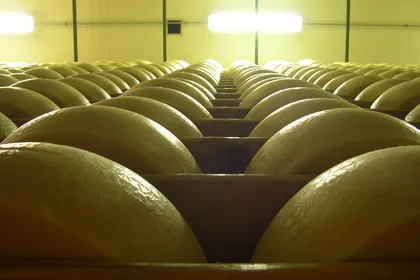
Raw milk, rennet, salt and twenty-four months at the very least: one kilo of cheese takes sixteen litres of milk, and the rulebook bans every additive. Parma uses it as an ingredient, in fillings, in sauces, over tortelli, and in shards with balsamic vinegar or pears. The gap between 24, 36 and 60 months is wide: the youngest is milky and sweet, the oldest grainy and almost sharp.
Salame Felino, coppa and pancetta
Salame Felino IGP takes its name from the village in the hills: coarse grind, little garlic, white wine, natural casing and a flask shape. Coppa di Parma IGP comes from the top of the neck and is aged at least sixty days; rolled pancetta closes the board with its fat sweetness. All three should be cut by hand and on the diagonal.
Local products
The province makes four protected foods in a concentration you will not find anywhere else: Prosciutto di Parma DOP from Langhirano, Culatello di Zibello DOP from the eight villages of the Bassa, Parmigiano Reggiano DOP and Salame Felino IGP, with Coppa di Parma IGP and the raw shoulder of Palasone alongside them. From the mountains come the Borgotaro porcini IGP, the first mushroom in Europe to earn a protected name, and the black truffle of Fragno, which Calestano celebrates in October.
Then there is tomato, which here is industry. Parma processes an enormous share of Europe's tomato paste, and the Tomato Museum tells the story of preserving from the eighteenth century on. There is Barilla pasta, which began as a shop in 1877, and the wines of the Colli di Parma, with aromatic Malvasia di Candia in white and the fizzy Lambruschi that go with cured pork better than anything else. The network of eight Food Museums across the province is the most complete way to see all of it without improvising.
Sweets and pastries
Parma's pastry is measured and not at all baroque. Spongata is the Christmas sweet of the mountains, Berceto and Corniglio above all: a disc of short pastry filled with honey, walnuts, almonds, pine nuts, raisins and spices, very old and also part of the Jewish communities of Emilia. Torta duchessa, named for Marie Louise of Austria, is an almond and custard cake that the pastry shops in the centre still make. Torta di tagliatelle layers thin egg pasta, almonds and sugar into a crisp tart that keeps for days.
Carnival brings fried sfrappole, village festivals bring sweet chisolini, summer brings rice cake and fried custard. The violets of Parma are a chapter of their own: candied flowers tied to Marie Louise and to the Borsari perfume house since 1870, sold in little tins and used to decorate cakes. Pasticceria Torino, in the centre, is the old address for risen doughs and feast-day sweets.
Where to try them
Piazza Ghiaia is the historic market, running for centuries between the Pilotta palace and the stream and now rebuilt: greengrocers, a fishmonger, a deli counter. For cured meats the reference is Salumeria Garibaldi on via Garibaldi, where they carve by hand and will let you taste at the counter; Specialità di Parma, on via Farini, works the same way. Enoteca Fontana, also on via Farini, is the bottle shop where people have drunk Lambrusco and Malvasia by the glass standing up for decades, with a plate of torta fritta.
To sit down, Trattoria Corrieri and Sorelle Picchi around via Farini cook classic Parma food; the Oltretorrente, the working-class quarter across the river, keeps prices down. The real step up, though, is outside town: in the Bassa, the Antica Corte Pallavicina at Polesine Parmense has culatello cellars below the level of the Po that can be visited, and the villages around it (Zibello, Roccabianca, Busseto) serve culatello, cooked shoulder and anolini at prices the centre no longer has.
Worth seeing: Parmigiano Reggiano dairies open to visitors at six in the morning, when the wheel is lifted out of the whey, and several take bookings; the ham plants at Langhirano can be visited; and Soragna, Langhirano, Felino and Polesine hold the Food Museums for Parmigiano, ham, salame and culatello.
When to go
Autumn and winter belong to culatello, because the fog of the Bassa is part of how it is made: November to February is when visiting and tasting make most sense. November brings November Porc, four consecutive weekends rotating through Sissa Trecasali, Polesine, Zibello and Roccabianca, built entirely around the pig, with street kitchens and tastings.
In September the Prosciutto di Parma Festival opens the Langhirano plants to visitors; in October Calestano holds the Fragno black truffle fair and Borgotaro the porcini fair, one of the oldest in Italy. On 23 June, the night of San Giovanni, tortelli d'erbetta are eaten outdoors; at Christmas and on Boxing Day anolini in broth are compulsory. In spring of even-numbered years Cibus brings Italy's biggest food trade fair to Parma and fills the hotels and restaurants for a week.
Food tours and classes here
Guides that cover this city
Frequently asked questions
What is the difference between prosciutto di Parma and culatello?
Prosciutto uses the whole leg with the rind and the bone, aged at least twelve months in the dry hill air of Langhirano. Culatello is only the muscular heart of the leg, boned and cased in a bladder, aged in the damp cellars of the Bassa along the Po. Culatello yields far less, tastes more intense and costs about three times as much.
What dish is Parma known for?
The board of cured meats with torta fritta is the compulsory opening. On pasta, anolini in broth, small filled pasta with braised beef and Parmigiano, traditional at Christmas, and tortelli d'erbetta with ricotta and chard, eaten on the night of San Giovanni in June.
Can you visit a Parmigiano Reggiano dairy?
Yes, many take bookings, usually at dawn, when the milk is worked and the wheels come out of the vat. A visit lasts about an hour and ends with a tasting of different ages. The province also has Food Museums devoted to Parmigiano, ham, salame and culatello.
How much does culatello di Zibello cost?
Between 80 and 130 euro a kilo at the counter, depending on age and producer, against 25 to 40 euro for prosciutto di Parma. The yield explains it: one leg gives one culatello, the production zone is eight villages, and the minimum ageing is ten to twelve months, often much longer.