Sila: where to eat and stay
A granite plateau at twelve hundred metres, with larch pines forty metres tall, man-made lakes and potatoes growing where nothing of the sort should grow in Calabria. It is the mountain that contradicts the postcard Calabria of beaches.
The Sila is a plateau rather than a range: a block of granite and gneiss a hundred kilometres long and forty wide, almost all of it above a thousand metres, topping out at Botte Donato just under two thousand. It splits into three parts with different histories. The Sila Grande, in the Cosenza province, is the one with the lakes and the resorts, with Camigliatello and Lorica as its poles. The Sila Piccola, in the Catanzaro province, is more wooded and less visited, with Villaggio Mancuso and Taverna. The Sila Greca, to the north-east, takes its name from the Arbëreshë, that is Albanian, communities settled here since the fifteenth century, which have kept their language and the Byzantine rite.
The national park was established in its present form in 2002, after an earlier protection dating from the 1960s, and in 2014 UNESCO recognised the area as a biosphere reserve. Inside are the largest larch pine forest in Europe, the Apennine wolf, the native Sila roe deer, and the lakes (Cecita, Arvo, Ampollino) that look natural and are all artificial, built in the 1920s and 1930s for hydroelectric power. That is worth knowing before admiring them: under Lake Arvo there is a valley with its pastures, and the old people of Lorica remember the stories about what was there before.
The most disorienting thing is the temperature. The Sila is half an hour by car from Cosenza and an hour from the Ionian beaches, but in winter it records some of the lowest minimums in Italy: the closed basins of the plateau trap cold air and minus twenty is not exceptional. In summer, while the coast sits at thirty-eight, it is twenty-five here with cool nights. That explains the vegetation, it explains the potatoes, and it explains why coastal Calabrians come up in August.
How people eat here
Sila cooking is mountain cooking and poverty cooking: potatoes, pulses, mushrooms, pork, cheese and bread. There is no fish and there is no 'nduja, which is a product of Spilinga on the opposite side of the region, above Tropea, and which is found here because it is sold everywhere in Calabria rather than because it belongs to the Sila. The pasta is made with water and semolina and rolled on a knitting needle: fileja, also called scilatelli or maccheroni al ferretto depending on the village, long twisted tubes that hold a pork sauce or a goat ragù. Potatoes appear in half the dishes, and the most typical way with them is patate 'mpacchiuse: sliced thin, cooked slowly in a pan with plenty of oil until they stick together into a compact mass, crisp at the edges, with chilli. It is a peasant dish that needs the right potatoes, and the right potatoes are here.
The Sila potato IGP is grown above a thousand metres on loose granitic soils, with strong day to night swings: it has firm flesh, little water and holds its shape. Several varieties are allowed by the rulebook, almost all yellow or white fleshed, with planting between April and June and harvest from August to October. It is the only Italian potato with a protected name tied to a mountain plateau, and the difference from an ordinary potato shows above all in dry cooking. During the harvest months you buy directly from growers along the roads of the plateau, and it costs little.
On cheese the big name is caciocavallo silano DOP, but the truth about the name should be told: the denomination was born here and carries the Sila's name, yet the rulebook allows production across a very large area taking in Calabria, Basilicata, Campania, Molise and part of Puglia. So a caciocavallo silano DOP may be made two hundred kilometres from here. It is a pulled-curd cow's milk cheese, often from podolica cattle in the better versions, shaped like a flask with a little head tied by a cord, aged from a month upwards. The one made in the Sila from pasture-fed podolica milk is a different category of product from the industrial caciocavallo found in supermarkets under the same wording, and the only way to tell them apart is to ask which dairy made it. Beside it are smoked ricotta, butirro (a caciocavallo with a heart of butter inside, which was how butter was kept without a fridge) and the pecorini of the Crotone slopes.
Mushrooms are the other pillar. The larch pine and beech woods produce porcini in quantity, and around Camigliatello picking and trading mushrooms is a real economy, with driers, preserves in oil and an autumn fair. Besides the porcino there are rositi, the milk caps, eaten grilled over embers with oil and garlic, and various local species. On pork, Calabria has four cured meats with protected names (soppressata, capocollo, pancetta and sausage) and all of them are made in the Sila, with chilli in varying doses. The signature sweet is the pitta 'mpigliata of San Giovanni in Fiore: strips of pastry rolled into roses, filled with walnuts, raisins, almonds, honey and liqueur, assembled in a tin and baked slowly. It is made at Christmas and keeps for weeks.
Working farms that take guests
Real places in this territory, checked one by one on their own site. What you read is what they state: the editorial visit has not happened yet, and when it does we will say so.
Fattoria Biò
Spezzano della Sila (CS)About a hundred hectares in the Sila, in contrada Santa Maria Lagarò at Camigliatello Silano, plus fifty at Rossano, all organically run: Calabrian podolica cattle with seasonal transhumance, and on-site production of cheese, ricotta, cured meats, bread and pasta. A farm restaurant with a Sila menu and a teaching farm.
fattoriabio.itAgriturismo Zagaria
Spezzano della Sila (CS)The Sirianni farm, in contrada Zagaria near Lake Cecita and about ten kilometres from Camigliatello: it makes ricotta, mozzarella and caciocavallo, grows vegetables and mushrooms and keeps farmyard animals. Rooms and a restaurant open for lunch and dinner all year.
agriturismozagaria.itAgriturismo BioSila
Acri (CS)An estate at 1,100 metres in contrada Filiciuzzi, with organic certification across the whole chain: cattle, sheep, goats, donkeys and farmyard animals, its own dairy and butchery, and pecorino, caciocavallo, Sila ricotta and giuncata. Accommodation and a farm restaurant, plus a shop and a teaching farm.
biosila.itThe foods of this territory
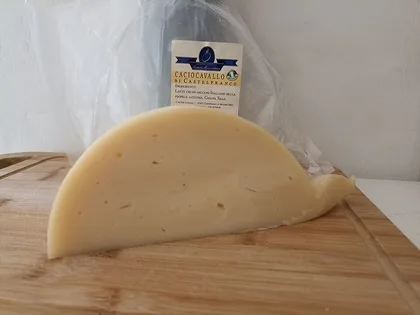 DOPCaciocavalloCaciocavallo is a stretched-curd cow's milk cheese from southern Italy, aged in a…
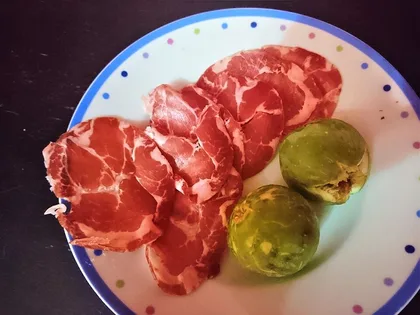 FoodCapocolloCapocollo is the pork neck muscle, salted whole and aged in casing.
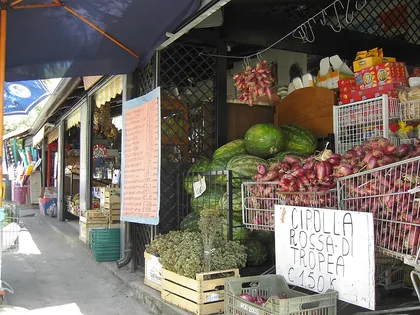 IGPTropea Red OnionTropea red onions are grown on a narrow strip of sand along Calabria's Tyrrhenian coast…
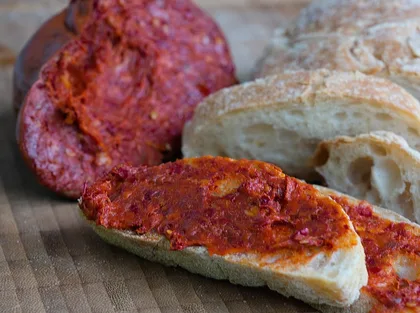 PAT'Nduja'Nduja is a soft, spreadable Calabrian pork salume that is up to 40% chilli.
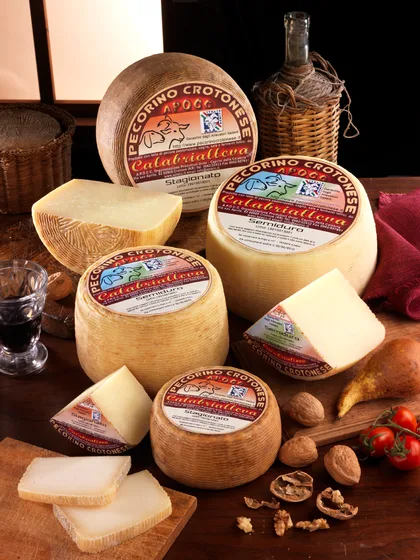 DOPPecorino CrotonesePecorino Crotonese DOP comes from the flocks that summer on the Sila plateau and winter in…
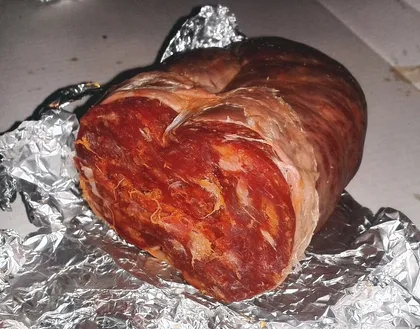 DOPSoppressataSoppressata is a coarse-ground dry salami from southern Italy, pressed flat between boards…
What to do here
The national park is the reason for the trip. The Fallistro reserve, above Croce di Magara, holds the so-called Giants of the Sila: a few dozen larch pines and maples up to forty metres tall and three and a half centuries old, survivors of the felling that stripped half the plateau after the war. It is a small area, run by the FAI, and visited in an hour: it is the most impressive thing in the Sila. The path around Lake Cecita, the routes on Monte Botte Donato and the climb from Lorica with the chairlift cover the rest. The park has licensed guides and the evening outings to hear the wolves howl are one of the few Italian nature activities done seriously.
The Sila train is the railway attraction: a narrow-gauge line built in the 1920s, run in season by a historic steam or diesel train between Moccone, Camigliatello and Silvana Mansio, which touches fourteen hundred metres and is the highest narrow-gauge station in Italy. Services run on set days and are booked: it is a slow two-hour journey through the woods, suitable even for people who do not walk.
On food, the real activities are visiting the dairies (to be arranged, and early in the morning if you want to see the curd pulled), buying potatoes directly on the plateau from August to October, and picking mushrooms, which requires a permit issued by the competent bodies, with daily limits on quantity and diameter. At Camigliatello, in autumn, a mushroom fair draws a lot of people and a lot of stalls: you buy well if you can tell a producer from a reseller, and that is not always easy.
Of the towns, San Giovanni in Fiore is the most important: it holds the Florense abbey founded by Joachim of Fiore at the end of the twelfth century, a first-rank monument and a place tied to one of the most influential intellectual figures of the European Middle Ages. Longobucco has a living tradition of loom weaving. In the Sila Greca, San Demetrio Corone and the Arbëreshë villages keep the Byzantine rite and the Albanian language.
An honest note on Camigliatello. It is the plateau's historic resort and in August and at New Year it is very crowded, with a main street entirely occupied by shops selling typical products. Part of that merchandise is local and good, another part is industrial packaged charcuterie with folkloric labels and imported dried mushrooms. The simplest rule is to ignore the shops with stuffed wild boar in the window and ask where the dairy is.
The year, month by month
From December to March the Sila is snow. The ski stations of Camigliatello, with Monte Curcio, and of Lorica, with Botte Donato, run their lifts when the cover holds, and the season varies from year to year: it is small-scale skiing with short runs and should be taken as such. Night-time minimums are among the lowest in Italy. On the table there are the cured meats of the winter slaughter, pulses, preserves and pitta 'mpigliata at Christmas. Many farm stays close, so the choice narrows.
April and May are the thaw: the lower paths open, the lakes are full, the meadow flowering is short and intense, and there is nobody about. It is perhaps the best time to walk, with the one caveat that above seventeen hundred metres the snow holds into late May.
June and July bring perfect temperatures and long days. It is the time for nature outings, for the train running and for swimmable lakes: the water is freezing, but some people do it. August is when coastal Calabrians come up in numbers to escape the heat: Camigliatello and Lorica fill, village feasts are continuous and finding a place without booking becomes difficult.
September, October and November are the best season for food. The potato harvest ends, the mushrooms begin with a peak between late September and October, the woods change colour, and the dairies work the milk of the last pasture before the animals come in. It is also when value for money is at its best, because the tourist season is over and the farm stays are working below capacity.
Getting there and getting around
By car you come off the motorway along the Tyrrhenian side of Calabria at Cosenza nord or at Rogliano depending on which side you want, and climb the SS107 Silana-Crotonese, the plateau's main road, which links Cosenza to Camigliatello, San Giovanni in Fiore and then down towards Crotone. Cosenza to Camigliatello is thirty-five minutes, Lamezia Terme about an hour and a half. The park's internal roads are good on the main routes and narrow and twisting on the secondary ones, with frequent animal crossings.
By train the main station is Cosenza, linked to Paola on the Tyrrhenian line where the fast and Intercity trains from Rome and Milan stop. From Cosenza you continue by local bus to the plateau, with daily but infrequent services. There is also the narrow-gauge Cosenza to Camigliatello line, run by the regional railway, with a limited and partly tourist service: it is not reliable as ordinary transport, but for one stretch it is a journey worth making.
The airport is Lamezia Terme, an hour and a half away, with domestic and seasonal international flights; from Lamezia the rail link to Cosenza is convenient. Reggio Calabria and Bari are distant alternatives.
Without a car the Sila is hard. The villages are linked by sparse buses, the park and the farm stays are outside the centres, and in winter services are cut further. Anyone arriving by train should hire a car at Cosenza or Lamezia.
One last note on winter: from November to April winter tyres or chains in the car are compulsory on the plateau roads, and it is not a bureaucratic formality. Snowfalls here can be heavy and the wind builds drifts that close the exposed sections. Anyone coming up on summer tyres after a storm risks being stuck.
Frequently asked questions
Is caciocavallo silano made only in the Sila?
No, and it is the commonest surprise. The denomination was born here and carries the plateau's name, but the DOP rulebook allows production across a very large area taking in provinces of Calabria, Basilicata, Campania, Molise and Puglia. A caciocavallo silano DOP may therefore be made hundreds of kilometres from the Sila and remain entirely within the rules. The real difference is the milk and the farming: a caciocavallo from pasture-fed podolica cattle, aged long, is a different product from an industrially made caciocavallo from indoor milk, even though both carry the same mark. The only way to navigate it is to ask for the dairy's name and where the milk comes from.
Why do Sila potatoes cost more?
Because they grow in conditions that cut yields and improve the product. Cultivation takes place above a thousand metres, on loose permeable granitic soils, with a single annual harvest between August and October and strong day to night temperature swings. The result is a potato with less water, firmer flesh and better behaviour in cooking, recognised with a protected geographical indication. Against a lowland potato grown on faster cycles with far higher yields, the production cost is higher. During the harvest you buy directly from growers along the plateau at prices far below the supermarket.
Is 'nduja a Sila product?
No. 'Nduja comes from Spilinga, in the Vibo Valentia area on the southern Tyrrhenian side, and belongs to that zone and its chilli. It is sold everywhere in the Sila because it has become the commercial symbol of Calabria as a whole, but it is not part of the plateau's tradition. The Sila cured meats are others: soppressata, capocollo, pancetta and sausage, all recognised as Calabrian denominations, made from pigs raised in the mountains and spiced with varying amounts of chilli. Anyone who wants good 'nduja should buy it where it is made; anyone in the Sila should look instead for an aged soppressata from a plateau producer.
When do you come to the Sila for mushrooms?
From late September to early November, with the peak depending on September rain: after a storm it takes two to three weeks for porcini to come up in quantity. The larch pine and beech woods of the plateau are very productive, and around Camigliatello picking is an economic activity with driers and preserves. Picking requires a permit, with daily weight limits and rules on minimum diameter, and the fines are real. Anyone who does not want to pick will still find mushrooms on every menu on the plateau in that period, and it is when Sila cooking is at its best.