What is Zolfino Bean?
The zolfino is a local ecotype of common bean grown on the western slope of the Pratomagno, the ridge dividing the upper Valdarno from the Casentino in the province of Arezzo. It has no EU designation: it is on Tuscany's list of traditional products and has been a Slow Food Presidium since the early 2000s, when cultivation had shrunk to a handful of family plots.
The seed is very small, about a centimetre and barely more than half a cannellino, almost spherical and slightly flattened at the poles. The colour is pale, even yellow with a white hilum, and it is that colour, the exact yellow of sulphur, that gives the bean its name. A cream or straw-coloured bean is not a zolfino.
The quality that matters is the skin. It is fine enough to dissolve during cooking: the bean stays whole but offers no resistance at all, and the interior is creamy, almost buttery, without the mealiness of larger beans. That is why in Tuscany the zolfino is eaten on its own, with raw olive oil and pepper, rather than buried in a soup.
The plant is a dwarf bush. It does not climb and needs no poles, it is grown entirely without irrigation, and it sits on terraces between 250 and 600 metres. The lack of water is deliberate: drought stress concentrates the flavour and keeps the seed small.
Total production runs to a few dozen hectares. This bean came close to disappearing altogether and was brought back in the 1990s by Valdarno growers who had kept the seed going in their own gardens.
What does it taste like?
Sweet, buttery and faintly chestnut-like, with none of the mealy, starchy quality that puts people off dried beans. The flavour is delicate rather than assertive, which is exactly why it is not thrown into soup.
The texture is what people remember. Cooked slowly the bean stays intact but the skin is imperceptible: a spoonful of soft creamy interiors rather than a mouthful of jackets. It is closer to a very good mashed potato than to a chickpea, and it takes on olive oil the way bread does.
Warm, under a heavy pour of Tuscan oil and coarse black pepper, it tastes green and peppery on top and sweet underneath. That is the dish; adding anything else is usually a mistake.
How to use it
Soak briefly or not at all. Three or four hours in cold water is enough, against ten or twelve for a cannellino, and with beans from the current harvest many cooks skip it. A long soak on a skin this fine makes the jackets slip off and ruins the texture.
Cook them slowly and without salt. In an earthenware pot or a heavy pan: beans, cold water three fingers above them, a garlic clove in its skin, a few sage leaves, a spoon of olive oil, five peppercorns. Keep the liquid barely trembling for an hour and a half to two hours. Salt goes in during the last ten minutes.
The traditional method is cooking in a flask, and it is worth doing once. Strip the straw from a Tuscan wine flask, fill it halfway with beans, add water to two thirds, then oil, garlic, sage and pepper. Plug the neck loosely with tow so steam can escape, and stand it beside the embers of a fire, never over a flame, for four or five hours. The beans cook in their own steam and absorb everything.
The finished dish is always the same, and that is the point: warm beans in a bowl, a heavy pour of raw Tuscan olive oil, black pepper ground over the top, bread. Nothing else. Beyond that they belong beside things: under a grilled sausage, next to a bistecca alla fiorentina, with sautéed cavolo nero. Do not put them in a long-simmered soup: too delicate, and far too expensive to be blended.
How long it keeps
Dried, in a sealed glass jar in a dark, dry cupboard, zolfini keep for two years. The date on the bag is not the point, though. Beans go on losing water as they sit, and a dehydrated bean takes longer and longer to soften: a zolfino from last August cooks in ninety minutes, while the same bean two years on can ask for three hours and still hold a skin you can feel. That is why the harvest year printed on the pack is the single most useful line on it, more useful than any best-before.
Keep them out of the refrigerator, where damp works against them, and on a cool pantry shelf instead. In a hot summer, two days in the freezer at minus eighteen sees off any weevil eggs and changes nothing else. Cooked beans sit three or four days in the refrigerator covered by their own liquid, and the second day is better than the first, and they freeze in portions for three months, again in the liquid. Do not pour that liquid away: it is thick and savoury and reheats the beans without drying them out.
Spot the real thing
Size and shape come before colour. A zolfino is about a centimetre across, noticeably smaller than a cannellino, and close to spherical with only a slight flattening, so anything long and kidney-shaped is another bean. The colour is the famous part and the most imitated: a pale, even, matte sulphur yellow, never glossy, with a clearly visible white hilum where the seed was attached to the pod. Cream or straw-coloured beans sold under the name are usually coco nani or fagioli del purgatorio, which are good beans wearing someone else's label.
Price does the rest of the work. Yields run six to ten quintals a hectare, sowing and sorting are done by hand, and the whole Pratomagno crop covers a few dozen hectares, so the real thing sits between 18 and 30 euros a kilo and anything under 12 is declaring an origin it does not have. Packs carry the producer, the comune and the harvest year, and Presidio ones the Slow Food snail. The pot is the final word: after ninety minutes of slow cooking the beans should be intact, with skins you cannot feel and a creamy centre.
How to pronounce Zolfino Bean
fah-JOH-loh dzol-FEE-noh
In fagiolo the 'gi' is soft, as in 'gem', and the 'o' between is barely sounded: fah-JOH-loh. Zolfino starts with a voiced 'dz', like the ending of 'kids': dzol-FEE-noh. Pratomagno has the Italian 'gn' of 'lasagna': prah-toh-MAH-nyoh.
Zolfino Bean compared
vsCannellini
The Tuscan bean everyone knows, and the one people reach for by default. The cannellino is bigger, kidney-shaped, thicker-skinned and about a tenth of the price. It is built for soups and ribollita; the zolfino is built to be eaten by itself.
| This | Cannellini | |
|---|---|---|
| Size | About 1 cm, near-spherical | 1.5-2 cm, kidney-shaped |
| Colour | Pale sulphur yellow | White to ivory |
| Skin | Very fine, dissolves in cooking | Thicker, stays perceptible |
| Soaking | 3-4 hours, sometimes none | 10-12 hours |
| Texture | Creamy, almost buttery | Firmer, slightly mealy |
| Best for | Served alone with oil and pepper | Soups, ribollita, pasta e fagioli |
| Price | 18-30 euro per kilo | 2-4 euro per kilo |
vsFagiolo di Sorana IGP
The other great Tuscan bean and the closest thing to a peer. Sorana grows on the sandy river gravels of the Pescia stream in the Valleriana, north of Pistoia, and carries an IGP. Both have famously thin skins and creamy flesh, and both are traditionally cooked in a flask. Sorana is white and flat; zolfino is yellow and round.
| This | Fagiolo di Sorana IGP | |
|---|---|---|
| Shape | Round, slightly flattened | Flat, oval, elongated |
| Colour | Sulphur yellow | Pearly white |
| Where | Pratomagno terraces, 250-600 m | Pescia river gravels, Valleriana |
| Water | Grown dry, never irrigated | Grown on damp riverside sand |
| Protection | Slow Food Presidium, regional PAT | IGP since 2002 |
| Classic method | Cooked in a flask by the embers | Cooked in a flask by the embers |
vsBorlotti and Lamon beans
Borlotti, the mottled red-and-cream bean, of which the Fagiolo di Lamon IGP from the Veneto is the finest example, are a different proposition entirely: larger, meatier, with a pronounced chestnut flavour and a skin you notice. Excellent in soup and in pasta e fagioli. Not a stand-in for a plate of beans in oil.
| This | Borlotti and Lamon beans | |
|---|---|---|
| Size | About 1 cm | 1.5-2.5 cm |
| Colour | Uniform pale yellow | Cream streaked with red |
| Skin | Dissolves | Firm, clearly perceptible |
| Flavour | Sweet, delicate, buttery | Strong, chestnut-like |
| Best for | Beans in oil, alongside grilled meat | Soup, pasta e fagioli, stews |
Zolfino Bean substitutes
- Fagiolo di Sorana IGP
The best substitute anywhere, and the only one that reproduces the vanishing skin. Slightly flatter, marginally quicker, equally hard to find outside Tuscany.
1:1 by weight - Coco nano or small white beans
Small, round and thin-skinned, and the honest everyday stand-in, often in fact what gets sold as zolfino. Slightly less creamy, and white rather than yellow.
1:1, soak 6 hours - Flageolet beans (France)
Pale green-yellow, small and tender, harvested young. The closest widely available match for both colour and delicacy, and good in the oil-and-pepper preparation.
1:1, soak 8 hours - Navy or haricot beans
Easy to find in the US and UK and small enough to behave. Thicker-skinned: cook longer and mash a spoonful back in for creaminess.
1:1, soak 10 hours - Cannellini
Workable but a different dish: bigger, firmer, with a skin you notice. Dress them warm and be generous with the oil.
1:1, soak 12 hours
Where to buy it
In Tuscany, from the growers themselves and from good grocers in Arezzo, Florence and the Valdarno towns, at 18 to 30 euro per kilo. The usual pack is 500 grams at 10 to 15 euro. Autumn, just after the beans have been cleaned and the new olive oil has been pressed, is the moment to buy both together.
Abroad it is a rarity. Italian specialists in the US and UK list it occasionally at 18 to 30 dollars per pound or 30 to 45 pounds per kilo. If a shop offers it cheaply, it is almost certainly coco nano, a fine bean under someone else's name.
Check the pack for the producer's name, the commune and the harvest year, which matters more than the best-before date, because beans dry out with age and a two-year-old zolfino can cook for three hours and still keep a tough skin. Then look at the beans themselves: small, round, matte, uniformly pale yellow with a white hilum. Cream-coloured, glossy or kidney-shaped beans are something else.
Where to eat it in Italy
Loro Ciuffenna, Castelfranco Piandiscò and Terranuova Bracciolini, the three towns at the centre of production. Local trattorie serve the beans the right way, warm with new oil and pepper, and several farms sell direct from the door.
Autumn is the season to go, when the August harvest has been cleaned and, more importantly, the new olive oil comes out of the mills in November. Zolfino beans under oil pressed the same week is the reason to make the trip.
Between late summer and early autumn the Valdarno villages hold bean festivals; dates shift from year to year, so check before setting out.
The natural circuit takes in the Romanesque church at Gropina above Loro Ciuffenna, the eroded clay pinnacles of the Balze del Valdarno, and the terraces themselves. Half an hour on those hillsides explains the price better than any label.
Frequently asked questions
When are zolfino beans sown and harvested?
Sown in late April, traditionally on the 25th, once the risk of late frost has passed. Harvested from the end of July through the first ten days of August. Whole plants are pulled up with the pods already dry and left to finish drying under cover before threshing.
Do zolfino beans need soaking?
Only briefly, three or four hours against ten to twelve for cannellini, and with current-year beans many cooks skip it entirely. The skin is so fine that a long soak makes it slip off and spoils the texture.
Why are they so expensive?
Yields are 600 to 1,000 kilos per hectare against 2,000 to 2,500 for irrigated lowland beans; sowing, weeding and sorting are all done by hand on terraces no machine can reach; and the total area planted across the whole Pratomagno is a few dozen hectares.
What is cooking in a flask?
The traditional Tuscan method. A wine flask stripped of its straw is filled halfway with beans, topped to two thirds with water, then given oil, garlic, sage and pepper. The neck is plugged loosely with tow so steam escapes, and the flask sits beside the embers of a fire, never over a flame, for four or five hours.
How do they compare with Sorana beans?
Sorana is white, flat and oval, grown on the sandy gravels of the Pescia stream near Pistoia, and holds an IGP. The zolfino is yellow, round and grown dry on the Pratomagno terraces, with no EU designation. Both have very thin skins, both turn creamy, and both are cooked in a flask.
Related foods
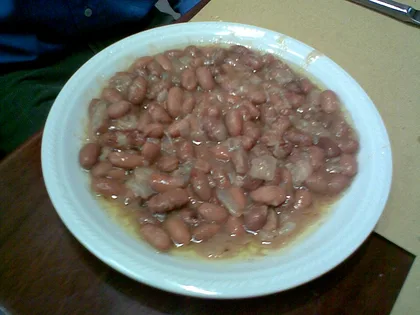 Vegetables and fruitLamon BeansLamon beans are mountain-grown borlotti with a skin so thin it disappears in the mouth and flesh that turns…
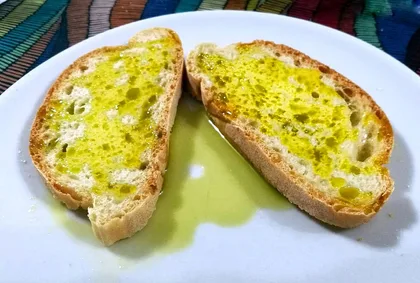 Oil and preservesExtra Virgin Olive OilTwo exams have to be passed, and one of them is carried out by people.Vegetables and fruitChestnutsFor a thousand years the Apennines made bread from them rather than dessert: Castanea sativa was the tree…
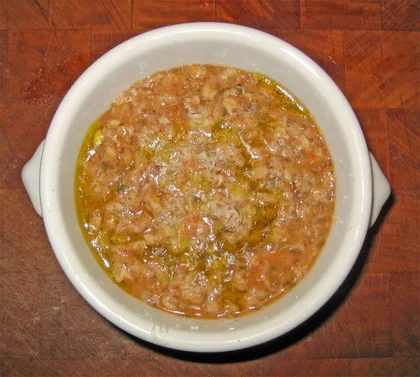 Vegetables and fruitGarfagnana FarroFarro della Garfagnana IGP is emmer wheat, Triticum dicoccum: the grain the Romans called far, still sown in…
 WineChianti ClassicoChianti Classico is the Black Rooster wine: at least 80 per cent Sangiovese from nine communes between…
 WineBrunello di MontalcinoBrunello di Montalcino is pure Sangiovese aged five years, at least two of them in oak, made only in the…
 Pasta and breadPappardelleRibbons of egg pasta two to three centimetres wide, the widest pasta you still eat twirled on a fork.
 SweetsCantucciCantucci are hard, twice-baked Tuscan almond biscuits. A log of dough is baked, sliced on the diagonal while…