Twelve Italian dishes that are better the next day
Ribollita, pasta e fagioli, jota, caponata, sardines in saor, Neapolitan ragù, genovese, parmigiana, lasagne, pastiera, migliaccio, vitello tonnato. Not a figure of speech: in some cases the rest is in the recipe.
That a dish is better the next day is not a consolation for leftovers: in these twelve cases it is a step of the preparation, and in two of them it is written into the name. Ribollita is called that because it is boiled again the following day, and without that second cooking it is bread soup.
There are three reasons and they can be isolated. Starch keeps working even cold: in pasta e fagioli and in pulse soups the dish thickens by itself over the hours, because the starch released by the beans keeps binding. Acid and sugar need time to spread: freshly made caponata and sardines in saor taste only of vinegar. And fats redistribute as they cool: in a long ragù or a parmigiana the structure settles and a cut holds.
There is a fourth case, concerning ricotta and wheat sweets. In a pastiera the filling keeps absorbing for two days, and a pastiera cut on the day, as its own page says, does not yet have a flavour: it has three separate ones. The rest is what makes them one.
toscana · 4 h 10′
The second boiling is in the name: without it this is bread soup. The next day the bread has merged with the broth and the soup holds a spoon upright, which is the point.
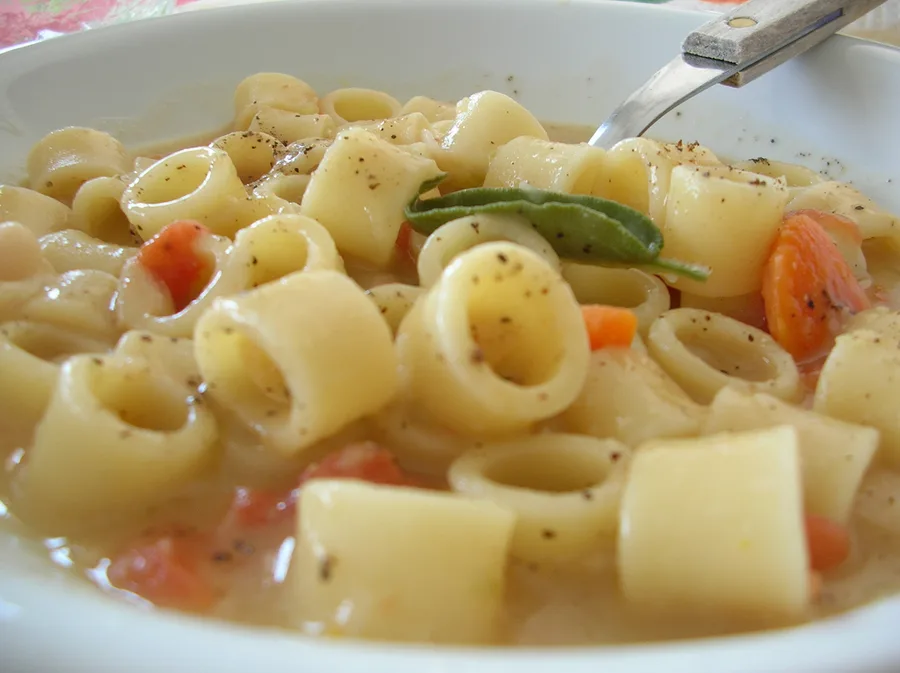 walimai73 · CC BY-SA 2.0
veneto · 2 h 50′
It thickens by itself over the hours, because the starch released by the borlotti keeps binding even cold. The next day it is loosened with a little hot water, not broth, which would salt it twice.
- 03
Jota
friuli venezia giulia · 2 h 55′
The sourness of the kraut spreads through the mass of beans and potato: freshly made, jota has two distinct flavours, the next day one. The pounded lardo and garlic have bound in the meantime.
- 04
Caponata
sicilia · 1 h 20′
Eaten the next day at room temperature: vinegar and sugar work on different clocks, and freshly made the vinegar stands in front and buries everything else.
veneto · 1 h 25′
At least a day's rest, and the Venetian rule is equal weights of fish and onion. Without that day the saor is a sour marinade, and the fried sardines have absorbed nothing.
campania · 5 h 40′
Five or six hours on the first day, and the next day the sauce is darker and thicker because the fats have redistributed. The meat is served separately, and reheated it stays tender.
campania · 5 h 45′
Four to six hours of onions going from watery to creamy: the next day that cream has firmed and the colour is darker. It is one of the few sauces deliberately made the day before.
campania · 1 h 45′
The next day it cuts and the piece holds, because the layers have settled and the moisture has spread. Straight from the oven it is good but it opens in the plate: a question of structure.
emilia romagna · 2 h 10′
The same reason as the parmigiana, with one more element: cold béchamel holds the layers. They are reheated covered, in a low oven, and not in a microwave, which dries the pasta.
piemonte · 1 h 50′
It has to be made the day before: the eye of round is cooked, cooled and sliced very thin, and the sauce has to stay cold. Warm, the dish does not exist.
campania · 2 h 50′
Two days' rest: a pastiera cut on the day does not yet have a flavour, it has three separate ones. The cooked wheat keeps absorbing even after baking.
campania · 1 h 30′
Semolina, ricotta and eggs: the custard needs a night in the fridge to firm up. In Naples it is made at Carnival and stays on the table for days, improving over the first two.
One last thing
There are also the dishes that do the opposite, and it is worth knowing so as not to misjudge the timing of a dinner. Everything fried has to be eaten within minutes, because the crust absorbs the moisture inside and softens: arancini, panzerotti, gnocco fritto, paranza fry. Minestrone with pesto loses its scent within hours, because the basil oxidises. Canederli fall apart. And fresh filled egg pasta has to be cooked at once: the sheet, wetted by the filling, gives way, and the next day they open in the pot.
The questions this list answers
These are real questions put to an AI assistant, in the period when Bing cited this site among its sources to answer them. The number is how many times we were cited. We read them in Bing Webmaster Tools, under AI performance, and they decide what goes on this page rather than the other way round.
- minestrone alla genovese294 citations
- baccalà alla vicentina ricetta originale88 citations
- cotognata590 citations
- sopressata1,226 citations
- tortellini ricetta originale93 citations
- frittura di paranza179 citations
Frequently asked questions
Why is ribollita cooked twice?
Because the second cooking is what melts the bread into the broth: it is prepared as a soup of bread, beans and black kale, left to rest and boiled again the next day. The name of the dish says exactly that.
How do you reheat lasagne the next day?
Covered, in a low oven, around a hundred and fifty degrees, for twenty or thirty minutes. A microwave heats the water and dries the pasta, which turns rubbery. If the lasagne is fridge-cold it helps to take it out half an hour early.
Which Italian dishes should not be made in advance?
Everything fried, which softens within minutes; minestrone with pesto, because cooked or standing basil oxidises; canederli, which fall apart; fresh filled pasta, because the sheet wetted by the filling gives way and opens while cooking.
Why is caponata eaten the next day?
Because vinegar and sugar need hours to balance: freshly made, the vinegar dominates. It is served at room temperature rather than fridge-cold, because cold mutes the sweetness and leaves only the acidity.