Pasta e Fagioli
Venetian pasta e fagioli is a thick soup of Lamon borlotti, two thirds of them passed through a mouli and one third left whole, flavoured with pork rind or pancetta and finished with raw oil. The critical point is the consistency: it has to hold a spoon upright once warm, and it gets there from the starch of the beans, not from added flour or potato.
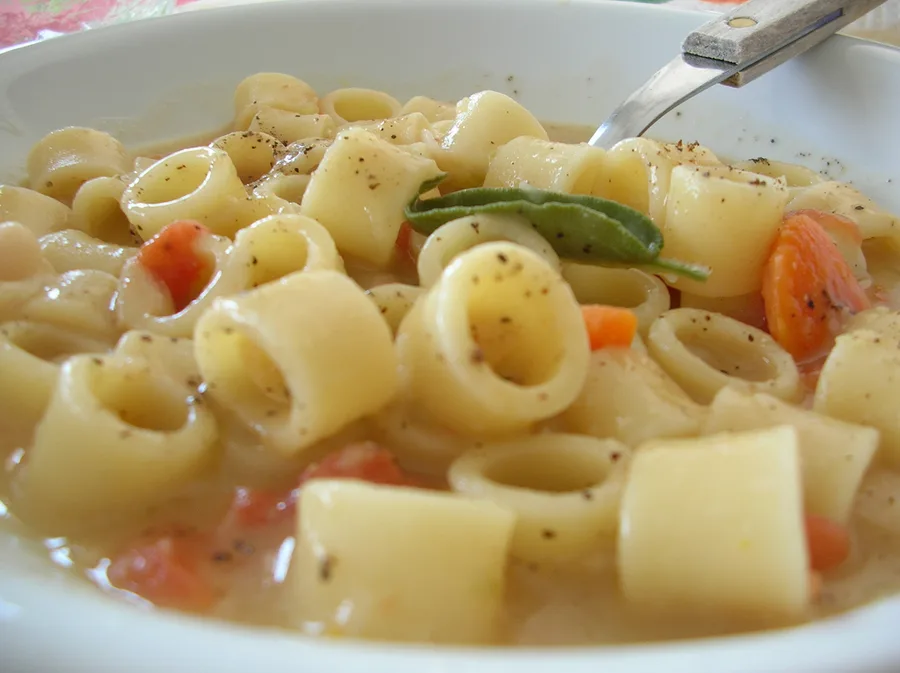
The bean reached the Veneto by a route documented with unusual precision. In 1528 Pope Clement VII gave a little sack of seeds from the New World to the humanist Pierio Valeriano of Belluno, who had them sown on the family land in the Val Belluna. From there the crop spread over the Lamon plateau, where the cool climate, the loose soils and the swings in temperature selected over four centuries four ecotypes (Spagnolit, Spagnolo, Calonega and Canalino) which in 1996 obtained protected geographical status as Fagiolo di Lamon della Vallata Bellunese IGP. The character that makes them right for soup is a thin skin, almost imperceptible in the mouth, and flesh that collapses in cooking and releases a great deal of starch: they are beans that make a cream by themselves.
Two choices separate a Venetian pasta e fagioli from all its namesakes in the rest of Italy. The first is the double consistency: part of the beans, usually two thirds, is passed through a mouli to build a velvety base, while the remaining third stays whole and meets you under the spoon. The second is the serving temperature: in the Veneto pasta e fasoi is eaten warm or almost cold, never piping hot, because it is at that temperature that the raw extra virgin oil can be read and the sweetness of the bean comes out. Pork enters as rind, a ham bone or pancetta, and is there for collagen and savour: in the poorest inland Veneto version it is the only animal fat in the dish. The pasta is short and irregular (maltagliati torn by hand, ditalini, or the typical broken bigoli) and is cooked in the soup, because its starch is part of the binding.
Ingredients
- Dried Lamon IGP borlotti beans350 g (12.3 oz), soaked 12 hours
- Scraped pork rind, or a ham bone150 g (5.3 oz)
- Flat pancetta in one piece80 g (2.8 oz)
- White onion100 g (1 small)
- Carrot80 g (2.8 oz)
- Celery1 stalk (60 g)
- Garlic1 unpeeled clove
- Rosemary1 sprig
- Sage4 leaves
- Bay1 leaf
- Tomato paste1 tsp (optional)
- Extra virgin olive oil for the base40 ml (2.7 tbsp)
- Cold water2 litres (8.4 cups)
- Semolina maltagliati or ditalini180 g (6.3 oz)
- Coarse saltto be added once the beans are cooked
- Raw extra virgin olive oila thread per plate
- Black pepper, ground freshto taste
Method
- 1The evening before, cover the beans with three times their volume of cold water and leave them to soak 12 hours somewhere cool. Throw out at once any that float and any that are broken. In the morning drain and rinse them: the soaking water is discarded, because it holds the oligosaccharides responsible for intestinal fermentation.
- 2Blanch the rind 5 minutes in boiling water, drain it, scrape the fat side well with a knife and cut half into thin strips, keeping the other half in one piece to give collagen and then be lifted out.
- 3In a heavy-based pot heat the oil over low heat and make a slow base of finely chopped onion, carrot and celery with the unpeeled garlic: 12 to 15 minutes without colouring, until the onion is translucent and sweet.
- 4Add the diced pancetta and the rind, raise to medium and brown 5 minutes. If you are using it, add the tomato paste and toast it 1 minute: it is there for colour and a point of acidity, not to turn the soup red.
- 5Add the drained beans, the bundle of rosemary, sage and bay tied with string and 2 litres of cold water. Bring to the boil, skim carefully the first time, then turn the heat to its lowest and cook covered for 90 to 110 minutes, with no salt. Lamon beans are ready when they crush between thumb and forefinger without effort.
- 6Take out the herb bundle, the garlic and the whole piece of rind. Lift out two thirds of the beans with a little of their liquid and pass them through a mouli with the medium plate: the skins stay in the sieve and in the mouth the cream is smooth. A stick blender is a shortcut that mills the skins too and gives a floury texture.
- 7Return the puree to the pot with the remaining whole beans, stir and judge the density: it should be that of a flowing veloute, because the pasta will absorb more liquid. If need be, loosen with hot water. Only now salt, tasting: the rind and the pancetta have already done their work.
- 8Bring it back to a shiver and drop the pasta straight into the soup. Cook it two minutes longer than the packet says, stirring often from the base with a wooden spoon, because at this density it catches easily.
- 9Turn off the heat once the pasta is done and let the pot stand covered at least 15 minutes. It is in this rest that the soup settles: the starch finishes swelling and the texture moves from soup to cream.
- 10Serve it warm, never piping hot, in wide bowls. On each plate a generous thread of raw extra virgin oil, black pepper ground fresh and, if you like, a few strips of the reserved rind. In the Veneto no cheese is added.
What ruins it
Density is everything and it is built with three levers, none of which is flour. The first is the quantity of water: two litres to 350 grams of dried beans is already measured to come out thick, and anyone who loosens it during the cooking will not get it back. The second is the ratio of puree to whole: two thirds and one third is the Venetian proportion, but those who want it more rustic pass half. The third is the final rest, which is worth half an hour of extra cooking.
On the beans, the harvest matters more than the variety. Dried pulses over two years old never soften completely, however long you soak them: look for packets with the year stated. The salt always goes in after the cooking, because sodium stiffens the pectin in the skins; the same goes for tomato, which is why the paste here goes in in a minimal quantity and at the start of the base, where the fat partly neutralises it.
On the pasta, the commonest error is cooking it separately to stop it overcooking. That starch is needed, and a pasta e fagioli with the pasta added at the end always has a loose base. If you make the soup the day before, though, the rule reverses: cook the base without pasta, keep it in the fridge and add the pasta when you reheat, or you will find it collapsed. One last detail: the rind has to be scraped well and blanched first, or it gives off a note of rancid fat that covers everything.
Frequently asked questions
Why is only part of the beans passed in Venetian pasta e fagioli?
To get two textures on the same spoon. The part passed through the mouli builds a creamy, thick base with no need of thickeners, while the beans left whole give the bite and keep the pulse recognisable. The traditional proportion is two thirds passed and one third whole; passing everything gives a veloute, passing nothing gives a loose soup.
Which beans should I use if I cannot find Lamon?
A good-quality dried borlotto from a recent harvest, such as the borlotto of Vigevano or a dwarf mountain type. The Lamon IGP has a particularly thin skin and flesh that collapses easily, so with other borlotti lengthen the cooking by twenty to thirty minutes and consider passing a slightly larger share to make up for thicker skins.
Should the pasta be cooked in the soup or separately?
In the soup, always, if you are eating it straight away. The starch the pasta releases is part of the binding and without it you lose density. The only exception is soup made the day before: in that case keep the base without pasta and cook it as you reheat, because a night in the fridge would reduce it to mush.
Is it served hot or warm?
Warm. In the Veneto pasta e fasoi comes to the table after a rest of at least a quarter of an hour, at a temperature where the raw extra virgin oil can be tasted distinctly and the sweetness of the bean is not buried under steam. In summer, in parts of the lowlands, it is even eaten at room temperature.