Frico
Frico is Montasio cooked in a pan until the fat separates and the paste knits again: it exists crisp, of cheese alone, and soft, with potatoes and onion. The critical point is the age of the cheese, because one that is too young stays rubbery and never dries, while one too old crumbles instead of binding.
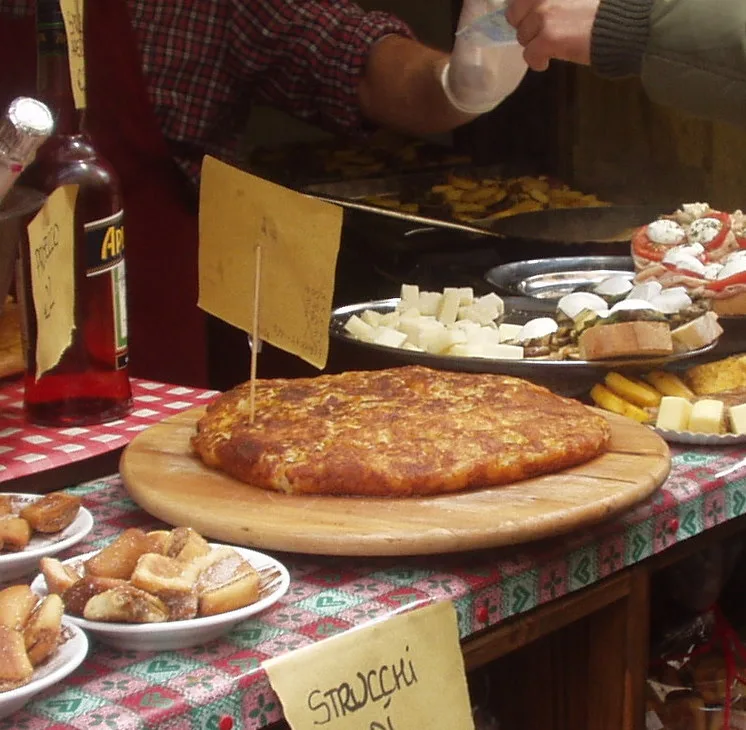
The oldest recipe describing frico is not Friulian by birth but by service. In the Libro de arte coquinaria of Maestro Martino, written around 1465, there is a preparation entitled per fare caso in patellecte: cheese cut into thin slices, put in a pan with a little butter, cooked and turned, and served with sugar and cinnamon. Martino came from the val di Blenio but worked as cook at the court of the Patriarch of Aquileia, and that passage is the first written record of a way of cooking cheese that in the Carnia was already household practice. It served to use up offcuts: trimmings from the wheels, scraped rinds, pieces too dry to sell. In the high Tagliamento valley and the Canale di Gorto frico remained for centuries a dish of salvage, and only in the twentieth century did it take the codified form now found in the osterie of Udine, Tolmezzo and Sappada.
There are two versions and they are not to be confused. Crisp frico (in Friulian frico cavatis, or frico of cheese alone) is a thin, golden, glassy wafer made exclusively of grated or sliced Montasio, with no other ingredient: it exploits the fact that the cheese, as it melts, releases its fat, fries in that fat and then dries, leaving a crust of protein and salt. Soft frico (frico cul patatis, what in the Carnia is simply called frico) is instead a kind of cake two or three fingers thick, with potatoes and stewed onion, moist inside and crisp only on the surface. What decides both is the age of the cheese: fresh Montasio DOP, between two and five months, strings and binds but holds too much water; the mezzano, between five and ten months, is the compromise that dries without hardening; one aged beyond ten months gives flavour and crispness but on its own tends to go grainy. In Friulian households soft frico has always been made by mixing three different ages, and the crisp one with cheese of at least six months.
Ingredients
- Montasio DOP mezzano (5 to 10 months), for the crisp frico200 g (7 oz)
- Fresh Montasio DOP (2 to 5 months), for the soft frico150 g (5.3 oz)
- Montasio DOP mezzano (5 to 10 months), for the soft frico150 g (5.3 oz)
- Aged Montasio DOP (over 12 months), for the soft frico100 g (3.5 oz)
- Yellow-fleshed potatoes, old and floury500 g (17.6 oz)
- White onion, thinly sliced150 g (1 medium)
- Butter20 g
- Lardo or Friulian pancetta, diced (optional, for the soft one)40 g (1.4 oz)
- Light meat broth or hot water100 ml (scant 1/2 cup)
- Fine salta pinch, to taste at the end
- Black pepper, ground freshto taste
- Yellow maize polenta, to go with itone portion a head
Method
- 1Prepare the cheese. For the crisp one grate the 200 g of Montasio mezzano on the coarse side, not the fine: a coarse grate leaves gaps for the moisture to escape through, a fine grate forms a compact mat that stays soft in the middle. For the soft one cut the three ages into half-centimetre dice, keeping the bowls separate, because they go into the pan at different moments.
- 2CRISP FRICO: heat a 24 cm non-stick pan over medium-low heat, with no fat. Spread 50 g of the grated cheese in a thin even layer, about 3 mm, leaving two fingers of free rim. Do not press.
- 3In the first two minutes the cheese melts and a veil of fat rises: that is normal and necessary, because the frico fries in its own butter. In the next two minutes the fat is reabsorbed and the wafer starts to knit at the edges. When the rim is amber and comes free by itself as you shake the pan (4 to 5 minutes in all) turn it with a wide spatula and cook the other side 2 minutes.
- 4Drain the wafer on kitchen paper and, if you want a basket, lay it while still hot and flexible over an upturned bowl: it hardens in 60 seconds and can no longer be shaped. Repeat with the remaining cheese, wiping the pan with kitchen paper between wafers.
- 5SOFT FRICO: boil the potatoes whole in their skins in unsalted water from cold, 35 to 40 minutes from the boil, until a knife blade goes in without resistance. Peel them while still hot and crush them roughly with a fork: recognisable pieces should remain, not a puree.
- 6In a 26 cm iron or non-stick pan melt the butter with the diced lardo over low heat, add the sliced onion and stew it 12 to 15 minutes with a spoonful of broth at a time, without letting it colour. It should turn translucent and sweet: if it takes colour the frico will taste fried.
- 7Raise to medium, add the crushed potatoes and let them take up the flavour for 5 minutes, turning with a wooden spoon, then add the aged and the mezzano Montasio. Stir until they melt, 4 to 5 minutes, and only at the end add the fresh: it goes in last because it is the one that strings and must not cook long.
- 8Turn the flame to its lowest, flatten the mixture with the back of the spoon into a disc two fingers thick and let the crust form for 8 to 10 minutes without touching it. The frico is ready to turn when, shaking the pan, it moves all together as a single block.
- 9Cover the pan with a flat lid or a wide plate, flip it over in one decisive movement and slide the frico back into the pan on its uncooked side. Cook another 6 to 8 minutes over low heat, until the second crust too is brown and compact.
- 10Taste and adjust the salt only now: between aged Montasio and lardo the dish is nearly always salty enough already. Serve the soft frico very hot, cut into wedges, with polenta just poured and still steaming; the crisp one is served warm, on its own or beside a glass of Friulano.
What ruins it
The first error is too hot a pan. Cheese, like butter, has a point beyond which the proteins burn before the water has evaporated: the crisp frico turns dark brown and bitter while staying soft in the middle. You work over medium-low heat and with patience, counting four or five minutes a side. The second error is using cheeses that are not Montasio: fontina, young asiago and provolone have different water contents and melting profiles, and the crisp version never dries. If Montasio cannot be found, the only structurally close substitute is a Friulian Latteria of the same age.
For the soft one, the potatoes are boiled in their skins and not steamed in pieces: the skin keeps water out, and watery potatoes make a soggy frico. They are crushed by hand and not put through a ricer, because the irregular pieces give the rustic texture the dish wants. The onion is no detail: in the Carnia a great deal goes in, almost a third of the weight of the potatoes, and it is stewed at length so its sugar balances the salt of the cheese.
Last point, the turn. If the frico breaks it is because the crust had not yet formed: put it back in the pan, press it together with the spatula and carry on cooking. Unlike an omelette, a frico heals, because the melted cheese acts as glue. Never add flour or eggs to hold it together: those are corrections from magazine recipes, not from the Carnia.
About the ingredient: Montasio →
Frequently asked questions
What is the difference between crisp and soft frico?
The crisp one is made only with grated Montasio, cooked in a dry pan until it becomes a glassy wafer two or three millimetres thick, and eaten as a snack or as a basket to fill. The soft one contains boiled potatoes and stewed onion as well as cheese, is two fingers deep, moist inside and crisp only in its two crusts, and is eaten as a dish with polenta. In the Carnia frico without any adjective nearly always means the second.
What age of Montasio does frico need?
The crisp one needs a Montasio DOP mezzano, between five and ten months: the fresh holds too much water and stays rubbery, one aged beyond a year tends to go grainy and to release too much fat. For the soft one Friulian practice is to mix three ages (fresh for the stringiness, mezzano for the body, aged for the flavour) in rough proportions of 150, 150 and 100 grams per half kilo of potatoes.
Why does my crisp frico stay soft in the middle?
For one of three reasons. The layer of cheese was too thick: beyond four millimetres the internal moisture cannot get out. The cheese was grated too finely and formed an impermeable sheet. Or the heat was high and the surface coloured before the water evaporated. Grate coarsely, spread thin, cook over medium-low heat and count at least four minutes before turning.
Do eggs or flour go into frico?
No. The binder is the cheese itself, which as it melts takes in the potatoes and onion, and the crust forms by dehydration of the proteins against the pan. Eggs and flour turn up in recent domestic versions to make the turning easier, but they change the texture into that of an omelette and cover the flavour of the Montasio.