Twelve Italian dishes where the egg does the work, and which work
It binds in carbonara, gives structure to the tajarin dough, whips in tiramisù, puffs in zeppole, holds the potato bake together. Four different jobs, at four different temperatures.
The egg does four distinct jobs in Italian cooking, and each has a temperature. It binds, as in carbonara, where the yolks thicken with residual heat into a cream: above sixty-five degrees the white sets and the cream turns grainy. It gives structure, as in egg pasta, where the proteins partly replace gluten and hold the sheet together.
It whips, that is it takes in air, and here the opposite of heat is needed: in tiramisù the yolks are beaten with boiling syrup poured in a thread, which pasteurises them while the whisk aerates them. And it puffs in the oven, as in the choux pastry of zeppole, where the water in the egg turns to steam and lifts the dough from inside.
The number of yolks per kilo of flour is the figure that changes a pasta. The tajarin of the Langhe reach forty yolks per kilo, and that richness serves not the flavour but the structure: a dough like that rolls out paper-thin without tearing, and carries butter and truffle to the mouth instead of competing with them.
lazio · 25′
Twenty-five minutes: the yolks thicken with residual heat and make the cream. The pan comes off the heat and is left to cool for a minute, because above sixty-five degrees the white sets.
piemonte · 1 h 5′
Up to forty yolks per kilo of flour: the richness serves the structure, because a dough like that rolls out very thin without tearing. Melted butter and truffle over the top, and nothing else.
piemonte · 2 h 45′
Very rich egg pasta rolled thin, closed one at a time with a pinch. Thickness is the critical point: on a two-centimetre raviolo a tenth of a millimetre more is felt under the teeth.
emilia romagna · 5 h
The pastry has to be rolled very thin and stay elastic while hundreds of pieces are closed: the egg is what gives it that hold, and a dough of water and flour alone would crack.
emilia romagna · 2 h 10′
Green spinach pasta, always with egg: the sheet has to carry ragù and béchamel without collapsing, and in a baked pasta that hold comes from the egg's proteins.
campania · 1 h 55′
An hour fifty-five: the eggs bind the mashed potato and hold the bake together. The critical point is moisture, because potatoes that are too wet will not bind even with egg.
 Fooding Around · CC BY 2.0
toscana · 1 h 50′
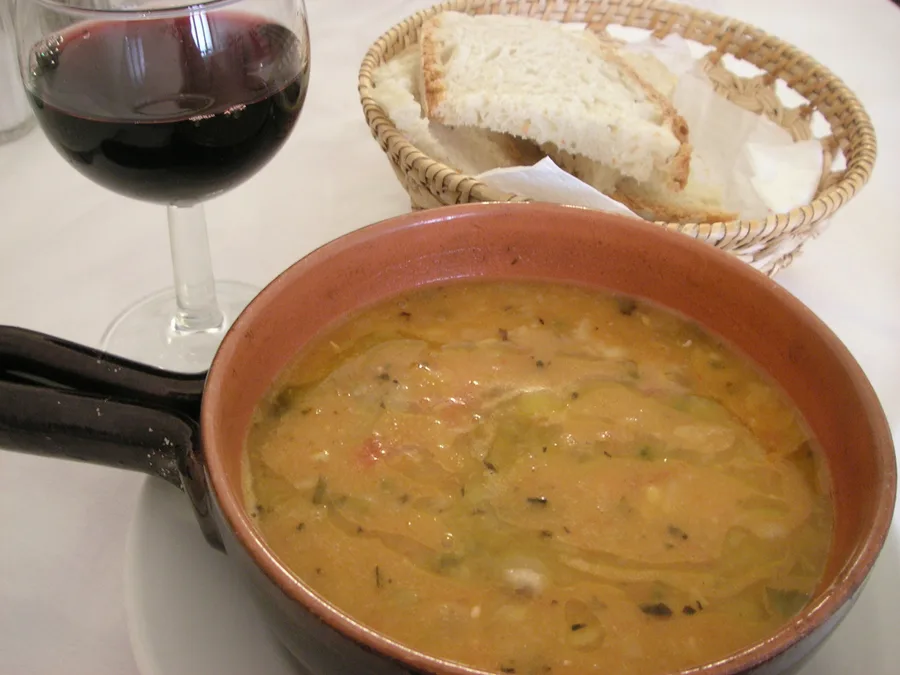
A poached egg in each bowl: not a garnish but the protein of the dish. The yolk broken into the broth binds it slightly and enriches it without adding fat.
- 08
Tiramisù
veneto · 45′
Forty-five minutes and no baking: the yolks are whipped with boiling syrup poured in a thread, which pasteurises them while the whisk aerates them. The coffee must be cold, or the savoiardi collapse.
campania · 1 h 20′
Choux pastry: the water in the eggs turns to steam in the heat and lifts the dough from inside, creating the hollow. The eggs go in one at a time, when the paste is warm rather than hot.
campania · 2 h 50′
The eggs bind ricotta and cooked wheat and give the filling the texture that holds a cut. Two days' rest let that structure settle; straight out of the oven it is still soft.
campania · 1 h 30′
Semolina, ricotta and eggs, an hour and a half: with no pastry and no sheets, here the egg is the only structure. It is the easiest feast-day sweet, and the baking must be slow so the custard does not split.
 Gmrozz · CC BY-SA 4.0
campania · 1 h 50′
Whole eggs, in their shells, set into the top of the bread and held by strips of pastry: they cook with the dough, and they are the symbol of the feast before they are an ingredient.
One last thing
Temperature is the only thing to keep in mind, and two numbers are enough. Yolks start to thicken around sixty-five degrees and whites set a little below eighty: that is why carbonara is worked off the heat, with the pan a minute down, and why a custard stops at eighty-two. In sweets where the egg has to whip, heat is needed but it comes from the sugar: boiling syrup poured in a thread over moving yolks pasteurises them without cooking them, which is why a tiramisù made that way keeps in the fridge and one with raw yolks does not.
The questions this list answers
These are real questions put to an AI assistant, in the period when Bing cited this site among its sources to answer them. The number is how many times we were cited. We read them in Bing Webmaster Tools, under AI performance, and they decide what goes on this page rather than the other way round.
- tortellini ricetta originale93 citations
- tajarin pasta8 citations
- what is agnolotti pasta127 citations
- zeppole600 citations
- what is zeppole28 citations
- maritozzi con la panna126 citations
- sfogliatella riccia175 citations
Frequently asked questions
Why does carbonara split?
Heat. Above sixty-five degrees the yolks go from cream to granules and the white sets. The pan comes off the heat and is left a minute before the egg goes in, and the pasta water is added hot but not boiling.
How many yolks go into a kilo of flour?
It depends on the pasta. A classic Emilian sheet uses one whole egg per hundred grams of flour; the tajarin of the Langhe reach forty yolks per kilo. More yolks give a more tenacious dough that rolls paper-thin without tearing.
Can tiramisù be made with raw eggs?
It is, and that is the traditional version, but it does not keep. Whipping the yolks with boiling sugar syrup poured in a thread brings them to pasteurisation temperature while the whisk aerates them: the result is more stable and keeps a few days in the fridge.
Why are the eggs added one at a time in choux pastry?
Because the paste has to absorb each one completely before the next, and the exact quantity depends on how much evaporated during cooking: you add until the paste falls from the spoon in a ribbon. They go in when the paste is warm, not hot, or they cook.