Acquacotta Maremmana
Acquacotta is a soup of onions, celery, tomato and field greens, poured boiling over slices of toasted stale bread and crowned with an egg poached in the soup itself. The critical point is the egg: it is broken straight into barely simmering liquid for three minutes, so the white sets and the yolk stays liquid and runs over the bread.
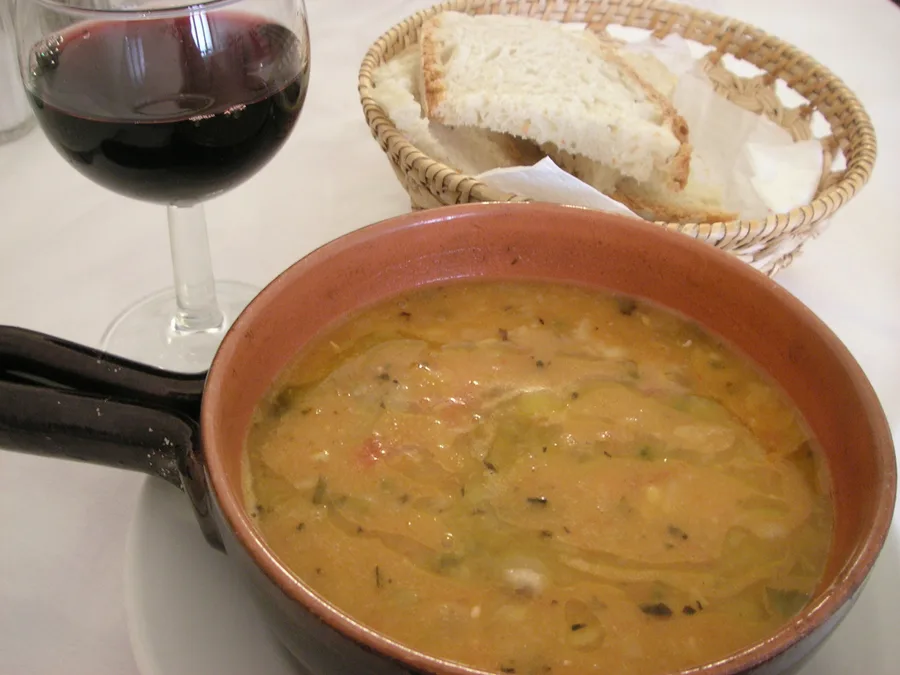
Acquacotta is the dish of the butteri, the charcoal burners and the labourers who worked the Maremma before the land was drained, in a territory that rises from the Grosseto plain towards Monte Amiata and drops into the upper Tuscia of Lazio. The name describes the technique literally: you set water to cook, not a broth and not a base, and threw in whatever there was. Onions, celery, a tomato in summer, field herbs gathered along the way, a thread of oil from the flask. Stale bread, often two or three days old, was the solid part that made the dish substantial: it was toasted over the embers and set in the bottom of the bowl so it would soak. The egg appeared when there was one, and it was the only animal protein. The dish does not appear in nineteenth-century Tuscan cookery books, because it belonged to a cuisine that was not written down; the first systematic records are twentieth-century and were collected orally.
Three elements separate a correct acquacotta from a generic Tuscan vegetable soup. The first is the onion, which is not part of a fried base but the main ingredient: a great deal goes in, in the Maremma even half a kilo for four people, thinly sliced and stewed at length until it dissolves and turns sweet. The second is the absence of broth: water is used, and the flavour is built with slowness and with the extra virgin oil, which is the new peppery oil of the metal-bearing hills. The third is the order of serving, which is ritual: the toasted bread, better still rubbed with garlic, goes in the bottom of the soup plate; the soup is poured over and soaks it; the egg, poached in the pot, is lifted out with a skimmer and laid on the bread; grated Tuscan pecorino closes it. There is a mountain variant from the Amiata with mushrooms and a version with beans typical of the Pitigliano area, but the structure does not change.
Ingredients
- White or brown onions, thinly sliced500 g (17.6 oz)
- Celery with its leaves3 stalks (200 g)
- Ripe tomatoes, peeled and chopped (or tinned peeled)400 g (14 oz)
- Wild chard, field chicory or leaf chard300 g (10.6 oz)
- Carrot1 (80 g)
- Garlic2 cloves, one for the base and one for the bread
- Fresh chillihalf, to taste
- Basil or wild mint (nepitella)a few leaves
- Tuscan extra virgin olive oil, for the cooking60 ml (4 tbsp)
- Water1.5 litres (6.3 cups)
- Stale unsalted Tuscan bread, 2 to 3 days old8 slices of 1.5 cm
- Very fresh eggs4
- Aged Tuscan pecorino, grated60 g (2.1 oz)
- Saltto taste
- Black pepper, ground freshto taste
- Raw extra virgin olive oila thread per plate
Method
- 1Slice the onions 2 to 3 millimetres thick, cut the celery into thin half-moons keeping the leaves aside, dice the carrot small. The onion is the main ingredient of the dish, not a flavouring: half a kilo for four people is the Maremma measure.
- 2In a wide earthenware or heavy-based pot heat 40 ml of the oil over low heat with a crushed garlic clove and the chilli. Add the onion, celery and carrot and stew 20 to 25 minutes over very low heat, covered, stirring every five minutes. The vegetables should soften and turn sweet without ever taking colour: if they brown, the dish turns bitter.
- 3If the vegetables dry too much, add two spoonfuls of water and carry on. At the end of this stage the onion should be translucent and almost creamy.
- 4Add the chopped tomatoes with their juice, raise to medium and cook 10 minutes uncovered, crushing them with the spoon, until most of the vegetation water has gone and the base has thickened.
- 5Add the chard or chicory, washed and roughly cut, stir and let them wilt 3 to 4 minutes. Then pour in 1.5 litres of boiling water, salt, add the celery leaves and the nepitella and bring to the boil.
- 6Lower the flame and cook uncovered 25 to 30 minutes at a shiver. The soup should stay fairly liquid but savoury: taste halfway and correct the salt and chilli. Add the remaining 20 ml of oil now, which at this point binds instead of evaporating.
- 7While the soup cooks, toast the slices of stale bread on a griddle, in a dry pan or in the oven at 200 °C (390 °F) for 6 to 8 minutes, until dry and barely golden. Rub them while still hot with the remaining garlic clove, cut in half: light pressure, one pass only.
- 8Bring the soup to a barely perceptible simmer (small bubbles at the edge, a trembling surface) and turn the heat to its lowest. Break the eggs one at a time into a cup and slide them gently onto the surface, well apart. Do not stir.
- 9Cook the eggs 3 to 4 minutes without touching them: the white should set and veil the yolk, which stays liquid. If the soup boils hard the white shreds and is lost in the liquid; if the heat is too low the egg does not coagulate. Help it by drawing a little white towards the centre with a spoon in the first thirty seconds.
- 10Build the plates: two slices of toasted bread in the bottom of each bowl, a dusting of pecorino, then the boiling soup ladled over until the bread is well soaked but not submerged.
- 11Lift each egg with a skimmer, let it drain and lay it in the middle on the bread. Finish with grated pecorino, black pepper ground fresh and a generous thread of raw extra virgin oil. Serve at once, before the bread falls apart entirely.
What ruins it
The bread is half the dish and it is not interchangeable. You need unsalted Tuscan bread, open-crumbed with a thick crust, stale by two or three days: fresh bread dissolves into mush in thirty seconds, industrial sliced bread liquefies sooner still. The toasting is not cosmetic but structural, because the dehydrated surface stands up to the boiling liquid and the slice stays recognisable under the egg.
On the egg, the rule is that the acquacotta is its poaching liquid. It is not poached separately in acidulated water and not added beaten like a stracciatella: it is broken straight into the simmering soup. The eggs must be very fresh, because an older white is looser and disperses instead of wrapping the yolk. Anyone struggling can break them first into a coarse sieve to get rid of the loosest white: a modern trick, but it works and betrays nothing.
On the vegetables, there is no fixed list, because acquacotta grew out of what the land offered: in spring borage, wild chicory, poppy leaves and wild fennel go in; in autumn porcini or ovoli in the Amiata variant; in winter black kale and beans around Pitigliano. What must never go in is meat broth or a stock cube, which betray the very idea of the dish, cooked water, and flatten its taste under a note of glutamate. One last note: the soup without egg and bread keeps two days in the fridge and improves, but the bread and the egg are always made at the moment.
Frequently asked questions
Why is it called acquacotta?
Because the base of the soup is water, not broth: you cooked the water with whatever vegetables you had. The name describes exactly the poverty of the dish, born among the butteri and charcoal burners of the Maremma, where the flavour had to come from long-stewed onion, extra virgin oil and stale bread, not from a meat base.
Is the egg cooked in the soup or separately?
In the soup. The liquid is brought to a barely perceptible simmer, the eggs are broken one at a time into a cup and slid onto the surface well apart, without stirring, for three or four minutes. Then they are lifted out with a skimmer and laid on the bread. The white should be set, the yolk still liquid, so it runs over the slice when broken.
What bread is used for acquacotta?
Unsalted Tuscan bread, stale by two or three days, cut into slices a centimetre and a half thick and toasted. The open crumb and thick crust stand up to the boiling liquid; fresh bread or sliced bread collapses at once. If you cannot find unsalted bread, use a naturally leavened soft-wheat loaf, cut thick and well toasted.
Which vegetables can be used?
Onion, celery and tomato are the fixed base. The others vary with the season and the area: wild chicory, borage, chard, black kale, wild fennel, and in the Amiata version mushrooms. What is to be avoided is adding meat broth or a cube: the soup has to build its own flavour from water, vegetables and oil, or it is no longer acquacotta.