Casatiello Napoletano
The casatiello is the rustic bread of the Neapolitan Easter: a dough worked with plenty of lard and black pepper, filled with salami, pork crackling and cheeses, closed into a ring and crowned with raw eggs set in the surface and held by a cross of dough. The critical points are the lard, which goes in twice (into the dough and spread over the rolled-out sheet), and the proving, which has to finish in the tin before baking.
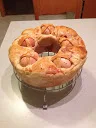
The name comes from caso, cheese, and the first written trace is old: Giambattista Basile cites it in the Cunto de li cunti, published between 1634 and 1636, in the tale of the Cat Cinderella, where casatielli appear among the festive foods. It is a bread of Easter and Easter Monday, made to be carried on an outing and eaten cold, which explains the quantity of fat: lard, besides giving flavour, keeps the crumb soft for days. The ring shape recalls the crown of thorns, and the eggs set into the surface, held by two crossed strips of dough, allude to the resurrection: they are raw when they go into the oven and set inside their shells as it bakes.
The casatiello has a twin it is constantly confused with, the tortano. The difference is precise and has nothing to do with the dough: in the tortano the hard-boiled eggs are cut into pieces and mixed into the filling, in the casatiello the eggs are whole, raw and in their shells, set on the surface and held by the cross of dough. On everything else Neapolitan tradition is broad: some use sharp provolone and some pecorino, some pancetta and some only the crackling. But on three elements there is no negotiating. The lard must be plentiful, at least 150 grams per kilo of flour, and it is used twice: worked into the dough and then spread over the rolled-out sheet before it is rolled up, because it is that second spreading that creates the layering inside. The black pepper must be coarsely ground and in a quantity that to a non-Neapolitan looks excessive. And the final proving must happen inside the tin, until the dough reaches two fingers from the rim: a casatiello baked prematurely stays rubbery and never develops.
Ingredients
- Medium-strength type 0 flour (W 260 to 280)600 g (21 oz)
- Warm water at 24 °C (75 °F)330 ml (1.4 cups)
- Fresh yeast12 g
- Lard for the dough100 g (3.5 oz)
- Lard to spread on the sheet60 g (2.1 oz)
- Fine salt14 g
- Coarsely ground black pepper6 g (2 heaped tsp)
- Salame Napoli, diced150 g (5.3 oz)
- Pancetta or guanciale, diced100 g (3.5 oz)
- Cicoli (pork crackling)100 g (3.5 oz)
- Sharp provolone, diced150 g (5.3 oz)
- Pecorino romano, grated60 g (2.1 oz)
- Parmigiano Reggiano, grated40 g (1.4 oz)
- Whole raw eggs for the surface5
- Lard for the tin20 g
Method
- 1Dissolve the yeast in the warm water and pour it over the flour. Knead 5 minutes, then add the salt and the coarsely ground black pepper and carry on another 5 until the dough is even.
- 2Add the 100 g of room-temperature lard in three additions, letting each part be absorbed before the next. Work 10 to 12 minutes in all: the dough should become smooth, soft and come away from the sides. Shape a ball, cover it and let it prove at 24 to 26 °C (75 to 79 °F) for 2 hours 30 to 3 hours, until doubled.
- 3Roll the dough out on a lightly greased surface into a rectangle of about 50 by 35 cm and half a centimetre thick. Spread the remaining 60 g of lard over the whole surface, leaving two centimetres free at the edges, and dust with the pecorino and parmesan and another grinding of pepper.
- 4Spread the salami, pancetta, crackling and provolone over the whole rectangle. Keep back a ball of dough the size of a mandarin: it will serve for the crosses over the eggs.
- 5Roll the rectangle up from the long side, tight and without air, sealing the join well. You get a long sausage which is then closed into a ring, joining the two ends and pressing to weld them.
- 6Grease a ring mould or a round 26 cm tin with an upturned glass in the middle with lard. Set the ring in with the join underneath.
- 7Set the 5 raw eggs in their shells on the surface, well apart, sinking them halfway into the dough. With the reserved dough make ten thin strips and cross two over each egg, pressing the ends firmly into the dough beneath: as it proves the dough rises, and without the cross the eggs move.
- 8Cover and let it prove in the tin at 24 to 26 °C (75 to 79 °F) for 3 to 4 hours, until the casatiello reaches two fingers from the rim and is visibly swollen between one egg and the next. There are no shortcuts on this time.
- 9Bake in a preheated conventional oven at 180 °C (355 °F) in the lower part for 55 to 65 minutes. If the surface colours too soon, cover it with foil after the first 35 minutes. It is done when the crust is brown and firm and the temperature at the heart reaches 94 to 96 °C (201 to 205 °F).
- 10Turn it out and let it cool completely on a rack, at least 4 hours. A casatiello is cut cold and should be eaten the next day: the crumb settles, the lard redistributes and the flavours of the cured meats pass into the bread.
What ruins it
The casatiello goes wrong through timidity. Cut the lard and you get an ordinary rustic loaf that is dry the next day: the fat is the technical reason this bread lasts a week and it is the character of the dish, not an affectation. The same goes for the pepper, which is ground fresh and coarse, and in a quantity you are meant to feel in the mouth. And spreading lard on the rolled-out sheet is not a repetition of the dough: it is what creates, in the oven, the separation between the coils of the roll, that is the layered crumb.
In the execution, the two fragile points are the sealing and the proving. The roll is rolled tight, sealed along its whole length, and the ring is welded firmly: if it opens in the oven the filling escapes and the cheese burns on the base. The second prove in the tin must be taken to the end even if it seems long: a dough this rich proves more slowly than ordinary bread, and baking early gives a low, rubbery ring. The cheeses are cut into one-centimetre dice, not grated or thinly sliced, or they melt and run. It keeps at room temperature under a cloth for five or six days; in the fridge it hardens, because the lard solidifies.
About the ingredient: Salame Napoli →
Frequently asked questions
What is the difference between casatiello and tortano?
The dough is almost identical. In the casatiello the eggs are whole and raw, set on the surface and held by a cross of dough, and they cook in their shells; in the tortano the eggs are already hard-boiled and are cut into pieces inside the filling. The casatiello is tied to Easter, the tortano is made all year.
Why is lard used in casatiello and not oil?
Because lard is solid at room temperature and creates the internal layering when spread on the rolled-out sheet, which oil does not, and it keeps the crumb soft for days: the casatiello exists to be carried on the Easter Monday outing and eaten cold.
Do the eggs on a casatiello go on raw or hard-boiled?
Raw and whole in their shells. They are sunk halfway into the dough before the last prove and bake in the oven along with the bread, setting inside the shell. The two crossed strips of dough are there to hold them still as the dough rises.
When is casatiello eaten?
It is made on Holy Saturday and eaten on Easter Day and above all on Easter Monday, cold, during the outing into the country. It is better the day after baking, once the crumb has settled and the flavours of the cured meats have soaked into the bread.