Suppli al Telefono
The Roman suppli is a rice croquette cooked in meat sauce, cooled and closed around a heart of mozzarella, then crumbed and fried. The critical point is the rice: it has to be cooked risotto-style in the sauce until dry and then chilled for hours, or in the fryer the croquette opens and the filling escapes into the oil.
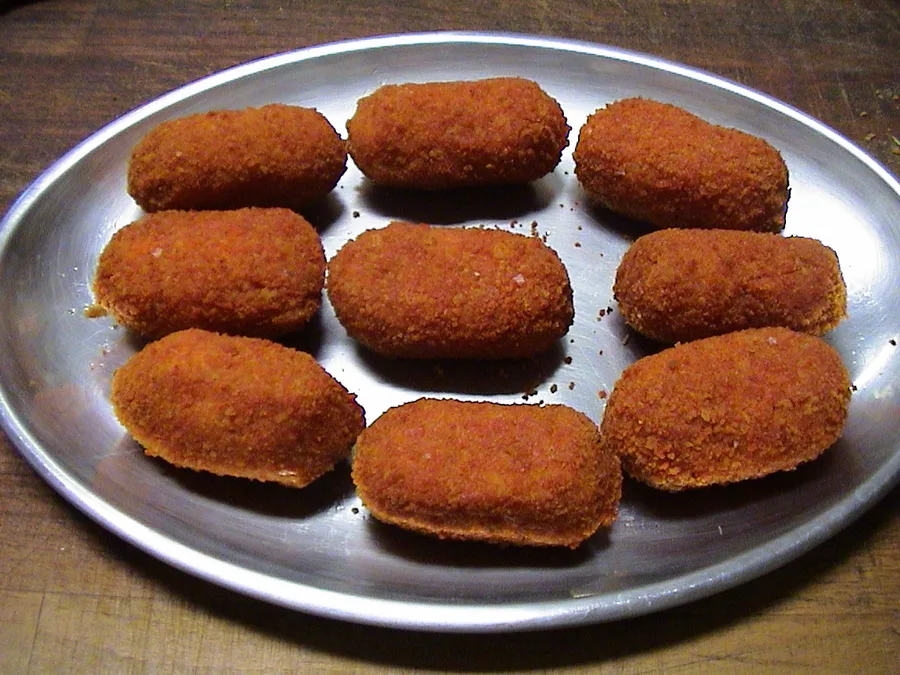
The suppli appears in Roman fry shops in the first half of the nineteenth century, when the city ate standing up and yesterday's leftover rice became something saleable. The name almost certainly garbles the French surprise, the surprise found on breaking the crust: in a Rome occupied by Napoleonic troops and then visited by Grand Tour travellers, French words entered the dialect by phonetic deformation rather than elegance. A menu from the Trattoria della Lepre, one of the historic places in via dei Condotti, already lists it in the 1870s. The nickname al telefono comes much later, in the twentieth century, when the handset telephone was in every house: break the suppli in two and the halves stay joined by a thread of mozzarella ten centimetres long, and the comparison makes itself.
What separates a Roman suppli from any other rice ball is where the rice meets the sauce. The rice is not boiled in water and then stirred into the sauce: raw rice is toasted inside the ragu and brought to doneness risotto-style, with hot broth added a little at a time, until it has absorbed everything and stays dry and bound. The second element is the chilling, which is not a pause but a technical step: the starch retrogrades, the mixture compacts and only then will it stand up to shaping and four minutes in the fat. The third is the heart, which in the older version is provatura (the smoked buffalo mozzarella Romans bought in the dairies) and today is cow's milk mozzarella left to drain, because whey in the fryer is enemy number one.
Ingredients
- Roma or Originario rice400 g (14 oz)
- Minced beef200 g (7 oz)
- Chicken giblets (livers and gizzards), chopped by knife100 g (3.5 oz)
- Tomato passata400 g (14 oz)
- White onion1 small (60 g)
- Carrot1 (70 g)
- Celery1 stalk (60 g)
- Dry white wine80 ml (1/3 cup)
- Hot meat brothabout 700 ml (3 cups)
- Extra virgin olive oil3 tbsp (30 ml)
- Pecorino romano DOP, grated60 g (2.1 oz)
- Eggs (1 in the mixture, 3 for crumbing)4
- Cow's milk mozzarella or provatura200 g (7 oz)
- Fine breadcrumbs250 g (8.8 oz)
- Peanut oil for frying1.5 litres (6.3 cups)
- Fine salt and black pepperto taste
Method
- 1Chop the onion, carrot and celery very finely and soften them in a casserole with the oil over medium-low heat for 10 minutes: they should turn translucent, not colour.
- 2Raise the flame, add the mince and the knife-chopped giblets and brown 7 to 8 minutes, breaking up the lumps with a wooden spoon. Deglaze with the white wine and let it evaporate 2 to 3 minutes until the sharp smell goes.
- 3Pour in the passata and a ladle of broth, salt, turn the heat to its lowest and cook covered for 50 to 60 minutes. The sauce should reduce and darken: left watery, the rice will never dry out later.
- 4Add the raw rice straight into the sauce and toast it 2 minutes, stirring. Then cook it risotto-style: hot broth a ladle at a time, stirring often, for 16 to 18 minutes. At the last ladle the rice should stay dry, and a spoon should leave a trail that does not close.
- 5Turn off the heat, wait 5 minutes for it to drop below 60 °C (140 °F), then stir in the pecorino and one beaten whole egg. Added over the heat the egg would scramble; added warm it simply binds.
- 6Spread the rice in a tray in a 2 cm layer, cover with film in contact and chill completely: 1 hour out and at least 4 hours in the fridge at 4 °C (39 °F), better overnight. It is the step no shortcut replaces.
- 7Cut the mozzarella into sticks of 1 by 1 by 3 cm and let it drain 30 minutes in a sieve, then pat it with paper. Every drop of whey is a crack in the coating.
- 8With wet hands take about 80 g of rice, flatten it on your palm, put a stick of mozzarella in the middle and close it, shaping an oval 8 to 9 cm long and 4 thick. Seal the ends well with your fingertips.
- 9Pass each suppli through beaten egg and then through the breadcrumbs, pressing with your fingers so it adheres everywhere; for a sturdier crust repeat the egg and crumbs a second time. Keep the crumbed suppli in the fridge 20 minutes.
- 10Bring the peanut oil to 175 to 180 °C (345 to 355 °F), checked with a thermometer, and fry 3 or 4 suppli at a time, never more, for 3 to 4 minutes, turning them halfway. Drain on a rack rather than on paper in contact, salt lightly and serve after two minutes: the heart should string without scalding.
What ruins it
The rice matters more than the mozzarella. Roma and Originario are round-grain varieties that give up plenty of starch and collapse slightly as they cook, which is exactly what a croquette that has to hold together needs; Carnaroli and Arborio stay too distinct and the suppli crumbles between your fingers. The sauce must be reduced: if it is still liquid when the rice goes in, raise the flame and dry it out, because the excess water stays in the mixture and reappears at the first contact with the oil.
The oil temperature is the other fixed point. Below 165 °C (330 °F) the coating absorbs and the suppli comes out greasy and soft; above 190 °C (375 °F) it burns in ninety seconds while the heart is still cold and the mozzarella does not string. Fry a few pieces at a time precisely so the temperature does not collapse. Do not use olive oil to fry: the smoke point is lower and the flavour covers the ragu. Finally, suppli are not made ahead for dinner: they can be crumbed in the morning and kept in the fridge, but they are fried at the last minute and taken to the table at once.
About the ingredient: Supplì →
Frequently asked questions
Why is it called suppli al telefono?
Because breaking the suppli in half stretches the heart of mozzarella into a thread joining the two parts, like the coiled cord of an old handset telephone. If it does not string, either there was too little mozzarella or the oil was so hot it browned the crust before the centre warmed through.
Which rice do suppli need?
Roma or Originario rice, round-grained and rich in starch. It is cooked directly in the meat sauce, risotto-style with hot broth, and must stay dry. Carnaroli and Vialone Nano hold the grain too well and the mixture will not bind.
Why do my suppli open while frying?
Three causes, in order of frequency: the rice was not cold enough (it needs at least four hours in the fridge), the sauce was too liquid, or the coating had a hole. Seal the ends carefully, crumb twice and do not go above 180 °C (355 °F).
Can they be baked or cooked in an air fryer?
They can, but they become something else: at 200 °C (390 °F) in a fan oven for 20 minutes, brushed with oil, the crust dries instead of puffing and the contrast between crisp shell and molten heart is lost. The Roman recipe is fried.