Seven dishes of the fifth quarter, and why they are the best
Roman tripe, oxtail alla vaccinara, Venetian liver, ossobuco with its marrow, saffron risotto, head cheese, liver sausage. What butchers could not sell became the finest part of Italian cooking.
The quinto quarto is what is left once the four quarters of meat have been sold: offal, tail, feet, head, marrow. In Rome the vaccinari of Testaccio took it as part of their wages, and the city's most famous dish comes from that necessity. This is not poor cooking as a figure of speech: it is literally the cooking of people who could not buy meat.
Technically these are opposite cuts. Tail and tripe are collagen, and they want three or four hours over the lowest heat to melt into gelatine. Liver is the exact opposite: sliced thin, it wants a few minutes and not one more, because beyond that it turns mealy. In between sits the ossobuco, where the meat stews for an hour and a half and the marrow is eaten with a small spoon.
The list brings together four recipes and three products, because the fifth quarter also lives in cured meats: Piedmontese head cheese and liver sausage were born on the day of the pista, when the whole animal was worked and nothing was thrown away. Marrow appears twice, in the ossobuco and in risotto alla milanese, where it is the starting fat.
veneto · 1 h
Veal liver sliced thin and tossed for a few minutes over a bed of onions stewed for half an hour. The timings are everything: the onion wants thirty-five minutes, the liver four, and reversing the order is the mistake that leaves it bitter and dry.
lombardia · 1 h 55′
Thick slices of veal shin with the marrow, floured, browned in butter and stewed for an hour and a half with onion, white wine and broth, finished with gremolada. The marrow is not a leftover: it is why that cut is chosen at all.
lombardia · 30′
Carnaroli rice toasted in butter and beef marrow, brought up with meat broth and coloured by saffron left to infuse. The marrow is the starting fat and gives a roundness butter alone does not: it is the same ingredient as in the ossobuco beside it.
 Calabrotto · CC BY-SA 4.0
lazio · 2 h 55′
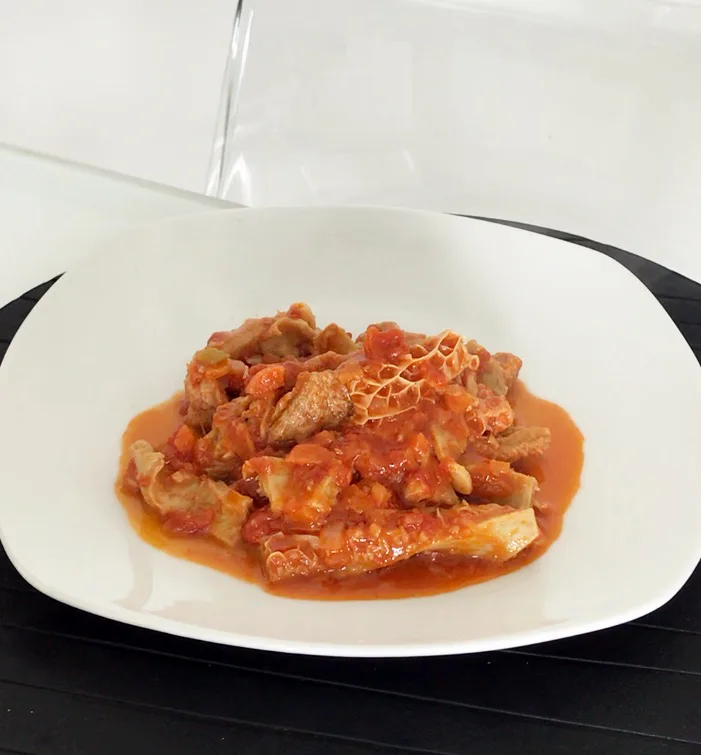
Beef tripe boiled, cut into strips and cooked in tomato sauce, finished with Roman mentuccia and pecorino. The two aromatics do not substitute: mentuccia is not mint, and without it the dish is something else.
lazio · 4 h 40′
Oxtail braised for three or four hours with tomato, white wine and plenty of celery: the chief dish of Rome's quinto quarto. The critical point is patience, because the meat only leaves the bone once the collagen has given way.
piemonte · liguria · 12-20 €/kg
The head boiled, boned while hot, seasoned and pressed in a wooden box until the gelatine binds it. It slices as a mosaic and costs a quarter of other cured meats, because it uses what the others discard.
basilicata · umbria · 12-18 €/kg
Coarsely chopped liver, fat, salt and spices in natural casing: the sausage of the slaughter day. Two opposite versions, sweet with honey or raisins and hot with chilli, and a short cooking, in a pan or over coals.
One last thing
One rule divides these dishes in two and explains nearly every failure. Collagen, which is what tail, tripe and shin are made of, melts into gelatine only between seventy and eighty-five degrees and only after hours: at a boil it squeezes out and the meat turns stringy, so the pot must barely tremble. Liver has no collagen to melt: it has proteins that set at once, and past four or five minutes it goes mealy. The same error, too much heat, means waiting twice as long in one case and throwing the dish out in the other.
The questions this list answers
These are real questions put to an AI assistant, in the period when Bing cited this site among its sources to answer them. The number is how many times we were cited. We read them in Bing Webmaster Tools, under AI performance, and they decide what goes on this page rather than the other way round.
- fegato alla veneziana ricetta tradizionale241 citations
- ossibuchi alla milanese ricetta originale88 citations
- ossobuco ricetta originale84 citations
- trippa ricetta classica65 citations
- coda alla vaccinara ricetta originale romana60 citations
- coda alla vaccinara ricetta originale50 citations
- ricetta ossibuchi alla milanese16 citations
- ossibuchi alla milanese: la ricetta originale con foto passo passo16 citations
Frequently asked questions
What is the quinto quarto?
Everything left of the animal once the four quarters of meat have been sold: offal, tail, feet, head, marrow, rind. In Rome the vaccinari of Testaccio received it as part of their wages, and tripe, oxtail alla vaccinara and pajata come from that necessity.
Why does Venetian liver turn bitter?
Because it is overcooked. Thinly sliced liver wants four or five minutes in the pan, no more, and it goes in when the onion has already stewed for half an hour. Cooking the two together from the start gives the liver thirty-five minutes, which is the sure way to make it bitter and dry.
Do you eat the marrow in an ossobuco?
Yes, and it is why the shin is chosen over another cut: it is drawn out with a small spoon or the tip of a knife and eaten on bread or stirred into the saffron risotto beside it. In Milan a dedicated spoon is served with it.
How long should tripe cook?
About three hours in all between boiling and sauce, so the collagen turns to gelatine without the meat seizing. Many butchers sell it already boiled: in that case the hour and a half in tomato sauce remains, and the mentuccia goes in only in the last minutes.