Trippa alla Romana
Beef tripe boiled and cut into strips, cooked in tomato sauce and finished with Roman mentuccia and pecorino. The critical points are the two aromatics that cannot be substituted: the mentuccia, which is lesser calamint and not mint, and the pecorino romano, which is stirred in off the heat.
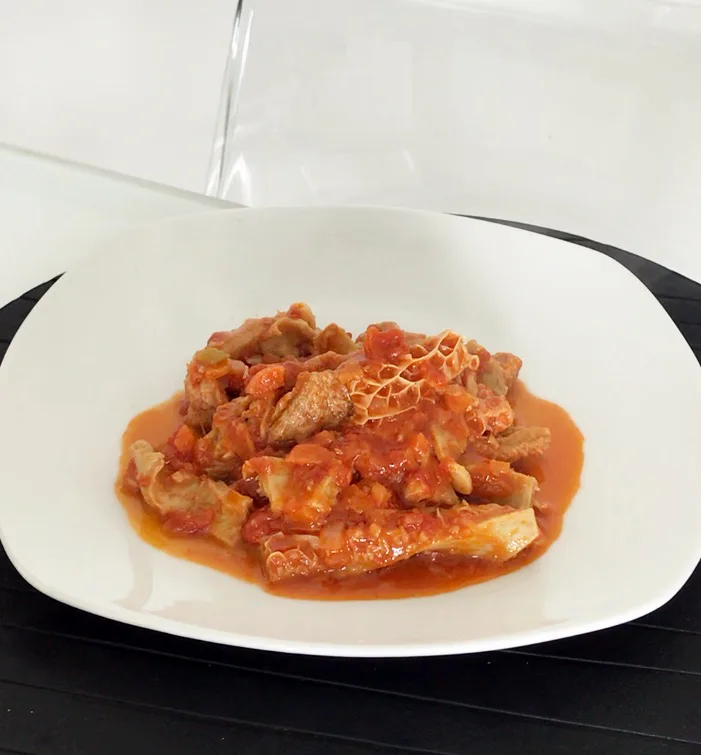
Trippa alla romana comes from the quinto quarto, the part of the animal left to the butchers of the Testaccio slaughterhouse, in use from 1891 to 1975. The vaccinari, the butchers who skinned the cattle, received part of their pay in offal: tail, pajata, sweetbreads, tripe. Out of that economy came a whole repertoire of dishes that now defines Roman cooking and that at the time was simply how you ate meat without buying it. Tripe had its day: Saturday. On the blackboards of the osterie of Testaccio and the Ghetto you read oggi trippa, tripe today, and the custom was so entrenched that it entered the city's weekly gastronomic calendar, alongside Thursday's gnocchi and Friday's salt cod.
Two details separate trippa alla romana from any other braised tripe in Italy. The first is Roman mentuccia, that is Calamintha nepeta, a wild herb that grows on walls and in the fields of Lazio and has nothing to do with peppermint: it smells of mint and oregano at once, with a bitter base that cuts the richness of the offal. It goes in in the last five minutes, torn by hand and not chopped with a knife, because cutting oxidises it and turns it dark. The second is pecorino romano, which is not a final dusting but a structural ingredient: stirred in off the heat it binds the sauce, turns it opaque and thick, and brings the savour the dish would otherwise lack.
Ingredients
- Cleaned beef tripe (honeycomb and bible)1 kg (2.2 lb)
- Tomato passata600 g (21 oz)
- White onion1 (100 g)
- Carrot1 (80 g)
- Celery1 stalk (60 g)
- Diced guanciale (optional)60 g (2.1 oz)
- Dry white wine100 ml (scant 1/2 cup)
- Extra virgin olive oil40 ml (2.7 tbsp)
- Fresh Roman mentuccia1 handful (about 20 leaves)
- Pecorino romano DOP, grated80 g (2.8 oz)
- Hot water or broth300 ml (1.25 cups)
- White vinegar, bay, lemon, for the boiling50 ml + 2 leaves + 1
- Coarse salt, fine salt and black pepperto taste
Method
- 1Even though tripe is sold already cleaned and blanched, rinse it at length under running water and rub it with half a lemon and a spoonful of coarse salt, then rinse again: it removes the residual barnyard smell.
- 2Boil it in plenty of water with the bay, half the onion and 50 ml of white vinegar for 60 to 90 minutes, counting from the boil. It is ready when the point of a knife goes in without resistance. Drain and let it cool a little.
- 3Cut the tripe into strips 1 cm wide and 6 to 7 long. Wider, they stay rubbery under the teeth; thinner, they break down as they cook and the dish loses its texture.
- 4In a heavy-based casserole heat the oil and soften the finely chopped onion, carrot and celery for 10 minutes over medium-low heat. If you are using it, add the diced guanciale and render it 4 minutes until the fat turns translucent.
- 5Raise the flame, add the tripe and let it take up the flavour 5 minutes, stirring, then deglaze with the white wine and let it evaporate 3 minutes over a lively flame.
- 6Pour in the passata, the hot water, salt and a grinding of pepper. Bring it to a simmer, then turn the heat to its lowest: the surface should barely move, a burble every two seconds.
- 7Cook covered for 1 hour 30, stirring every 20 minutes and checking that the base is not catching; if the sauce dries too soon add hot water a ladle at a time.
- 8Take the lid off for the last 20 minutes and raise the flame slightly: the sauce should reduce until it veils the tripe with no free liquid left on the base.
- 9Five minutes before turning off the heat add the mentuccia torn by hand, stir and cover: the herb should give up its aroma without cooking.
- 10Turn off the heat, wait a minute and stir in 50 g of pecorino romano, working from the bottom. Serve steaming on warm plates with the rest of the pecorino and a few fresh mentuccia leaves.
What ruins it
Roman mentuccia is the ingredient nobody can skip without changing the dish. Calamintha nepeta is sold in Roman markets in bunches from November to June; in the rest of Italy you find it as nepitella, above all in Tuscany. It is not peppermint: that brings a sweet cold menthol which against tomato turns unpleasant. If you really cannot find it, use a touch of fresh oregano and accept that the result is a different recipe.
On the tripe, the best cut is the honeycomb, because it is the most tender and holds the sauce in its cells; the bible, or centopelli, stands up well but wants twenty minutes more; the omasum stays leathery and is not the Roman choice. The pecorino always goes in off the heat: over the flame it strings, separates and leaves rubbery filaments instead of binding. Finally, tripe is better the next day: the aromatics settle and the sauce compacts. Reheat it over the lowest heat with two spoonfuls of water, adding fresh mentuccia and pecorino at the end.
About the ingredient: Pecorino Romano →
Frequently asked questions
What kind of tripe is needed?
The honeycomb is the most tender part and the classic choice; the bible (centopelli) works but needs longer boiling. Buy tripe already cleaned and blanched from the butcher, then boil it anyway for 60 to 90 minutes before dressing it.
What is Roman mentuccia?
It is Calamintha nepeta, also called nepitella, a wild herb of Lazio whose scent sits between mint and oregano, with a bitter base. It is not peppermint and cannot be replaced by it: the sweet menthol of common mint jars with the tomato and the offal.
Why is tripe eaten on Saturday in Rome?
Because in the calendar of the Roman osterie every day had its dish, tied to the cycles of the Testaccio slaughterhouse and the rules of fasting: Thursday gnocchi, Friday fish or salt cod, Saturday tripe. Many historic trattorie still keep the words on the blackboard.
How long does trippa alla romana keep?
Three days in the fridge in a closed container, and the flavour improves from the second. It freezes for up to three months, better without the pecorino, which is added fresh when you reheat it over low heat with a couple of spoonfuls of water.