Risotto alla Milanese
Risotto alla milanese is Carnaroli rice toasted in butter and beef marrow, brought up with meat broth and coloured by saffron steeped beforehand. It is finished off the heat with cold butter and Grana, and it has to ripple: if it stands up on the plate, it is wrong.
The legend says that in 1574 an apprentice of the Flemish glassmaker working on the windows of the Duomo, nicknamed Saffron because he used the spice for his yellows, tipped it as a joke into the rice at the wedding banquet of the master's daughter. It is a fine story and a late one, written down only in the nineteenth century. What is documented is that yellow rice with saffron and marrow appears in Milanese cookbooks from the early 1800s, and that the city of Milan registered a reference version with the chamber of commerce in 2007.
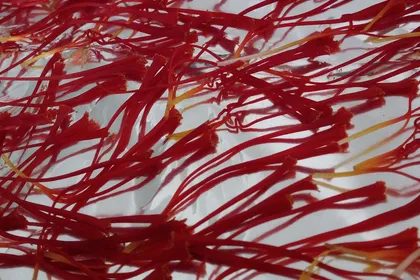
What makes this risotto Milanese is the beef marrow: it gives a round, sweet fattiness that butter alone does not produce, which is why it is rendered with the onion at the start. The saffron should steep in hot but not boiling broth for at least half an hour and go in during the last minutes: cooked for long it loses its volatile aromas and leaves only colour. The rest is technique: broth always at a simmer, a real toasting until the grains are hot to the touch, and finishing off the heat with butter straight from the fridge, which emulsifies instead of simply melting.
Ingredients
- Carnaroli rice320 g (11.3 oz)
- Meat brothabout 1.5 litres (1.6 qt)
- Beef marrow30 g (1 oz)
- White onion, very finely chopped40 g (1.4 oz), half a small one
- Butter60 g (2.1 oz): 30 for the base, 30 cold for finishing
- Grana Padano DOP, grated60 g (2.1 oz)
- Saffron threads0.4 g, or 1 sachet of powdered saffron
- Dry white wine60 ml (1/4 cup)
- Fine saltto taste
Method
- 1Steep the saffron threads in 100 ml (scant 1/2 cup) of hot but not boiling broth, around 70 °C (160 °F), for at least 30 minutes and preferably two hours. Powdered saffron needs only 15.
- 2Keep the broth simmering on a neighbouring burner, around 90 °C (195 °F): adding it cold drops the temperature of the rice and stops the starch coming out.
- 3In a wide heavy pan melt 30 g of butter with the chopped marrow over low heat. Add the onion and soften it for 5 to 6 minutes without letting it colour: it should turn translucent.
- 4Raise the heat, add the rice and toast it for 2 to 3 minutes, stirring. It is ready when the grains are translucent at the edges with a white heart and are hot if you touch one with the back of a spoon.
- 5Deglaze with the white wine and let it evaporate completely, until you can no longer smell alcohol.
- 6Add the simmering broth a ladle at a time, waiting each time until the previous one is nearly absorbed. Stir regularly but not constantly: the point is to release starch, not to wear the rice out. From here, count 16 to 18 minutes.
- 7Five minutes from the end pour in the saffron infusion with all the threads and stir: the risotto turns a full yellow.
- 8Turn off the heat while the rice is still slightly short, a minute before the point you want, and let it rest for 60 seconds untouched. It should stay fairly loose, because finishing will tighten it.
- 9Finish off the heat with the 30 g of cold butter in cubes and the Grana, stirring hard and fast for 40 to 50 seconds until it turns glossy and creamy.
- 10Bang the pan on the worktop to level it, plate it and spread it with a flick of the wrist: the surface should settle into a sheet by itself. That is the wave.
What ruins it
Cold broth is the most expensive mistake: it stops the cooking at every ladle and gives a loose risotto with grains frayed outside and raw inside. The second is skipping or shortening the toasting: without it the starch comes out all at once and the risotto turns into gluey soup. The third is throwing the saffron in at the start, which loses the scent and leaves only the colour.
Never wash the rice, because the surface starch is exactly what you need. Do not use olive oil instead of butter and do not add garlic: the Milanese risotto has none. Do not finish it over the flame or with butter at room temperature, or you get a greasy dressing instead of an emulsion. And do not wait: risotto keeps cooking on the plate and in three minutes it sets into a block.
Guides that cover this
Frequently asked questions
Can you make risotto alla milanese without marrow?
You can, replacing it with another 20 g of butter, but it changes. The marrow gives a round fattiness and a sweet meaty note that butter does not reproduce: it is what separates the Milanese version from a generic saffron risotto.
Carnaroli or Vialone Nano?
Milan uses Carnaroli, which holds its cooking better and releases starch gradually. Vialone Nano is from the Veneto, cooks faster and absorbs more: it gives a softer risotto with a less defined grain.
Saffron threads or powder?
Threads give more aroma and a less uniform colour, powder is more predictable and colours more strongly. Either way it should be steeped in hot broth and added only in the last minutes.
Why does my risotto not ripple?
In most cases it was too dry to begin with or badly finished. Turn off the heat while the rice still flows, finish off the heat with butter straight from the fridge and stir hard for almost a minute: it is the agitation that creates the emulsion.