Fourteen Italian tomato dishes, and which tomato each wants
Peeled plum tomatoes for long sauces, passata for baked pasta, fresh tomatoes for panzanella and brodetto, concentrate for Neapolitan ragù: not one ingredient in four forms.
The tomato came from South America and rewrote Italian cooking in the eighteenth century, but it did not arrive as one ingredient: it arrived as four different products that do not substitute for each other. Long peeled tomatoes, low in water, serve sauces that cook for hours; passata serves where a sauce has to be smooth; fresh tomatoes serve where there is no cooking; concentrate serves where colour and body are wanted without water.
That is why Campania has two DOP tomatoes with two uses. The San Marzano is long, thin skinned and low in seeds, and exists for preserving; the piennolo tomato is small, sharp and concentrated, grows on lava ash without irrigation and is hung in bunches for the winter. Swapping one for the other changes the dish.
Water content is also why some of these dishes work or fail. In panzanella and pappa al pomodoro the tomato has to be ripe and juicy, because its water is what wets the bread; in a parmigiana or a sartù too liquid a sauce collapses the structure. In Italy a tomato is chosen by how much water it brings.
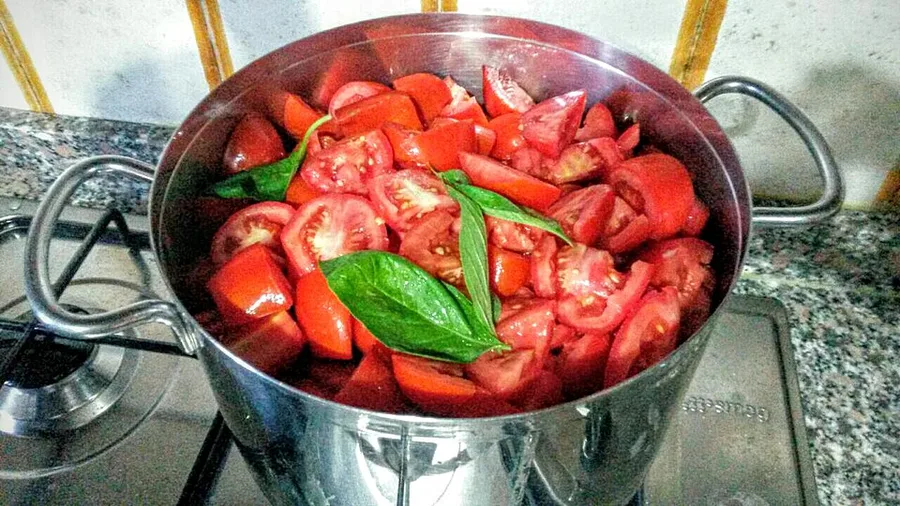 Assianir · CC BY-SA 3.0
campania
A long peeling tomato, thin skinned, with few seeds and little water: the tomato of long sauces, where excess water would stretch the cooking. Without the DOP seal on the tin it is just a long tomato.
campania · 6-12 €/kg
Small, sharp, concentrated, grown on the ash of Vesuvius without irrigation. In a sauce it should be dosed as a concentrate rather than as bulk: a hundred grams go much further.
toscana · 30′
Half an hour, no cooking: here the tomato must be ripe and juicy, because its water, with the oil, is what wets the bread. A firm, underripe tomato leaves the bread dry.
toscana · 1 h 5′
An hour and five minutes: the stale unsalted bread has to break down completely into the tomato. It wants ripe tomato, garlic, basil and oil, and nothing else: every addition buries a four-ingredient dish.
campania · 1 h 10′
Seventy minutes at home: tomato, fiordilatte or buffalo mozzarella, basil, raw oil at the end. The tomato goes on raw and barely crushed, not pre-cooked: in sixty to ninety seconds of oven it cooks by itself.
lazio · 35′
Thirty-five minutes: guanciale, San Marzano, pecorino, chilli. No onion and no garlic, and the guanciale comes out of the pan after browning so it does not harden in the sauce.
sicilia · 50′
Fifty minutes: aubergine deep-fried, tomato, basil, flakes of salted ricotta. Oven-roasted aubergine gives another dish, because frying is what makes it creamy.
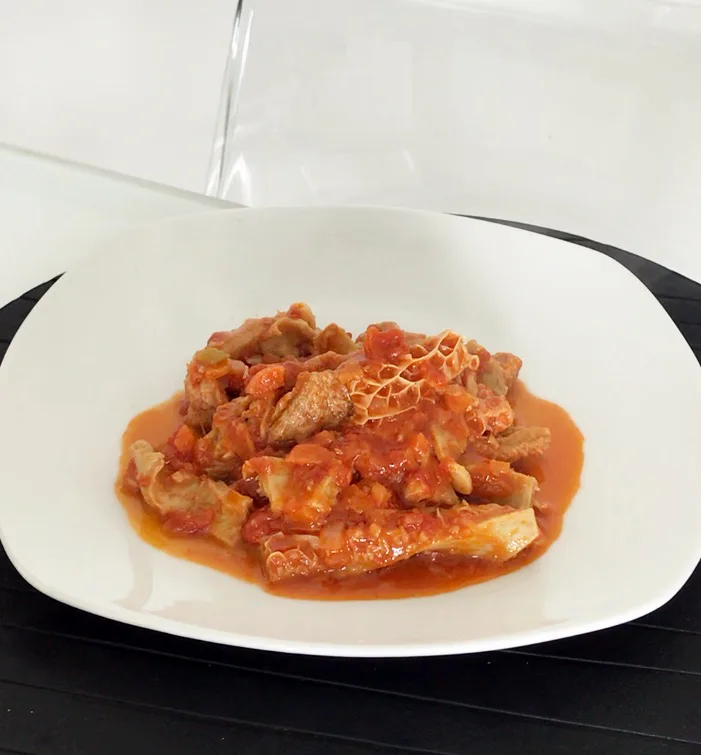 Calabrotto · CC BY-SA 4.0
lazio · 2 h 55′
Two hours fifty-five: tripe boiled and then cooked in tomato sauce, with mentuccia and pecorino at the end. The two aromatics do not substitute, and mentuccia is not mint.
campania · 1 h 45′
Two and a quarter hours, and the sauce must be thick: too watery a tomato collapses the layers and the parmigiana opens in the plate. The aubergines are fried, not baked.
campania · 5 h 40′
Five or six hours with onion, concentrate and passata, and the meat in whole pieces. The concentrate gives colour and body without adding water, which is why the sauce stays dark and thick.
emilia romagna · 3 h 25′
Three hours twenty-five: here there is very little tomato, and the milk at the end matters more than it does. It is the opposite of the Neapolitan ragù, and calling them by one name confuses two different dishes.
toscana · 2 h 5′
Two hours and five minutes: five kinds of fish in staggered times, with tomato, chilli and red wine. Here the tomato is a base rather than the lead, and the order in which the fish go in is the recipe.
campania · 1 h
One hour: mussels in a genuinely hot tomato sauce over twice-baked bread. The bread soaks up the base, so the sauce has to be plentiful and well seasoned: it is the bread's dressing.
- 14
Caponata
sicilia · 1 h 20′
An hour and twenty, and the tomato is only part of the sweet-and-sour: vinegar and sugar do the rest. It is eaten the next day at room temperature, because the two need hours to balance.
One last thing
Tomato concentrate is the most misunderstood ingredient on this list. It is not a ready-made sauce and not a fallback: it is tomato with the water taken out, and it belongs where colour and body are wanted without lengthening the cooking. In Neapolitan ragù it goes in at the start, fried with the onion, and those few minutes in hot fat are what remove its raw, metallic taste. Stirred cold into a finished sauce, concentrate stays sharp and shows: that is the error that makes people think it is a low-quality product.
The questions this list answers
These are real questions put to an AI assistant, in the period when Bing cited this site among its sources to answer them. The number is how many times we were cited. We read them in Bing Webmaster Tools, under AI performance, and they decide what goes on this page rather than the other way round.
- san marzano tomatoes dop20 citations
- dop san marzano tomatoes12 citations
- pomodori del piennolo7 citations
- minestrone alla genovese294 citations
- trippa ricetta classica65 citations
- frittura di paranza179 citations
- sopressata1,226 citations
- arancini siciliani ricetta originale7 citations
Frequently asked questions
Which tomato is used for long sauces?
Long peeled tomatoes, such as the San Marzano DOP: thin skin, few seeds and little water, so they reduce sooner and do not stretch the cooking. Passata is better where the sauce has to be smooth, as in baked pasta.
What is tomato concentrate for?
Giving colour and body without adding water. It goes in at the start and is fried for a few minutes in hot fat with the onion: that step removes its raw taste. Stirred cold into a finished sauce it stays sharp and shows.
Why is the tomato not pre-cooked on Neapolitan pizza?
Because the pizza's own cooking, sixty to ninety seconds at 380 to 430 degrees, is enough: raw crushed tomato cooks on the pizza and stays fresh. A pre-cooked sauce turns bitter and dry in those seconds of oven heat.
What is the difference between Neapolitan and Bolognese ragù?
The Neapolitan uses whole pieces of meat and plenty of tomato, between concentrate and passata, and cooks five or six hours; the Bolognese is coarsely minced meat with pancetta, very little tomato and milk at the end. Two different dishes with a shared name.