Sfogliatella Riccia
The sfogliatella riccia is a shell of forty or fifty paper-thin layers, crisp outside and filled with a mixture of semolina, ricotta, candied peel and cinnamon. The critical point is the pastry: the dough is rolled to a veil you can read through and greased with soft lard, and between the rolling and the cutting it needs at least two long rests in the fridge.
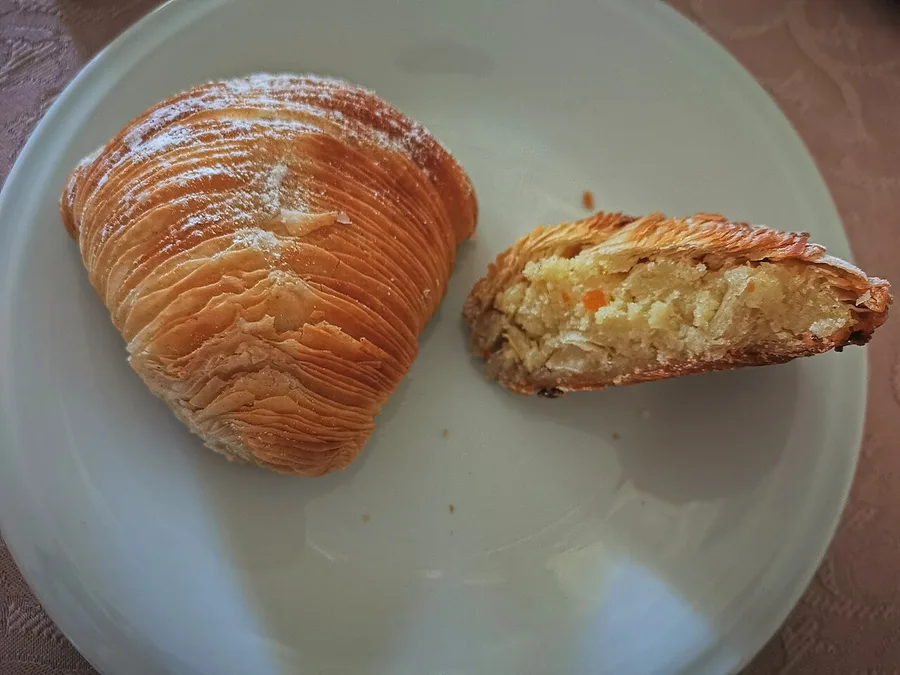
The sfogliatella was born in a monastery on the Amalfi coast. In the convent of Santa Rosa da Lima at Conca dei Marini, in the seventeenth century, the nuns used up leftover semolina cooked in milk by adding dried fruit, sugar and liqueur, and closed it in two sheets shaped like a monk's hood: the Santa Rosa, which still carries pastry cream and a cherry on top. The move to Naples is documented: in 1818 the innkeeper Pasquale Pintauro, whose shop was in via Toledo, obtained the recipe and changed it, taking off the cream and the cherry and tightening the shape into a smaller, more manageable shell. From then on the riccia became street food, a pastry for breakfast and mid-morning, and the frolla (its smooth sister, unlayered, in a shortcrust shell) came later, for those who did not want their hands covered in crumbs.
The riccia is a test of technique before it is a recipe. The dough is hard, almost awkward: strong flour, water and salt at 40 to 45 per cent hydration, worked until smooth and then left to rest at least twelve hours in the fridge so the gluten relaxes. Then it is rolled into a very long, very thin ribbon (by hand with a pin in the domestic version, on a sheeter in a bakery) down to a tenth of a millimetre, the thickness at which newsprint can be read through the pastry. Each stretch of ribbon is greased with softened lard, never butter, and rolled up on itself into a very tight cylinder: it is the rolling that creates the forty or fifty layers that separate into a fan in the oven. The cylinder rests another twelve to twenty-four hours, is cut into slices a centimetre and a half thick, and each slice is hollowed with the thumbs into a cone. The filling is the simple part: cooked semolina, sieved sheep's ricotta, candied orange, cinnamon.
Ingredients
- Strong flour W 300 for the pastry500 g (17.6 oz)
- Cold water200 ml (3/4 cup)
- Fine salt8 g
- Honey15 g
- Softened lard to grease the layers250 g (8.8 oz)
- Finely milled durum wheat semolina for the filling125 g (4.4 oz)
- Water for the semolina250 ml (1 cup)
- Whole milk for the semolina125 ml (1/2 cup)
- Salt for the semolina2 g
- Well-drained sheep's ricotta250 g (8.8 oz)
- Caster sugar180 g (6.3 oz)
- Medium eggs2
- Candied orange in small dice80 g (2.8 oz)
- Ground cinnamon3 g
- Vanilla pod1
- Icing sugar to finishto taste
Method
- 1Work the flour, water, salt and honey in a mixer with the dough hook for 10 to 12 minutes at medium speed. The dough is extremely hard and feels wrong: it has to be. Once it is smooth and compact, wrap it in film and put it in the fridge for at least 12 hours, better 24. It is the rest that makes the dough rollable.
- 2Make the filling. Bring the water, milk and salt to the boil, rain in the semolina while whisking and cook 4 to 5 minutes until it leaves the sides. Spread the semolina on a wide plate and let it cool completely.
- 3Sieve the ricotta and work it with the sugar, then add the cold semolina in pieces, the eggs, the candied peel, the cinnamon and the vanilla seeds. The mixture should be firm enough to hold the spoon: if it is soft, it will escape from the shell in the oven. Cover it and put it in the fridge.
- 4Divide the dough into four pieces and work one at a time, keeping the others covered. With a pin roll each piece into a long thin strip, then pass it through a pasta sheeter, reducing the thickness one notch at a time to the minimum, or carry on with the pin until you can read the pattern of the worktop through the dough. It must be transparent.
- 5Lay the strip on the table and brush it all over with plenty of softened lard, without stinting. Roll it up on itself from the short side, pulling slightly, so the cylinder comes out tight and without air. Attach the next strip to the end of the previous one and carry on rolling, always greasing, until all the dough is used: you will have a single sausage 9 to 10 cm across.
- 6Wrap the cylinder in film and put it in the fridge for 12 to 24 hours. The cold firms the lard and allows a clean cut: a cylinder cut while warm turns to mush and the layers stick together.
- 7Cut the cylinder into 1.5 cm slices, discarding the two ends. Take a slice, lay it on a palm greased with lard and with your thumbs start pressing from the centre outwards while turning: the layers slide over each other and the slice opens into a cone 5 to 6 cm deep. It is the key movement of the sfogliatella, and the first three will go badly.
- 8Fill each cone with 35 to 40 g of filling, close it by pressing the edges with greased fingers and set the sfogliatelle on a baking-paper lined tray, point downwards and the belly up.
- 9Bake in a preheated fan oven at 200 °C (390 °F) for 20 minutes, then lower to 180 °C (355 °F) and carry on another 8 to 10. The layers should open into a fan and colour to a decided brown: a pale riccia is a soft riccia.
- 10Take them out and let them cool 5 minutes on a rack, then dust with icing sugar. They are eaten warm, within the hour: a sfogliatella riccia loses its crispness fast and the next day it is a different pastry.
What ruins it
The fat is the choice that decides everything. You need lard, and you need it at the consistency of a soft paste: butter contains 16 to 18 per cent water which in the oven makes steam and glues the layers together, while lard is almost pure fat and keeps them apart to the end. Anyone avoiding it for dietary reasons gets a more compact pastry with no way to put it right. The quantity matters too: you grease generously, until the dough looks glossy, because every layer has to be insulated from the next.
The other point is the rolling. If the dough tears, it has not rested enough: put it back in the fridge for half an hour and start again. If it resists and springs back like elastic, the same problem. The cylinder is rolled keeping the strip under tension, or air pockets remain that in the oven become voids and the shell collapses. The filling must be firm and cold, and must not go above two thirds of the capacity of the cone. If the sfogliatelle open in the oven, you overfilled them or failed to seal the edges. The raw cylinder freezes very well: wrapped in film it keeps three months, and it cuts straight from half-frozen with better results than fresh.
About the ingredient: Sfogliatella →
Frequently asked questions
How many layers does a sfogliatella riccia have?
Between forty and fifty, formed by rolling lard-greased pastry into a tight cylinder. They are not obtained with the folds of classic puff pastry but from the continuous winding of a single ribbon rolled to a veil.
What is the difference between sfogliatella riccia and frolla?
The filling is the same; the casing differs. The riccia is made of dozens of paper-thin layers of lard-greased pastry and has a crisp, flaky surface; the frolla is enclosed in a smooth shortcrust shell and is eaten without making crumbs.
Can I use butter instead of lard?
Technically yes, but the result changes for the worse. Butter contains nearly twenty per cent water, which in the oven makes steam and welds the layers together: the pastry opens less and stays more compact. Lard is almost pure fat and is the reason the riccia flakes at all.
Where does the sfogliatella come from?
From the monastery of Santa Rosa da Lima at Conca dei Marini, on the Amalfi coast, in the seventeenth century. The Neapolitan shell version is owed to Pasquale Pintauro, who in 1818 in his shop in via Toledo took the cream and the cherry off the Santa Rosa and reduced the shape.