Genoese Minestrone
Genoese minestrone is a soup of vegetables put raw into cold water and cooked slowly until they collapse, with no fried base, finished with a spoonful of pesto off the heat. The critical point is that last step: above 60 °C (140 °F) pesto loses the essential oils of the basil and turns cooked and grassy.
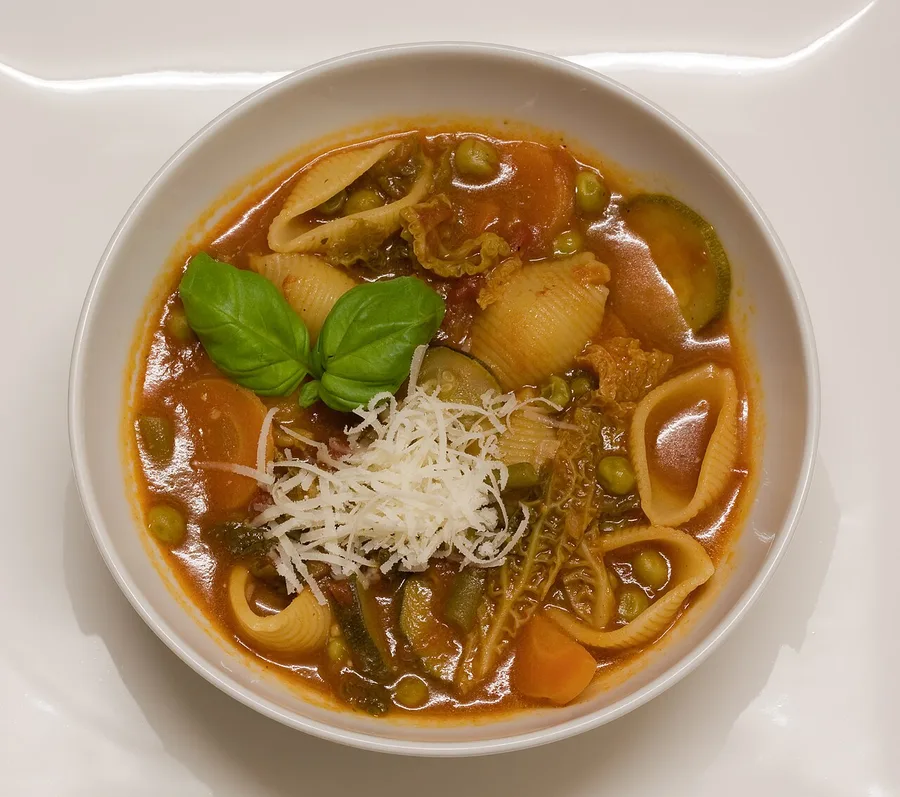
The oldest printed recipe for Genoese minestrone is in Giovanni Battista Ratto's Cuciniera genovese, published in Genoa in 1863: a list of vegetables put into the pot with no preliminary browning and dressed, at the end, with what the author calls pesto, a pounding of basil, garlic, cheese and oil. Ratto's text is also the first printed source to describe pesto in finished form, and that is no coincidence: in Genoese cooking pesto and minestrone come from the same world of terraced gardens and ships' stores. Minestrone was the ration of sailors and dockers, made in quantity in the morning and eaten at intervals through the day, progressively cooler. Hence its texture, thick enough to stand a spoon in, and its serving temperature, which in Genoa is never piping hot.
Two technical choices separate it from every other Italian minestrone. The first is the absence of a fried base: the vegetables go into cold water raw, all together or nearly so, and are brought slowly to the boil. There is no Maillard reaction, no toasted note, and the flavour is the clean vegetable taste of produce that collapses over two and a half hours releasing starch and pectin. The second is the pesto, which is not a garnish but the seasoning of the dish and goes in off the heat, once the pot has stopped steaming: Genoese DOP basil contains volatile compounds (linalool, eucalyptol, estragole) that degrade above sixty degrees, and cooked pesto takes on an army-green colour and a taste of boiled grass. The pasta is traditionally short and small: broken bricchetti, ditalini, or trenette snapped by hand. And the soup is eaten warm, and eating it at room temperature in summer is considered normal rather than a fallback.
Ingredients
- Fresh podded borlotti beans, or 150 g dried and soaked300 g (10.6 oz)
- Green beans, cut into pieces200 g (7 oz)
- Courgettes250 g (8.8 oz)
- White-fleshed potatoes300 g (10.6 oz)
- Yellow pumpkin200 g (7 oz)
- Chard300 g (10.6 oz)
- Savoy cabbage200 g (7 oz)
- Celery2 sticks
- Carrots150 g (5.3 oz)
- White onion100 g (3.5 oz)
- Ripe tomatoes, peeled and chopped200 g (7 oz)
- Dried mushrooms (optional, a Genoese habit)5 g
- Cold water3 litres (3.2 qt)
- Ligurian extra virgin olive oil40 ml
- Bricchetti, ditalini or broken trenette180 g (6.3 oz)
- Genoese DOP basil, small leaves only50 g (1.8 oz)
- Pine nuts15 g (0.5 oz)
- Sweet garlic, from Vessalico if you can find it1 clove
- Parmigiano Reggiano DOP, grated40 g (1.4 oz)
- Aged Sardinian pecorino, grated20 g (0.7 oz)
- Ligurian extra virgin oil for the pesto60 ml (1/4 cup)
- Coarse salta pinch for the mortar, the rest at the end
Method
- 1Prepare every vegetable before lighting the heat: peel and cut the potatoes, pumpkin and carrots into two-centimetre (3/4 in) cubes, slice the onion and celery, top and tail the green beans and cut them in three, cut the courgettes into thick half-moons, strip the chard stalks into ribbons and shred the leaves and the cabbage. The pieces should be large: they will cook for two and a half hours.
- 2Put every raw vegetable into a tall roomy pot with the beans, the chopped tomatoes and the dried mushrooms, pour in the extra virgin oil and cover with 3 litres (3.2 qt) of cold water. No frying, no browning: this is what defines Genoese minestrone.
- 3Bring slowly to the boil over medium heat, which will take a good 20 minutes, then turn it to the lowest setting, half cover and cook for two and a half hours. Stir from the bottom every twenty minutes with a wooden spoon. Do not salt yet, because the beans would toughen.
- 4Halfway through, crush a dozen cubes of potato and a ladle of beans against the side of the pot: the starch they release is what gives Genoese minestrone its characteristic density, without flour or purée.
- 5The minestrone is ready when the vegetables have lost all structure and the liquid is opaque and thick. Genoa wants it at a point that elsewhere would look overcooked: the courgettes should have melted, the green beans be yielding, the potatoes nearly collapsed. Taste and salt now.
- 6While the soup finishes, make the pesto in a mortar. Pound the peeled and degermed garlic with a pinch of coarse salt to a cream, add the pine nuts and reduce them to a paste, then add the basil leaves a handful at a time, crushing them against the wall with a rotating movement of the pestle, never striking.
- 7When the basil has become a bright green cream, 6 to 8 minutes, work in the two grated cheeses and pour in the oil in a stream, mixing with the pestle without whipping. The pesto should be thick and opaque; if you use a blender, chill the blades and jug and work in very short pulses, because the heat of the blades oxidises the basil and blackens it.
- 8Raise the flame under the pot and drop the pasta straight into the minestrone, stirring often because at this density it catches. Cook it a minute past the packet time: al dente is not what you want here.
- 9Turn off the heat and wait. At least 8 to 10 minutes have to pass, until the minestrone has stopped steaming and the temperature has fallen below 60 °C (140 °F): without a thermometer, the right point is when you can hold the back of your hand over the pot without being scalded.
- 10Only now fold in three quarters of the pesto, mixing well to distribute it. Cover and leave another 15 minutes so the aroma permeates the whole soup.
- 11Serve warm, in bowls, with a teaspoon of the remaining pesto in the middle of each and a thread of raw oil. Grated cheese on the side for those who want it. In summer in Genoa it goes to the table an hour later, at room temperature, and the soup is better for it.
What ruins it
Not making a soffritto is a choice, not an oversight. Browning onion and celery in oil produces Maillard compounds that push the dish towards the sweet, toasted register of Lombard or Tuscan minestrone; the Genoese version wants the clean taste of the vegetable and the sweetness that comes from long cooking in water. For the same reason there is no stock cube and no broth: only water.
On the pesto, the fatal mistake is adding it over the heat. Even a few seconds of boiling degrade the basil terpenes and turn the bright green towards olive brown. The second mistake is too much garlic: one clove to 50 grams of basil is already a lot by Genoese standards, and in minestrone half is enough. The third is the wrong basil: the Genoese DOP has small leaves and lacks the mint note of Neapolitan basil, which in pesto becomes intrusive. The leaves are not washed if they are clean, and if they are washed they are dried one by one without squeezing.
On the vegetables: the list is wide but flexible, because Genoese minestrone is seasonal. The one indispensable group is what gives density (beans, potatoes, pumpkin) alongside the green element of chard, cabbage and green beans. Fennel, peppers and aubergine are traditionally left out, because they bring aromas that are too assertive. And the dish is much better the next day, with the caveat that half the pesto should go in at the time and half cold, because after a night in the fridge the aroma has nearly gone.
About the ingredient: Pesto Genovese →
Frequently asked questions
Why is the pesto added off the heat?
Because basil owes its scent to volatile compounds, above all linalool and eucalyptol, which evaporate and degrade past sixty degrees, and because the polyphenols oxidise and give the army-green colour. Cooked pesto tastes of boiled grass and has lost half its point. Wait eight or ten minutes after turning off the heat, until the pot has stopped steaming, then fold it in.
Is Genoese minestrone eaten hot?
Warm, and in summer even at room temperature. That is the temperature at which the pesto reads best and at which the sweetness of the vegetables comes through without being buried by steam. In Genoa it is traditionally made in the morning and eaten at midday or in the evening, and nobody considers it a cold-dish compromise.
Why is there no fried base?
Because Genoese minestrone is built on the direct taste of the vegetables drawn out by long cooking in water, not on the toasted notes of a soffritto. Every vegetable goes raw into cold water with the oil, and slowness does the rest: two and a half hours over a low flame collapse the potatoes and the beans, whose starch gives the dish its density.
Can I make the pesto in a blender?
Yes, with two precautions. Put the jug and blades in the freezer for a quarter of an hour, because the heat the blades generate oxidises the basil and blackens it, and work in very short pulses rather than continuously. The result will still differ from the mortar, where the basil is crushed rather than cut and the cells release their oils without oxidising.