Baba al Rum
The baba is a sweet leavened cake shaped like a mushroom, very rich in eggs and butter, baked dry and then soaked in rum syrup until it becomes a swollen sponge. The two critical points are the proving, which must be long and in two stages so the dough develops the gluten network that holds the liquid, and the temperature of the syrup: 60 °C (140 °F), never boiling, or the baba falls apart.
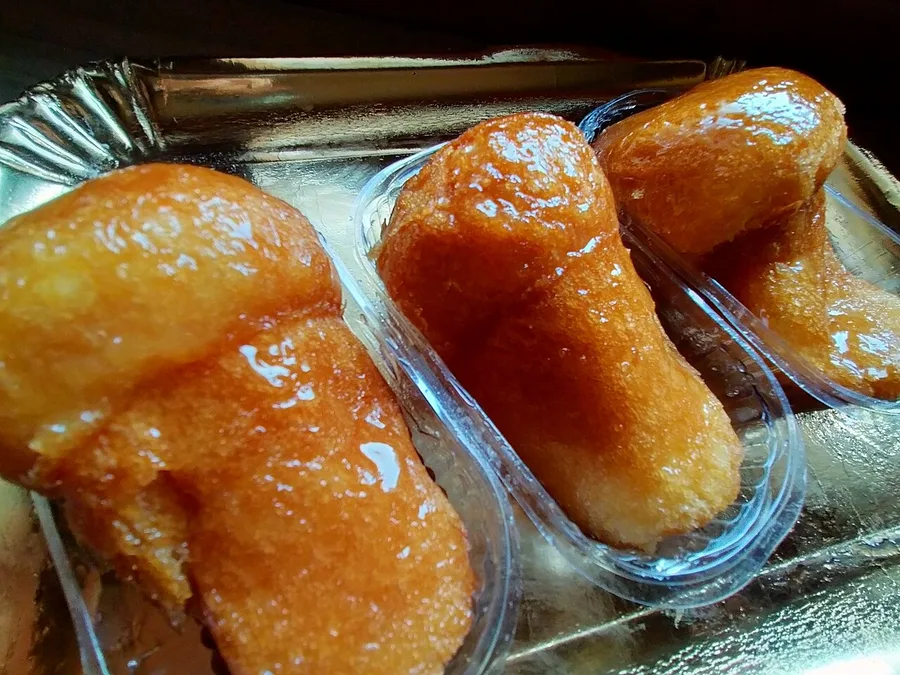
The legend of the baba is better documented than confectionery legends usually are. Stanislaw Leszczynski, the deposed king of Poland exiled in Lorraine at the beginning of the eighteenth century, found the Alsatian kugelhupf too dry and took to dipping it in Malaga wine; the name, according to the most credited version, comes from Ali Baba of the Thousand and One Nights, which the king was reading in Antoine Galland's translation. His court pastry chef, Nicolas Stohrer, opened a shop in Paris in rue Montorgueil in 1730 and took the cake with him. In Naples the baba arrives with the French monsu between the end of the eighteenth century and the beginning of the nineteenth, and Ippolito Cavalcanti mentions it as early as 1837. In two centuries it has become so Neapolitan that si' nu babba, in Naples, is the warmest compliment you can pay a person.
What separates a real baba from a soaked bun is the internal structure. The dough is an extreme brioche, with 250 to 300 g of egg and 150 to 200 g of butter per kilo of flour, and it has to be worked at length so the gluten network becomes elastic and able to hold a quantity of liquid equal to its own weight. You need strong flour, W between 300 and 330, and the butter goes in only once the dough has come together on the hook, a piece at a time, or the fat interrupts the formation of the gluten and the baba stays heavy. The baking must be complete and dry: a baba damp at the centre dissolves in the syrup. And the syrup is held at 60 °C (140 °F), the temperature at which it penetrates without cooking the walls of the crumb; above 75 °C (167 °F) the cake breaks down into mush, below 40 °C (105 °F) it stays wet at the surface and dry at the heart. The rum goes in off the heat, once the syrup is already warm rather than hot, because alcohol evaporates at 78 °C (172 °F) and the aroma goes with it.
Ingredients
- Strong flour W 300 to 330 (manitoba or a mix)300 g (10.6 oz)
- Medium eggs at room temperature5 (about 250 g)
- Soft butter, beaten to a paste100 g (3.5 oz)
- Fresh yeast10 g
- Caster sugar for the dough20 g
- Acacia honey10 g
- Fine salt6 g
- Butter for the moulds30 g
- Water for the syrup1 litre (4.2 cups)
- Caster sugar for the syrup400 g (14 oz)
- Unwaxed lemon zest1
- Unwaxed orange zest1
- Dark rum, 40 to 54 per cent200 ml (3/4 cup)
- Apricot glaze for the shine80 g (2.8 oz)
Method
- 1Dissolve the yeast in two beaten eggs and pour it into the mixer bowl with the flour, the sugar and the honey. Work with the dough hook at low speed for 5 minutes, until the dough gathers.
- 2Add the remaining eggs one at a time, waiting for each to be completely absorbed before the next: 12 to 15 minutes in all. The dough will pass through a loose and unpleasant stage and then come back together. Add the salt and work it until it leaves the sides and clings to the hook: that is the corda, and without it there is no baba.
- 3Only now add the softened butter in five additions, a piece at a time, bringing the dough back onto the hook after each. At the end it should be glossy, elastic and able to hold the windowpane: stretched between your fingers it spreads into a transparent membrane without tearing. That is another 10 minutes of machine time.
- 4Cover and let it prove in the bowl at 26 to 28 °C (79 to 82 °F) for 1 hour 30 to 2 hours, until it triples. The dough is very soft and sticky: that is normal and should not be corrected with more flour.
- 5Butter 12 baba or muffin moulds. With wet hands, tear off portions of 45 to 50 g, round them roughly and put them in the moulds, filling them a third. Cover and prove 1 hour 30 to 2 hours at 26 to 28 °C (79 to 82 °F), until the dough reaches the rim and begins to dome.
- 6Bake in a preheated conventional oven at 180 °C (355 °F) for 20 to 25 minutes, without opening it for the first 15. The baba should be brown and dark, not pale gold: the baking must be complete to the heart, and a skewer pushed into the middle must come out perfectly dry. Turn them out at once onto a rack and let them cool completely, better still for a few hours: a slightly stale baba absorbs better.
- 7Make the syrup: bring the water to the boil with the sugar and the lemon and orange zest, let it simmer 5 minutes, then turn off the heat. Take out the zest and let the temperature drop to 60 °C (140 °F), checking with a thermometer. Only then pour in the rum and stir.
- 8Dip the cold baba into the syrup at 60 °C (140 °F), three or four at a time, holding them under with a slotted spoon for 40 to 60 seconds a side. They should swell and become heavy, with the syrup showing at the pores. If they still float lightly, they are not done.
- 9Lift each baba with the skimmer and set it on a rack over a tray, pressing lightly with the back of a spoon to let the excess out. Let them drain 15 minutes.
- 10Warm the apricot glaze with two spoonfuls of water until it flows and brush it over the surface of the baba: it gives the shine and, above all, seals the moisture inside. Serve at room temperature, with a spoonful of rum poured into the hollow at the last moment if you like.
What ruins it
The baba forgives little, and nearly all the errors are in the dough. If you do not bring the mass onto the hook before the butter, the gluten network does not form and the cake bakes compact, with small closed cells that absorb nothing: in the syrup it will stay a wet stone. If you add flour because the dough seems too soft, you get the same result. The correct consistency is close to a thick cream that clings to the hook, and it is handled with wet hands, not floured ones.
On the syrup, the 60 °C (140 °F) rule is the only one that really counts. At higher temperatures the internal structure collapses and the baba turns to mush; at temperatures too low the syrup does not go in and you are left with a wet outer ring and a dry heart. The second widespread error is putting the rum into boiling syrup: alcohol evaporates at 78 °C (172 °F), the aroma goes and only sweetness remains. You want a dark rum of medium strength, agricole or Navy, not a neutral spirit. Finally, a freshly baked baba absorbs worse than a rested one: if you can, bake it in the evening and soak it the next day. Once soaked it keeps two or three days under a glass dome, and improves over the first twenty-four hours.
Frequently asked questions
Why does my baba fall apart when I dip it?
Because the syrup is too hot or the baba is not baked enough. The syrup is used at 60 °C (140 °F) measured with a thermometer, and the cake must be cold, dry at the centre and well browned: a pale baba keeps internal moisture and breaks down on contact with the liquid.
How much rum goes into a baba?
About 200 ml of dark rum to a litre of syrup, a ratio of one to five. The rum goes in off the heat once the syrup has come down to 60 °C (140 °F): if it is boiling, the alcohol evaporates and only the sweetness of the sugar is left.
What flour does a baba need?
A strong flour, with W between 300 and 330 and at least 13 g of protein per 100 g. It is needed to carry the enormous quantity of eggs and butter and to build the elastic network that then holds the syrup. With a weak flour the dough never comes together and the baba stays heavy.
Is the baba Neapolitan or French?
The invention is from Lorraine, attributed to the Polish king Stanislaw Leszczynski and spread in Paris by the pastry chef Nicolas Stohrer in 1730. It reached Naples with the French cooks between the eighteenth and nineteenth centuries and is cited by Cavalcanti in 1837: the mushroom shape and the rum syrup as we know them today are Neapolitan.