Puntarelle alla Romana
The inner shoots of catalogna chicory cut into very thin strips, curled in iced water and dressed with a sauce of anchovies, garlic and vinegar pounded in a mortar. The critical point is the water: it has to be ice cold, and the puntarelle must be dried perfectly before they are dressed.
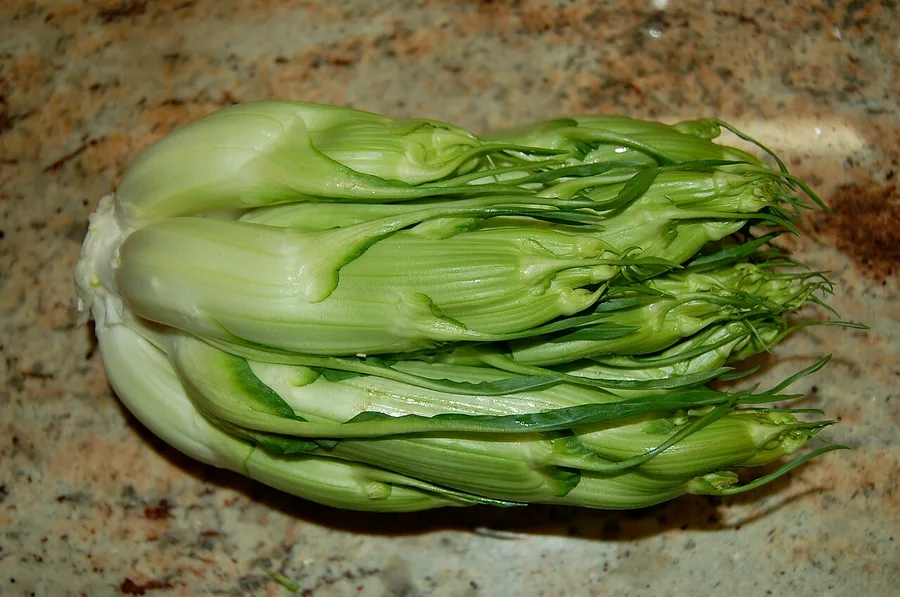
The puntarella is the inner shoot of catalogna chicory of the puntarelle type, a variety of Cichorium intybus grown in the Agro Romano and particularly on the Pontine plain, around Sezze, Priverno and Velletri, where the mild climate allows harvesting from November to March. Until a few decades ago Rome had its puntarellare, women who at the stalls of Campo de' Fiori and the Testaccio market cut the shoots with a wire cutter, a grid of blades that reduces a wedge to strips in one stroke, and sold them already immersed in water. The dish is the winter salad of the Roman osterie, served beside abbacchio or coda alla vaccinara, and it has the same function as the artichoke: to clean the palate after the fat.
The technique is all in the cutting and the water. The strips are taken lengthways, two or three millimetres thin, and plunged into very cold water with plenty of ice: the cells on the outer and inner sides lose turgour at different rates and the strip curls on itself into the characteristic ringlets, while part of the bitter compounds passes into the water. If the strips stay straight, the water was not cold enough. The sauce is the other pole: salted anchovies desalted, a clove of garlic, white wine vinegar and oil, pounded in a mortar to an opaque cream. A stick blender makes too fast an emulsion, which separates and turns the garlic pungent.
Ingredients
- Catalogna chicory of the puntarelle type1.5 kg (yielding about 500 g of shoots)
- Salted anchovy fillets8 (or 10 fillets in oil)
- Garlic1 large clove
- White wine vinegar25 ml
- Fruity extra virgin olive oil80 ml (1/3 cup)
- Ice1 kg (2.2 lb)
- Black pepper, ground freshto taste
- Fine salta pinch, often not needed
Method
- 1Pull the long serrated outer leaves off the head: they are not thrown away, they are boiled and sauteed. At the centre remain the pale, hollow, pointed shoots, which are the puntarelle proper.
- 2Cut away the hard woody base of each shoot and split it lengthways into 4 to 6 wedges, depending on size.
- 3Cut each wedge lengthways into strips of 2 to 3 mm, laying it on the board and using a well-sharpened knife. If you have the wire cutter, push the wedge through the grid in a single stroke.
- 4Fill a roomy bowl with very cold water and at least a kilo of ice, plunge the strips in and put it in the fridge for 1 to 2 hours. They should curl visibly: it is the sign that the water was cold enough and that the bitterness has passed into the water.
- 5Meanwhile desalt the salted anchovies under cold running water, open them out flat with your fingers, remove the backbone and the dorsal fin, then dry them on paper.
- 6In the mortar pound the garlic clove, its green germ removed, with a pinch of salt to a cream, then add the anchovies and carry on pounding until no recognisable piece remains.
- 7Add the vinegar and work 30 seconds with the pestle, then pour in the oil in a thread while turning always in the same direction: the result should be a thick opaque sauce that holds together.
- 8Drain the puntarelle and dry them carefully in a salad spinner or spread out on a clean cloth. Left wet, the sauce slides off them and gathers in the bottom of the bowl.
- 9Tip the puntarelle into a wide bowl, add the sauce and toss, lifting from the bottom, for a good minute, until every ringlet is veiled. Grind over the pepper.
- 10Let it stand 10 minutes before taking it to the table, the time the sauce needs to cling. Beyond half an hour the puntarelle begin to give way and lose their crispness.
What ruins it
The garlic has to be calibrated. Anyone wanting it present but not aggressive soaks it in milk for 20 minutes before pounding, or simply rubs the cut clove round the walls of the mortar and then discards it, leaving only the scent. The green germ in the centre is always removed: it is the part that stays in the mouth for hours. Do not use a stick blender for the sauce: the fast blades warm the oil, the emulsion breaks within ten minutes and the garlic releases sulphur compounds that turn pungent.
On the outer leaves, throwing them away is a waste Rome has never committed: they are boiled 10 minutes in salted water, squeezed and sauteed with oil, garlic and chilli for five minutes, and they are the side dish that goes with sausage. Dressed puntarelle do not keep: the vinegar goes on working and after an hour the ringlets go limp. The cut shoots, by contrast, keep in cold water in the fridge for up to a day, with one change of water.
About the ingredient: Puntarelle →
Frequently asked questions
What exactly are puntarelle?
They are the inner shoots, hollow and pointed, of catalogna chicory of the puntarelle type, a variety of Cichorium intybus grown above all in Lazio. The long jagged outer leaves are not eaten raw: they are boiled and sauteed in a pan.
Why do puntarelle go into iced water?
For two reasons: the strips curl because the two sides of the fibre lose turgour at different rates, and much of the bitter compounds passes into the water. They need at least an hour in very cold water with plenty of ice. In lukewarm water they stay straight and bitter.
Can puntarelle be made without anchovies?
They can be dressed with oil, vinegar, garlic and pepper, but that is not the Roman recipe: the anchovies bring the savour and the umami that balance the bitterness of the chicory. If fish is the problem, there is no convincing substitute, and you may as well call it a catalogna salad.
When are puntarelle in season?
From November to March, peaking between December and February. Out of season you find greenhouse or imported produce, with more fibrous and less bitter shoots that curl badly even in iced water.