Maritozzi con la Panna
The Roman maritozzo is a sweet leavened bun, soft and scented with orange, cut on the diagonal and filled with fresh unsweetened whipped cream. The critical point is the cream: it is whipped at the last moment, kept soft and glossy, and the maritozzi are filled only minutes before serving.
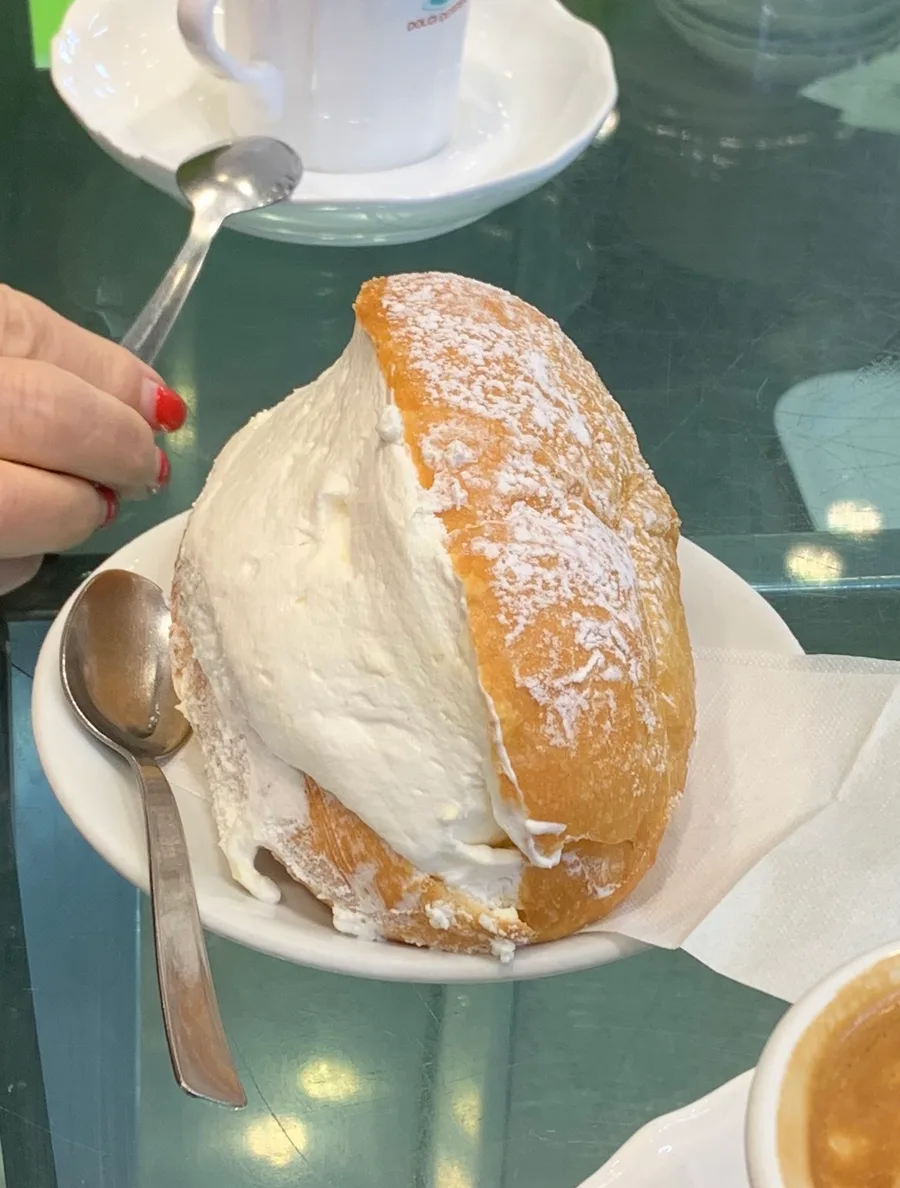
The maritozzo is the Roman descendant of Lenten sweet breads, the one sugared concession allowed in the forty days of fasting: a dough enriched with raisins, pine nuts and candied peel, with no dairy. From there comes the documented custom of the first Friday in March, when young men gave their brides-to-be a larger, decorated maritozzo, inside which a ring or a small gold gift might be hidden. The name comes from that: maritozzo as a joking diminutive of marito, husband, and Giuseppe Gioachino Belli catches the echo of it in the Rome of the early nineteenth century, where the bun was sold at stalls and in shops alongside bread.
The version with cream, by contrast, is twentieth-century and urban, born when Roman bars began whipping fresh cream for breakfast. What separates a well-made maritozzo from an industrial one is the softness of the dough (plenty of eggs, butter or lard worked to the windowpane, a double slow prove) and above all the cream, which is not sweetened. The dough already carries ninety grams of sugar and a syrup glaze: if the cream is sweet too, the maritozzo becomes cloying at the second bite. The cream is there as a cold, rich counterpoint, whipped firm but not grainy, cut level with a spatula in a single movement, so the section stays clean and white.
Ingredients
- Strong type 0 flour (W 300 to 330)500 g (17.6 oz)
- Warm whole milk (28 °C / 82 °F)180 ml (3/4 cup)
- Medium eggs2 (110 g)
- Caster sugar90 g (3.2 oz)
- Soft butter (or 60 g of lard)80 g (2.8 oz)
- Fresh yeast12 g
- Acacia honey15 g
- Grated zest of unwaxed orange1
- Fine salt8 g
- Yolk plus 1 tbsp of milk, to glaze1
- Water and sugar for the syrup50 ml + 50 g
- Fresh whipping cream, 35% fat500 ml (2.1 cups)
- Icing sugar to finishto taste
Method
- 1Make the pre-ferment: dissolve the yeast in 100 ml of milk at 28 °C (82 °F), combine it with 150 g of the flour and work to a thick batter. Cover and leave at 26 °C (79 °F) for 60 minutes, until it doubles and the surface is covered in bubbles.
- 2Add to the pre-ferment the rest of the flour, the eggs, the sugar, the honey, the orange zest and the remaining milk. Knead 10 minutes at low speed (or 15 by hand) to a dough that comes together and leaves the sides.
- 3Add the salt, knead 2 minutes, then the soft butter in pieces in three additions, waiting each time for it to be absorbed. Carry on 12 to 15 minutes to the windowpane test: a piece stretched between your fingers should turn transparent without tearing. The dough must not go above 26 °C (79 °F).
- 4Put it in a greased bowl, cover and let it prove 2 hours at 26 °C (79 °F) until doubled. Alternatively, 12 hours in the fridge at 4 °C (39 °F): the aroma gains a great deal and the handling is easier.
- 5Tip the dough onto the worktop, divide it into 8 pieces of 110 g, round each piece into a taut ball and let them rest 15 minutes covered.
- 6Shape the ovals: flatten each ball, roll it up tightly on itself and roll it under your hands into a 12 cm log with slightly tapered ends. Set them on a baking-paper lined tray, 6 cm apart.
- 7Prove 2 to 2.5 hours at 26 to 28 °C (79 to 82 °F), covered. They are ready when a finger pressed into the dough leaves a dent that rises slowly without quite disappearing.
- 8Brush with the yolk and milk and bake in a conventional oven at 175 °C (345 °F) for 14 to 16 minutes, until the surface is hazelnut-coloured and the heart reaches 92 °C (198 °F). Meanwhile bring the water and sugar to the boil for the syrup.
- 9As soon as they come out, glaze them with the hot syrup using a brush, then let them cool completely on a rack. Filling a warm maritozzo means melting the cream.
- 10Whip the cream at 4 °C (39 °F) in a cold bowl for 2 to 3 minutes, without sugar: it should stay glossy and creamy, firm but not grainy. Cut each maritozzo on the diagonal two thirds of the way through without separating the halves, fill with about 60 g of cream and level it with a spatula in a single movement from bottom to top. Dust the edges with icing sugar and serve within the hour.
What ruins it
The cream is where nearly everyone goes wrong. It must be fresh whipping cream with at least 35 per cent fat, straight from the fridge at 4 °C (39 °F), in a chilled metal bowl; UHT or vegetable cream whips more stably but leaves a film of fat in the mouth and an artificial sweetness. Do not sweeten it: if you must, 20 grams per half litre, not one more. If it goes past the point and turns grainy, it can be rescued by adding two spoonfuls of cold liquid cream and stirring gently with a hand whisk.
The dough wants time and a controlled temperature. Prove it in a kitchen at 30 °C (86 °F) and the butter begins to leak out of the gluten network and the crumb comes out greasy and heavy; better the oven switched off with only the light on, which sits around 26 °C (79 °F). The glaze of hot syrup is not decoration: it seals the surface and keeps the maritozzo soft for a whole day. Filled, they keep at most three or four hours in the fridge before the bread takes up the moisture of the cream; empty, they freeze very well and thaw at room temperature in an hour.
About the ingredient: Maritozzo →
Frequently asked questions
Why is it called a maritozzo?
The name comes from marito, husband. It was the bun young men gave their brides-to-be on the first Friday in March, sometimes with a ring or a small jewel hidden in the dough. In the old Lenten version it held raisins, pine nuts and candied peel and had no cream.
Should the cream in maritozzi be sweetened?
No, or at most with 20 g of icing sugar per 500 ml. The dough is already sweet and is glazed with syrup: sweetened cream makes the whole thing cloying and cancels the contrast between the warm orange-scented bread and the cold richness of the cream.
Can I use lard instead of butter?
Yes, and it is closer to the old version: 60 g of lard replaces 80 g of butter. The crumb comes out softer and slightly drier, with a less milky scent that leaves more room for the orange.
How long do maritozzi keep?
Empty and well closed in a bag they stay soft two days, and they freeze for up to a month. Filled, they should be eaten within three or four hours, kept in the fridge: beyond that the cream gives up water and the inside of the bun turns soggy.