Olive all'Ascolana
Olive all'ascolana are tender Ascoli olives stoned in a spiral with a small knife, filled with a stuffing of three meats, crumbed and fried. The critical point is the stoning: the cut has to be one continuous ribbon that winds back around the filling, because an olive cut in half opens in the fat and loses everything.
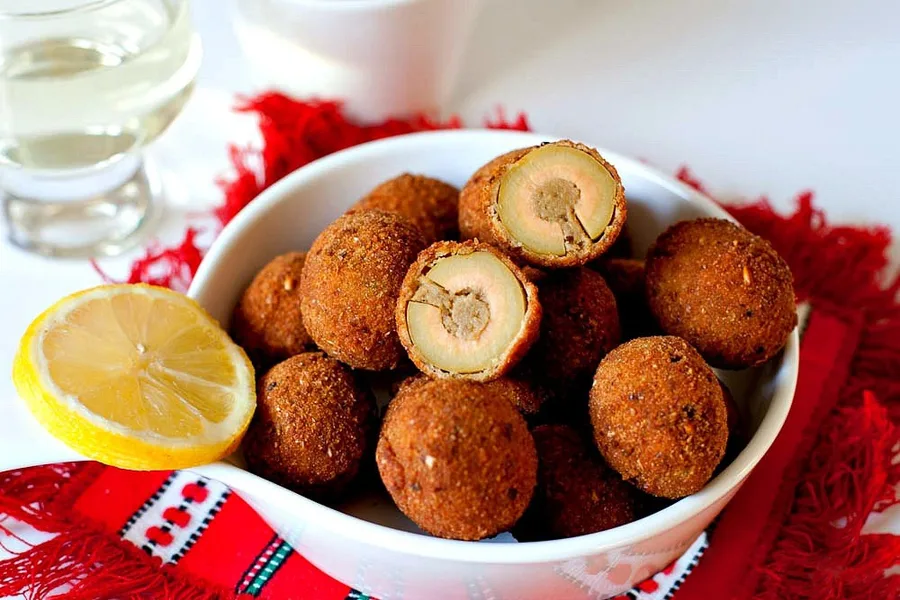
The olives of Ascoli have an ancient reputation: Pliny the Elder in the Naturalis historia names the olives of the Piceno among the best in the empire, and Martial lists them in the Xenia as a table gift. The cultivar is the Oliva tenera ascolana, a table olive with a large fruit, fleshy pulp and small stone, kept in brine after a long debittering process. The stuffed and fried recipe, by contrast, is nineteenth-century and was born in the kitchens of noble Ascoli families, where the cooks had leftovers of roast meats of various kinds and were looking for a way to use them: local tradition places the invention around 1800. Since 2005 the name Oliva Ascolana del Piceno has been protected as a DOP, in two types: the green olive in brine and the stuffed olive, which is precisely this preparation.
The correct version shows in two things. The first is the spiral stoning: with a sharp short-bladed knife you cut into the olive at the tip and cut around the stone following a helical line, releasing the flesh as a single ribbon that stays intact. That ribbon is then wound back around the ball of filling, rebuilding the shape of the olive, and the continuity of the cut is what stops the crumb coating opening in the hot fat. The second is the filling, which must be of three meats: beef, pork and chicken, in some houses with turkey in place of the chicken or veal added as well, browned together in a vegetable base, deglazed with white wine, finely minced and bound with eggs, Parmigiano, nutmeg and lemon zest. A filling of raw mince alone, or of sausage meat alone, is the industrial shortcut found in chiller cabinets, and it gives a compact, flat result where the real filling is soft and layered. The frying, finally, is done in oil at 170 to 175 °C (340 to 345 °F), never hotter: a high temperature colours the crumb before the heat reaches the filling.
Ingredients
- Large tender Ascoli olives in brine60 pieces (about 700 g)
- Beef (chuck or eye of round) in cubes150 g (5.3 oz)
- Pork loin or shoulder in cubes150 g (5.3 oz)
- Chicken breast or thigh in cubes100 g (3.5 oz)
- Prosciutto crudo or mortadella (optional)40 g (1.4 oz)
- Onion60 g (2.1 oz)
- Carrot50 g (1.8 oz)
- Celery40 g (1.4 oz)
- Dry white wine100 ml (scant 1/2 cup)
- Tomato paste1 tsp
- Extra virgin olive oil for the base30 ml (2 tbsp)
- Eggs for the filling2
- Parmigiano Reggiano DOP, grated60 g (2.1 oz)
- Breadcrumbs for the filling2 tbsp, if needed
- Nutmega generous grating
- Grated zest of unwaxed lemonhalf a lemon
- Ground cinnamon (the Ascoli touch)a scant pinch
- Plain flour for crumbing100 g (3.5 oz)
- Eggs for crumbing3
- Fine breadcrumbs for crumbing200 g (7 oz)
- Peanut oil for frying1 litre (4.2 cups)
- Salt and black pepperto taste
Method
- 1Drain the olives from the brine and taste one: if it is very salty, keep them 30 to 60 minutes in cold water, changing it twice, then dry them. Do not soak them too long, because the flesh softens and tears during the stoning.
- 2THE FILLING. In a casserole heat the oil with the finely chopped onion, carrot and celery and stew 10 minutes over low heat. Raise the flame and brown the three meats in cubes, adding the beef first, the pork after 5 minutes and the chicken after another 5, since it cooks faster.
- 3Deglaze with the white wine, let it evaporate, add the paste dissolved in half a glass of hot water, salt and pepper. Lower the heat and cook covered 45 to 50 minutes, adding hot water if it dries: the meats should be tender and the base almost dry.
- 4Let it cool completely, then mince the meats through the fine plate of a mincer (two passes) together with the prosciutto or mortadella. The filling is minced cold: hot, the fat separates and what is left is a greasy paste.
- 5In a bowl work the mince with the 2 eggs, the Parmigiano, the nutmeg, the lemon zest and the pinch of cinnamon. It should be a firm, workable mixture: if it is too soft add a spoonful of breadcrumbs at a time. Rest it in the fridge 30 minutes, so it firms up.
- 6THE STONING. Take a short, sharp knife. Cut into the olive at the tip and cut around the stone in a helical movement, turning the olive with your left hand and holding the knife still, as you would peel an apple. The flesh should come away as a single continuous ribbon, unbroken.
- 7The first ten will go badly: that is normal, the gesture is learnt. An olive broken into two or three pieces is not lost, but use it last and close it with more care, because the join is where the filling escapes into the fat.
- 8Take a ball of filling a little larger than the stone, set it at the end of the ribbon of flesh and wind the spiral back around it, rebuilding the shape of the olive. Compact it between your palms and set it on a tray. Carry on with all of them, keeping your hands slightly damp so the filling does not stick.
- 9THE CRUMBING. Pass each olive first through the flour, shaking off the excess, then through beaten egg, finally through the fine breadcrumbs, pressing well with your fingers. For a sturdier crust repeat the egg and crumbs a second time: it is the double crumbing the Ascoli fry shops use for olives destined for the counter.
- 10Put the crumbed olives in the fridge at least 30 minutes before frying. The coating dries and adheres, and the cold filling slows the expansion of the steam that tends to burst the olive.
- 11THE FRYING. Heat the peanut oil in a tall narrow pot to 170 to 175 °C (340 to 345 °F), checking with a thermometer. Fry 6 to 8 olives at a time, never more: each batch lowers the temperature, and below 160 °C (320 °F) the coating absorbs oil instead of sealing.
- 12Cook 3 to 4 minutes, turning them with a skimmer, until evenly golden. Above 180 °C (355 °F) the coating darkens in ninety seconds and the filling stays cold: if you notice them colouring too fast, lower the flame and wait for the oil to come down.
- 13Drain on kitchen paper, salt lightly because the olives are already savoury, and serve them very hot, within five minutes. Olive all'ascolana lose half their character once they cool, because the coating takes up moisture from the filling and softens.
What ruins it
Spiral stoning is the only technique that really works, and it has to be learnt with patience. Mechanical pressure stoners, the kind that push the stone out of the olive, leave a hollow cylinder with two openings: the filling escapes from both while frying. A curved knife or a well-sharpened paring knife, with the olive turning between your fingers and the blade held still, gives a continuous ribbon. The gesture improves quickly and after a hundred olives becomes automatic. Anyone short of time can buy olives already spiral-stoned, which some Ascoli producers sell vacuum-packed.
On the filling, three meats is not a decorative number. The beef gives structure and flavour, the pork fat and softness, the chicken delicacy and lightness: take one of the three away and the result goes off balance. The meats are braised, cooled and then minced, not minced raw: that is the point that separates the Ascoli recipe from its imitations. Cinnamon and lemon zest are traditional and many houses add a generous grating of nutmeg too: these are pinch-sized doses, but without them the filling comes out flat.
On the frying, a thermometer is not optional. At 170 to 175 °C (340 to 345 °F) the crust seals in three or four minutes and the heat reaches the centre. Above 180 °C (355 °F) the coating burns first; below 160 °C (320 °F) it absorbs oil and the olive comes out greasy. Fry a few at a time and let the temperature climb back between batches. Peanut oil is preferable for its high smoke point and neutral taste; extra virgin, which some in Ascoli use, is fine only if it is of good quality and in any case kept below 175 °C (345 °F). Raw crumbed olives freeze very well on a tray and then in bags, and fry from frozen with one extra minute: that is how the stoning is worth tackling, making a great many at once.
Frequently asked questions
How do you stone an olive in a spiral?
With a short, sharp knife: cut into the olive at the tip and cut around the stone in a helical movement, turning the olive between your fingers and holding the blade still, as you would peel an apple. The flesh comes away as a single continuous ribbon which is then wound back around the ball of filling. Pressure stoners will not do, because they leave a cylinder open at both ends from which the filling escapes while frying.
Which meats go into the filling?
Three: beef, pork and chicken, in rough proportions of 150, 150 and 100 grams per sixty olives. In some Ascoli households the chicken is replaced by turkey or veal is added, and often a share of prosciutto crudo or mortadella goes in. They are braised with a vegetable base, cooled and then finely minced, not minced raw: it is the braising first that gives the filling its characteristic softness.
At what temperature are olive all'ascolana fried?
Between 170 and 175 °C (340 and 345 °F), measured with a thermometer, in peanut oil, for three or four minutes. Above 180 °C (355 °F) the coating colours before the filling is hot; below 160 °C (320 °F) it absorbs oil and the olive comes out greasy. Fry six or eight at a time and wait for the oil to climb back between batches.
Can they be prepared ahead or frozen?
Yes, and it is the most sensible way to handle them. Crumbed and raw, they are set apart on a tray, frozen for two hours and then moved into bags: they keep three months and fry straight from frozen at 170 °C (340 °F) with about a minute more. Once fried, though, they do not hold: after a quarter of an hour the coating takes up moisture from the filling and loses its crispness.